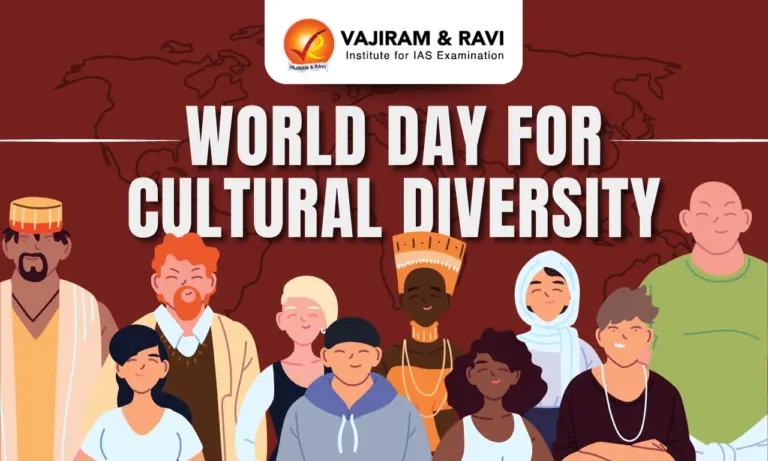
World Day for Cultural Diversity is a day that reminds us to respect and celebrate the different cultures, traditions, languages, and ways of life found around the world. It highlights how diversity makes our societies richer and more interesting. This day encourages people to learn from each other, promote understanding, and live together peacefully despite differences.
About the Day
- World Day for Cultural Diversity is observed every year on 21 May, and it is led by UNESCO to promote awareness about the importance of cultural diversity across the world, encouraging people to respect and appreciate different traditions, languages, and ways of life instead of seeing differences as barriers.
- The main idea behind celebrating this day is not just to recognize cultural richness, but also to highlight how understanding and dialogue between cultures can help build peaceful societies and support overall development at the global level.
- It also serves as a reminder that in today’s interconnected world, cooperation between cultures is essential for solving global challenges and ensuring inclusive growth.
Origin and History
- The idea of promoting cultural diversity gained global recognition when UNESCO adopted the Universal Declaration on Cultural Diversity in 2001, highlighting its importance for humanity.
- In 2002, the UN General Assembly officially declared 21 May as the World Day for Cultural Diversity for Dialogue and Development.
- Later, in 2015, another resolution emphasized the role of culture in sustainable development, further strengthening its importance at the global level.


Goals of the Day
- The day aims to support strong systems for managing and promoting culture effectively at national and international levels.
- It encourages the balanced exchange of cultural goods and services and promotes the mobility of artists and cultural professionals across countries.
- It also focuses on integrating culture into development policies so that it becomes a key part of decision-making processes.
- Another important goal is to promote human rights and fundamental freedoms, ensuring that everyone has the right to express and practice their culture.
Significance of Protecting Cultural Diversity
- Protecting cultural diversity has become more important than ever because globalization, digital media, and modernization are slowly reducing the uniqueness of many cultures, making it necessary to preserve traditions, languages, and cultural expressions for future generations.
- Studies show that around 89% of current conflicts occur in countries where intercultural dialogue is weak, which clearly indicates that misunderstanding between cultures often leads to tension, conflict, and instability.
- Strengthening intercultural dialogue helps people understand each other better, reduces prejudice and discrimination, and creates a foundation for long-lasting peace and cooperation among nations.
- Cultural diversity also promotes creativity and innovation, as different perspectives and ideas come together, leading to new solutions and progress in society.
Role of Culture in Development
- The cultural and creative sector plays a very important role in global development, as it provides employment to more than 48 million people worldwide, making it one of the largest sources of jobs across the globe.
- Nearly half of these jobs are held by women, which shows that this sector also contributes significantly to gender equality and women’s empowerment.
- It accounts for about 6.2% of total global employment and 3.1% of global GDP, highlighting its strong economic importance.
- The sector is especially important for young people under the age of 30, as it offers a wide range of opportunities in areas like art, music, design, media, and digital content creation.
- However, despite its major contribution, the cultural sector is still often ignored in government policies and international cooperation, which limits its full potential for growth and development.
Significance of Cultural Diversity
- Cultural diversity is extremely important because around three-fourths of global conflicts have a cultural dimension, meaning they are influenced by differences in beliefs, traditions, or identities.
- Promoting understanding and dialogue between cultures can help reduce these conflicts and build more stable and peaceful societies.
- Cultural diversity is not only important for economic growth but also for improving people’s quality of life, including their emotional, intellectual, moral, and spiritual well-being.
- It acts as a powerful tool for poverty reduction and sustainable development, as it creates opportunities and promotes inclusion.
- The use of modern technologies like media and Information and Communication Technologies (ICTs) helps spread awareness about different cultures and encourages mutual respect and understanding.
World Day for Cultural Diversity Celebration
- On this day, people around the world, including communities, schools, organizations, and governments organize activities that promote respect, inclusion, and understanding among different cultures, helping people connect beyond differences.
- Cultural festivals are commonly held where different traditions are showcased through music, dance, art, clothing, and food, allowing people to experience and appreciate cultural diversity in an enjoyable way.
- Educational workshops and discussions are organized in schools, colleges, and workplaces to spread awareness about the importance of cultural diversity, especially in building inclusive environments and reducing discrimination.
- Community dialogues and group discussions are encouraged so that people can share ideas, talk about cultural differences, and challenge stereotypes, which helps in building trust and stronger social relationships.
- Schools and institutions often conduct activities like debates, essay writing, and cultural programs, helping students learn about different cultures and develop respect from an early age.
- Governments and organizations also run awareness campaigns through media and social platforms, spreading messages of unity, equality, and peaceful coexistence.
Culture and Sustainable Development
- In September 2015, the United Nations adopted the 2030 Agenda for Sustainable Development, which focuses on achieving global progress through 17 Sustainable Development Goals (SDGs).
- Later, in December 2015, the UN also passed a resolution highlighting the important role of culture in sustainable development, making the message of cultural diversity even more relevant.
- Culture plays a key role in achieving the SDGs, as it brings creativity, innovation, and different perspectives that help solve global challenges in more inclusive ways.
- By using the richness of diverse cultures and encouraging continuous dialogue among people, societies can ensure that development benefits everyone equally, without leaving any group behind.
- Cultural diversity also helps promote social inclusion, mutual respect, and peaceful coexistence, which are essential for sustainable growth.
- To measure the role of culture in development, UNESCO introduced the Culture | 2030 Indicators.
- These indicators act as a framework to track and monitor how culture contributes to achieving the SDGs, helping governments and organizations make better policies and decisions.

 Last updated on Oct, 2026
→ UPSC 2027 Notification will be released on 13 January 2027 at upsconline.nic.in.
→ Check Nobel Prize 2026 Winners List here.
→ Download PIB PRiSM Monthly Magazine 2026 here.
→ Check UPSC Monthly Current Affairs Magazine The Recitals here.
→ Check out the latest UPSC Syllabus here.
→ Download UPSC Model Answers for Mains 2026
→ UPSC Mains Question Paper 2026 is out now for Essay & GS Paper 1, 2, 3 & 4.
→ UPSC Calendar 2027 has been released.
→ Enroll in Vajiram & Ravi’s UPSC Mains Test Series 2027 for structured answer writing practice, expert evaluation, and exam-oriented feedback.
→ Join Vajiram & Ravi’s UPSC Mentorship Program 2027 for personalized guidance, strategy planning, and one-to-one support from experienced mentors.
→ Go through the UPSC Mains Previous Year Papers to enhance your preparation.
→ UPSC has released UPSC Toppers List 2025 with the Civil Services final result on its official website.
→ Also check Best UPSC Coaching in India
World Day for Cultural Diversity FAQs
Q1. What is World Day for Cultural Diversity?+
Q2. What is World Day for Cultural Diversity and why is it celebrated?+
Q3. When is World Day for Cultural Diversity observed every year?+
Q4. Who started World Day for Cultural Diversity?+
Q5. Why is cultural diversity important in today’s world?+
Q6. How is World Day for Cultural Diversity celebrated globally?+
Tags: important days in 2026 important days in may 2026 world day for cultural diversity