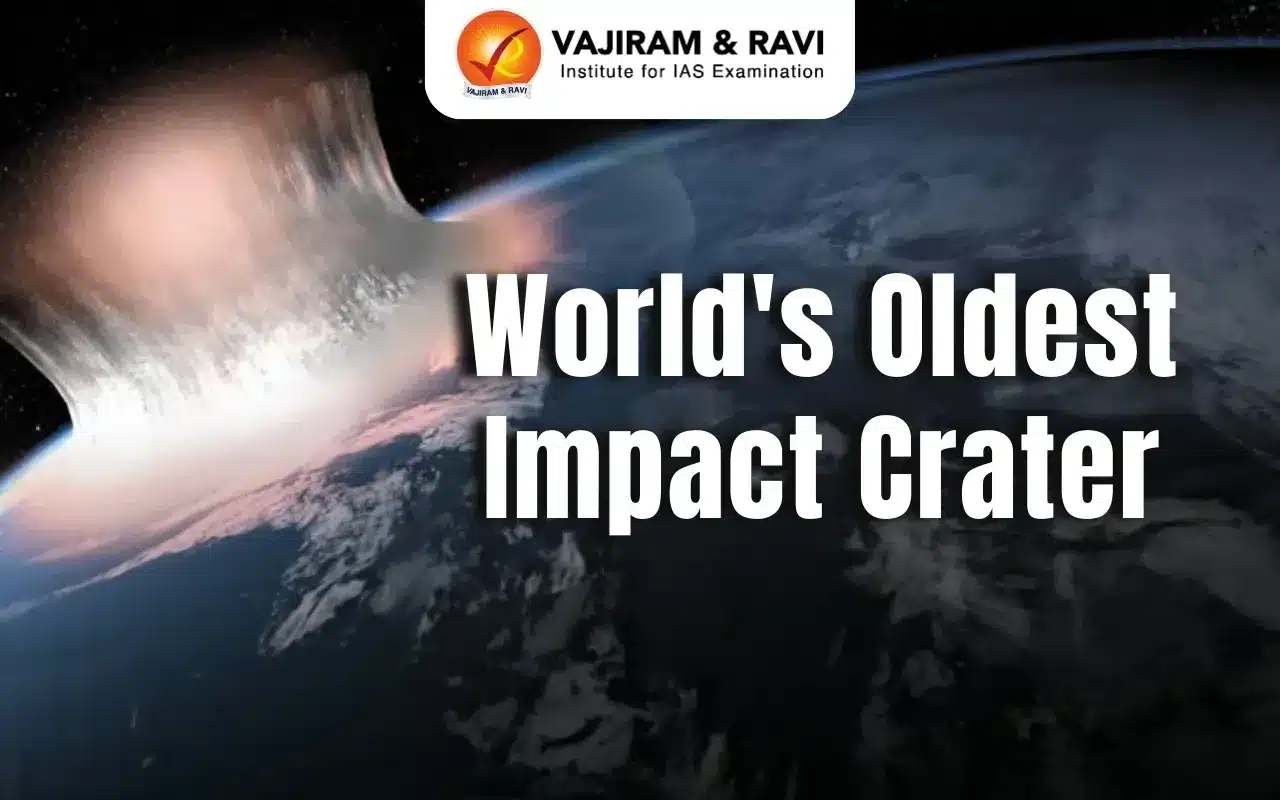
World’s Oldest Impact Crater Latest News
Scientists in Australia have discovered the world’s oldest known meteorite impact crater in northwestern Australia, estimated to be 3.47 billion years old.
About World’s Oldest Impact Crater
- Scientists in Australia have identified what they believe to be the world’s oldest known meteorite impact crater, a finding that could reshape understanding of Earth’s history and the origins of life.
- The crater, discovered in the remote North Pole dome region in northwestern Australia, is estimated to be 3.47 billion years old—more than a billion years older than any previously known impact site.
- The crater, named the North Pole Crater, was likely formed by a meteorite striking Earth at more than 36,000 kilometres per hour, creating an impact site over 100 kilometres wide. The collision may have sent debris flying across the planet, with molten droplets possibly landing as far away as South Africa.
- This discovery challenges previous assumptions about Earth’s ancient history and suggests that such impacts may have contributed to the origins of life by creating environments suitable for microbial activity.


What Is an Impact Crater?
- An impact crater forms when a fast-moving asteroid or meteorite crashes into a planet or moon.
- The impact is so powerful that it vaporizes the object, creating shockwaves that melt and reshape the ground, leaving a large circular hole with scattered rocks.
- Examples: Barringer Crater, Tycho Crater etc.
World’s Oldest Impact Crater FAQs
Q1. Where is the world’s oldest meteorite crater located?
Ans. It is located in the Pilbara region of Western Australia, specifically in the North Pole Dome area16.
Q2. How old is the crater?
Ans. The crater is approximately 3.5 billion years old, making it the oldest known meteorite impact crater on Earth.
Q3. What role might this crater have played in the origins of life?
Ans. The crater may have created environments conducive to microbial life, such as hot water pools, which could have played a role in the origins of life on Earth
Source: TOI

 Last updated on Oct, 2026
→ UPSC 2027 Notification will be released on 13 January 2027 at upsconline.nic.in.
→ Check Nobel Prize 2026 Winners List here.
→ Download PIB PRiSM Monthly Magazine 2026 here.
→ Check UPSC Monthly Current Affairs Magazine The Recitals here.
→ Check out the latest UPSC Syllabus here.
→ Download UPSC Model Answers for Mains 2026
→ UPSC Mains Question Paper 2026 is out now for Essay & GS Paper 1, 2, 3 & 4.
→ UPSC Calendar 2027 has been released.
→ Enroll in Vajiram & Ravi’s UPSC Mains Test Series 2027 for structured answer writing practice, expert evaluation, and exam-oriented feedback.
→ Join Vajiram & Ravi’s UPSC Mentorship Program 2027 for personalized guidance, strategy planning, and one-to-one support from experienced mentors.
→ Go through the UPSC Mains Previous Year Papers to enhance your preparation.
→ UPSC has released UPSC Toppers List 2025 with the Civil Services final result on its official website.
→ Also check Best UPSC Coaching in India