Youth Discontent in India Latest News
- The nationwide youth protests, triggered by repeated examination paper leaks, reflect a deeper crisis of unemployment, uncertainty in the education system and declining public investment in human capital.
- India’s demographic dividend is at risk due to inadequate job creation, inconsistent education policies and weakening institutional credibility.
India’s Demographic Dividend
- Under stress:
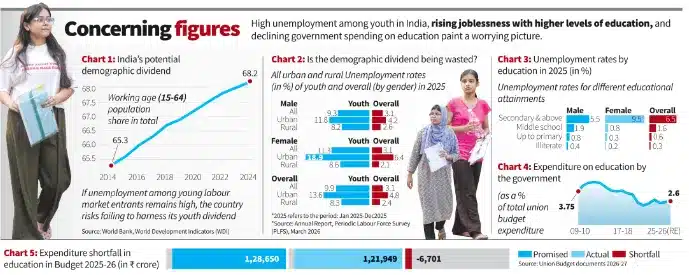
- India possesses one of the world’s largest working-age populations (15–64 years), offering a significant demographic dividend.
- However, a demographic advantage translates into economic gains only when accompanied by productive employment, quality education and skill development.
- Persistently high youth unemployment indicates that India is failing to fully utilise its young workforce.
- Key trends:
- Youth unemployment (15–29 years) is nearly three times the overall unemployment rate.
- Female youth unemployment is disproportionately higher, with urban women being the most affected.
- Educated youth face even greater unemployment, indicating that the problem lies in insufficient job creation (demand-side constraint) rather than lack of education or skills.


Employment Crisis
- A structural challenge:
- Economic growth has not translated into adequate employment generation.
- Rising educational attainment has not improved employability because the economy is creating too few quality jobs.
- The mismatch between aspirations and available opportunities has intensified youth frustration.
- Implications:
- Rising educated unemployment.
- Social unrest and declining trust in public institutions.
- Risk of losing the demographic dividend before India becomes an ageing society.
Declining Public Investment in Education
- Key issues:
- Government expenditure on education as a share of GDP has declined over the past decade.
- The share of education in the Union Budget has also consistently fallen despite the National Education Policy (NEP) 2020 recommending public expenditure of around 6% of GDP.
- Budgetary allocations reportedly remained below announced commitments, affecting educational expansion and quality.
- Consequences:
- Limited expansion of educational infrastructure.
- Growing competition for higher education seats.
- Reduced accessibility, especially for economically weaker students.
Challenges in Higher Education Admissions
- Frequent policy changes have increased uncertainty for students.
- Concerns regarding CUET:
- Greater dependence on the Common University Entrance Test (CUET) has shifted focus from school learning to examination coaching.
- Multiple-choice entrance examinations increasingly determine admissions for both undergraduate and postgraduate programmes.
- Coaching institutes have expanded rapidly as students prioritise test preparation over holistic learning.
- Operational issues:
- Delays in examination and admission schedules.
- Disruptions in academic calendars.
- Students joining institutions well after the semester has commenced.
- Continued logistical challenges despite several years of implementation.
Examination Reforms, Quality of Higher Education and Broader Governance Issues
- Examination reforms:
- Frequent changes in admission criteria, technological interventions in evaluation without adequate preparedness, and increased uncertainty surrounding examinations and assessments have been criticised.
- Such instability reduces predictability and increases stress among students.
- Quality issues:
- Expanding the number of institutions alone is insufficient.
- Major concerns:
- Infrastructure expansion without proportional funding.
- Inadequate investment in faculty recruitment and academic quality.
- Allegations of political interference in appointments affecting institutional autonomy and teaching standards.
- Key insight: Strong educational institutions depend not only on physical infrastructure but also on academic excellence, institutional autonomy and qualified faculty.
- Governance issues:
- Youth dissatisfaction has been linked to broader governance concerns, such as,
- Repeated examination paper leaks.
- Administrative inefficiencies in conducting national examinations.
- Perceived lack of accountability.
- Policy uncertainty affecting students’ academic and career planning.
- These factors collectively weaken confidence in public institutions.
- Youth dissatisfaction has been linked to broader governance concerns, such as,
Policy Efforts to Preserve India’s Demographic Dividend
- Accelerating: Labour-intensive employment generation through manufacturing, MSMEs and services.
- Increasing: Public expenditure on education in line with NEP 2020 commitments.
- Strengthening: Examination security, transparency and accountability.
- Ensuring: Predictable, student-centric admission processes with minimal policy disruptions.
- Improving: Faculty quality, institutional autonomy and governance in higher education.
- Enhancing: Female labour force participation through targeted employment and skilling initiatives.
Conclusion
- India’s demographic dividend remains one of its greatest developmental opportunities, but it cannot be realised without sustained investments in education, employment generation and institutional credibility.
- Addressing youth aspirations through transparent governance, quality human capital development and inclusive economic growth will be essential for transforming demographic potential into long-term national prosperity.
Source: TH

 Last updated on Oct, 2026
→ UPSC 2027 Notification will be released on 13 January 2027 at upsconline.nic.in.
→ Asian Games 2026 are being held in Aichi-Nagoya, Japan, from 19 September to 4 October.
→ Check Nobel Prize 2026 Winners List here.
→ Download PIB PRiSM Monthly Magazine 2026 here.
→ Check UPSC Monthly Current Affairs Magazine The Recitals here.
→ Check out the latest UPSC Syllabus here.
→ Download UPSC Model Answers for Mains 2026
→ UPSC Mains Question Paper 2026 is out now for Essay & GS Paper 1, 2, 3 & 4.
→ UPSC Calendar 2027 has been released.
→ Enroll in Vajiram & Ravi’s UPSC Mains Test Series 2027 for structured answer writing practice, expert evaluation, and exam-oriented feedback.
→ Join Vajiram & Ravi’s UPSC Mentorship Program 2027 for personalized guidance, strategy planning, and one-to-one support from experienced mentors.
→ Go through the UPSC Mains Previous Year Papers to enhance your preparation.
→ UPSC has released UPSC Toppers List 2025 with the Civil Services final result on its official website.
→ Also check Best UPSC Coaching in India
Youth Discontent in India FAQs
Q1. Why is India's demographic dividend described as a "potential" dividend?+
Q2. How does rising educated unemployment reflect a structural challenge?+
Q3. Why is sustained public investment in education crucial for human capital formation?+
Q4. What are the major concerns associated with the implementation of the CUET? +
Q5. What policy measures are needed to safeguard India's demographic dividend? +
Tags: youth discontent in india