Zircon Missile Latest News
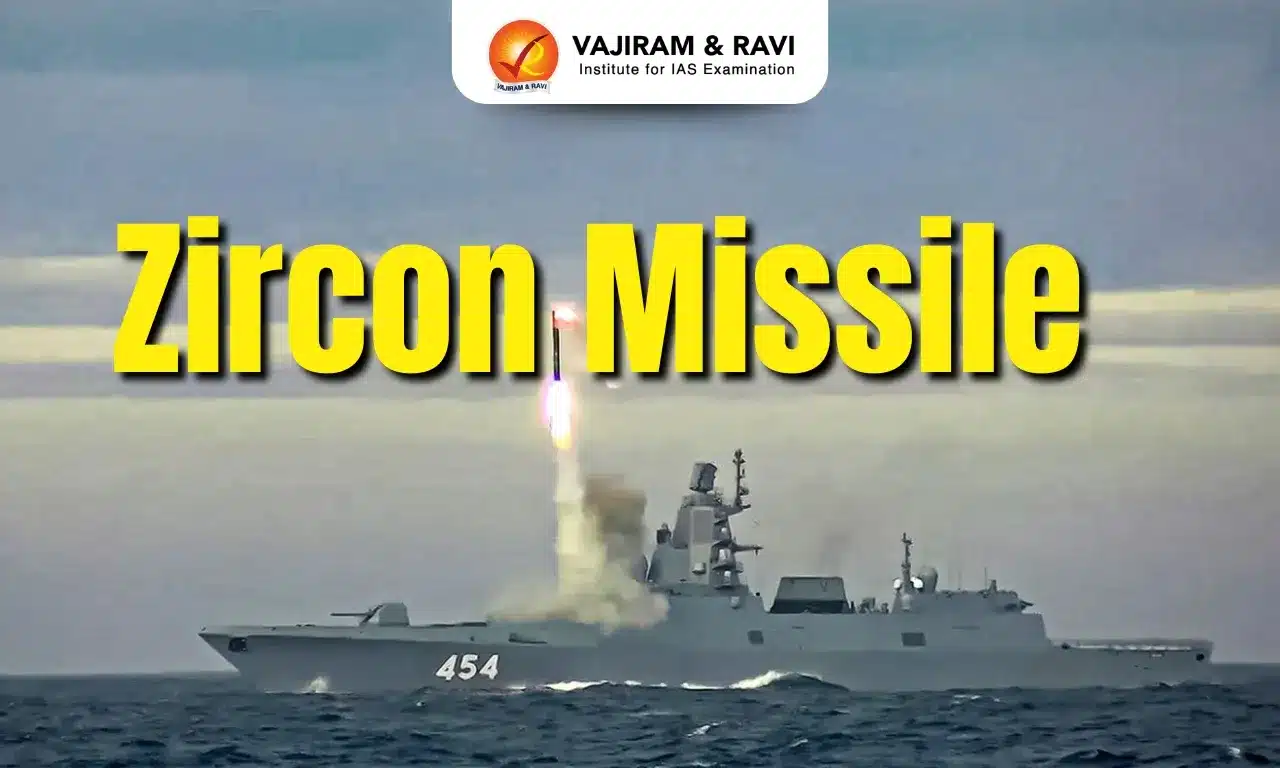
Russia recently said that it had fired a Zircon (Tsirkon) hypersonic cruise missile at a target in the Barents Sea.
About Zircon Missile
- The 3M22 Zircon (Tsirkon), NATO code-named SS-N-33, is a scramjet-powered hypersonic cruise missile developed by Russia.
- Initially designed to target naval assets, the missile has evolved to include land-attack capabilities, making it an important tool for precision strike missions.
- It entered service in 2022, with initial deployments on Project 22350 Admiral Gorshkov-class frigates.


Zircon Missile Features
- It has an estimated length of 9 meters (30 feet) and a diameter of 60 cm (24 inches), with an estimated weight of between 3,000 and 4,000 kg (3–4 tons).
- The missile is powered by a two-stage propulsion system.
- The first stage consists of a booster engine powered by solid fuel, which accelerates the missile to supersonic speeds.
- After reaching a certain speed, the scramjet engine in the second stage ignites, utilizing liquid fuel to accelerate the missile to hypersonic speeds.
- Its speed—reaching up to Mach 9—makes it extremely difficult to intercept.
- The operational range of the Zircon is reported to be around 400–450 km (250–280 miles) at low altitudes, while it can extend up to 1,000 km (620 miles) in a semi-ballistic trajectory.
- It is capable of carrying both conventional and nuclear warheads, providing it with a versatile role in modern warfare.
- The missile uses a combination of inertial navigation, radar homing, and plasma stealth to navigate towards its target.
- One of the key features of the Zircon is its ability to generate a plasma cloud during hypersonic flight, which absorbs radio waves and makes the missile more difficult to detect by radar. This phenomenon is known as plasma stealth.
Source: TH

 Last updated on Oct, 2026
→ UPSC 2027 Notification will be released on 13 January 2027 at upsconline.nic.in.
→ Asian Games 2026 are being held in Aichi-Nagoya, Japan, from 19 September to 4 October.
→ Check Nobel Prize 2026 Winners List here.
→ Download PIB PRiSM Monthly Magazine 2026 here.
→ Check UPSC Monthly Current Affairs Magazine The Recitals here.
→ Check out the latest UPSC Syllabus here.
→ Download UPSC Model Answers for Mains 2026
→ UPSC Mains Question Paper 2026 is out now for Essay & GS Paper 1, 2, 3 & 4.
→ UPSC Calendar 2027 has been released.
→ Enroll in Vajiram & Ravi’s UPSC Mains Test Series 2027 for structured answer writing practice, expert evaluation, and exam-oriented feedback.
→ Join Vajiram & Ravi’s UPSC Mentorship Program 2027 for personalized guidance, strategy planning, and one-to-one support from experienced mentors.
→ Go through the UPSC Mains Previous Year Papers to enhance your preparation.
→ UPSC has released UPSC Toppers List 2025 with the Civil Services final result on its official website.
→ Also check Best UPSC Coaching in India
Zircon Missile FAQs
Q1. The Zircon Missile was developed by which country?+
Q2. The Zircon missile is powered by which type of propulsion system?+
Q3. What is the NATO reporting name for the Zircon missile?+
Q4. What is the maximum speed of the Zircon missile?+
Tags: prelims pointers upsc current affairs upsc prelims current affairs zircon missile