Zonal Councils Latest News
The Union Home Minister recently said zonal councils have transformed from being mere discussion forums into “engines of cooperation”, noting that 83% of issues taken up in their meetings have been resolved.
About Zonal Councils
- The idea of the creation of Zonal Councils was mooted by the first Prime Minister of India, Pandit Jawahar Lal Nehru, in 1956.
- The Zonal Councils are the statutory bodies.
- Five zonal councils were set up in 1957 under Sections 15-22 of the States Reorganisation Act, 1956.
- Objective: To provide a common meeting ground to the states and UTs in each zone for resolution of interstate and regional issues, fostering balanced socio-economic regional development and building harmonious Centre- State relations.
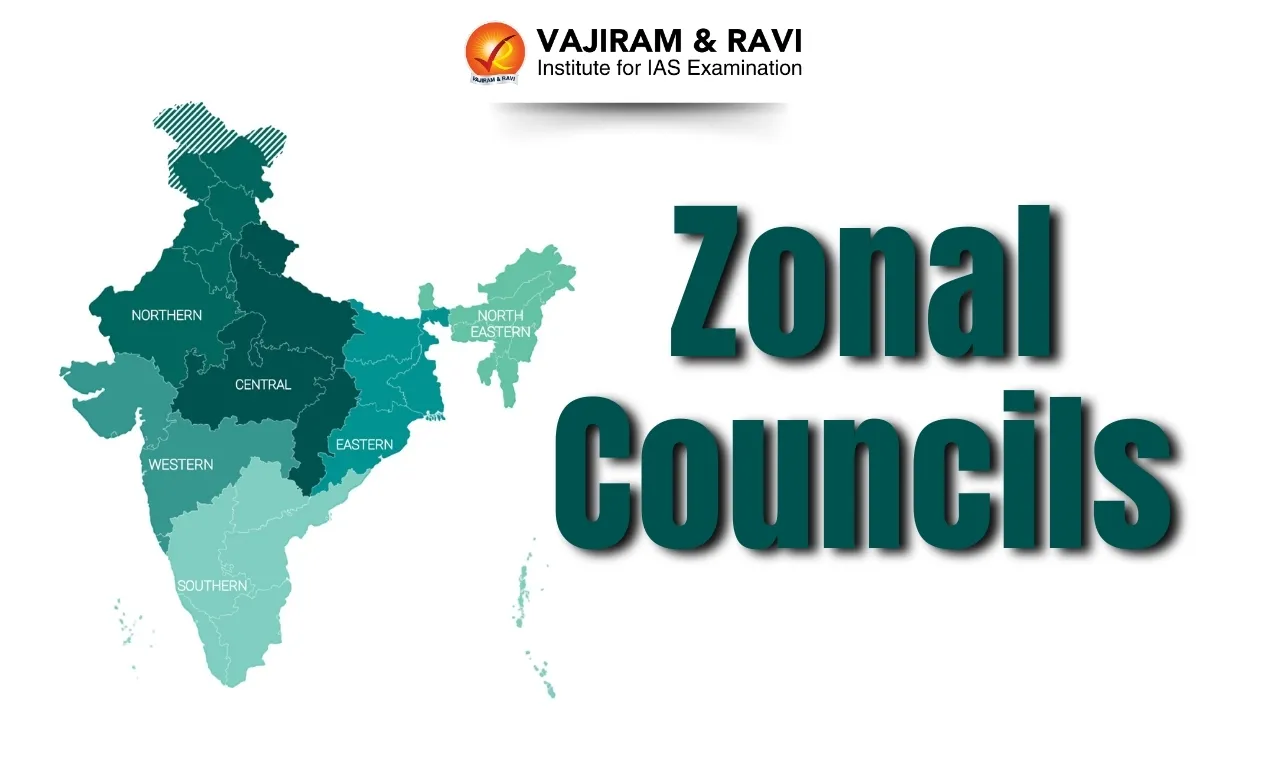
- The present composition of each of these five Zonal Councils is as follows:
- Northern Zonal Council: Haryana, Himachal Pradesh, Jammu & Kashmir, Ladakh, Punjab, Rajasthan, Delhi, and Chandigarh.
- Central Zonal Council: Chhattisgarh, Uttarakhand, Uttar Pradesh, and Madhya Pradesh.
- Eastern Zonal Council: Bihar, Jharkhand, Odisha, and West Bengal.
- Western Zonal Council: Goa, Gujarat, Maharashtra, and Daman & Diu and Dadra & Nagar Haveli.
- Southern Zonal Council: Andhra Pradesh, Telangana, Karnataka, Kerala, Tamil Nadu, and Puducherry.
- North Eastern Council:
- The North Eastern States, i.e. Assam, Arunachal Pradesh, Manipur, Tripura, Mizoram, Meghalaya, and Nagaland, are not included in the Zonal Councils, and their special problems are looked after by the North Eastern Council, set up under the North Eastern Council Act, 1972.
- The State of Sikkim has also been included in the North Eastern Council vide the North Eastern Council (Amendment) Act, 2002, notified on 23rd December 2002.
- Each Zonal Council is an advisory body and may discuss any matter in which some or all of the States represented in that council, or the Union and one or more of the States represented in that Council, have a common interest and advise the Central Government and the Government of each State concerned as to the action to be taken on any such matter.


Zonal Councils Organisational Structure
- Chairman: The Union Home Minister is the Chairman of each of these Councils.
- Vice Chairman: The Chief Ministers of the States included in each zone act as vice-chairman of the zonal council for that zone by rotation, each holding office for a period of one year at a time.
- Members: Chief Minister and two other ministers as nominated by the Governor from each of the States and two members from Union Territories included in the zone.
- Each Zonal Council has set up a Standing Committee consisting of Chief Secretaries of the member States of the respective Zonal Councils.
- The Standing Committees meet from time to time to resolve the issues or to do necessary groundwork for further meetings of the Zonal Councils.
- Senior officers from the NITI Aayog (erstwhile Planning Commission), Central Ministries, and State Governments are associated with the meetings depending upon necessity.
Source: IE

 Last updated on Oct, 2026
→ UPSC 2027 Notification will be released on 13 January 2027 at upsconline.nic.in.
→ Check Nobel Prize 2026 Winners List here.
→ Download PIB PRiSM Monthly Magazine 2026 here.
→ Check UPSC Monthly Current Affairs Magazine The Recitals here.
→ Check out the latest UPSC Syllabus here.
→ Download UPSC Model Answers for Mains 2026
→ UPSC Mains Question Paper 2026 is out now for Essay & GS Paper 1, 2, 3 & 4.
→ UPSC Calendar 2027 has been released.
→ Enroll in Vajiram & Ravi’s UPSC Mains Test Series 2027 for structured answer writing practice, expert evaluation, and exam-oriented feedback.
→ Join Vajiram & Ravi’s UPSC Mentorship Program 2027 for personalized guidance, strategy planning, and one-to-one support from experienced mentors.
→ Go through the UPSC Mains Previous Year Papers to enhance your preparation.
→ UPSC has released UPSC Toppers List 2025 with the Civil Services final result on its official website.
→ Also check Best UPSC Coaching in India
Zonal Councils FAQs
Q1. Is the zonal council a statutory body?+
Q2. How many Zonal Councils are there in India?+
Q3. Who acts as the Chairman of Zonal Councils?+
Q4. Who acts as the Vice Chairman of a Zonal Council?+
Tags: prelims pointers upsc current affairs upsc prelims current affairs zonal councils