About Spring Equinox
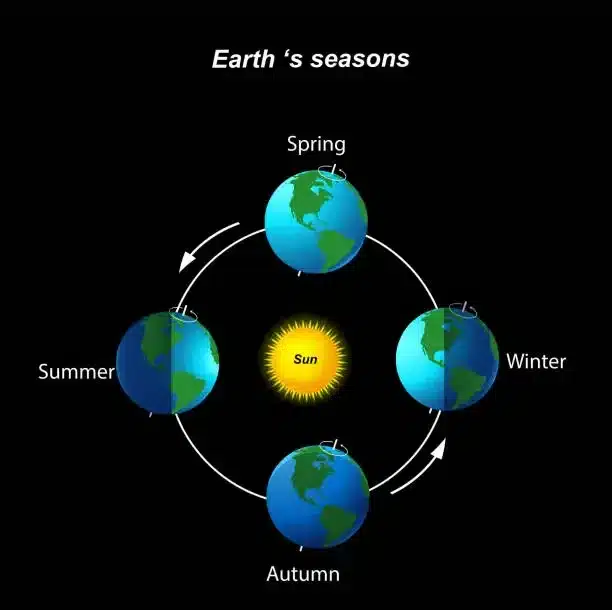
- As Earth revolves around the Sun, there are two moments each yearwhen the Sun is exactly above the equator.
- These moments — called equinoxes — occur around March 19, 20 or 21 and September 22 or 23.
- Equinox literally means “equal night,” since the length of day and night is nearly equal in all parts of the worldduring the equinoxes.
- The March equinox marks when the Northern Hemisphere starts to tilt toward the sun, which means longer, sunnier days.
- In the Northern Hemisphere, the March equinox is called the vernal equinox, because it signals the beginning of spring (vernal means fresh or new like the spring).
- The September equinox is called the autumnal equinox, because it marks the first day of fall (autumn).
- When the Northern Hemisphere starts to tilt toward the sun in spring, the Southern Hemisphere starts to tilt away from the sun, signaling the start of fall.
- Thus, in the Southern Hemisphere, the March equinox is called the autumnal equinox, and the September equinox is called the vernal equinox.
- While the March equinox brings later sunrises, earlier sunsets, chillier winds and dry, falling leaves in the Southern Hemisphere, while the reverse happens in the Northern Hemisphere.
Q1: What is Solstice?
A solstice is an event in which a planet’s poles are most extremely inclined toward or away from the star it orbits. On our planet, solstices are defined by solar declination—the latitude of Earth where the sun is directly overhead at noon. On Earth, solstices are twice-yearly phenomena in which solar declination reaches the Tropic of Cancer in the north and the Tropic of Capricorn in the south. During the June solstice (marked between June 20 and June 22), solar declination is about 23.5°N (the Tropic of Cancer). During the December solstice (marked between December 20 and December 23), solar declination is about 23.5°S (the Tropic of Capricorn).
Source:Spring Begins. Know About Vernal Equinox That Brings on A New Season


 Last updated on Oct, 2026
→ UPSC 2027 Notification will be released on 13 January 2027 at upsconline.nic.in.
→ Asian Games 2026 are being held in Aichi-Nagoya, Japan, from 19 September to 4 October.
→ Check Nobel Prize 2026 Winners List here.
→ Download PIB PRiSM Monthly Magazine 2026 here.
→ Check UPSC Monthly Current Affairs Magazine The Recitals here.
→ Check out the latest UPSC Syllabus here.
→ Download UPSC Model Answers for Mains 2026
→ UPSC Mains Question Paper 2026 is out now for Essay & GS Paper 1, 2, 3 & 4.
→ UPSC Calendar 2027 has been released.
→ Enroll in Vajiram & Ravi’s UPSC Mains Test Series 2027 for structured answer writing practice, expert evaluation, and exam-oriented feedback.
→ Join Vajiram & Ravi’s UPSC Mentorship Program 2027 for personalized guidance, strategy planning, and one-to-one support from experienced mentors.
→ Go through the UPSC Mains Previous Year Papers to enhance your preparation.
→ UPSC has released UPSC Toppers List 2025 with the Civil Services final result on its official website.
→ Also check Best UPSC Coaching in India