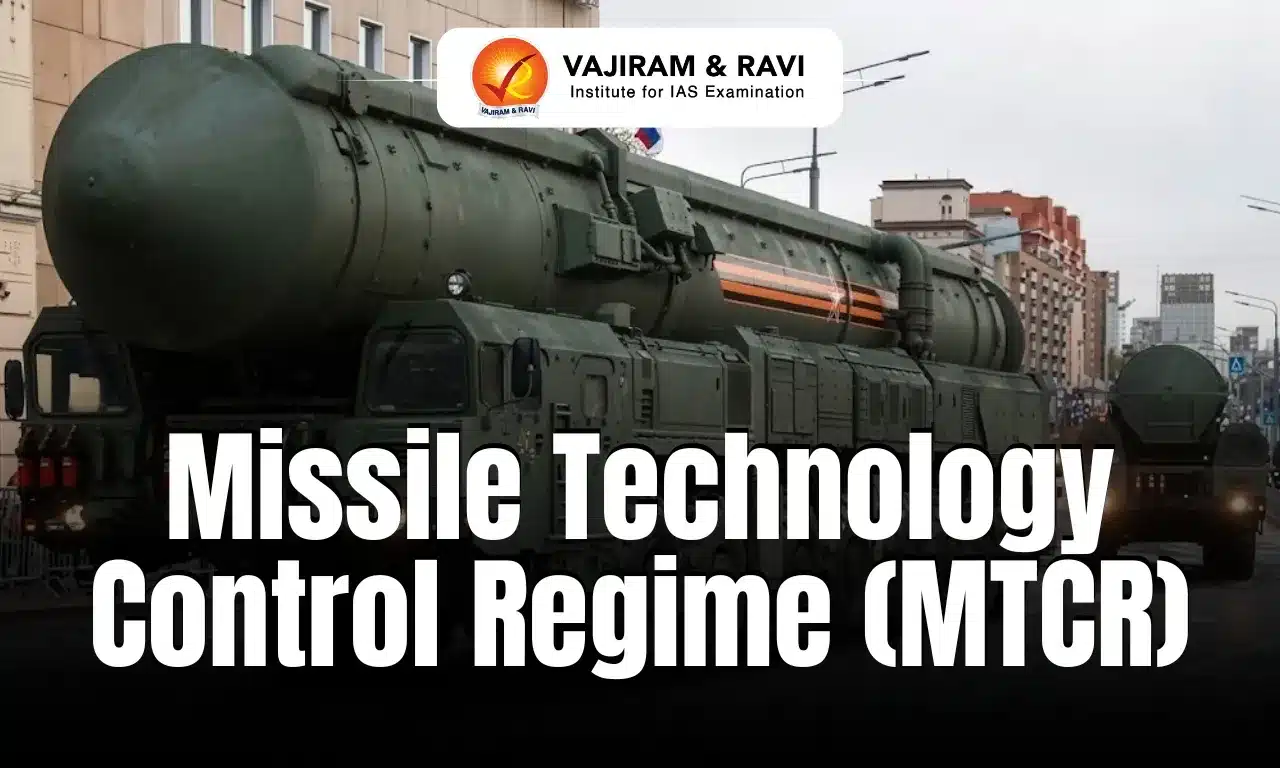
Missile Technology Control Regime (MTCR) is an informal and voluntary multilateral export control regime designed to prevent the proliferation of missiles, unmanned aerial vehicles (UAVs), and related technologies capable of delivering weapons of mass destruction (WMD).
The Missile Technology Control Regime (MTCR) brings participating countries together around a shared objective of reducing the risk that such systems and technologies could contribute to the development or delivery of WMDs. Rather than functioning as a formal international organisation, the MTCR provides a framework through which participating nations cooperate to strengthen controls over sensitive missile-related items and technologies.
Missile Technology Control Regime (MTCR) About
The MTCR is a voluntary association of states that coordinate their export-licensing policies for sensitive missile technology. It is one of the major international export-control regimes, along with the Nuclear Suppliers Group (NSG), Wassenaar Arrangement, and Australia Group. Unlike formal arms-control treaties, the MTCR works through voluntary coordination and national-level export controls.
MTCR Full Form
The full form of MTCR is the Missile Technology Control Regime. It covers missiles, complete rocket systems, unmanned air vehicles, and related equipment or technology that may be used to deliver nuclear, chemical, or biological weapons. MTCR is independent of the United Nations (UN).
MTCR Background
The background of MTCR can be traced back to the Cold War, when it emerged as one of the multilateral export control regimes in response to international concerns about the proliferation of ballistic missile technology capable of delivering nuclear weapons.
- The G7 nations - Canada, France, Germany, Italy, Japan, the United Kingdom, and the United States launched the MTCR in April 1987 in response to the growing availability of missile technologies in international markets.
- At first, the regime's main goal was to limit the export of missiles with nuclear warheads. The scope of MTCR greatly increased as threats to global security changed.
- The regime's mandate was expanded by participating nations in 1992 to include missile systems that could deliver any kind of weapon of mass destruction (WMD), including chemical, biological, and nuclear weapons.


MTCR Members
Members of MTCR include 35 countries, including India, the USA, UK, France, Germany, Italy, Japan, Russia, and South Africa, with membership requiring consensus.
- Important members of the MTCR include India, the United States of America, the United Kingdom, France, Germany, Italy, Japan, Russia, South Africa, etc
- MTCR Membership is open only through consensus, meaning every existing member must agree before a new country is admitted.
- China is not a member state of the MTCR despite having previously requested membership and claiming adherence to numerous MTCR export control criteria.
MTCR Objectives
Missile Technology Control Regime (MTCR) aims to limit the proliferation of missiles, complete rocket systems, unmanned aerial vehicles, and related technology for systems that can deliver weapons of mass destruction (WMD) and carry a 500 kg payload at least 300 kilometres. MTCR's objectives apply to both member and non-member countries.
- Restrict the spread of missiles that can deliver WMD.
- Limit the sharing of production technologies, software, and sensitive missile equipment.
- Encourage participating nations to implement sensible export control measures.
- Minimise the possibility that non-state actors or terrorists may obtain missile technology.
- In export licensing, promote openness and collaboration.
- Encourage international efforts to prevent the proliferation of nuclear, chemical, and biological weapons.
- Strike a balance between lawful, peaceful trade and international security.
- Strengthen national export regulations by establishing uniform standards.
MTCR Organisational Structure
The organisational structure of MTCR differs from many formal international institutions because it does not have a permanent headquarters or an established secretariat. It is also not based on a legally binding treaty. Rather, the regime operates through recurring gatherings of participating nations.
- Consensus-Based Decisions: The MTCR follows a consensus-based approach, requiring the participating countries to reach a common agreement on major matters such as membership and amendments to export-control lists.
- Unanimous Approval: Significant policy decisions, requests for membership, and revisions to the export-control lists require the unanimous consent of all participating governments.
- Rotating Chairmanship: The chairmanship changes annually among participating countries, with the chair responsible for coordinating meetings and facilitating discussions.
- National Control Over Exports: The arrangement enables members to cooperate on missile non-proliferation while allowing each country to retain full control over its own national export-control policies.
MTCR Guidelines
Missile Technology Control Regime guidelines assist members in determining whether the transfer of missile-related goods could lead to the spread of delivery systems for weapons of mass destruction (WMD). Important MTCR guidelines are the following:
- Implement stringent export regulations for technology, software, materials, and equipment connected to missiles.
- To examine each export application individually.
- Make sure that WMD delivery methods are not developed using foreign goods.
- It demands robust end-use and end-user guarantees from importing nations.
- Transferring the most delicate missile technologies should be done with the utmost caution.
- To promote collaboration and openness among the participating states.
- Permit lawful, peaceful, and civilian space programmes while avoiding abuse.
- Bolster national export regulations in accordance with MTCR guidelines.
MTCR Category I and Category II items
Missile Technology Control Regime classifies controlled items into two categories—Category I and Category II To regulate the transfer of missile-related technologies.
- Category I: Complete rocket and unmanned aerial vehicle systems (such as ballistic missiles, space launch vehicles, sounding rockets, cruise missiles, target drones, and reconnaissance drones) that can deliver a payload of at least 500 kg to a range of at least 300 km.
- It also includes major complete subsystems, such as rocket stages, engines, guidance systems, re-entry vehicles, along with associated software and related technological expertise.
- According to the MTCR Guidelines, exports of Category I commodities are licensed for export only infrequently and are subject to an unconditional strong presumption of denial regardless of the objective of the export.
- Category II: Other less sensitive and dual-use missile-related parts, as well as other full missile systems with a minimum 300-kilometre range, independent of payload, are classified as Category II products.
- Examples: Propulsion systems, propellants, materials, avionics, guidance equipment, software, production technology.
- Licensing restrictions that take into account the non-proliferation criteria outlined in the MTCR Guidelines apply to their export.
- There is a strong presumption of denial for exports that the exporting nation determines are meant for use in the delivery of WMD.
MTCR and International Trade
Missile Technology Control Regime (MTCR) is designed to regulate, not prohibit, international trade in missile-related technologies. Participating nations use the shared guidelines of the MTCR framework to execute national export control procedures.
- Promotes Responsible International Trade: Encourages Member Nations to Adopt Harmonised Export Control Policies for Missile-Related Products and Technologies to Promote Responsible Exports.
- Promotes Peaceful Cooperation: Permits lawful trade as long as exports adhere to MTCR regulations in fields such as satellite technology, space research, civil aerospace, and scientific cooperation.
- Strengthens International Supply Chains: Promotes openness and confidence among member nations, enabling safe trading in high-tech goods.
- Reduces Proliferation Risks: To stop critical technologies from being misused or diverted, strict export licensing and end-user verification procedures are implemented.
- Promotes Technology Collaboration: Provides chances for ethical international collaborations in the fields of sophisticated manufacturing, military, and aerospace, while upholding stringent non-proliferation regulations.
MTCR and India
Missile Technology Control Regime (MTCR) was joined by India as its 35th member on June 27, 2016, a significant step toward its incorporation into the global export control framework.
- India has increased collaboration with MTCR members in fields like space research, defence manufacturing, aerospace, and missile technology since joining.
- India implements the Missile Technology Control Regime through domestic laws like the
- Weapons of Mass Destruction and their Delivery Systems Act of 2005,
- The Foreign Trade Act of 1992, and
- The Customs Act of 1962.
Significance of MTCR for India
Missile Technology Control Regime membership has strengthened India’s strategic capabilities; at the same time, it has enhanced India’s credibility and opened avenues for responsible exports and deeper cooperation with like-minded countries.
- Availability of cutting-edge technologies: India now has better access to advanced missile-related equipment, UAV technologies, and dual-use systems for both military and civilian uses.
- However, membership does not automatically guarantee access to sensitive technologies, as all exports remain subject to the exporting country's national laws, export control policies, and licensing decisions, such as the International Traffic in Arms Regulations (ITAR) of the US.
- A more robust space programme: On cutting-edge space technology, satellite launch systems, and aerospace research, Indian organisations can work more readily with foreign partners.
- Increase in Defence Production: By promoting technical collaborations and military industry cooperation, MTCR participation promotes the Make in India mission.
- Increased International Credibility: India's reputation as a responsible nuclear state dedicated to international non-proliferation standards was strengthened by its membership in the MTCR.
- Export Prospects: In compliance with MTCR regulations, membership has allowed India to export some domestic defence systems to friendly nations.
- For instance, after joining the MTCR, India was able to sell the BrahMos supersonic cruise missile to the Philippines, subject to the relevant export control regulations.
- Assistance with Strategic Goals: Membership in the MTCR improved India's participation in international technology governance and bolstered its argument for joining other export control regimes.
MTCR UPSC PYQs
Q1. Consider the following (UPSC Prelims 2022)
- Asian Infrastructure Investment Bank
- Missile Technology Control Regime
- Shanghai Cooperation Organisation
India is a member of which of the above?
a) 1 and 2 only
b) 3 only
c) 2 and 3 only
d) 1, 2 and 3
Ans: (d)

 Last updated on Oct, 2026
→ UPSC 2027 Notification will be released on 13 January 2027 at upsconline.nic.in.
→ Check Nobel Prize 2026 Winners List here.
→ Download PIB PRiSM Monthly Magazine 2026 here.
→ Check UPSC Monthly Current Affairs Magazine The Recitals here.
→ Check out the latest UPSC Syllabus here.
→ Download UPSC Model Answers for Mains 2026
→ UPSC Mains Question Paper 2026 is out now for Essay & GS Paper 1, 2, 3 & 4.
→ UPSC Calendar 2027 has been released.
→ Enroll in Vajiram & Ravi’s UPSC Mains Test Series 2027 for structured answer writing practice, expert evaluation, and exam-oriented feedback.
→ Join Vajiram & Ravi’s UPSC Mentorship Program 2027 for personalized guidance, strategy planning, and one-to-one support from experienced mentors.
→ Go through the UPSC Mains Previous Year Papers to enhance your preparation.
→ UPSC has released UPSC Toppers List 2025 with the Civil Services final result on its official website.
→ Also check Best UPSC Coaching in India
Missile Technology Control Regime (MTCR) FAQs
Q1. What is the full form of MTCR?+
Q2. When was MTCR established?+
Q3. How many members does MTCR have?+
Q4. Is MTCR a legally binding treaty?+
Q5. Does the MTCR have an observer status?+
Tags: Missile Technology Control Regime mtcr quest UPSC International Relations and Institutions Notes