The Belt and Road Initiative (BRI) is China’s major international connectivity and infrastructure programme. Announced by Chinese President Xi Jinping in 2013, it seeks to connect Asia, Europe, Africa, and other regions through ports, railways, roads, energy corridors, industrial zones, digital networks, and trade links.
China’s Belt and Road Initiative (BRI) has significant economic and geopolitical implications. Supporters view it as a means to bridge infrastructure gaps and expand trade, while critics raise concerns about debt, transparency, environmental effects, and China’s growing strategic influence.
Belt and Road Initiative Meaning
The Belt and Road Initiative (BRI) is China's flagship global connectivity and infrastructure initiative, launched in 2013 to enhance connectivity, trade, investment, and economic integration across Asia, Europe, Africa, and other regions by reviving the ancient Silk Routes.
- Initially known as One Belt One Road (OBOR), it was later renamed Belt and Road Initiative (BRI) to reflect a broader and more inclusive vision.
- Comprises two components:
- Silk Road Economic Belt (SREB): Land-based connectivity across Eurasia.
- 21st Century Maritime Silk Road (MSR): Sea-based connectivity linking Asia, Africa, and Europe.
- Focuses on developing transport, energy, and digital infrastructure to strengthen regional connectivity, trade, investment, and economic cooperation.
Belt and Road Initiative Objectives
China’s BRI seeks to strengthen connectivity, expand economic cooperation, and support China's long-term economic and strategic interests through infrastructure-led development.
- Improve Connectivity: Develop transport, energy, and digital infrastructure through roads, railways, ports, pipelines, and economic corridors linking Asia, Europe, Africa, and beyond.
- Promote Trade and Investment: Expand trade, cross-border investment, industrial cooperation, and regional economic integration.
- Address Domestic Economic Needs: Utilise surplus industrial capacity and capital while creating new overseas markets for Chinese enterprises.
- Enhance Energy Security: Diversify energy supply routes and reduce dependence on traditional maritime chokepoints.
- Expand Global Influence: Strengthen China's economic, diplomatic, and strategic engagement through long-term connectivity partnerships.
Belt and Road Initiative Members
Around 146 to 150 countries have joined China’s Belt and Road Initiative (BRI) by signing Memorandums of Understanding (MoUs). These participating nations span across Africa, Asia, Europe, Latin America, the Middle East, and Oceania.
- Major BRI Participating Countries: Pakistan, Bangladesh, Sri Lanka, Nepal, Malaysia, Indonesia, Kazakhstan, Uzbekistan, Kenya, Egypt, Saudi Arabia, the United Arab Emirates, Greece, Hungary, Serbia and others.
- Countries against Belt and Road Initiative: Most G7 nations (such as the United States, France, Germany, Japan, the United Kingdom, and Canada) have not joined. Italy joined earlier but officially exited the initiative.
- India has consistently refrained from joining due to sovereignty concerns regarding the China-Pakistan Economic Corridor (CPEC).


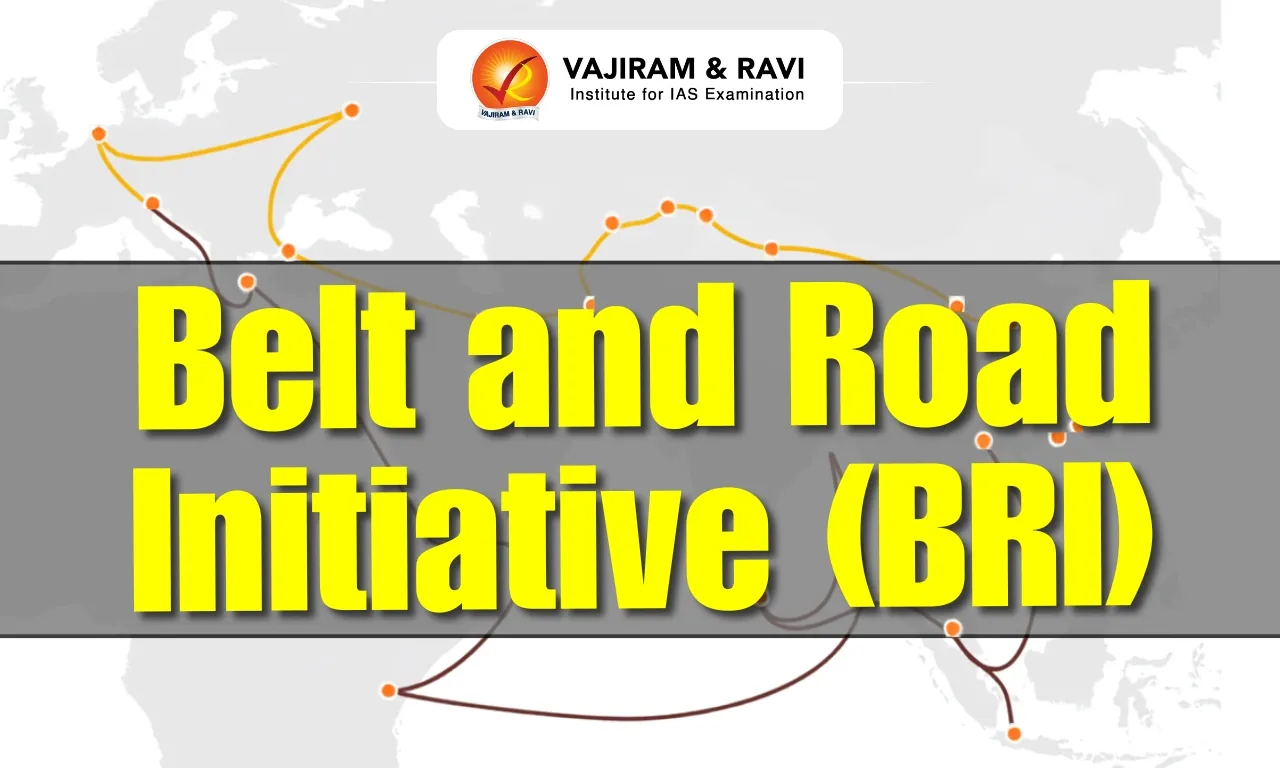
China's Belt and Road Initiative Map
China's Belt and Road Initiative maps a vast global infrastructure network. It links Asia, Europe, and Africa via land corridors (the Belt) and strategic maritime ports (the Road).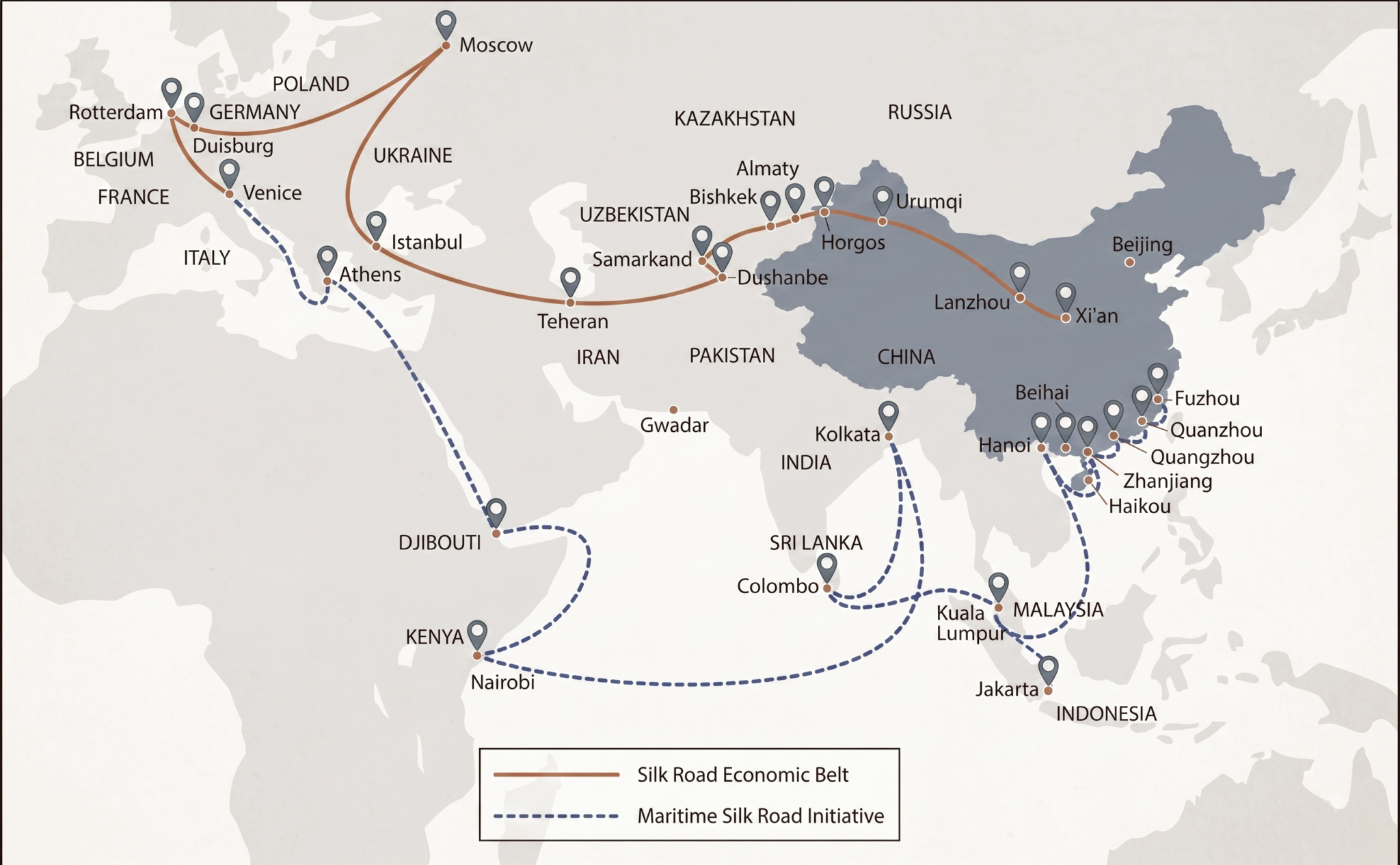
Belt and Road Initiative (BRI) Criticism
Despite its wide geographical reach, China’s Belt and Road Initiative (BRI) faces economic, political, environmental, and governance-related challenges that have affected its implementation in several countries.
- Debt Trap Diplomacy: Large infrastructure loans have increased debt burdens in some participating countries. Sri Lanka's Hambantota Port is often cited in this context. The World Bank (2019) noted that 12 of the 43 corridor economies faced elevated debt risks.
- Sovereignty and Geopolitical Concerns: Projects such as the CPEC have raised sovereignty concerns, while several countries view BRI as expanding China's strategic influence.
- Lack of Transparency: Concerns remain over project selection, financing arrangements, procurement practices, and governance standards.
- Environmental Concerns: Large infrastructure projects have been criticised for their impact on ecosystems, biodiversity, and local communities.
- Political and Security Risks: Political instability, internal conflicts, and security challenges in some partner countries have delayed or affected project implementation.
- Global Scepticism: Countries such as India, the United States, and several European nations have expressed concerns over the long-term strategic and economic implications of the initiative.
Belt and Road Initiative India's Stand
India has not joined China’s Belt and Road Initiative (BRI). It maintains that connectivity initiatives should be transparent, financially sustainable, consultative, and respect the sovereignty and territorial integrity of all countries.
- Opposition to CPEC: India opposes the CPEC as it passes through Pakistan-occupied Kashmir (PoK), which India considers a violation of its sovereignty.
- Principles of Connectivity: India maintains that connectivity projects should be transparent, financially sustainable, environmentally responsible, and based on equal consultation among participating countries.
- Non-participation in BRI: India has not participated in the Belt and Road Forums and has consistently conveyed its position at bilateral and multilateral platforms.
- Selective Engagement: India continues to support multilateral infrastructure financing through institutions such as the Asian Infrastructure Investment Bank (AIIB) while remaining outside the BRI.
Belt and Road Initiative Impact on India
The Belt and Road Initiative (BRI) is the primary driver of friction in India-China relations. India firmly opposes the BRI, most notably because its flagship project—the China-Pakistan Economic Corridor (CPEC)—runs through Pakistan-occupied Kashmir (PoK), which India views as a severe violation of its sovereignty.
- Strategic Security: Chinese-funded ports and infrastructure in the Indian Ocean Region (IOR) have raised concerns over China's expanding maritime presence.
- Regional Influence: China's growing economic engagement with Pakistan, Sri Lanka, Nepal, Bangladesh, and Myanmar has increased its influence in India's neighbourhood.
- Economic Competition: BRI has strengthened China's role in regional trade, infrastructure financing, and supply chains.
- Neighbourhood Diplomacy: The initiative has increased competition for regional connectivity and development partnerships in South Asia.
- Economic Potential: Better regional infrastructure can improve trade and connectivity across Eurasia if concerns relating to sovereignty, transparency, and financial sustainability are addressed.
Belt and Road Initiative UPSC PYQs
Q1: "China's Belt and Road Initiative (BRI) has transformed South Asia from а regional space into a theatre of great power competition.” Analyse the strategic implications of the BRI for India's security and regional influence in South Asia. (UPSC Mains 2026)

 Last updated on Oct, 2026
→ UPSC 2027 Notification will be released on 13 January 2027 at upsconline.nic.in.
→ Check Nobel Prize 2026 Winners List here.
→ Download PIB PRiSM Monthly Magazine 2026 here.
→ Check UPSC Monthly Current Affairs Magazine The Recitals here.
→ Check out the latest UPSC Syllabus here.
→ Download UPSC Model Answers for Mains 2026
→ UPSC Mains Question Paper 2026 is out now for Essay & GS Paper 1, 2, 3 & 4.
→ UPSC Calendar 2027 has been released.
→ Enroll in Vajiram & Ravi’s UPSC Mains Test Series 2027 for structured answer writing practice, expert evaluation, and exam-oriented feedback.
→ Join Vajiram & Ravi’s UPSC Mentorship Program 2027 for personalized guidance, strategy planning, and one-to-one support from experienced mentors.
→ Go through the UPSC Mains Previous Year Papers to enhance your preparation.
→ UPSC has released UPSC Toppers List 2025 with the Civil Services final result on its official website.
→ Also check Best UPSC Coaching in India
Belt and Road Initiative FAQs
Q1. What is the Belt and Road Initiative?+
Q2. What is the main purpose of the Belt and Road Initiative?+
Q3. Which country is known for its Belt and Road Initiative?+
Q4. Who proposed the Belt and Road Initiative?+
Q5. Is India a member of the BRI?+
Tags: belt and road initiative quest UPSC International Relations and Institutions Notes