The United Nations Development Programme (UNDP) is the UN’s lead development agency, working around the world to reduce poverty, inequality and vulnerabilities and advance the SDGs. It provides policy expertise, technical support and partnerships for sustainable development.
UNDP works on poverty reduction, governance, climate action, gender equality, crisis resilience and capacity building. Its major challenges include funding constraints, conflicts, climate change, widening inequalities and geopolitical tensions, which complicate long-term development efforts.
United Nations Development Programme (UNDP) About
The United Nations Development Programme (UNDP) is a UN development agency focused on helping countries achieve sustainable and inclusive development. It serves as the principal agency of the United Nations (UN) for promoting human development and sustainable development.
- UNDP Global Presence: UNDP has a presence in over 170 countries and territories. It works primarily through country offices, which design programmes in consultation with national governments and align them with local development priorities.
UNDP Full Form
The full form of UNDP is the United Nations Development Programme. It is a United Nations development organisation that supports countries in achieving inclusive, resilient, and sustainable human development.
UNDP Headquarters
The headquarters of United Nations Development Programme is located in New York, USA, and operates as the UN’s principal development agency. Its current Strategic Plan 2026–2029 places importance on prosperity for all, effective governance, crisis resilience and a healthy planet.
UNDP Membership
The UNDP does not have “membership” in the same manner as organisations such as the United Nations Security Council or the World Trade Organisation. Its governance is supervised by an Executive Board, whose members are elected by the UN Economic and Social Council.
UNDP Funding
The UNDP funding is financed mainly through voluntary contributions from governments, multilateral institutions, foundations, private-sector partners, and other funding sources. It does not receive compulsory assessed contributions in the manner of the UN’s regular budget.
United Nations Development Programme (UNDP) Background
The origins of UNDP lie in the post-Second World War international effort to promote economic development, technical cooperation, and social progress in newly independent and developing countries.
- The Expanded Program of Technical Assistance (EPTA): It was established in 1949 to give developing nations financial support, technical assistance, and training.
- UN Special Fund: Established in 1958, it provides funding for larger, pre-investment infrastructure and technical projects.
- UNDP Established: The UNDP was established in 1965 by the UN General Assembly by combining two existing UN bodies (ETPA and UN special Fund) to prevent overlapping projects and provide more organized support.


United Nations Development Programme (UNDP) Objectives
The United Nations Development Programme’s Strategic Plan 2026–2029 is built around four strategic objectives that guide its support to countries in achieving inclusive, resilient and sustainable human development.
- Prosperity for All: Ensuring that development benefits reach vulnerable and marginalised groups by promoting inclusive economic transformation, reducing poverty and inequality, and expanding livelihoods and employment opportunities.
- Effective Governance: Strengthen institutions that are responsive, accountable, and inclusive; enhance public services; and promote democratic governance, the rule of law, and increased citizen participation.
- Crisis Resilience: Help countries anticipate, prevent and recover from crises such as conflicts, disasters and economic shocks, while strengthening community resilience and protecting development gains.
- Healthy Planet: Accelerate climate action and environmental sustainability by supporting low-carbon development, biodiversity conservation, sustainable resource management and greater resilience to climate change.
UNDP Organisational Structure
The United Nations Development Programme (UNDP) has a decentralised organisational structure, combining global leadership at headquarters with regional and country-level offices. It enables UNDP to develop global policies while adapting programmes to regional and national development needs.
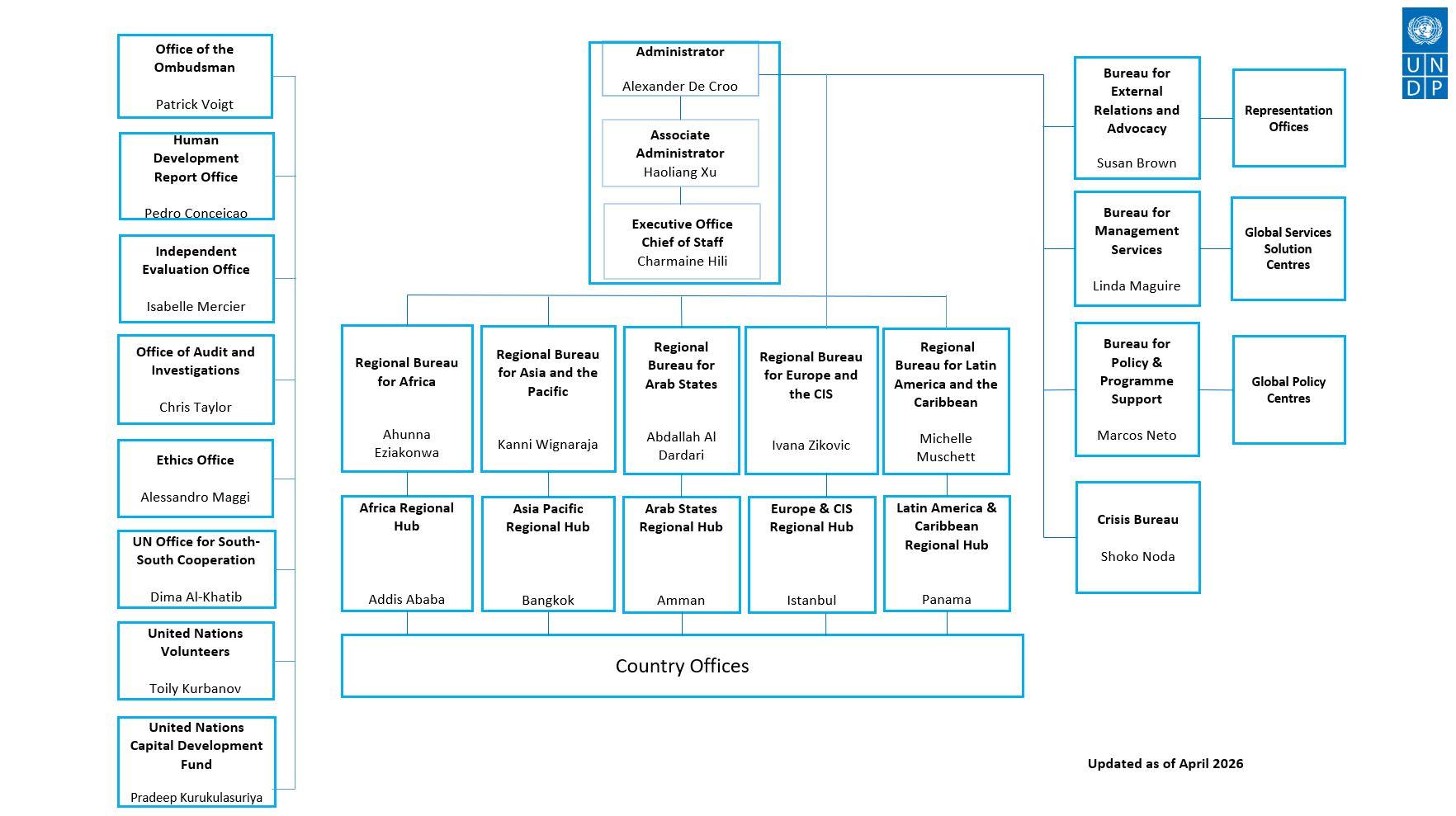
- Administrator: The head of UNDP (UNDP Chairman), responsible for providing overall strategic and executive leadership and implementing the decisions of the Executive Board.
- Executive Board: The UNDP Executive Board has 36 members, elected by the UN Economic and Social Council (ECOSOC) for three-year terms, and seats are allocated by regional groups.
- HQ Bureau: Specialised organisational units that support UNDP in areas such as policy and programmes, crisis response, management, and external relations.
- Secretariat: Provides administrative, technical and coordination support to the Executive Board, including preparing meetings and documentation, conducting consultations and maintaining Board records.
- Regional Bureaus: Five distinct teams coordinate UNDP’s work across Africa, Arab States, Asia and the Pacific, Europe and Central Asia, and Latin America and the Caribbean.
- Country Offices: These offices serve as the main field-level delivery platform, working with national governments and local stakeholders to implement UNDP programmes.
UNDP Functions
The functions of United Nations Development Programme (UNDP) include policy support, technical assistance, capacity building and partnerships, helping countries achieve inclusive, resilient and sustainable development.
- SDG Implementation: It helps countries translate the SDGs into national and local development plans while strengthening systems for monitoring and measuring progress.
- Poverty Reduction: Supports inclusive livelihoods and economic opportunities, particularly for vulnerable communities, helping address poverty and socio-economic inequality.
- Research & Reporting: Produces authoritative development assessments and data to guide policy; the Human Development Report (HDR), published by UNDP since 1990, introduced the Human Development Index (HDI) and provides comparative analysis of human development across countries.
- Development Financing: UNDP helps countries mobilise and align financial resources for development priorities by supporting Sustainable Development Goals (SDG) financing strategies, innovative financing mechanisms and partnerships.
- Climate Action: Promotes climate-resilient and low-carbon development through programmes on renewable energy, climate adaptation and sustainable resource management.
- Capacity Building: The Regional Bureau strengthens national institutions through training, technical assistance and knowledge-sharing, including support for public administration and electoral institutions.
United Nations Development Programme (UNDP) Reports
UNDP publishes global development reports, thematic assessments and statistical reports like the Human Development Index, Global Multidimensional Poverty Index, etc that provide evidence for policymaking and track progress in human development. Its reports are used to understand poverty, inequality, gender, climate, and emerging development challenges.
United Nations Development Programme Human Development Index
The Human Development Index (HDI) was developed to highlight the idea that a nation's development should be evaluated based on its people and their abilities rather than just its economic growth. HDI measures human development through three core dimensions, reflecting a country's achievements in health, education, and standard of living.
- Countries are classified into Very High, High, Medium, and Low Human Development categories based on their HDI scores, which range from 0 to 1.
- Iceland ranks 1st with an HDI of 0.972, while South Sudan ranks 193rd with an HDI of 0.388, highlighting the wide disparity in human development outcomes across countries.
Multidimensional Poverty Index (MPI)
The Multidimensional Poverty Index (MPI) is a composite measure developed by the United Nations Development Programme (UNDP) and the Oxford Poverty and Human Development Initiative (OPHI) to assess poverty beyond income. It evaluates 10 core global indicators to determine if individuals suffer simultaneous disadvantages.
- Serbia recorded an MPI value of 0.000, while Chad recorded 0.517; meanwhile, India’s MPI value was 0.069, with 24.82 crore people estimated to have exited multidimensional poverty over the nine years.
United Nations Development Programme (UNDP) India
Since 1951, the United Nations Development Programme (UNDP) has worked in India in nearly every aspect of human development, including resilience, sustainable energy, inclusive growth, sustainable livelihoods, and systems and institutional strengthening.
- Gender Equality: UNDP India promoted women’s economic empowerment, digital inclusion, leadership and access to opportunities while addressing structural barriers such as unpaid care work through its CoWIN partnership,
- UNDP supported the participation of over 70,000 female health workers, vaccinators and trainers in India’s COVID-19 vaccination efforts.
- Digital Health: Digital health infrastructure has improved the tracking and delivery of essential health services. Through UNDP’s support to U-WIN, India’s digital immunisation platform, 97 million children were reached in 2025.
- Agricultural Resilience: Crop insurance has strengthened farmers’ ability to cope with crop losses and climate-related risks. UNDP-supported initiatives helped extend crop-insurance coverage to 42 million farmers by 2025.
- Social Protection: Social security inclusion has helped vulnerable sanitation workers gain access to formal welfare mechanisms. In 2025, UNDP-supported interventions connected 34,900 Safai Mitras with social protection, reducing their vulnerability.
- Environmental Sustainability: Ozone protection and energy-efficiency measures have supported India’s transition towards environmentally sustainable development.
- UNDP-backed initiatives contributed to a 67.5% reduction in HCFC production and consumption, helping India meet its commitments under the Montreal Protocol.
- Land Restoration: Community-led land restoration has combined ecological recovery with local participation. UNDP-supported programmes restored 8,500 hectares of degraded land, helping communities improve their productivity.
- Tribal Empowerment: Grassroots capacity building has strengthened the participation of tribal communities in governance and implementation of forest rights.
- UNDP-supported programmes trained 270,000 tribal community facilitators, enabling communities to better understand and exercise their rights.
United Nations Development Programme (UNDP) Challenges
UNDP faces a complex development environment where rising global crises, funding pressures and widening inequalities make it difficult to sustain long-term development interventions.
- Funding Constraints: Declining core/regular resources make long-term planning and rapid crisis response more difficult; UNDP notes that core contributions have fallen to only 12% of total resources.
- Multiple Global Crises: Conflicts, displacement and humanitarian emergencies increasingly disrupt development progress, requiring UNDP to balance long-term development with crisis response and recovery.
- For instance, the Gaza conflict has severely damaged infrastructure and livelihoods, with UNDP estimating that development in Gaza was set back by up to 69 years.
- Climate Change: Intensifying climate shocks and environmental pressures threaten livelihoods, human development and resilience, particularly in vulnerable countries. UNDP identifies climate shocks as becoming more frequent and costly, increasing the complexity of development interventions.
- Geopolitical Fragmentation: Weakening multilateral cooperation and geopolitical tensions create uncertainty for international development cooperation.
United Nations Development Programme (UNDP) Way Forward
The United Nations Development Programme should focus on strengthening its ability to deliver development outcomes amid funding constraints, geopolitical crises, climate risks, and rapid technological change.
- Boost Core Financing: UNDP's capacity to react quickly to emergencies and assist the most vulnerable can be restored with increased and more consistent core funding.
- Boost climate resilience: By expanding sustainable livelihoods, renewable energy, nature-based solutions, and climate adaptation while mobilising creative climate finance to safeguard development gains.
- Strengthen Public-Private Partnerships: Development projects can benefit from increased funding, technology, and expertise if governments, development finance organisations, private investors, and philanthropy work together more closely.
- Adopt Digital & AI: Address cybersecurity, digital exclusion, and responsible AI issues while utilising digital public infrastructure, Artificial Intelligence, and data-driven solutions to enhance public services and development delivery.

 Last updated on Oct, 2026
→ UPSC 2027 Notification will be released on 13 January 2027 at upsconline.nic.in.
→ Check Nobel Prize 2026 Winners List here.
→ Download PIB PRiSM Monthly Magazine 2026 here.
→ Check UPSC Monthly Current Affairs Magazine The Recitals here.
→ Check out the latest UPSC Syllabus here.
→ Download UPSC Model Answers for Mains 2026
→ UPSC Mains Question Paper 2026 is out now for Essay & GS Paper 1, 2, 3 & 4.
→ UPSC Calendar 2027 has been released.
→ Enroll in Vajiram & Ravi’s UPSC Mains Test Series 2027 for structured answer writing practice, expert evaluation, and exam-oriented feedback.
→ Join Vajiram & Ravi’s UPSC Mentorship Program 2027 for personalized guidance, strategy planning, and one-to-one support from experienced mentors.
→ Go through the UPSC Mains Previous Year Papers to enhance your preparation.
→ UPSC has released UPSC Toppers List 2025 with the Civil Services final result on its official website.
→ Also check Best UPSC Coaching in India
United Nations Development Programme (UNDP) FAQs
Q1. What is the United Nations Development Programme?+
Q2. What is the main function of UNDP?+
Q3. What are the 5 main objectives of the UN?+
Q4. How many countries are in UNDP?+
Q5. Where is UNDP headquartered?+
Tags: quest United Nations Development Programme (UNDP) UPSC International Relations and Institutions Notes