Question
Vikas is a government officer with over a decade of service in public administration. He has recently moved as the District Collector (DC) of Nainipura, a remote hilly district bordering a forest. Due to Nainipura’s low levels of economic development, one of his major duties is to ensure proper functioning of the public distribution system (PDS) amongst the economically weaker sections (EWS).
During his on-site visits, Vikas was apprised of a typical administrative challenge in operating the PDS. To prevent leakages, all distributors were required to carry out real-time biometric identification of the beneficiaries, whose fingerprints were tallied with identity card records. This was creating problems as the operating system sometimes rejected fingerprint matching in the cases of growing children, manual labourers and senior citizens. The problem was further compounded in periods of low WIFI connectivity. The distributors, in such cases, resorted to personal discretion when they could identify the recipient.
Vikas had to address this problem on priority. Strictly adhering to ‘government regulations’ would ensure fiscal probity but would greatly trouble the proposed beneficiary, i.e., EWS. It may even impinge on their fundamental right to life as per Article 21 of the Constitution. Conversely, leaving the resolution solely to the discretion of the distributors could lead to misuse and leakages.
(a) What are the options open to Vikas? How should he balance fiscal probity with empathy towards the designated beneficiaries?
(b) Discuss the ethics of using technology as a gatekeeper for welfare schemes.
Detailed Solution
Recent reports of welfare exclusion and starvation deaths due to biometric authentication failures highlight the acute ethical conflict between administrative fiscal probity and the fundamental right to life under Article 21.
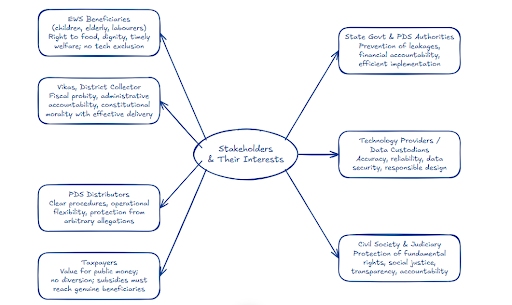
(a) Options Open to Vikas and Balancing Probity with Empathy
- Strictly enforce biometric authentication
|
Merits |
Demerits |
|
|
- Allow distributors unrestricted discretion
|
Merits |
Demerits |
|
|
- Introduce a technology-plus-human fallback mechanism
|
Merits |
Demerits |
|
|
(b) Ethics of Using Technology as a Gatekeeper for Welfare Schemes
Technology can improve welfare governance, but its ethical legitimacy depends upon how it is designed and deployed.
Ethical advantages
- Transparency: Digital records create an audit trail and reduce opaque transactions.
- Efficiency: Automated authentication can reduce duplication and fraudulent beneficiaries.
- Accountability: Digital transactions make diversion easier to detect.
- Objectivity: Technology can reduce arbitrary human discretion.
Ethical concerns
- Digital exclusion: People with worn fingerprints, disabilities, age-related changes or poor connectivity may be wrongly excluded.
- Automation bias: Officials may treat technological rejection as an unquestionable determination of ineligibility.
- Distributive injustice: The poorest citizens may bear the highest cost of technological imperfections.
- Privacy: Biometric databases involve sensitive personal information and require strong purpose limitation and data protection.
- Opacity: Beneficiaries may not understand why authentication failed or how to challenge the decision.
- Accountability gap: When an algorithm or device causes exclusion, responsibility may become diffused between the government, distributor and technology provider.
- Procedural versus substantive justice: A technically uniform rule can produce substantively unequal outcomes.
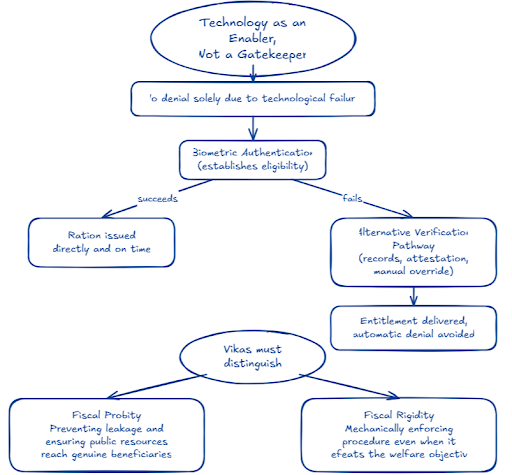
"Recall the face of the poorest and the weakest man whom you may have seen, and ask yourself if the step you contemplate is going to be of any use to him." — Mahatma Gandhi
Development must be understood in terms of expanding people's real freedoms and capabilities. Technology should therefore strengthen welfare delivery without allowing technical failure to become human exclusion
Last updated on Oct, 2026