Question
Rajapuram is a border district. Jhara and Biru, its two major communities are in continual conflict with each other. The social fabric is fractured and demands mending.
Ethnic tensions between the two communities have erupted into violence resulting in a large number of deaths. The stated causes are conflicting land claims, uneven resource allocation and inadequate political representation in government bodies. Separate relief camps had to be created for the two communities. The situation is volatile and appears to be getting out of control.
Rajan has been appointed the District Magistrate (DM) of Rajapuram and tasked to quickly get the situation under control. His immediate tasks include restoring administrative authority, reopening the highway and initiating peace talks. On taking over his appointment, Rajan realized that the inter-community rivalry had even seeped into the local administration and police. With functional neutrality being the immediate casualty, it had made both communities distrustful of the government. The neighbouring country could utilize the opportunity to spur insurgent activity and further aggravate the situation. Rajan favoured a controlled approach starting with opening the highway to restore food and medical supplies. He toyed with the idea of requisitioning CRPF units to help restore administrative control.
(a) Discuss the ethical issues that need to be addressed in this case.
(b) What are the options open to Rajan? Which option would ensure protection of his non-partisan image without compromising ethics?
Detailed Solution
Recent ethnic conflicts in India’s border regions show how administrative partisanship, resource inequity and weak reconciliation can convert social tensions into threats to peace and national security.
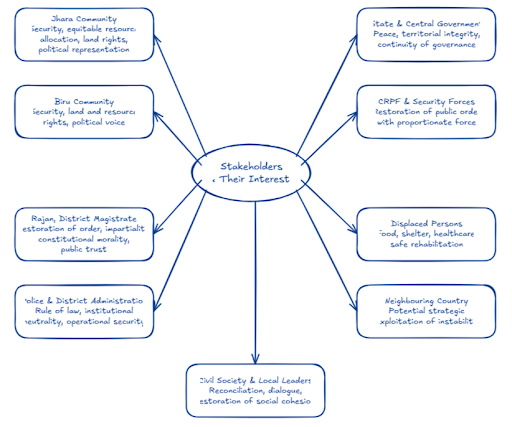
(a) Ethical Issues to be Addressed
- Conflict between order and liberty: Rajan must restore law and order without allowing coercive state power to become excessive or discriminatory.
- Administrative neutrality: Communal penetration of the police and administration compromises objectivity, impartiality and institutional integrity, eroding citizens' trust in the State.
- Equality and distributive justice: Uneven resource allocation and political under-representation raise questions of fairness, substantive equality and distributive justice.
- Humanitarian responsibility: Separate relief camps reflect the immediate need to protect life, dignity and basic necessities without institutionalising communal segregation.
- Proportionality in use of force: CRPF deployment may be necessary, but force must remain minimum, proportionate, accountable and targeted.
- Reconciliation versus retribution: The administration must distinguish between criminal accountability for violence and collective punishment of communities.
- National security: A prolonged ethnic conflict may provide opportunities for cross-border insurgency, radicalisation and destabilisation, creating an ethical duty to secure the border district.
(b) Options Available to Rajan
- Rely solely on local administration and police; avoid central forces
|
Merits |
Demerits |
|
|
- Immediate, force-led restoration — requisition CRPF, impose curfew, clear highway by coercion
|
Merits |
Demerits |
|
|
- Phased, consultative approach — neutral force as backstop, humanitarian first, dialogue in parallel, administrative cleansing alongside
|
Merits |
Demerits |
|
|
Option selected
Rajan should adopt Option 3: a phased, consultative approach, using CRPF as a neutral enabling instrument rather than as the primary strategy. This preserves his non-partisan image precisely because impartiality is demonstrated through visible, symmetrical process, not merely asserted.
Course of action
- Reopen the highway as a humanitarian corridor escorted by CRPF, with representatives of both communities present at the announcement, framing it as relief for all, not victory for one.
- Transfer officials with proven partisan conduct, constitute mixed-community policing teams, place a written record of every such decision on file to withstand scrutiny.
- Every visit, every relief consignment, every meeting mirrored across both camps; publish relief data openly.
- District Peace Committee with equal representation, including women's groups, elders and youth; a neutral facilitator; a time-bound agenda on land records, resource allocation and representation.
- Initiate transparent land-record survey and a public resource-allocation audit; refer representation issues to the State Government with a reasoned recommendation.
- Daily verified bulletins in both languages; calibrated, judicially defensible restrictions rather than blanket shutdowns.
Justification through ethical reasoning
- Rawlsian justice as fairness: Decisions on land, relief and representation must be defensible from behind a veil of ignorance — Rajan should ask whether he would accept the arrangement without knowing which community he belonged to. This is the operational test of impartiality.
- Gandhian means-end unity: Peace imposed by force is not peace. "Mending the social fabric" is a moral end that can only be reached through non-violent, dialogic means.
- Kantian deontology: Every displaced person is an end in himself. Relief distributed by need, not by identity, honours the categorical imperative; a maxim of ethnically weighted relief cannot be universalised.
- Weber's ethic of responsibility, over the ethic of conviction: Rajan cannot simply do what feels righteous; he must weigh foreseeable consequences—including cross-border exploitation of a security vacuum.
- Ambedkar's constitutional morality: Fraternity is not sentiment but a constitutional obligation. Political representation and resource grievances must be routed through lawful institutional channels, not street power.
- Aristotle's phronesis and the golden mean: Neither reckless force nor paralysing inaction — practical wisdom lies in calibrated firmness.
- Emotional intelligence (Goleman): Empathy, self-regulation and social skill are Rajan's principal tools; he must listen to grief before he issues orders.
As Martin Luther King Jr. observed, “Peace is not merely the absence of tension; it is the presence of justice.” Rajan must therefore convert restored order into lasting, equitable peace.
Last updated on Oct, 2026