Question
Ajit has been recently promoted as the Head of the Department of Weapon Sales (DWS) in the Ministry of Defence Production (MDP). His charter of duties includes international sales of weapons produced domestically by MDP.
In two recent wars, MDP weapons have performed admirably, resulting in many countries showing interest in buying them, particularly long-range artillery and missiles. Country A and country B have asked for these weapons. However, production constraints restrict DWS to accept only one purchase order.
Country A is a developing nation with a sound technology base. MDP is planning R&D collaboration with it for the next generation of weapons. It is not part of any security alliance and needs weapons for protection from a troublesome neighbour. It seeks a large acquisition on a long-term loan.
Country B is also a developing nation. Military strength is its priority, with the military budget often ingressing into allocations for human resources and infrastructure development. It is in security alliance with a superpower who has a large military base there and periodically allots it financial grants. It is a member of an economic bloc with which the government is currently negotiating a free trade agreement. It is not a signatory of NPT but possesses smaller nuclear weapons and delivery systems. It supports some guerrilla forces abroad. It has sought a smaller acquisition and is prepared to make some advance payment. It is currently negotiating arms purchases from another nation too.
Ajit discussed this case with his counterparts in the related departments. Therein, the significant economic benefits, employment generation and stronger diplomatic relations arising from this sale were highlighted. It was also emphasized that refusing the deal could result in country B purchasing weapons from some other supplier.
Ajit was aware that in arms sales, due diligence at each stage was pivotal to ensure conformity to national policy and international treaties.
(a) Discuss the options available to Ajit. Which option should he select and why?
(b) How can Ajit balance nation’s economic and strategic interests with ethical considerations?
Detailed Solution
Amid escalating global arms exports and proxy conflicts, this case highlights the dilemma of balancing economic-strategic gains against international ethics, non-proliferation norms, and just war stewardship.
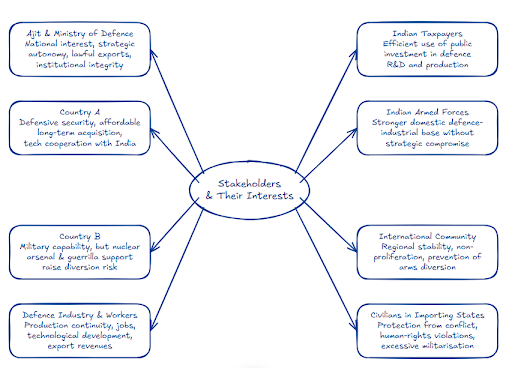
(a) Options Available to Ajit
- Accept Country A’s order
|
Merits |
Demerits |
|
|
- Accept Country B’s order
|
Merits |
Demerits |
|
|
- Option 3: Defer both
|
Merits |
Demerits |
|
|
Recommended option: Select Country A, subject to enhanced due diligence
I would recommend Country A, provided comprehensive due diligence confirms its legitimate end-use and compliance with India's export-control framework.
The decision should not be based merely on which country offers greater immediate economic benefit. The character of the buyer, intended use, regional consequences and possibility of diversion must form part of the ethical assessment.
Conditions attached to the sale
- Verify end-user certificates and final recipients.
- Conduct comprehensive strategic and security due diligence.
- Include strict no-transfer/no-re-export clauses.
- Establish mechanisms for end-use monitoring.
- Assess possible implications for regional stability.
- Ensure conformity with India's national export-control policy and applicable international obligations.
- Create safeguards against diversion to non-state actors.
- Review the transaction periodically if the regional security situation changes.
India itself has emphasised that conventional arms transfers must be controlled in accordance with national and international obligations, alongside legitimate security and foreign-policy interests
Ethical justification
- Just War tradition: The distinction between jus ad bellum and jus in bello highlights that legitimate self-defence does not automatically make every means of warfare ethically acceptable.
- Similarly, an arms exporter bears responsibility for foreseeable consequences of transfers.
- Kant's categorical imperative: Arms that may reach guerrillas treat distant civilians as mere means; the maxim fails universalisability.
- Rawls' Law of Peoples: No duty exists to arm an outlaw regime that abets cross-border violence; duties of assistance favour A.
- Rule utilitarianism (Mill over Bentham): B's advance payment is short-term hedonic gain; A's partnership maximises enduring aggregate welfare.
- Doctrine of trusteeship: Ajit is not the owner of the public defence capability; he is its trustee.
- Therefore, national resources and technological capabilities must be deployed for the broader public interest rather than short-term departmental or commercial gains.
(b) Balancing Economic and Strategic Interests with Ethical Considerations
- Rigorous end-use certification: Obtain binding assurances against transfer, re-export or diversion.
- Post-sale verification: Conduct inspections and monitoring throughout the weapon's lifecycle.
- Human-rights assessment: Evaluate the recipient's conflict behaviour and record of civilian protection.
- Treaty compliance: Ensure conformity with India's export-control regime and applicable international obligations.
- Strategic assessment: Examine the impact on India's regional security, alliances and strategic autonomy.
- Economic safeguards: Prefer secure payment mechanisms, insurance and commercially viable financing.
- Institutional oversight: Maintain documented, transparent and auditable decision-making to prevent conflict of interest and arbitrary discretion.
- Technology protection: Ring-fence sensitive technologies and impose appropriate technology-security clauses.
As Immanuel Kant observed, “Act only according to that maxim whereby you can, at the same time, will that it should become a universal law.” For Ajit, responsible arms trade must make national interest compatible with global responsibility.
Last updated on Oct, 2026