The Pension Fund Regulatory and Development Authority (PFRDA) is the statutory regulator of India’s pension sector, established under the PFRDA Act, 2013, to promote old-age income security and protect the interests of pension subscribers. The PFRDA regulates and develops the National Pension System (NPS) and other pension schemes within its statutory mandate while overseeing various intermediaries involved in the pension ecosystem.
The Pension Fund Regulatory and Development Authority also regulates pension funds, Central Record Keeping Agencies, Points of Presence, custodians and other intermediaries to ensure transparency, efficient fund management and subscriber protection. Its regulatory framework covers schemes such as NPS and Atal Pension Yojana (APY), thereby strengthening pension coverage and supporting the development of a sustainable and inclusive pension ecosystem in India.
PFRDA Overview
The PFRDA is the statutory regulator of India's pension sector.
- PFRDA Full Form: The full form of PFRDA is the Pension Fund Regulatory and Development Authority.
- Genesis: It was established following the recommendations of the OASIS (Old Age Social and Income Security) Committee; the Interim Pension Fund Regulatory and Development Authority was constituted in August 2003.
- Statutory Status: The Pension Fund Regulatory and Development Authority was established under Section 3 of the PFRDA Act, 2013, as a body corporate with perpetual succession and a common seal.
- The PFRDA Act, 2013, was enacted on 19 September 2013 and came into force on 1 February 2014.
- Mandate: To promote old-age income security by establishing, developing, and regulating pension funds while protecting the interests of pension subscribers.
- Functions: The Pension Fund Regulatory and Development Authority regulates, promotes, and ensures the orderly growth of the National Pension System (NPS) and other pension schemes not governed by any other law; it also administers the Atal Pension Yojana (APY).
- Administrative Ministry: The Pension Fund Regulatory and Development Authority operates under the Department of Financial Services, Ministry of Finance.
PFRDA Functions
Under Section 14 of the Pension Fund Regulatory and Development Authority Act, 2013, PFRDA regulates and develops the pension sector, safeguards subscribers' interests, promotes financial inclusion, and ensures the efficient functioning of the National Pension System (NPS).
- Regulates Pension Schemes: The Pension Fund Regulatory and Development Authority regulates the National Pension System (NPS) and other pension schemes covered under the Act, including approval of schemes, their terms and investment guidelines.
- Regulates Intermediaries: The Pension Fund Regulatory and Development Authority registers, supervises, renews, modifies, suspends, or cancels the registration of pension intermediaries.
- Protects Subscribers: The Pension Fund Regulatory and Development Authority safeguards subscribers' interests by ensuring the safety of contributions, reasonable operational costs, and an effective grievance redressal mechanism.
- Regulates Pension Assets: The Pension Fund Regulatory and Development Authority oversees the management of pension funds and regulated assets to ensure prudent investment and financial stability.
- Dispute Resolution: The Pension Fund Regulatory and Development Authority adjudicates disputes between intermediaries and between intermediaries and subscribers.
- Inspection & Enforcement: The Pension Fund Regulatory and Development Authority conducts inspections, audits, enquiries, investigations, and calls for information to ensure regulatory compliance.
- Research & Capacity Building: The Pension Fund Regulatory and Development Authority undertakes research, collects pension-related data, promotes pension awareness, provides training to intermediaries, and supports professional development in the pension sector.
- Transparency & Administration: The Pension Fund Regulatory and Development Authority standardises disclosure of pension fund performance, prescribes accounting and reporting standards, levies regulatory fees, and performs other functions assigned under the Act.


PFRDA Structure
The structure of the Pension Fund Regulatory and Development Authority is described below.
- Present Composition of the Authority (as of 14th September 2026): As per Section 4 of the PFRDA Act, 2013, the Authority consists of:
- Chairperson
- Three Whole-Time Members
- Three Part-Time Members
- These members are appointed by the Central Government and are selected based on their expertise in economics, finance, or law, ensuring leadership with integrity and professional standing.
- PFRDA Chairman: Shri Sivasubramanian Ramann
- Members of PFRDA:
- Shri Randip Singh Jagpal, Whole-time Member (Law)
- Shri Sanjay Pandey, Whole-time Member (Finance)
- Ms Parama Sen (IA&AS 1994), Part-time Member, Additional Secretary (Pers.), Department of Expenditure, Ministry of Finance.
- Shri Chandradeep Kumar Jha (ISS 2000), Part-time Member, Statistical Advisor, Department of Financial Services, Ministry of Finance.
- PFRDA Headquarters: New Delhi, India.
PFRDA Pension Ecosystem and Intermediaries
Effective functioning of the pension ecosystem depends on coordinated efforts of various intermediaries appointed by the Pension Fund Regulatory and Development Authority. Key intermediaries include:
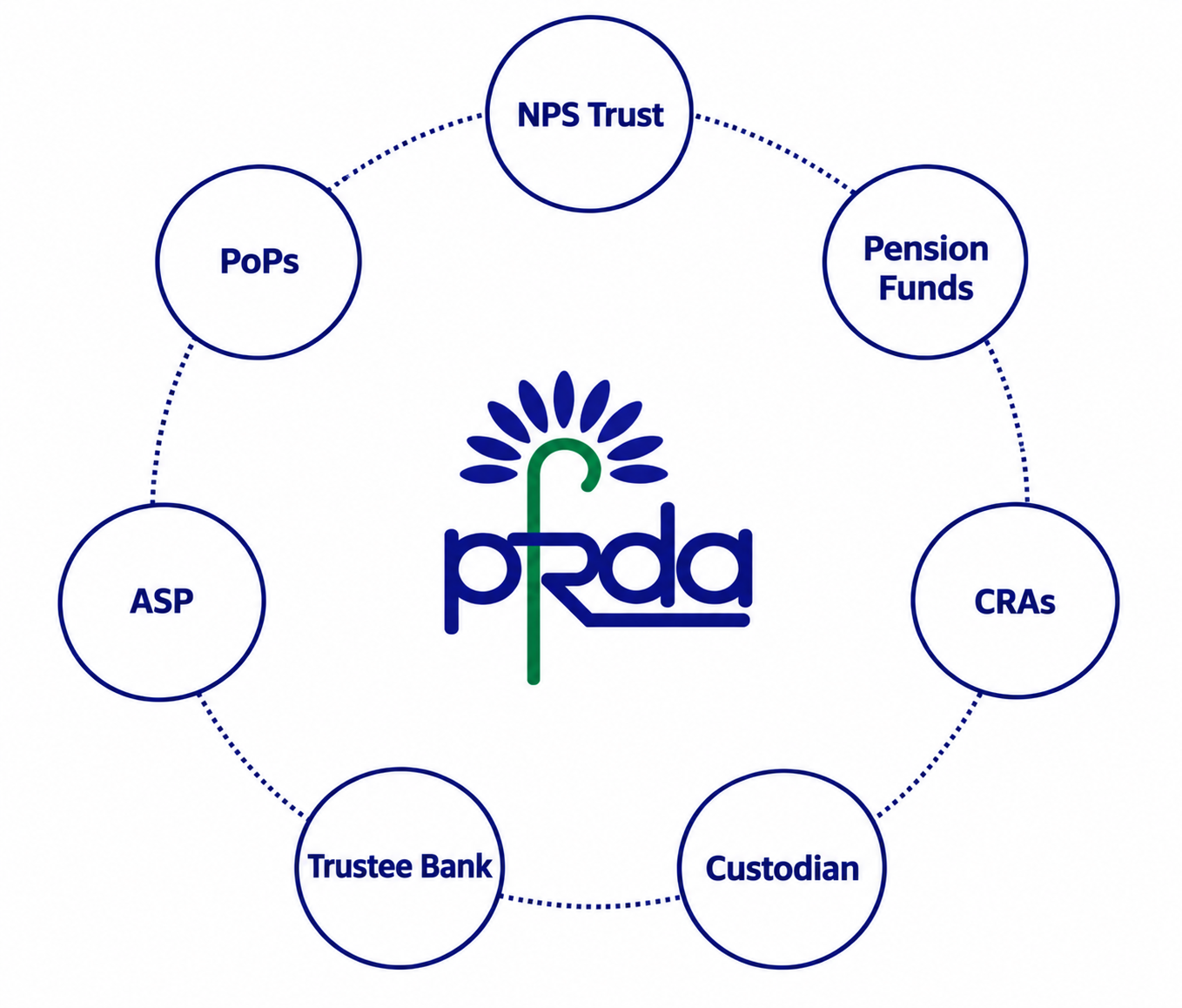
- Central Record Keeping Agency (CRA): Serves as the technological and operational backbone of NPS.
- Maintains subscriber records, processes transactions and issues the Permanent Retirement Account Number (PRAN).
- Pension Funds: Manage subscribers’ contributions and invest the accumulated pension corpus as per regulations.
- Calculate NAV and manage investment portfolios while following prescribed investment norms.
- NPS Trust: Safeguards the interests of NPS subscribers and oversees the functioning of intermediaries in accordance with the regulatory framework.
- Point of Presence (PoPs): Serve as the primary interface between subscribers and NPS.
- Handle subscriber registration, KYC, contribution processing and related services.
- Custodians: Safeguard securities and assets of pension schemes.
- Maintain custody records and facilitate settlement and related transactions.
- Trustee Bank: Manages banking operations of NPS, including receipt, transfer and disbursement of funds among NPS intermediaries.
- Nodal Offices: Act as administrative interfaces between government/other organisations and the CRA.
-
- Include offices such as Drawing and Disbursing Offices (DDOs) and Pay and Accounts Offices (PAOs).
- Aggregators: Facilitate pension enrolment and servicing, particularly for subscribers under NPS Lite/Swavalamban.
-
- Support KYC, contribution-related services and grievance handling, helping expand pension coverage among underserved sections.
PFRDA Schemes
The Pension Fund Regulatory and Development Authority administers and regulates various pension schemes to provide old-age income security for government employees, private sector employees, unorganised workers, and citizens across different age groups.
- National Pension System (NPS): It is a mandatory defined-contribution pension scheme for Central Government employees (except Armed Forces), State Governments and autonomous bodies who joined on or after January 1, 2004, with contributions from both employer and employee.
- NPS All Citizen Model: It is a voluntary pension scheme for all Indian citizens aged 18-85 years, offering Tier I (retirement) and Tier II (voluntary savings) accounts with flexible investment choices.
- NPS Corporate Model: Employer-facilitated voluntary pension scheme for employees of registered corporates, allowing contributions from both employer and employee.
- NPS Vatsalya (2024): A contributory, market-linked pension/savings scheme for minors, operated by a parent or legal guardian. The minimum contribution is ₹250 at registration/opening and ₹250 in each financial year, with no maximum limit. On attaining 18, the subscriber can continue under NPS Vatsalya up to 21, shift the corpus to NPS or exit, subject to applicable rules.
- Unified Pension Scheme (UPS) (2025): It is an optional scheme for Central Government employees under the NPS framework, providing a 50% assured pension after 25 years of qualifying service, a minimum pension of ₹10,000 per month for eligible subscribers retiring after at least 10 years of qualifying service and a 60% family pension.
- Atal Pension Yojana (APY): Government-backed pension scheme for Indian citizens aged 18–40 years, particularly unorganised sector workers, providing a guaranteed monthly pension of ₹1,000–₹5,000 after the age of 60; income-tax payers are ineligible to join from 1 October 2022.
- NPS Lite / Swavalamban: A low-cost pension scheme for workers in the unorganised sector, with government co-contribution under Swavalamban. Following the launch of APY in 2015, fresh enrolment ceased except for eligible Gramin Dak Sevaks (GDS) of the Department of Posts.

 Last updated on Sep, 2026
→ UPSC 2027 Notification will be released on 13 January 2027 at upsconline.nic.in.
→ Asian Games 2026 are being held in Aichi-Nagoya, Japan, from 19 September to 4 October.
→ Check out the latest UPSC Syllabus here.
→ Download UPSC Model Answers for Mains 2026
→ UPSC Mains Question Paper 2026 is out now for Essay & GS Paper 1, 2, 3 & 4.
→ UPSC Calendar 2027 has been released.
→ Enroll in Vajiram & Ravi’s UPSC Mains Test Series 2027 for structured answer writing practice, expert evaluation, and exam-oriented feedback.
→ Join Vajiram & Ravi’s UPSC Mentorship Program 2027 for personalized guidance, strategy planning, and one-to-one support from experienced mentors.
→ Go through the UPSC Mains Previous Year Papers to enhance your preparation.
→ UPSC has released UPSC Toppers List 2025 with the Civil Services final result on its official website.
→ Also check Best UPSC Coaching in India
PFRDA FAQs
Q1. What is PFRDA?+
Q2. What is the full form of PFRDA?+
Q3. Who is the present chairman of PFRDA?+
Q4. When was the PFRDA Act established in India?+
Q5. Where is the headquarters of PFRDA?+
Tags: pfrda quest upsc economy notes