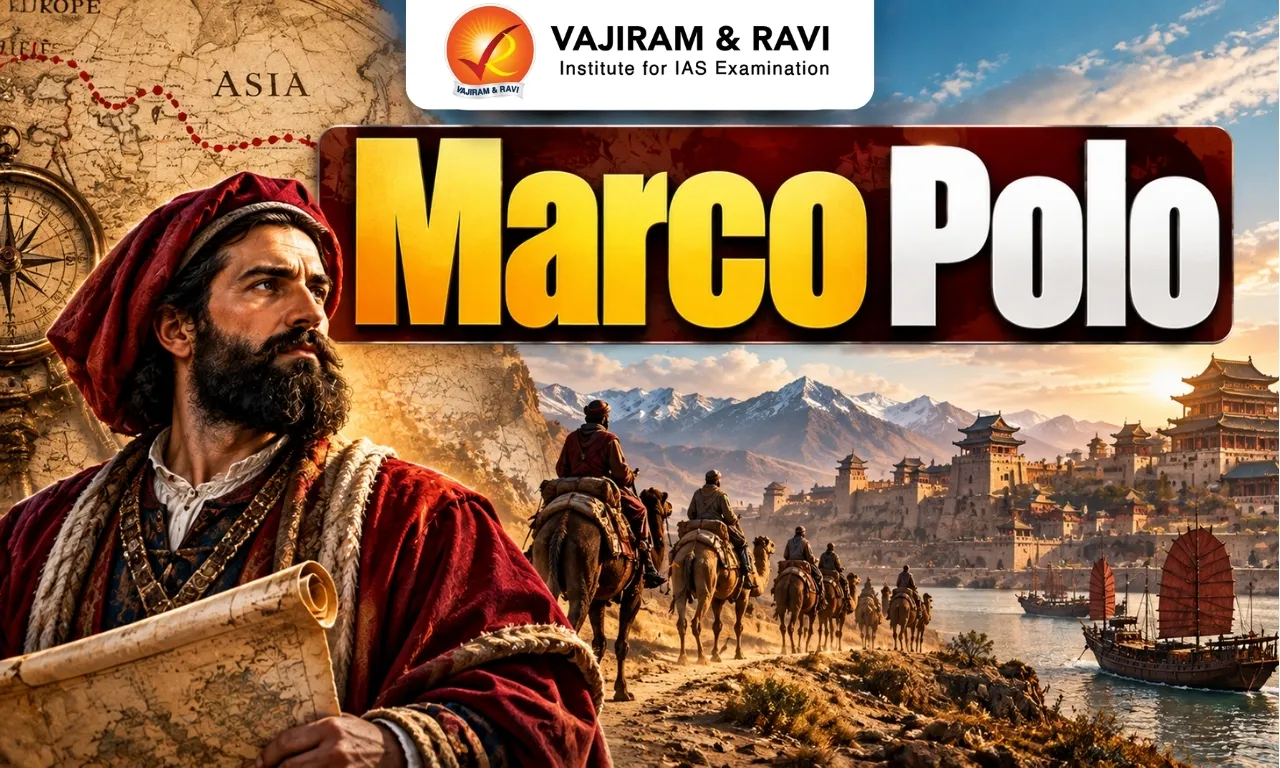
Marco Polo was a Venetian merchant and traveller who journeyed extensively across Asia, including China and South India. His association with Kublai Khan, observations of Asian societies and economies, and experiences during his travels formed the basis of The Travels of Marco Polo.
Polo’s account provides an important foreign perspective on 13th-century South India, particularly the Pandya kingdom, pearl fisheries, trade, maritime connections, social customs and religious practices. Though valuable for historical reconstruction, it also contains hearsay and legendary material, requiring critical evaluation alongside other sources.
Marco Polo About
Marco Polo (c. 1254-1324) was a Venetian merchant and traveller who travelled extensively across Asia in the 13th century. He was one of the renowned foreign travellers who visited India. He is particularly associated with the court of Kublai Khan, where his long stay enabled him to observe the political, economic and cultural life of the Mongol Empire. His experiences later formed the basis of The Travels of Marco Polo.
Marco Polo Biography
Marco Polo’s life was shaped by his family’s commercial links with the East and his extensive travels across Asia, culminating in the compilation of The Travels of Marco Polo.
- Early Life and Family: Born around 1254 in Venice into a merchant family. His father, Niccolò Polo, and uncle Maffeo Polo had previously travelled to the East.
- Journey to Asia: In 1271, Polo travelled with his father and uncle, passing through Persia and Central Asia before reaching China.
- Service under Kublai Khan: The traditional account states that Marco spent approximately 17 years in China and undertook assignments associated with the Mongol court.
- Return Journey: The Polos departed China by sea around 1291, escorting the Mongol princess Kököchin to Persia. Their voyage passed through Southeast Asia and the Indian Ocean, including regions of South India. They returned to Venice around 1295.
- Compilation of The Travels of Marco Polo: Polo was captured by the Genoese during the Venice–Genoa conflict and imprisoned in Genoa. According to tradition, he narrated his experiences to Rustichello of Pisa, who composed the travel narrative.


Marco Polo Visit to India
Marco Polo visited India during the Indian Ocean stage of his return journey from China to Persia in the early 1290s, conventionally associated with the period around 1292–1293. His account provides insights into the political, economic, social, religious and maritime life of 13th-century South India, particularly the Pandya kingdom.
Marco Polo Accounts of India
Polo’s account of India provides valuable insights into the Pandya kingdom, pearl fisheries, trade, maritime connections, social customs and religious practices, offering a foreign perspective on medieval South Indian society.
- Pandya Kingdom: Polo described Ma'bar, a region associated with the Pandya dynasty, as prosperous and commercially active. His narrative is particularly valuable for its references to coastal commerce and pearl fisheries.
- Pearl Fisheries: Polo described pearl diving on the southern Indian coast and the role of ritual specialists who were believed to protect divers through charms or prayers.
- Trade and Economy: Polo noted horse imports from Arabian and Persian Gulf trading centres, including Aden, fine cotton textiles, pepper, indigo, leather workshops, and date wine, reflecting the region’s commercial activity.
- Maritime Connections: His observations of the Indian coastline and overseas commerce highlight South India’s links with the wider Indian Ocean trade network.
- Social Customs: Polo recorded customs involving food, drinking, betel chewing, religious beliefs and ritual practices. He also reported practices interpreted as sati and described a shrine associated with St Thomas in India. He also reported the presence of devadasis associated with temples.
- Religion and Beliefs: He also recorded the importance of astrology, mantras, reverence for cattle, and religious practices in society.
- Political Observations: Polo described Mutfili, generally associated with Motupalli in the Kakatiya dynasty, as a kingdom ruled by a queen conventionally identified with Rudrama Devi.
- His account should not be treated as evidence that he personally met her: the Chandupatla inscription places her death in 1289, before the conventionally dated early-1290s return voyage.
- Rudrama Devi belonged to the Kakatiya dynasty, not the Pandya dynasty.
- Religious Diversity: Polo described a shrine identified as the tomb of St Thomas at Mylapore, now part of Chennai, and reported that Christians and Muslims visited it on pilgrimage.
Marco Polo Book - The Travels of Marco Polo
The Travels of Marco Polo, also known as The Description of the World (Divisament dou Monde), records Polo’s journeys and observations across Asia. Dictated to Rustichello of Pisa during his imprisonment in Genoa, it became an important medieval European source on Asian geography, political systems, commerce and social life.
- Geographical Account: Describes regions, cities, routes and landscapes across Asia.
- Political Information: Provides accounts of rulers, kingdoms and administration, particularly under Kublai Khan.
- Economic & Commercial Details: Records trade, commodities, markets, manufacturing and commercial centres.
- Social & Cultural Life: Describes customs, food practices, professions and religious beliefs.
- South Indian Observations: Includes accounts of pearls, trade, textiles, pepper, indigo and social practices.
- Source Limitations: Combines personal observations, information obtained from others, hearsay and legendary material; hence, its contents require critical evaluation.
Marco Polo Travel Narratives Impact
Polo’s Travels became an influential European account of Asia, combining descriptions of geography, societies, commerce and cultures with information gathered from others and legendary material. Its circulation expanded European geographical knowledge and stimulated interest in Asian commerce and distant regions.
- European Exploration: Became part of the geographical literature consulted by later European explorers; Christopher Columbus possessed and annotated a copy of Polo’s work.
- Geographical Knowledge: Expanded European awareness of Central Asia, China and the wider Asian world, including distant regions and societies.
- Perceptions of the East: Descriptions of cities, wealth, rulers, commodities and customs shaped European perceptions of Asian societies.
- Commercial Interest: Accounts of Asian wealth, commodities and trade stimulated Western interest in Eastern commerce.
- Cartographic Influence: Information from the Travels contributed to subsequent European geographical writings and mapping traditions.

 Last updated on Oct, 2026
→ UPSC 2027 Notification will be released on 13 January 2027 at upsconline.nic.in.
→ Check Nobel Prize 2026 Winners List here.
→ Download PIB PRiSM Monthly Magazine 2026 here.
→ Check UPSC Monthly Current Affairs Magazine The Recitals here.
→ Check out the latest UPSC Syllabus here.
→ Download UPSC Model Answers for Mains 2026
→ UPSC Mains Question Paper 2026 is out now for Essay & GS Paper 1, 2, 3 & 4.
→ UPSC Calendar 2027 has been released.
→ Enroll in Vajiram & Ravi’s UPSC Mains Test Series 2027 for structured answer writing practice, expert evaluation, and exam-oriented feedback.
→ Join Vajiram & Ravi’s UPSC Mentorship Program 2027 for personalized guidance, strategy planning, and one-to-one support from experienced mentors.
→ Go through the UPSC Mains Previous Year Papers to enhance your preparation.
→ UPSC has released UPSC Toppers List 2025 with the Civil Services final result on its official website.
→ Also check Best UPSC Coaching in India
Marco Polo FAQs
Q1. Who was Marco Polo?+
Q2. What was Marco Polo famous for?+
Q3. What did Marco Polo do in India? +
Q4. Why was Marco Polo jailed?+
Q5. What did Marco Polo say before he died?+
Tags: marco polo quest upsc ancient history notes