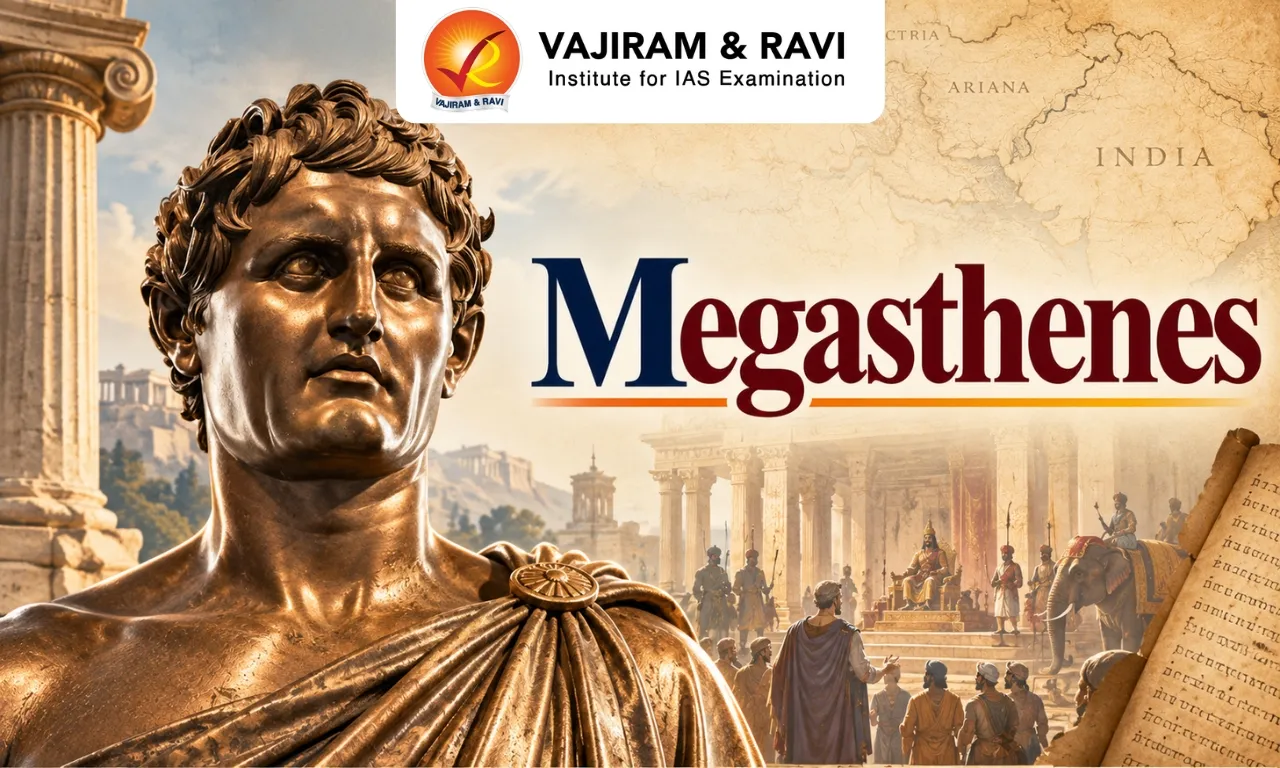
Megasthenes was a Greek diplomat, historian, and ethnographer who visited India as an envoy of Seleucus I Nicator to the court of Chandragupta Maurya at Pataliputra. His observations formed the basis of Indica, an important foreign account of Mauryan India.
He described Mauryan administration, society, economy, geography, religion, customs, and Pataliputra. Although the original Indica is lost, fragments preserved by later writers make it a valuable source for reconstructing Mauryan history, while its inaccuracies and Greek perspective require critical evaluation.
Megasthenes Biography
Megasthenes was a Greek ambassador and writer and one of the foreign travellers who visited India in ancient India. He is believed to have lived during the late 4th and early 3rd centuries BCE. His diplomatic mission to the Mauryan Empire established an important connection between the Hellenistic world and ancient India.
- Megasthenes was the ambassador of Seleucus I Nicator to the court of Chandragupta Maurya. His position enabled him to observe the political and administrative organisation of the Mauryan court and record information about its people, geography and economic activities.
- His account is an important source for historians studying ancient India, particularly the Mauryan Empire. However, since the original text is unavailable, historians must reconstruct his observations using quotations and references preserved by later writers.
Megasthenes Early Life
Megasthenes was an Ionian Greek, but reliable information about his birthplace, family, and education is limited. His birth is generally placed around 350 BCE, and his death around 290 BCE.
- After Alexander the Great's death, he entered the service of Seleucus I Nicator, one of Alexander's generals and the founder of the Seleucid Empire.
- In 302 BCE (305 BCE according to some sources), Seleucus sent Megasthenes as his ambassador to the court of Chandragupta Maurya in India.
Megasthenes as Ambassador to Chandragupta Maurya
Megasthenes served as the envoy of Seleucus I Nicator to Chandragupta Maurya’s court. His embassy belonged to the period of diplomatic engagement between the Seleucid and Mauryan kingdoms around the end of the fourth century BCE. Pataliputra was central to his description of Mauryan political life, although the exact dates, frequency, and duration of his visits remain uncertain.
Megasthenes Books
Megasthenes wrote Indica, also spelt Indika, an account of India traditionally described as consisting of four books. It discussed the country’s geography, inhabitants, customs, animals, and political organisation.
Indica Megasthenes
Indica book by Megasthenes was an important account of Mauryan India, particularly the reign of Chandragupta Maurya. Megasthenes wrote Indica based on his observations and information about India, although the original work has been lost.
- Sources of Information: Important references to Indica are preserved by Diodorus Siculus, Strabo, Arrian, and Pliny the Elder.
- Scope: The Indica book discussed India’s rivers, soil, climate, plants, animals, agricultural production, administration, social groups, customs, and religious beliefs.
- Greek Comparisons: Megasthenes and later Greek writers interpreted some Indian traditions through Greek concepts, associating Indian deities or figures with Dionysus and Herakles.
- Descriptive Accounts: Alongside useful observations, Indica included extraordinary stories about distant regions, unusual creatures and unfamiliar peoples.
- Historical Value: Despite its limitations, Indica remains an important literary source for reconstructing aspects of the Mauryan Empire in India, particularly when compared with archaeological evidence, Ashokan inscriptions and other historical texts.


Megasthenes in India
Megasthenes was the ambassador of Seleucus I Nicator and is associated with the court of Chandragupta Maurya at Pataliputra, the Mauryan capital.
- Areas Described: His account contains information about northwestern India, the Punjab and the Ganga-Yamuna region, including the imperial capital.
- Nature of Observations: Some descriptions may have been based on direct observation, while others came from local informants and accounts of regions he may not have visited personally.
- Uncertain Travel History: The precise duration of his stay and the full extent of his travels cannot be established with certainty. Therefore, every geographical description in Indica should not automatically be treated as a firsthand observation.
Megasthenes Observation of India
He described several aspects of Indian life, providing insights into the Mauryan state and society. His observations are especially useful when examined thematically and distinguished from claims that may reflect hearsay or Greek perceptions.
Geography and Natural Environment
Megasthenes’ observations of India’s geography and natural environment highlighted the subcontinent’s physical features, river systems, agricultural resources and diverse wildlife, alongside accounts of remarkable phenomena in distant regions.
- Geographical Extent: He presented India as a large and distinctive land, although ancient geographical descriptions did not always correspond to modern boundaries.
- Rivers: He discussed major rivers, particularly the Indus and Ganga, and described their importance for agriculture, settlement, and transportation. Greek writers sometimes compared Indian rivers with major rivers known to them, such as the Nile and Danube.
- Soil and Climate: He noted the fertility of Indian soil and the suitability of many regions for agricultural production.
- Flora and Fauna: His account referred to diverse plants and animals, including elephants and monkeys, and described the training of horses and the capture of elephants. Some descriptions of distant regions included unusual animals and peoples (which need further clarification).
Political Administration
Megasthenes portrayed the Mauryan state as an organised political system centred on the king and supported by ministers and officials.
- King: He described Chandragupta Maurya's luxurious lifestyle and magnificent palace.
- The king reportedly changed his sleeping room regularly and rarely appeared in public, except during military campaigns, judicial proceedings, religious sacrifices and hunting expeditions.
- A large network of spies, including women, ensured his security. Megasthenes also noted Chandragupta's respect for his chief minister, Chanakya (Kautilya), who lived in a modest hut near the royal palace.
- Provincial Administration: The country was divided into provinces governed by capable officers responsible for public welfare and maintaining law and order. Provinces were further divided into districts comprising several villages. The district officer was known as the Sthanika, while the village officer was called the Gopa.
Pataliputra and Municipal Administration
Megasthenes verifies archaeological findings that a great number of cities existed during his day, although Pataliputra (he refers to it as Palibothra) stood out among them. The Greek adjective Palibothra refers to a city with many gates.
- Fortifications: According to Arrian’s account of Megasthenes, the city had a wooden palisade, a deep moat, 570 towers and 64 gates.
- Dimensions: Arrian reports the city’s dimensions as 80 stadia in length and 15 stadia in breadth. These are figures transmitted through ancient literature and should not be treated as independently verified modern measurements.
- Municipal Administration: Megasthenes described six committees, each comprising five members, that dealt with different aspects of urban life and economic regulation.
- Six Municipal Committees: Megasthenes reported that Pataliputra’s civic administration was managed by six committees, each comprising five members. Each committee performed specific functions related to urban management, public welfare, and commercial regulation.
- Industrial Arts: The first committee supervised industrial activities and crafts.
- Foreigners: The second committee looked after foreigners, including their accommodation, welfare and supervision.
- Births and Deaths: The third committee maintained records of births and deaths.
- Trade and Commerce: The fourth committee regulated trade and supervised weights and measures.
- Manufactured Goods: The fifth committee supervised the sale of manufactured goods and distinguished newly produced articles from second-hand ones.
- Tax Collection: The sixth committee collected taxes on merchandise sold in markets.
Military Organisation
Megasthenes' book Indika described the Mauryan military establishment as a large and organised institution supporting the power of the empire.
- Size of the army: He reported that the Mauryan army numbered approximately 400,000 soldiers. This figure may be exaggerated, but it reflects the Greek perception of Mauryan military strength.
- Military board: According to his account, military administration was overseen by a board of 30 officials divided into six committees. The committees were responsible for the army, navy, cavalry, transport, chariots and elephants.
- Military logistics: The separate attention given to transport, chariots and elephants indicates the importance attributed to logistical support and specialised military resources in the reported organisation.
Social Organisation
Megasthenes classified Indian society into seven groups, based on their occupations and social functions. This classification is valuable as evidence of how a Greek observer understood Indian society, but it does not correspond neatly to the four-varna framework or the complex system of jatis.
- Seven Groups: The groups included:
- Philosophers: People engaged in intellectual and religious pursuits.
- Farmers: Agriculturalists who cultivated land and produced food.
- Herders and Hunters: People engaged in animal husbandry and hunting.
- Artisans and Traders: Craftspeople, manufacturers and merchants.
- Soldiers: People who served in the military.
- Overseers and Inspectors: Officials who supervised activities and reported information.
- Counsellors and Officials: People associated with governance and advising the ruler.
- Occupational Classification: Megasthenes suggested that people generally remained within their occupational groups.
- Slavery: Megasthenes claimed slavery did not exist in India, portraying society as prosperous and free. However, according to the Arthashastra, slavery existed, and he may have mistaken slaves for willing state employees.
- The term Kautilya uses for them is ahitakas.
- Marriage Practices: His account also made claims about marriage within groups and restrictions on occupational change.
- Philosophical Groups: Strabo distinguished between Brachmanes, generally identified with Brahmanas, and Garmanes, commonly associated with shramanas or other renunciant traditions.
Economic Life and Trade
Megasthenes’ observations provide information about agriculture, crafts, commerce, taxation, transport and the role of the state in economic activities.
- Agriculture: Farming was an important economic activity, supported by fertile soil and favourable conditions in many regions.
- Crafts and Manufacturing: Artisans and manufacturers formed a distinct occupational group in his classification.
- State Supervision: His account refers to the regulation of markets, weights and measures, manufactured goods and taxation. He also describes state support or arrangements for certain occupational groups, including weapons makers.
- Panyadhyaksha: Megasthenes refers to the controller and manager of trade as panyadhyaksha. His duties included determining and establishing exchange rates, managing and channelling commodity surpluses, and so forth.
- Trade Routes: The account provides clues about routes connecting the north-western regions with Pataliputra and areas farther south and west, including places associated with Sahasram (Sasaram) and Mirzapur.
- Trade Links: Megasthenes mentions north-south trade links, describing Pandyan territory as pearl-rich and ruled by a woman. Ashokan edicts also refer to southern dynasties outside the Mauryan Empire.
Religion and Philosophy
Megasthenes also sheds light on religious issues. He identifies Shiva as Dionysus. Megasthenes also mentions Herakles' worship in the Mathura region. Historians identify this character as the versatile Krishna who rose to prominence in the Puranic faith after the Gupta period.
- Brahmanas and Shramanas: Strabo’s account of Megasthenes distinguishes Brachmanes (Brahmanas) and Garmanes (commonly associated with shramanas), indicating different groups of Indian religious thinkers.
- Dionysus and Herakles: Megasthenes’ account, as preserved by later Greek writers, associated aspects of Indian history and traditions with these Greek figures.
Customs and Extraordinary Accounts
The surviving accounts attributed to Megasthenes also describe certain customs and unusual stories. These should be distinguished from observations supported by independent historical evidence.
- Royal Activities: Later accounts associated with Megasthenes describe royal hunting and the participation of women in some hunting activities.
- Unusual Creatures and Peoples: The transmitted accounts include gold-digging ants, enormous snakes, one-horned horses, people said to have backwards-facing feet or eight toes, and dog-headed peoples.
- The Silas River: One report describes a river called the Silas in which objects supposedly could not float.
- Historical Interpretation: Such descriptions illustrate the mixture of geographical information, hearsay and fabulous traditions found in ancient ethnographic writing. They should not be presented as established facts.
Megasthenes’ Account Limitations
Although Indica is an important source for Mauryan history, its reliability must be assessed critically. The limitations arise from the loss of the original work, the perspective of a foreign observer, and the nature of the material preserved by later writers.
- Fragmentary Evidence: The original Indica has not survived. Its contents are known through later writers, who selected and reproduced passages for their own purposes.
- Limited Firsthand Knowledge: Megasthenes’ precise travel history is uncertain. Some information may have come from informants rather than personal observation.
- Greek Cultural Bias: His descriptions sometimes interpreted Indian institutions and religious traditions through Greek categories, potentially simplifying or misrepresenting local practices.
- Extraordinary Claims: Accounts of unusual creatures, peoples and natural phenomena cannot be accepted without independent corroboration.
- Generalisation about Society: His classification of society into seven groups does not adequately represent the complexity of Indian social organisation.
- Questionable Social Claims: Reports that India had no slavery, that theft was rare, that people did not lie or lend and borrow, and that farmers were left undisturbed during wars should not be accepted uncritically. Some of these claims require comparison with other textual and historical evidence, including the Arthashastra.
- Critical Reception: Strabo criticised aspects of the accounts of Megasthenes and other ancient writers on India, while Arrian also expressed reservations about some extraordinary reports.

 Last updated on Oct, 2026
→ UPSC 2027 Notification will be released on 13 January 2027 at upsconline.nic.in.
→ Check Nobel Prize 2026 Winners List here.
→ Download PIB PRiSM Monthly Magazine 2026 here.
→ Check UPSC Monthly Current Affairs Magazine The Recitals here.
→ Check out the latest UPSC Syllabus here.
→ Download UPSC Model Answers for Mains 2026
→ UPSC Mains Question Paper 2026 is out now for Essay & GS Paper 1, 2, 3 & 4.
→ UPSC Calendar 2027 has been released.
→ Enroll in Vajiram & Ravi’s UPSC Mains Test Series 2027 for structured answer writing practice, expert evaluation, and exam-oriented feedback.
→ Join Vajiram & Ravi’s UPSC Mentorship Program 2027 for personalized guidance, strategy planning, and one-to-one support from experienced mentors.
→ Go through the UPSC Mains Previous Year Papers to enhance your preparation.
→ UPSC has released UPSC Toppers List 2025 with the Civil Services final result on its official website.
→ Also check Best UPSC Coaching in India
Megasthenes FAQs
Q1. Who was Megasthenes?+
Q2. When did Megasthenes visit India?+
Q3. Who is the father of history in India?+
Q4. What did Megasthenes say about India?+
Q5. Why is Megasthenes' Indica important?+
Tags: megasthenes quest upsc ancient history notes