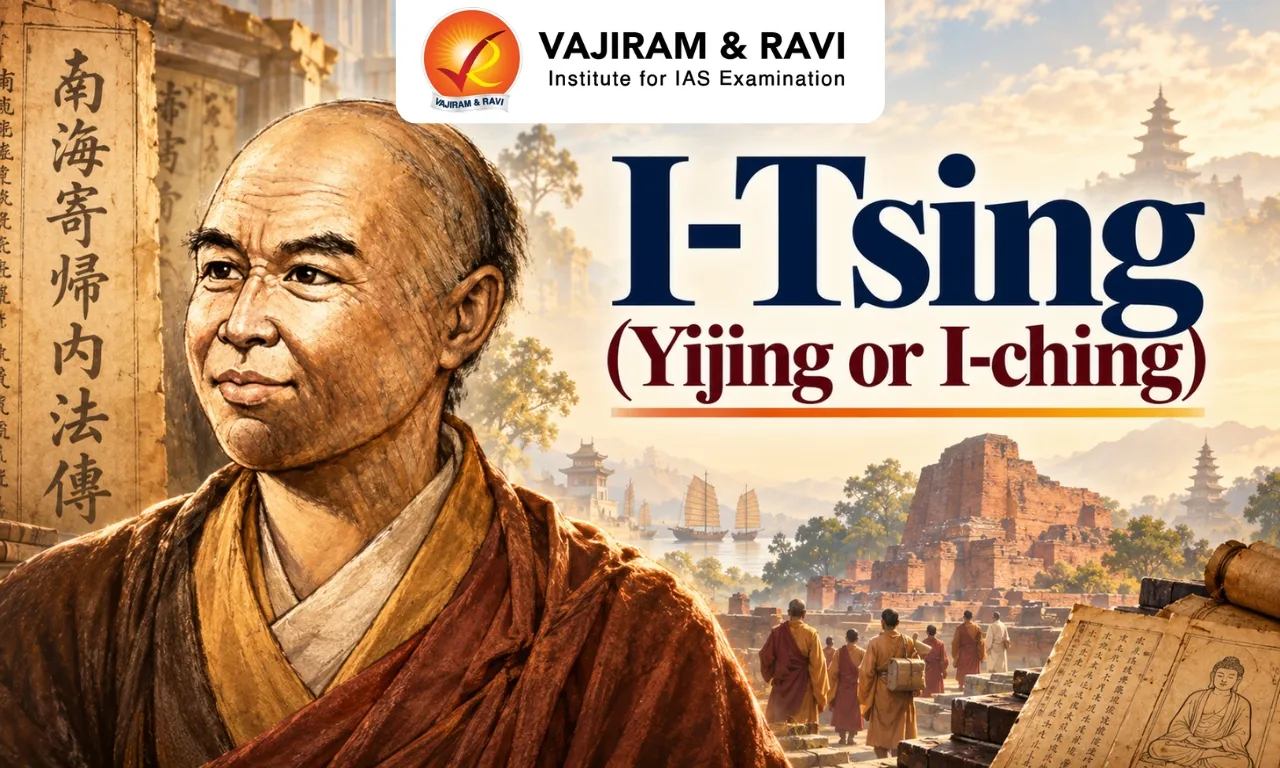
I-Tsing (Yijing or I-ching) was a 7th-century Chinese Buddhist monk, scholar and traveller who visited India to study Buddhist scriptures, Sanskrit and monastic discipline. He departed China by sea in 671 CE, travelled through Srivijaya and reached India around 673 CE. He arrived at Nalanda in 674 CE. He studied at Nalanda for approximately ten years, focusing on Buddhist teachings, Sanskrit texts and monastic discipline.
I Tsing’s writings provide valuable information on Indian education, Buddhist institutions, monastic life, Sanskrit learning and intellectual traditions, including interactions between Buddhist and non-Buddhist schools. His travel accounts also highlight the India–China transmission of Buddhist knowledge and complement the accounts of earlier Chinese travellers such as Faxian and Xuanzang.
I-Tsing (Yijing) About
I Tsing, also known as I-Ching or Yijing, was a Chinese Buddhist monk, scholar and traveller who visited India in the 7th century CE. His writings are important sources for understanding Buddhism, monastic education and cultural relations between India, China and Southeast Asia.
- Birth: I-Tsing was born in China in 635 CE and became a Buddhist monk.
- Religious Training: He studied Buddhism, particularly the Vinaya, which contains rules governing the conduct and discipline of Buddhist monks.
- Inspiration: Inspired by the journeys of earlier Chinese Buddhist pilgrims, including Xuanzang (Hiuen Tsang), he travelled to India to study Buddhist teachings.
- Main Objectives: He wanted to study Buddhist scriptures in their original language, learn Sanskrit, understand monastic discipline, and collect manuscripts for translation into Chinese.
I-Tsing Visit to India
I-Tsing visited India during the reign of contemporary regional rulers in the 7th century CE. I-Tsing began his journey in 671 CE and travelled by sea through Southeast Asia before reaching India. His travels provide evidence of the connections between Buddhist learning centres in India and Southeast Asia.
- Maritime route: His journey took him through Srivijaya, a major maritime kingdom centred in present-day Indonesia. He also travelled through other parts of Southeast Asia before reaching the eastern Indian port of Tamralipti around 673 CE.
- Srivijaya: During his initial visit, Yijing studied Sanskrit there for approximately six months. He later returned to Srivijaya and continued his scholarly and translation activities.
- Arrival in India: After reaching Tamralipti, he continued his Sanskrit studies and travelled towards the major Buddhist centres of eastern and northern India.
- Nalanda: Yijing reached Nalanda in 674 CE and studied there for approximately ten years.
- Important places: His Indian journey was associated with Tamralipti, Nalanda and major Buddhist pilgrimage sites, including Rajagriha and Bodh Gaya. Other places, such as Vaishali and Sarnath, should be included among his personal visits where supported by the historical accounts.
- Period of travel: Yijing's journey began in 671 CE, and he returned to China in 695 CE. His travels therefore extended across approximately twenty-four years.
- Manuscript collection: He collected Buddhist manuscripts and worked on translating Buddhist literature from Sanskrit into Chinese. His activities contributed significantly to the transmission of Buddhist knowledge between India and China.


I-Tsing Travel Account
I-Tsing’s writings are important foreign literary sources for understanding Buddhism and education in early medieval India. I-Tsing wrote this account based on his travels and observations in India and Southeast Asia. I-Tsing's book on India provides information on Buddhist practices, monastic discipline, and cultural links between India and Southeast Asia.
- Major work: A Record of the Buddhist Religion as Practised in India and the Malay Archipelago (A.D. 671–695) describes Buddhist doctrines, monastic discipline, religious observances and educational practices in the regions he encountered.
- Other important work: His biographical collection, commonly translated as Memoirs of Eminent Monks Who Went to the Western Regions in Search of the Dharma during the Great Tang Dynasty, records the journeys and activities of Chinese Buddhist monks who travelled to India and neighbouring regions.
- Translation of texts: Yijing collected Buddhist manuscripts and translated numerous Buddhist works from Sanskrit into Chinese. His scholarly activities helped preserve and transmit Buddhist teachings across Asia.
- Historical importance: His accounts are valuable for reconstructing the history of Buddhist institutions, the organisation of monasteries and intellectual connections between India, China and Southeast Asia.
Nalanda and Buddhist Centres
I Tsing spent several years at Nalanda, studying Buddhist subjects and copying Sanskrit texts. He also visited Bodh Gaya, Vaishali, Banaras and other centres, providing evidence of the wider network of Buddhist institutions.
- Nalanda: I-Tsing studied Buddhist teachings and monastic discipline at Nalanda, one of the most important Buddhist learning centres in India.
- Other Indian Centres: Tamralipti was an important port on his route to India. His pilgrimage was also associated with major Buddhist sacred sites, including Rajagriha and Bodh Gaya.
- Srivijaya: Located in Sumatra, Srivijaya was an important centre of Buddhist learning and Sanskrit studies. It connected Buddhist scholars travelling between India and Southeast Asia.
- Vikramashila and Vallabhi: These were important centres of learning in early medieval India. However, their inclusion in a general discussion of Buddhist education should not be taken as proof that I-Tsing personally studied at both institutions.
- Scholarly Networks: His travels demonstrate that Buddhist education involved connections between monasteries and scholars across different regions of Asia.
Buddhism and Monastic Life
The I-Tsing account gives detailed information about Vinaya, Buddhist practices, rituals, and monastic life. He also observed differences in the functioning of monasteries, including the importance of discipline, competent teachers, and scholarly training.
- Vinaya: The Vinaya was central to his interests. It prescribed rules governing the conduct, discipline and organisation of Buddhist monastic communities.
- Religious practices: His writings describe Buddhist customs, rituals and observances followed by monks in India and neighbouring regions.
- Monastic discipline: I-Tsing emphasised the importance of following monastic rules and maintaining discipline within religious institutions.
- Role of teachers: His account discusses teaching, learning and the relationship between teachers and pupils in Buddhist education.
- Regional differences: His descriptions provide evidence of variations in Buddhist customs and monastic practices across different regions.
Education and Learning
I Tsing provides valuable information on Indian educational practices, particularly Sanskrit learning, memorisation, and advanced Buddhist studies.
- Sanskrit Learning: I-Tsing studied Sanskrit to read Buddhist scriptures in their original language and support their translation into Chinese.
- His Buddhist studies included the Vinaya, Abhidharma, Madhyamaka, and Yogachara traditions.
- Buddhist education involved close study of scriptures, memorisation, guidance from teachers, and disciplined learning.
- Philosophical Diversity: His writings help place Buddhist scholarship within India’s wider intellectual environment, which included philosophical traditions such as Samkhya and Vaisheshika. However, his direct study of these systems should not be assumed without specific evidence.
- Wider Learning: Buddhist institutions existed within a broader intellectual environment that included subjects such as medicine and other fields of knowledge. These subjects should not all be attributed directly to I-Tsing’s personal studies.
I-Tsing Limitations
Although I-Tsing’s writings are valuable historical sources, they do not provide a complete picture of Indian society because their focus is mainly religious and educational.
- Religious Focus: His account concentrates primarily on Buddhism, Buddhist scriptures, monastic discipline, and religious institutions.
- Limited Political Information: It provides comparatively less information about political administration, warfare, and the wider economy.
- Geographical Coverage: His observations mainly reflect the places he visited and the Buddhist communities with which he interacted.
- Institutional Perspective: He gives greater attention to monasteries and scholarly communities than to the everyday lives of all sections of society.
I-Tsing UPSC PYQs
Q1: Assess the importance of the accounts of the Chinese and Arab travellers in the reconstruction of the history of India. (UPSC Mains 2020)

 Last updated on Oct, 2026
→ UPSC 2027 Notification will be released on 13 January 2027 at upsconline.nic.in.
→ Check Nobel Prize 2026 Winners List here.
→ Download PIB PRiSM Monthly Magazine 2026 here.
→ Check UPSC Monthly Current Affairs Magazine The Recitals here.
→ Check out the latest UPSC Syllabus here.
→ Download UPSC Model Answers for Mains 2026
→ UPSC Mains Question Paper 2026 is out now for Essay & GS Paper 1, 2, 3 & 4.
→ UPSC Calendar 2027 has been released.
→ Enroll in Vajiram & Ravi’s UPSC Mains Test Series 2027 for structured answer writing practice, expert evaluation, and exam-oriented feedback.
→ Join Vajiram & Ravi’s UPSC Mentorship Program 2027 for personalized guidance, strategy planning, and one-to-one support from experienced mentors.
→ Go through the UPSC Mains Previous Year Papers to enhance your preparation.
→ UPSC has released UPSC Toppers List 2025 with the Civil Services final result on its official website.
→ Also check Best UPSC Coaching in India
I-Tsing FAQs
Q1. When did I-Tsing come to India?+
Q2. Which book did I-tsing write?+
Q3. I-Tsing visited India during whose reign?+
Q4. Did Yijing travel to India?+
Q5. Who was I-Tsing?+
Tags: i-tsing quest upsc ancient history notes