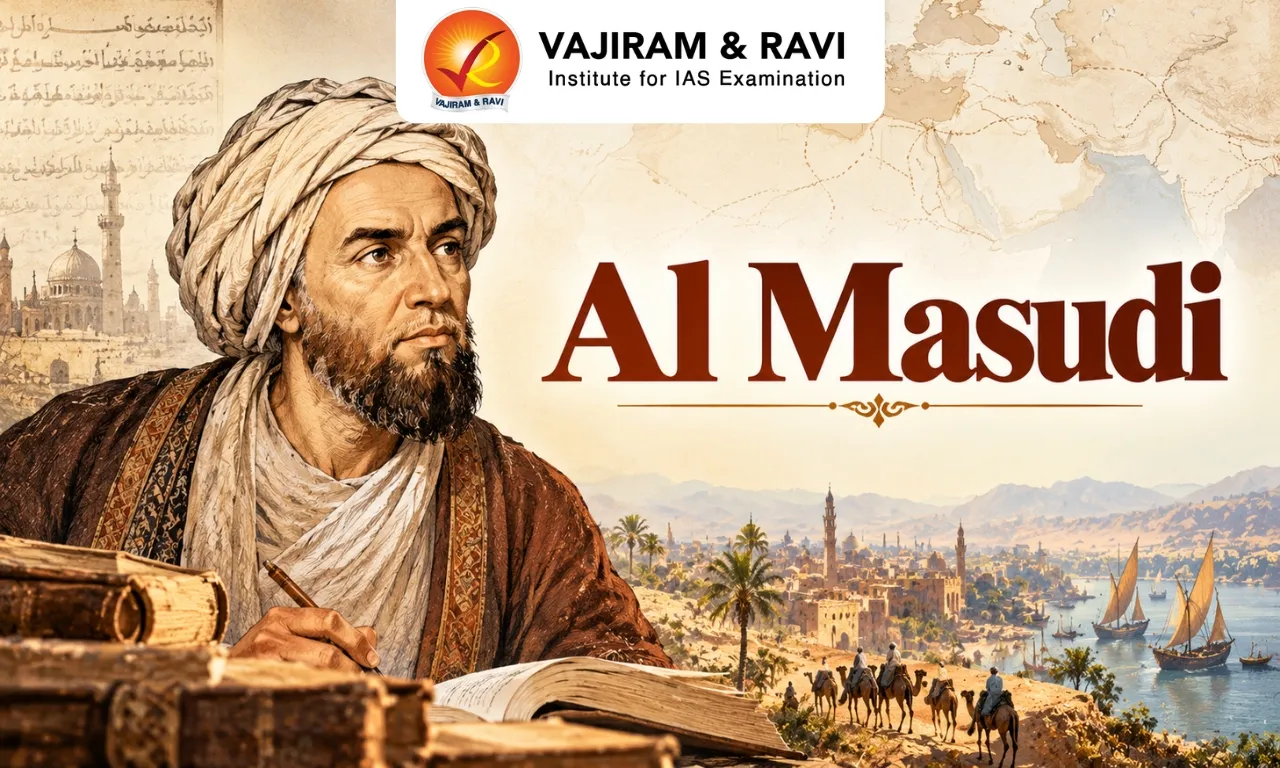
Al Masudi was a 10th-century Arab historian, geographer, and traveller from Baghdad who visited India around 915-16 CE. His writings, particularly Murūj al-dhahab, provide valuable information on India’s political conditions, trade, geography, religious practices and interactions with the Arab world.
Al-Masudi's account is especially useful for understanding the Gurjara-Pratihara kingdom, Gujarat’s overseas trade and India’s wider maritime connections. However, his writings combine personal observations with information from other sources, including anecdotes and traditional accounts. Therefore, details such as territorial extent and military strength need corroboration from other contemporary evidence.
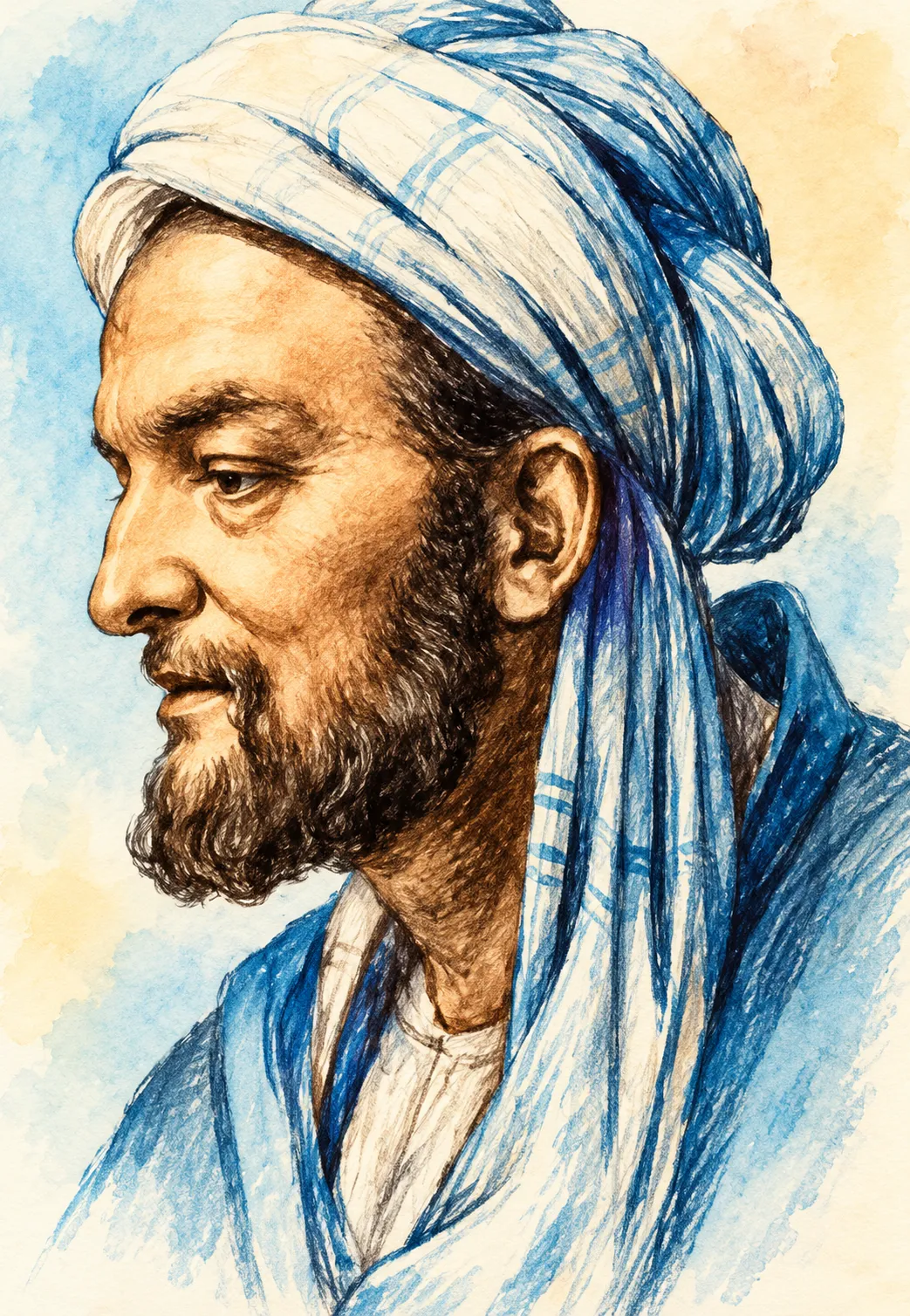
Al Masudi About
Al Masudi’s full name was Abu al-Hasan Ali ibn al-Husayn al-Masudi. Born in Baghdad in the late ninth century, he travelled extensively before spending his final years in Egypt. He died in 956 CE. As one of the foreign travellers who visited India, his writings provide valuable insights into early medieval Indian society and its wider regional connections.
- Extensive travels: He travelled across parts of Persia, India, East Africa and other regions, gathering information about different peoples, places and societies.
- Multidisciplinary scholarship: His writings covered political history, geography, religious beliefs, social customs, trade and natural phenomena.
- Historical approach: He combined historical narratives with geographical observations and comparisons between regions, rather than presenting events solely as a chronological account.
Al Masudi’s Visit to India
Al Masudi visited parts of India during the early 10th century, providing an external account of the region’s political landscape and geographical connections.
- Travel route: His reported itinerary included the Indus Valley, Punjab, Sindh and the western coast of India. Multan and Mansura are associated with his travels.
- Visit to Cambay: He is reported to have visited Cambay, present-day Khambhat in Gujarat, around 915–916 CE. Cambay was an important centre of western Indian maritime commerce.
- Political context: His travels occurred during a period when the Gurjara-Pratiharas, Palas and Rashtrakutas were major political powers in India. The precise identification of some rulers mentioned in his account remains uncertain.
- Regional observations: His writings discuss Indian kingdoms, religious communities, trade and geographical features, offering an external perspective on early medieval India.
- Wider itinerary: Al-Masudi travelled extensively across the Indian Ocean world. Some traditional accounts attribute visits to Sri Lanka and other distant regions to him, but the details are disputed.


Al Masudi Book Name
Al-Masudi authored several works on history and geography, drawing on his travels, observations and knowledge of earlier writings. His two major surviving works, Muruj al-Dhahab wa Ma'adin al-Jawahir and Kitab al-Tanbih wa al-Ishraf, provide insights into his understanding of the history and geography of the known world.
Muruj al-Dhahab wa Ma'adin al-Jawahir
Muruj al-Dhahab wa Ma'adin al-Jawahir, commonly translated as The Meadows of Gold and Mines of Gems, is Al-Masudi’s best-known surviving work. It combines historical narratives with geographical descriptions and observations about the societies of different regions.
- Contents: The work discusses historical events, geographical conditions, religions, political systems, cultures, and the customs of different peoples.
- Information on India: It provides information about Indian kingdoms, political rivalries, military organisation, religious communities and commercial connections with overseas regions.
- Sources: Al-Masudi drew upon his own travel experiences, personal observations, information obtained from other people, and material derived from earlier writings.
Kitab al-Tanbih wa al-Ishraf
Kitab al-Tanbih wa al-Ishraf is another major surviving work by Al-Masudi that summarises and revisits aspects of his historical and geographical knowledge. The work reflects his broad interest in the history and geography of the known world.
Al Masudi's Contribution to Historiography
Al-Masudi introduced an important geographical and interpretative dimension into Arabic historical writing by relating the environment of a region to the history of its inhabitants.
- Integration of History and Geography: He combined historical narratives with geographical descriptions because he believed that human history developed within a particular physical environment.
- Use of Travel Observations: He incorporated knowledge acquired through his extensive travels and personal observations into his historical accounts.
- Comparative method: He compared different regions and societies to identify similarities, differences, and relationships between human activities and physical conditions.
- Social and cultural history: His writings extended beyond rulers and wars to include information about religions, societies, commercial activities and cultural interactions.
Al Masudi’s Description of India
Al-Masudi’s writings describe India’s political kingdoms, religious communities, geographical features, and commercial connections. They provide an external perspective on early medieval India, although some details come from reports and geographical ideas that require cautious interpretation.
Political Landscape
Al Masudi’s account presents India as a region comprising several kingdoms with distinct political interests, languages, and religious traditions.
- Powerful Kingdoms: His account refers to the Gurjara-Pratiharas and the ruler known as Balhara, associated with the Rashtrakutas.
- Political Rivalries: The wider historical context included competition among the Gurjara-Pratiharas, Palas and Rashtrakutas, particularly over Kannauj.
- Geographical extent: His geographical writings refer to regions such as Sind, Khurasan and Tibet, as well as Zabaj and its Maharaja in the region between India and China. These references reflect medieval geographical conceptions.
Gurjara-Pratihara Dynasty
Al-Masudi’s account provides information about the territorial extent and military reputation of the Gurjara-Pratiharas, one of the major powers of early medieval northern India.
- Name of the Kingdom: He referred to the Gurjara kingdom as al-Juzr, an Arabic rendering associated with Gurjara. He recorded the ruler’s name as Baura. Its identification with Mihira Bhoja, who used the title Adivaraha, remains uncertain.
- Territorial Extent: The account reportedly attributes around 180,000 settlements and a territory extending approximately 2,000 km in both length and breadth to the kingdom. These figures should be treated as reported estimates.
- Military Organisation: Al-Masudi is reported to have described four army divisions, each supposedly comprising 700,000-900,000 men. These figures are unusually large and should not be treated as verified troop counts.
- Military Campaigns: His account refers to conflicts involving neighbouring powers, including Multan and the Rashtrakutas. The precise deployment of individual army divisions requires verification.
- The account reportedly mentions approximately 2,000 war elephants and describes the kingdom’s cavalry as among the finest in India.
Rashtrakuta Dynasty
Al Masudi described the Rashtrakuta ruler using the designation “Balhara,” commonly associated with the royal title Vallabharaja. His account presents the Rashtrakutas as a powerful dynasty whose ruler enjoyed considerable prestige among Indian kings. His account refers to the respect shown to the ruler and his representatives.
Religious Communities and Social Relations
Al-Masudi reports that Muslim communities enjoyed considerable religious security in the kingdom of the Balhara. He mentions mosques and congregational prayers, providing evidence of established Muslim religious life in parts of India during the tenth century.
Trade, Ports and Maritime Connections
Al-Masudi’s writings provide information about Indian ports, valuable commodities and maritime routes connecting the subcontinent with West Asia and other regions.
- Cambay (Khambhat): Cambay in Gujarat was an important centre of western Indian maritime commerce and is associated with Al-Masudi’s visit around 915–916 CE.
- Al-Masudi described a broad estuary comparable to the Nile or Tigris. His account mentions settlements, cultivated fields, gardens, palm trees, coconut trees, and birds in the surrounding landscape.
- Malabar Coast: Arabic geographical accounts describe the Malabar Coast as an important pepper-producing region connected to Indian Ocean trade. Al-Masudi's writings form part of the broader Arabic geographical tradition documenting India's overseas commercial connections.
- The expression Balad-i Filfil, meaning the “land of pepper,” is associated with descriptions of Malabar in Arab geographical accounts.
- Commercial Commodities: Arab geographical accounts described India as a source of valuable goods that attracted merchants from overseas regions. These accounts associated India with spices, fragrant woods, and textiles.
- Commercial exchange contributed to interactions between Indian communities and traders from West Asia and other parts of the Indian Ocean world.
Geography and Natural Phenomena
Al Masudi combined geographical descriptions with observations about the natural environment, climatic conditions and the societies inhabiting different regions.
- The Ganges: He referred to the Ganges as Jinjis. His reported description of the river's source and course reflects medieval geographical understanding rather than modern geography.
- Kashmir: His geographical descriptions include mountainous regions and their role in shaping political and social conditions. Precise numerical claims about towns and villages require verification.
- India and Italy: Some secondary accounts attribute to him a comparison between India and Italy, including a reference to Rome as Benares on the Tiber.
- Winds and windmills: His geographical writings are associated with discussions of periodic winds in regions identified in modern summaries as Herkend and with windmills in Sajistan.
- Oceanography: The supplied notes attribute to him the belief that the Atlantic and Indian oceans were connected and the description of the Atlantic as the “Dark-Green Sea.” These should be understood as historical geographical ideas.
Al Masudi Account Limitations
Al Masudi's writings are valuable historical sources, but they must be examined critically because they combine personal observations with information obtained from other sources.
- Mixed Sources: His writings combine personal travel observations, reports received from others, and information derived from earlier works, making it necessary to distinguish between different kinds of evidence.
- Difficulty of Verification: Some reports, especially those concerning distant regions and military strength, cannot be independently verified from his account alone.
- Inherited Theories: He sometimes incorporated cosmographical theories from earlier writings rather than relying exclusively on direct observation.
- Possibility of Exaggeration: His reports concerning territorial extent, military strength and war elephants should be compared with other historical evidence before being accepted as precise figures.
- Incomplete Geographical Coverage: His account does not provide a comprehensive description of every region, community or political development in the Indian subcontinent.

 Last updated on Oct, 2026
→ UPSC 2027 Notification will be released on 13 January 2027 at upsconline.nic.in.
→ Check Nobel Prize 2026 Winners List here.
→ Download PIB PRiSM Monthly Magazine 2026 here.
→ Check UPSC Monthly Current Affairs Magazine The Recitals here.
→ Check out the latest UPSC Syllabus here.
→ Download UPSC Model Answers for Mains 2026
→ UPSC Mains Question Paper 2026 is out now for Essay & GS Paper 1, 2, 3 & 4.
→ UPSC Calendar 2027 has been released.
→ Enroll in Vajiram & Ravi’s UPSC Mains Test Series 2027 for structured answer writing practice, expert evaluation, and exam-oriented feedback.
→ Join Vajiram & Ravi’s UPSC Mentorship Program 2027 for personalized guidance, strategy planning, and one-to-one support from experienced mentors.
→ Go through the UPSC Mains Previous Year Papers to enhance your preparation.
→ UPSC has released UPSC Toppers List 2025 with the Civil Services final result on its official website.
→ Also check Best UPSC Coaching in India
Al Masudi FAQs
Q1. Why is Al-Masudi famous?+
Q2. Did Al-Masudi visit India?+
Q3. Which book was written by Al-Masudi?+
Q4. Who is the father of Arab geography?+
Q5. Al-Masudi came to India during the reign of which dynasty?+
Tags: al masudi quest upsc ancient history notes