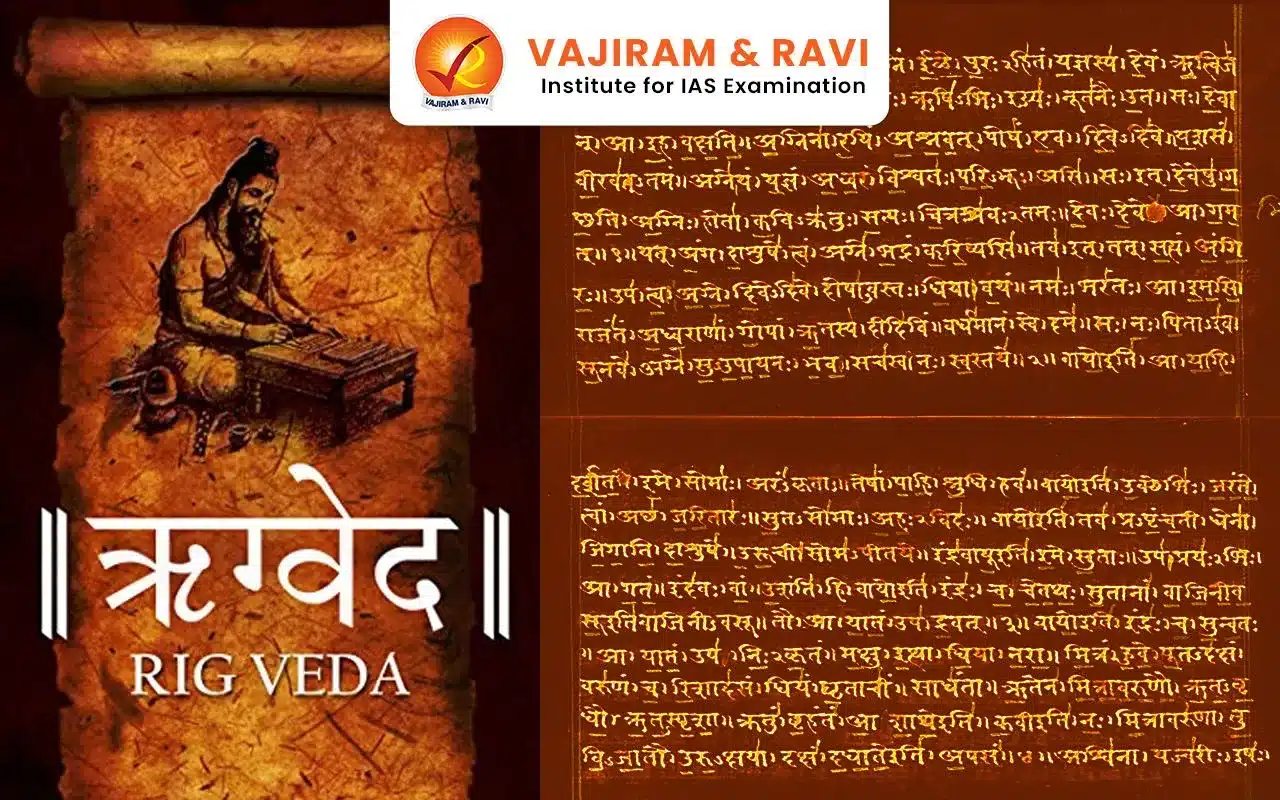
The Rigveda is the oldest and most sacred Hindu scripture, composed in Vedic Sanskrit around 1500-1000 BCE. It contains 1,028 hymns and 10,600 verses organised into 10 books (mandalas). The Rigveda explores themes such as ritual and sacrifice, cosmology and creation, and the role of deities like Indra, Agni, and Soma.
The Rigveda provides insights into early Vedic society, which was pastoral and agrarian, with a semi-nomadic tribal structure and a patriarchal family system. The text also touches upon the polity, with a tribal chief at the centre and the emergence of monarchy in later Vedic periods. Recognising its universal value, UNESCO has listed the Rigveda as part of the World Heritage.
Rig Veda Origin
The Rig Veda is an ancient collection of Vedic Sanskrit hymns. It is one of Hinduism's four sacred texts, a part of the Vedic Literature, and ranks among the world's oldest scriptures. Originating as a collection of oral hymns, it forms the foundational pillar of early Vedic culture and philosophy.
- Composition period: The hymns that comprise the Rigveda are estimated to have been composed over a vast period from ~1500 BCE to 1000 BCE.
- However, the compilation into the canonical text likely occurred between 1200 BCE and 900 BCE.
- Geographical Region: The Rig Veda was composed in the Sapta Sindhava region, meaning the "land of seven rivers," which spans parts of modern-day northwestern India and Pakistan.
- Oral tradition: Hymns were preserved through generations by Brahmin families using advanced oral tradition techniques, which included mnemonic devices, lyrical composition patterns, pitching accents, and melodic recitation.
- Rishi families: Prominent families of ṛiṣhis (sages) are credited with composing the hymns.
- These ṛiṣhi clans include Kashyapa, Atri, Bharadwaja, Vishwamitra, Gautama, Jamadagni, and Vasishta.
- Associated texts: These texts are accompanied by Brahmanas and Upanishads, which the same ten Rishi families authored over centuries.
Vedic Texts
The Rig Veda is accompanied by Vedic texts composed to explain its complex hymns, guide sacrificial rituals, and explore its deeper, ultimate philosophical and metaphysical meanings.
- Samhitas: This is the foundational text of the Rig Veda itself. It comprises the original 1,028 metric hymns (suktas) dedicated to deities like Indra and Agni, which form the basis for all subsequent interpretations.
- Brahmanas: Written in prose, these texts explain the execution, symbolism, and procedural rules of sacrifices. Ex: Aitareya Brahmana.
- Aranyakas: Transitionary treatises emphasising internal meditation, symbolism, and secret rituals meant for hermits living in isolation.
- Upanishads: The culmination of Vedic thought (Vedanta), exploring the nature of Atman (Self) and Brahman (Ultimate Reality).
Rigvedic Sakhas/Schools
Rigvedic schools, known historically as shakhas (branches or recensions) and preserved through traditional gurukulas or veda patasalas, represent the ancient oral lineages that memorised and transmitted the Rig Veda.
- Out of the original five shakhas (recensions), only two have survived: the Sakalya and Baskala.
|
Rig Veda |
|||
|
Sakhas/Schools |
Description |
||
|
Sakalya |
Most prominent and complete surviving school; associated with the Aitareya Brahmana, Aitareya Aranyakas and Aitareya Upanishads |
||
|
Baskala |
Early school containing supplementary hymns (Khilani); associated with the Kaushitaki Brahmana, Kaushitaki Aranyakas, Kaushitaki Upanishads |
||
|
Asvalayana |
Known for extensive ritual and domestic literature (Shrauta Sutra and Grhya Sutra). |
||
|
Shankhayana |
Traditional branch historically linked to specialized ritual texts and rare surviving practices. |
||
|
Mandukayana |
One of the early foundational phonetic and recitation schools of the Rigvedic tradition. |
||
Rig Veda Structure and Mandalas
The Rigveda is organized into 10 mandalas. Each mandala is further divided into suktas (hymns) and verses. In total, the Rigveda contains around 1,028 suktas and over 10,600 verses. The mandalas are not arranged chronologically, but rather by length and content.
Rig Veda Mandalas
The Rigveda is divided into 10 major books called mandalas. Within the books, the text breaks down into smaller structural units like Suktas and Hymns. The Rigveda’s oldest core consists of Mandalas II through VII (The Family Books), with Mandala VI featuring the most archaic language. These ancient books were composed first by specific sage lineages, while Mandalas VIII and IX were added later, and Mandalas I and X form the youngest layers.
|
Mandala |
Hymns |
Decription |
|
Mandala 1 |
191 Hymns |
- Dedicated to Agni, Indra, Varuna, Mitra, and the Ashvins - Contains the philosophical Riddle Hymn on cosmic unity. |
|
Mandala 2 |
43 Hymns |
- Focuses primarily on Agni and Indra. - Oldest core "Family Book." |
|
Mandala 3 |
62 Hymns |
- Dedicated to Agni, Indra, and the Vishvedevas. - Includes the Gayatri Mantra |
|
Mandala 4 |
58 Hymns |
- Dedicated to Agni, Indra, and the Rbhus (divine craftsmen). - Attributed to Vāmadeva Gautama |
|
Mandala 5 |
87 Hymns |
- Addresses Agni, Indra, Vishvedevas, Maruts, and Mitra-Varuna. - Mainly attributed to the Atri clan |
|
Mandala 6 |
75 Hymns |
- Dedicated to Agni, Indra, and other deities. -Includes hymns dedicated to River Saraswati. - Attributed to Bharadvaja and the Bārhaspatya family of Angirasas |
|
Mandala 7 |
104 Hymns |
- Dedicated to Agni, Indra, Varuna, and the Vishvedevas. - Contains references to the Dasarajna (Battle of Ten Kings). - Attributed to Rishi Vasiṣṭha Maitravaruṇi and his family |
|
Mandala 8 |
103 Hymns |
- Dedicated to various gods (Indra, Agni, Ashvins). - Includes 11 apocryphal Vālakhilya hymns. - Mainly attributed to Kanva and Angiras families. |
|
Mandala 9 |
114 Hymns |
- Exclusively devoted to Soma Pavamana (purified Soma potion) used in Vedic rituals. |
|
Mandala 10 |
191 Hymns |
- Later linguistic additions. - Contains Nadistuti Sukta (hymn praising rivers) and Nasadiya Sukta (speculations on creation). |
Rig Veda Deities
Rigvedic gods are the personified forces of nature and cosmic order worshipped through sacred hymns in the Rigveda. Early books (2–9) focus on praising natural forces and deities like Indra, Agni, and Soma. The 9th book is dedicated entirely to Soma.
|
Maṇḍala |
Deities |
Key Ṛṣis |
|
Mandala 1 |
Agni, Indra |
Madhuchchhandas, Medhatith, Gotama and others |
|
Mandala 2 |
Agni, Indra |
Gṛitasamada and His Family |
|
Mandala 3 |
Agni, Indra |
Vishvamitra and His Family |
|
Mandala 4 |
Agni, Indra |
Vamadeva and His Family |
|
Mandala 5 |
Soma |
Atri and His Family |
|
Mandala 6 |
Agni, Soma |
Bharadvaja and His Family |
|
Mandala 7 |
Agni, Indra |
Vashiṣṭha and His Family |
|
Mandala 8 |
Various |
Kanva, Angriva and their family |
|
Mandala 9 |
Soma |
Kaśyapa, Soma Devata and others |
|
Mandala 10 |
Agni, Indra |
Vimada, Indra, Shachi and others |


Rig Veda Society in the Rigvedic Age
The Rigvedic Age emerged in the Indian subcontinent between 1500 and 1000 and laid the foundation of early Indian civilisation. Reconstructed through the Rig Veda, this era featured a semi-nomadic, pastoral society driven by tribal kinship.
Rigvedic Society
Rigvedic society was a kinship-based patriarchal structure transitioning from an egalitarian tribal lifestyle toward initial social divisions.
- Kinship and Tribe: Tribal identity was central; the jana (tribe) comprised clans (vis) residing in gramas (villages).
- Family Unit: The patriarchal joint family (griha) was headed by the grihapati. Preferential desire existed for male heirs due to martial needs.
- Status of Women: Women held a respectable position, attended assemblies (sabhas, vidhatas), married at 16–17 years, and could remarry as widows.
- Social Stratification: Equal initially, divisions emerged later. The Purusha Sukta introduced the four-fold Varna System (Brahmanas, Kshatriyas, Vaishyas, Shudras) at the era’s end.
- Economy: The economy was dominated by pastoralism (wealth measured in cows) and agriculture (cultivating barley and wheat).
Rigvedic Polity
Rigvedic polity was a militaristic, tribal-based organisation centred around a hereditary chief and active popular assemblies.
- Tribal Chief: The ruler, or rajan (also called gopa or gopati), protected the tribe, secured cattle, and shared war booty.
- Assemblies: Popular assemblies like the sabha (elites), samiti (general folk), and vidhata (tribal assembly) performed military and religious functions.
- Key Officials: The king was assisted by a purohita (spiritual advisor), senani (army chief), and Vrajapati (territorial leader).
- Taxation: No formal taxation officers existed; people offered voluntary tributes called bali.
- Warfare: Clashes (gavishthi) occurred primarily over cattle, using bows, arrows, and horse-drawn chariots.
Rigvedic Religion
The Rigvedic religion was a naturalistic, polytheistic system where natural phenomena were personified as divinities and appeased through sacrifices.
- Pantheon of Gods: Prominent male deities included Indra (Purandara, the fort destroyer), Agni (sacrificial intermediary), and Varuna (upholder of natural order).
- Goddesses: Ushas (dawn), Aditi, Prithvi, and Sinivali were worshipped, though female deities held less prominence.
- Rituals and Sacrifices: Religious worship focused on chanting hymns and performing sacrifices to secure cattle, children, and victory.
- Soma Cult: Soma, the god of plants, was central to rituals, with many hymns dedicated to preparing the sacred intoxicating drink.
- Nature Worship: Divinities personified natural forces like the sun, moon, rivers, wind, and rain.
Rig Veda Significance
The Rigveda is considered one of the most sacred texts of Hinduism, and its significance extends beyond its historical and cultural importance.
- Philosophical and Spiritual Significance: The Rigveda is primarily concerned with the worship of Hindu deities such as Surya, Indra, Rudra, Vayu, Agni, Vishnu, and others.
- The Rigveda mentions several female deities, with Ushas, the dawn goddess, being the most celebrated, along with Aditi, Prithvi, Rathri, Sarasvathi, and Vageshvari (Vac), but none are central to the text.
- The hymns and stories within the Rigveda reflect the Hindu philosophy and belief system.
- They were used for ritualistic purposes in ceremonies like marriages and to ward off illness and negativity.
- The text addresses issues of morality and righteous societal behaviour, tackling topics like gambling and good governance.
- Geographical and Cultural Significance: The Rigveda contains significant references to the geographical features of the Indian subcontinent, including mentions of rivers, seasons, and other natural phenomena.
- The instructions and teachings of the Rigveda influenced life in the subcontinent for centuries, outlining the duties of the different social classes and emphasising the importance of religion, worship, sacrifices, and religious rituals.
- Cultural Legacy: The Rigveda and its scriptures remain deeply rooted in Hindu culture, with many verses and prayers still recited on auspicious occasions. It is one of the world's oldest religious texts still in use today, with an impact on Hinduism and Indian culture.
- UNESCO: The Rigveda manuscripts have been included in UNESCO's Memory of the World Register, a compendium of documentary heritage of exceptional value, recognising their global significance and the need to preserve this invaluable cultural treasure.
Rig Veda UPSC PYQs
Q1: Underline the changes in the field of society and economy from the Rig Vedic to the Later Vedic period. (UPSC Mains 2024)
Q2: What are the main features of Vedic society and religion? Do you think some of the features are still prevailing in Indian society? (UPSC Mains 2023)
Q3. Consider the following statements: (UPSC Prelims 2024)
- There are no parables in Upanishads.
- Upanishads were composed earlier than the Puranas.
Which of the statements given above is/are correct?
(a) 1 only
(b) 2 only
(c) Both 1 and 2
(d) Neither 1 nor 2
Ans: (b)
Q4: With reference to the difference between the culture of Rigvedic Aryans and Indus Valley people, which of the following statements is/are correct? (UPSC Prelims 2017)
- Rigvedic Aryans used the coat of mail and helmet in warfare whereas the people of Indus Valley Civilization did not leave any evidence of using them.
- Rigvedic Aryans knew gold, silver and copper whereas Indus Valley people knew only copper and iron.
- Rigvedic Aryans had domesticated the horse whereas there is no evidence of Indus Valley people having been aware of this animal.
Select the correct answer using the code given below:
(a) 1 only
(b) 2 and 3 only
(c) 1 and 3 only
(d) 1, 2 and 3
Ans: (c)
Q5: The national motto of India, 'Satyameva Jayate' inscribed below the Emblem of India is taken from: (UPSC Prelims 2014)
(a) Katha Upanishad
(b) Chandogya Upanishad
(c) Aitareya Upanishad
(d) Mundaka Upanishad
Ans: (d)

 Last updated on Oct, 2026
→ UPSC 2027 Notification will be released on 13 January 2027 at upsconline.nic.in.
→ Check Nobel Prize 2026 Winners List here.
→ Download PIB PRiSM Monthly Magazine 2026 here.
→ Check UPSC Monthly Current Affairs Magazine The Recitals here.
→ Check out the latest UPSC Syllabus here.
→ Download UPSC Model Answers for Mains 2026
→ UPSC Mains Question Paper 2026 is out now for Essay & GS Paper 1, 2, 3 & 4.
→ UPSC Calendar 2027 has been released.
→ Enroll in Vajiram & Ravi’s UPSC Mains Test Series 2027 for structured answer writing practice, expert evaluation, and exam-oriented feedback.
→ Join Vajiram & Ravi’s UPSC Mentorship Program 2027 for personalized guidance, strategy planning, and one-to-one support from experienced mentors.
→ Go through the UPSC Mains Previous Year Papers to enhance your preparation.
→ UPSC has released UPSC Toppers List 2025 with the Civil Services final result on its official website.
→ Also check Best UPSC Coaching in India
Rig Veda FAQs
Q1. What is Rig Veda?+
Q2. What does the Rigveda talk about?+
Q3. Who wrote the Rig Veda?+
Q4. Is the Rigveda older than the Bible?+
Q5. Is Rigveda 6000 years old?+
Tags: quest rig veda UPSC Art and Culture Notes