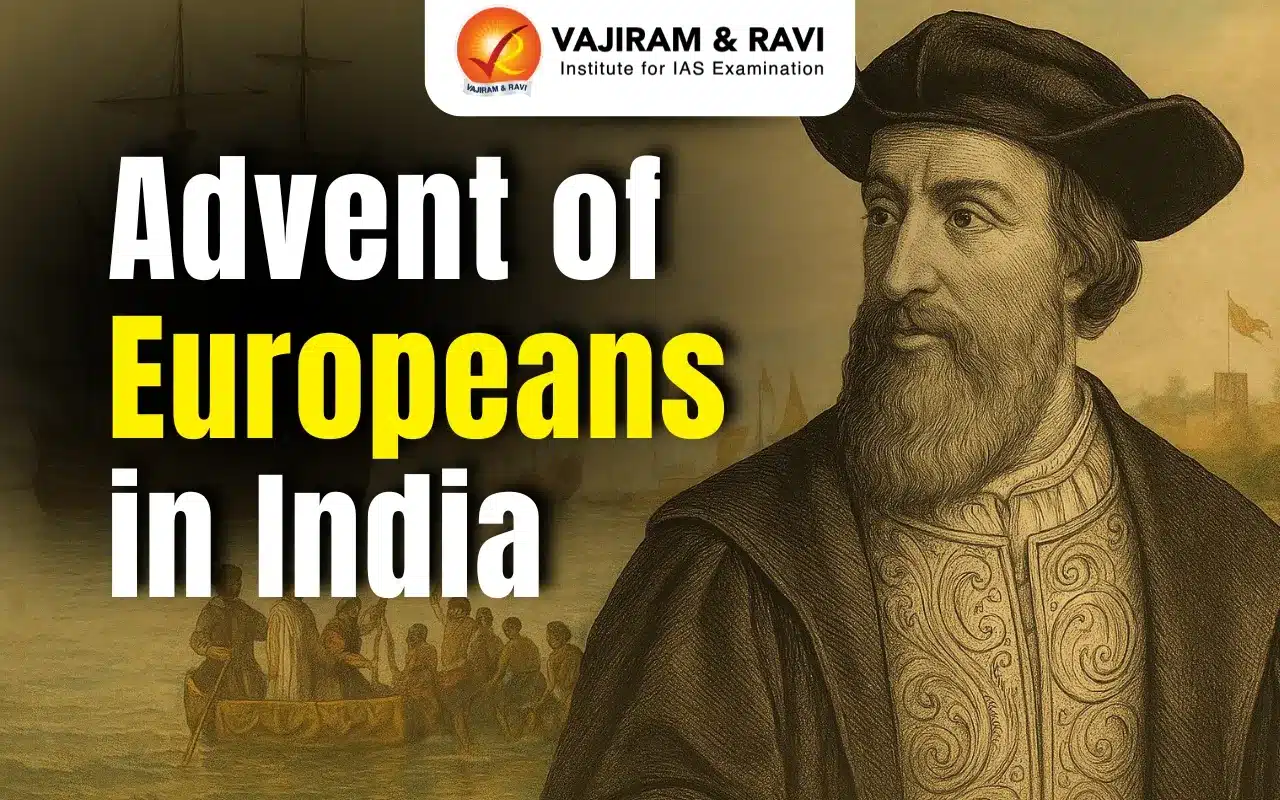
The advent of Europeans in India began in the late 15th century with the arrival of the Portuguese, led by Vasco da Gama in 1498. They were followed by other European powers like the Dutch, British, and French, each aiming to establish trade and expand their influence. Initially focused on commerce, especially in spices, they later sought territorial control.
Over time, rivalry among these powers increased, eventually leading to British dominance in India by the mid-18th century. The establishment of trading posts and colonies paved the way for a new chapter in India's history, shaped by global interactions and the eventual ascendance of British colonial rule.
Advent of Europeans in India Background
The advent of Europeans in India began with Vasco da Gama’s arrival in 1498, opening sea trade routes and leading to European powers competing for control, trade dominance, and eventual colonial influence in the Indian subcontinent.
- Arrival of Vasco da Gama: It began with the arrival of Portuguese explorer Vasco da Gama in 1498, establishing a direct sea route between Europe and India. This pivotal moment opened doors to European colonialism and trade domination in the subcontinent.
- Other Europeans: The Portuguese, followed by other European powers, sought to control the lucrative spice trade, leading to the establishment of trading posts and fortifications along the Indian coastline.
- Impact: Their arrival brought about cultural exchanges, conflicts with local rulers, and the reshaping of Indian society. This period laid the foundation for centuries of European influence and colonial rule in India.
Advent of Europeans in India Map
The map of the arrival of Europeans in India highlights the arrival and major settlements of the Portuguese, Dutch, English, Danish, and French, showing their principal trading centres and areas of influence.

Factors contributing to the advent of Europeans in India included the search for new trade routes, economic interests in Indian spices, technological advancements, missionary zeal, political rivalries among European powers, and the ambition to build overseas empires.
- Search for Direct Sea Route: The fall of Constantinople in 1453 and subsequent Ottoman control over traditional land routes to the East forced Europeans to seek a direct maritime route to India, bypassing Arab and Italian middlemen and reducing the cost of valuable commodities like spices and textiles.
- Technological Advancements: Innovations in navigation (such as the compass and astrolabe), shipbuilding, and the use of gunpowder-equipped ships enabled longer, safer, and more profitable sea voyages, making exploration and overseas trade feasible for European powers.
- Economic Ambitions: The immense wealth of India, especially its spices, textiles, and precious stones, attracted European traders eager to maximise profits and meet rising demand in Europe, which had grown due to economic revival and urbanisation.
- Spirit of Renaissance and Adventure: The Renaissance era in Europe fostered a spirit of curiosity, adventure, and a desire for glory, motivating explorers to discover new lands and routes and spread their influence globally.
- Religious and Political Motives: European powers, particularly Portugal and Spain, were motivated by a zeal to spread Christianity and expand their political influence, supported by strong monarchs and papal decrees like the Treaty of Tordesillas.
- Emergence of Joint Stock Companies: The rise of joint stock companies provided the necessary capital, risk-sharing, and organisational structure for sustained overseas ventures, enabling European nations to establish and maintain trading posts and colonies in India.


Advent of Europeans in India Chronological Order
The chronological order of European powers arriving in India for trade begins with the Portuguese in 1498 and concludes with the French in 1664.
- Portuguese (1498): On May 20, 1498, explorer Vasco da Gama arrived in Calicut (Kozhikode), Kerala, establishing the first direct sea route between Europe and India. They established their first plant in Cochin around 1503.
- Dutch (1602): The Netherlands' United East India Company (VOC) was formed and landed in Masulipatnam in 1605, where they established their first trade post and factory.
- English / British (1600/1608): In 1600, the British East India Company was established, and their representatives arrived in Surat to trade, obtaining legal license for a factory following the Battle of Swally in 1612.
- Danes (1616): In 1620, the Danish East India Company built a settlement in Tranquebar (Tharangambadi), Tamil Nadu.
- French (1664): The French East India Company was established under Louis XIV in 1664, setting up their first factory in Surat in 1668.
Advent of Europeans in India Portuguese
Portuguese in India were the first Europeans to establish a colonial presence, beginning with Vasco da Gama’s arrival in 1498. They set up trading posts, mainly in Goa, and controlled coastal trade routes for over a century.
Factors behind the Portuguese Voyage to India
After the decline of the Roman Empire and the fall of Constantinople in 1453, the Arabs established dominance in Egypt and Persia, controlling the trade routes to India. The Europeans lost direct contact with India and the easy accessibility to Indian commodities.
- Spirit of the Voyage: In the 15th century, there was a growing eagerness in Europe for adventurous sea voyages to reach the East, driven by the spirit of the Renaissance and advancements in shipbuilding and navigation.
- Division of the Non-Christian World: The Treaty of Tordesillas(1494) divided the non-Christian world between Portugal and Spain, granting Portugal the eastern territories and Spain the western territories. This set the stage for Portuguese incursions into the waters around India.
Portuguese Governors
Portuguese governors played a key role in establishing and expanding Portuguese power in India. Vasco da Gama opened the sea route, while Francisco de Almeida enforced the Blue Water Policy to dominate trade. Alfonso de Albuquerque expanded control with strategic conquests like Goa and abolished sati. Nino da Cunha shifted the capital to Goa and extended influence to Gujarat and Bengal.
Decline of Portuguese in India
Portuguese in India began to lose their influence by the 18th century due to rising regional powers like the Marathas, who captured key territories like Salsette and Bassein in 1739. Their rigid religious policies, including forced conversions and hostility towards Muslims, triggered widespread resentment and weakened their political and commercial standing in India.
Advent of Europeans in India Dutch East India Company
Dutch East India Company began its journey as part of the Dutch pursuit of expanding their commercial interests in the East. In 1602, the States-General of the Netherlands unified several smaller trading ventures into a single powerful entity—the Dutch East India Company (VOC).
- Dutch East India Company was given significant powers, including the right to wage wars, sign treaties, acquire land, and build forts, making it a sovereign power in foreign territories.
- The Dutch first secured control over Masulipatnam in 1605 and later established a significant trading post at Pulicat in 1610, which became the centre of their operations in India.
Advent of Europeans in India English East India Company
British East India Company was established in 1599 by a group of English merchants called the 'Merchant Adventurers' who aimed to participate in the profitable Eastern trade, which was then dominated by the Portuguese.
- On December 31, 1600, Queen Elizabeth I granted a royal charter to this group, officially naming it the ‘Governor and Company of Merchants of London trading into the East Indies.’
- This charter gave the company exclusive trading rights with the East Indies, initially for fifteen years.
- However, this trading monopoly was later extended without a fixed time limit, allowing the company to expand its operations and influence in Asia over the coming centuries.
Foothold in West and South
In 1609, Captain Hawkins arrived at the court of Jahangir in an attempt to establish a factory at Surat, but it was unsuccessful due to Portuguese opposition. However, the English began trading at Masulipatnam in 1611 and established a factory there in 1616.
- Battle with Portuguese: In 1612, Captain Thomas Best defeated the Portuguese in a sea Battle off Surat, leading to Jahangir granting permission for an English factory in Surat in 1613. Peace was established with the Portuguese, and an Anglo-Dutch compromise allowed the English to trade without interference.
- Gift of Bombay: Bombay was gifted to King Charles II in 1662 and later given to the East India Company in 1668, becoming their headquarters in 1687.
- Madras: The English also obtained trading privileges from the Sultan of Golconda and built a fortified factory at Madras in 1639, which became the headquarters of English settlements in South India.
Foothold in Bengal
Bengal, a prosperous and significant province of the Mughal Empire, attracted English merchants due to its trade and commercial opportunities. In 1651, Shah Shuja, the subahdar of Bengal, granted the English permission to trade in Bengal in exchange for an annual payment.
- Request for a Fortified Settlement: Seeking a fortified settlement, William Hedges, the first agent and governor of the Company in Bengal, appealed to Shaista Khan, the Mughal governor, but hostilities ensued.
- Settlement at Sutanuti: In 1686, Hooghly was sacked by the Mughals, leading to English retaliation. After negotiations, Job Charnock signed a treaty with the Mughals in 1690, allowing the English to establish a factory at Sutanuti.
- Fort William: The English obtained permission to buy the zamindari of Sutanuti, Gobindapur, and Kalikata in 1698, and the fortified settlement was named Fort William in 1700, becoming the seat of the eastern presidency (Calcutta).
Advent of Europeans in India Danish
Danish East India Company, also known as the Danish Asiatic Company, was established in 1616 and 1620; they founded a factory at Tranquebar near Tanjore, on the eastern coast of India.
- Their principal settlement was at Serampore near Calcutta.
- The Danish factories, which were not important at any time, were sold to the British government in 1845.
- The Danes are better known for their missionary activities than for commerce.
Advent of Europeans in India French
French in India arrived in the 17th century, establishing trade posts in places like Pondicherry and Chandernagar. They competed with British and Dutch powers but faced challenges. Their cultural impact included agricultural and architectural contributions, and they held territories until 1954.
- Formation: Established in 1664 under King Louis XIV to compete in Asian trade.
- Trade in India: Secured rights from Mughal Emperor Aurangzeb, setting up posts in Surat, Masulipatam, Chandernagar, and Pondicherry for trading textiles, spices, and saltpetre.
- Cultural Impact: Introduced crops like cauliflower and peas, contributed to architecture and education, and influenced local culture.
- Challenges: Struggled against the British and Dutch East India Companies due to limited French government support.
- Military Role: Allied with Indian rulers in the Carnatic Wars (1746–1763) but lost key battles like Wandiwash (1760) to the British.
- Territorial Control: Controlled regions like Pondicherry and Mahe, ruling them as French India until integration with India in 1954.
Reasons for English Success Against Other Europeans
Reasons for English success against other Europeans in India include their well-structured East India Company, naval superiority, industrial advancements, disciplined military, stable government, and less religious zeal, allowing for more efficient colonisation and control.
- Well-structured: The English East India Company, unlike its counterparts, was controlled by a board of directors elected annually, with shareholders exercising considerable influence.
- Naval Superiority: The Royal Navy of Britain was the largest and most advanced in Europe, having achieved notable victories such as the defeat of the Spanish Armada and the French at Trafalgar.
- Industrial Revolution: England was at the forefront of the Industrial Revolution, benefiting from inventions and advancements in textiles, metallurgy, steam power, and agriculture.
- Military Skill and Discipline: British soldiers were highly disciplined and well-trained. British commanders demonstrated strategic prowess and implemented innovative tactics, which, combined with technological advancements, allowed smaller groups of British fighters to defeat larger armies.
- Stable Government: Compared to other European nations experiencing periods of political upheaval, Britain enjoyed relatively stable governance with efficient monarchs. France, in particular, faced the turbulent period of the French Revolution and the Napoleonic Wars, weakening its position and forcing it to align with Britain.
- Lesser zeal for religion: Unlike Spain, Portugal, and the Dutch, Britain displayed less zeal in spreading Christianity. This more tolerant approach made British rule more acceptable to the local population in India.
- Use of Debt Market: Britain successfully utilised the debt markets to fund its wars, particularly through the establishment of the Bank of England.
Advent of Europeans in India Consequences
The arrival of European trading powers transformed India’s trade, economy, political landscape and society. What began as commercial contact gradually developed into European territorial ambitions, culminating in British political dominance.
- Drain of Wealth: Under expanding British control, unequal trade practices and the transfer of Indian revenues and resources contributed to the outflow of wealth from India.
- Decline of Traditional Industries: Competition from machine-made British goods, especially cotton textiles, weakened several traditional Indian handicrafts and weaving centres during British rule.
- Loss of Life and Famines: Colonial economic policies, revenue demands and the export-oriented structure of the economy contributed to severe hardships and recurring famines, particularly during British rule.
- Rise of Nationalism: Colonial exploitation, Western education and new political ideas contributed to the emergence of political consciousness and later organised nationalism.
- Christian Missionary Activities: European powers, particularly the Portuguese, promoted Christian missionary activities, contributing to religious and cultural interactions.
Advent of Europeans in India UPSC PYQs
Q1: Why did the armies of the British East India Company – mostly comprising Indian Soldiers – win consistently against the more numerous and better-equipped armies of the then-Indian rulers? Give reasons. (UPSC Mains 2022)
Q2: Who among the following rulers of medieval Gujarat surrendered Diu to the Portuguese? (UPSC Prelims 2023)
a) Ahmad Shah
b) Mahmud Begarha
c) Bahadur Shah
d) Muhammad Shah
Ans: (c)
Q3: In the first quarter of the seventeenth century, in which of the following was/were the factory/factories of the English East India Company located? (UPSC Prelims 2021)
- Broach
- Chicacole
- Trichinopoly
Select the correct answer using the code given below.
(a) 1 only
(b) 1 and 2 only
(c) 3 only
(d) 2 and 3 only
Ans: (a)

 Last updated on Oct, 2026
→ UPSC 2027 Notification will be released on 13 January 2027 at upsconline.nic.in.
→ Check Nobel Prize 2026 Winners List here.
→ Download PIB PRiSM Monthly Magazine 2026 here.
→ Check UPSC Monthly Current Affairs Magazine The Recitals here.
→ Check out the latest UPSC Syllabus here.
→ Download UPSC Model Answers for Mains 2026
→ UPSC Mains Question Paper 2026 is out now for Essay & GS Paper 1, 2, 3 & 4.
→ UPSC Calendar 2027 has been released.
→ Enroll in Vajiram & Ravi’s UPSC Mains Test Series 2027 for structured answer writing practice, expert evaluation, and exam-oriented feedback.
→ Join Vajiram & Ravi’s UPSC Mentorship Program 2027 for personalized guidance, strategy planning, and one-to-one support from experienced mentors.
→ Go through the UPSC Mains Previous Year Papers to enhance your preparation.
→ UPSC has released UPSC Toppers List 2025 with the Civil Services final result on its official website.
→ Also check Best UPSC Coaching in India
Advent of Europeans in India FAQs
Q1. What is the meaning of the advent of the Europeans into India?+
Q2. Why did the Portuguese lose favour with the Mughals?+
Q3. Why was the advent of Europeans in India?+
Q4. Which European country was the first to arrive in India?+
Q5. Who was the first European to go to India?+
Tags: advent of europeans in india quest upsc modern history notes