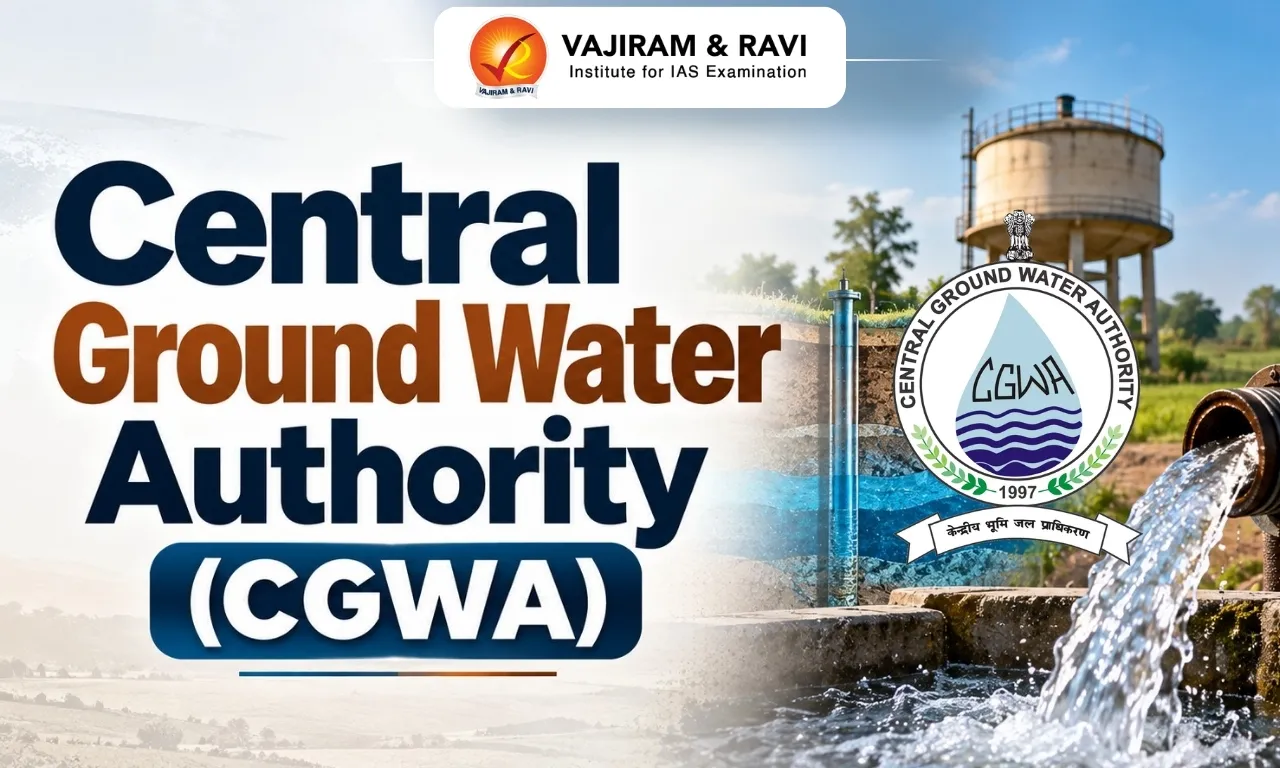
The Central Ground Water Authority (CGWA) serves as India’s apex national regulatory body responsible for regulating, controlling, and managing groundwater development. Functioning under the Ministry of Jal Shakti with headquarters in New Delhi, the authority utilises the institutional framework and infrastructure of the Central Ground Water Board (CGWB).
The Central Ground Water Authority (CGWA) plays a crucial role in preventing indiscriminate extraction of groundwater, categorising groundwater assessment units, and ensuring nationwide long-term water security and sustainability across agricultural, industrial, and domestic sectors.
Central Ground Water Authority About
The Central Ground Water Authority (CGWA) was established in 1997 under Section 3 (3) of the Environment (Protection) Act, 1986, to regulate and control the development and management of groundwater resources in the country.
- Judicial Directive: The authority was created following explicit directives from the Supreme Court of India in the M.C. Mehta vs. Union of India Case (1997) to combat critical depletion.
- Parent Ministry: It functions directly under the administrative jurisdiction of the Ministry of Jal Shakti, Government of India.
- Institutional Link: The authority operates by utilising the established structural framework and infrastructure of the Central Ground Water Board.
Central Ground Water Authority Functions
The Central Ground Water Authority (CGWA) performs many functions under the Environment (Protection) Act, 1986. The CGWA enforces strict regulation, monitoring, and management of India’s groundwater resources.
- Groundwater Extraction Regulation: CGWA enforces strict volumetric caps on daily and annual abstraction limits for industrial units by issuing guidelines for groundwater abstraction to ensure the sustainability of groundwater both in terms of quantity and quality.
- NOC Issuance: CGWA regulates groundwater development and management by issuing ‘No Objection Certificates’ (NOCs) for groundwater extraction to industrial, infrastructure, and mining operations before extracting groundwater.
- Resource Zoning: It evaluates regions and categorises assessment units into Safe, Semi-Critical, Critical, or Over-Exploited zones.
- Notified Areas: The body imposes strict bans or heavy restrictions on new groundwater extraction projects within designated Notified Assessment Units.
- Enforcement Measures: It has statutory authority to take enforcement action, including issuing closure notices, levying environmental compensation fines and penalties, etc.
- Conservation Initiatives: CGWA promotes groundwater conservation by mandating artificial rainwater harvesting, water recycling, and the implementation of conservation structures for all bulk water users.
- Digital Integration: It mandates that all new applications, processing, and compliance filings are handled digitally via the BhuNeer portal.


Central Ground Water Authority and Central Ground Water Board
The Central Ground Water Authority acts as a statutory regulatory body to manage India's water security under the Ministry of Jal Shakti, performing a distinct role from the Central Ground Water Board, which serves as a scientific research organisation.
| Feature | Central Ground Water Board (CGWB) | Central Ground Water Authority (CGWA) |
|
Role |
Scientific and technical apex body that studies groundwater |
Statutory regulatory body that regulates groundwater extraction |
|
Establishment |
Founded in 1970 (Faridabad, Haryana) |
Constituted in 1997 under EPA 1986 (New Delhi) |
|
Functions |
Surveys aquifers, drills exploratory wells, and monitors water levels and quality. |
Controls groundwater extraction, notifies critical areas, and regulates bulk users |
|
Functions |
Provides technical inputs and assessment reports |
Issues No Objection Certificates (NOCs) and imposes environmental compensation fines |
Central Ground Water Authority Significance
The Central Ground Water Authority serves as India’s highest regulatory watchdog for preventing groundwater over-exploitation. It bridges rapid industrial expansion with ecological preservation to secure long-term national water security.
- Statutory Enforcement & Legal Backing: Drawing direct powers from Section 5 of the EPA, 1986, the authority issues binding directives, levies environmental compensation fines, seals illegal borewells, and initiates penal proceedings against defaulting entities.
- Guarding Ecological Stability: The authority regulates extraction in over-exploited, critical, and semi-critical zones to prevent absolute depletion, land subsidence, and pollutant contamination, safeguarding water-stressed ecosystems.
- Controlled Industrial Siting: Through a mandatory No Objection Certificate (NOC) regime, it regulates bulk water withdrawal for industrial, infrastructure, and mining projects, compelling commercial entities to invest in rainwater harvesting and recycling infrastructure.
- Data-Driven Oversight: By enforcing annual water audits for bulk consumers withdrawing over 100m3/day, the authority tracks macro-level consumption patterns and dynamically guides national and local policy restrictions based on block classification.
- Regulatory Federalism: While water remains a State List subject, the authority exercises central environmental oversight under the Union/Concurrent List via the EPA, establishing a balanced framework between central environmental protection and state water management.
Central Ground Water Authority Challenges
The Central Ground Water Authority faces critical operational, structural, and legal hurdles in regulating India's vast groundwater resources. Widespread illegal extractions, archaic legal ownership frameworks, agricultural subsidies, and severe institutional capacity constraints continually impair its nationwide enforcement efficacy.
- Administrative Shortages: Acute staffing and resource deficits across the authority make physical monitoring of millions of private and commercial extraction points across India virtually impossible.
- Low Compliance & Illegal Drilling: Commercial entities regularly bypass mandatory No Objection Certificates (NOCs), leading to widespread unmonitored borewells and pervasive unauthorised extraction.
- Archaic Ownership Laws: The Indian Easement Act of 1882 links groundwater ownership directly to landownership, creating legal hurdles that restrict aggressive regulatory intervention and public trust enforcement.
- Agricultural Distortion: Heavily subsidised farm electricity alongside Minimum Support Prices (MSP) incentivises water-intensive crops like paddy and sugarcane, driving unchecked agricultural depletion.
- Groundwater Contamination: Industrial effluents, agricultural nitrates, and geogenic toxins (arsenic, fluoride) degrade water quality, while gaps in real-time aquifer data hinder targeted response planning.
Central Ground Water Authority UPSC PYQs
Q1: Examine the factors responsible for depleting groundwater in India. What are the steps taken by the government to mitigate such depletion of groundwater? (UPSC Mains 2025)
Q2: Consider the following statements: (UPSC Prelims 2023)
Statement-I: According to the United Nations' World Water Development Report, 2022', India extracts more than a quarter of the world's groundwater withdrawal each year.
Statement-II: India needs to extract more than a quarter of the world's groundwater each year to satisfy the drinking water and sanitation needs of almost 18% of world's population living in its territory.
Which one of the following is correct in respect of the above statements?
(a) Both Statement-I and Statement-II are correct and Statement-II is the correct explanation for Statement-I
(b) Both Statement-I and Statement-II are correct and Statement-II is not the correct explanation for Statement-I
(c) Statement-I is correct but Statement-II is incorrect
(d) Statement-I is incorrect but Statement-II is correct
Ans: (c)
Q3: Consider the following statements: (UPSC Prelims 2020)
- 36% of India's districts are classified as "overexploited" or "critical" by the Central Ground Water Authority (CGWA).
- CGWA was formed under the Environment (Protection) Act.
- India has the largest area under groundwater irrigation in the world.
Which of the statements given above is/are correct?
(a) 1 only
(b) 2 and 3 only
(c) 2 only
(d) 1 and 3 only
Ans: (b)

 Last updated on Oct, 2026
→ UPSC 2027 Notification will be released on 13 January 2027 at upsconline.nic.in.
→ Check Nobel Prize 2026 Winners List here.
→ Download PIB PRiSM Monthly Magazine 2026 here.
→ Check UPSC Monthly Current Affairs Magazine The Recitals here.
→ Check out the latest UPSC Syllabus here.
→ Download UPSC Model Answers for Mains 2026
→ UPSC Mains Question Paper 2026 is out now for Essay & GS Paper 1, 2, 3 & 4.
→ UPSC Calendar 2027 has been released.
→ Enroll in Vajiram & Ravi’s UPSC Mains Test Series 2027 for structured answer writing practice, expert evaluation, and exam-oriented feedback.
→ Join Vajiram & Ravi’s UPSC Mentorship Program 2027 for personalized guidance, strategy planning, and one-to-one support from experienced mentors.
→ Go through the UPSC Mains Previous Year Papers to enhance your preparation.
→ UPSC has released UPSC Toppers List 2025 with the Civil Services final result on its official website.
→ Also check Best UPSC Coaching in India
Central Ground Water Authority UPSC PYQs
Q1. What is the central ground water authority?+
Q2. Who heads the Central Ground Water Authority?+
Q3. What are the powers of the CGWA?+
Q4. When was the Central Groundwater Authority established?+
Q5. What are the four main types of underground water?+
Tags: central ground water authority quest UPSC Environment and Ecology Notes