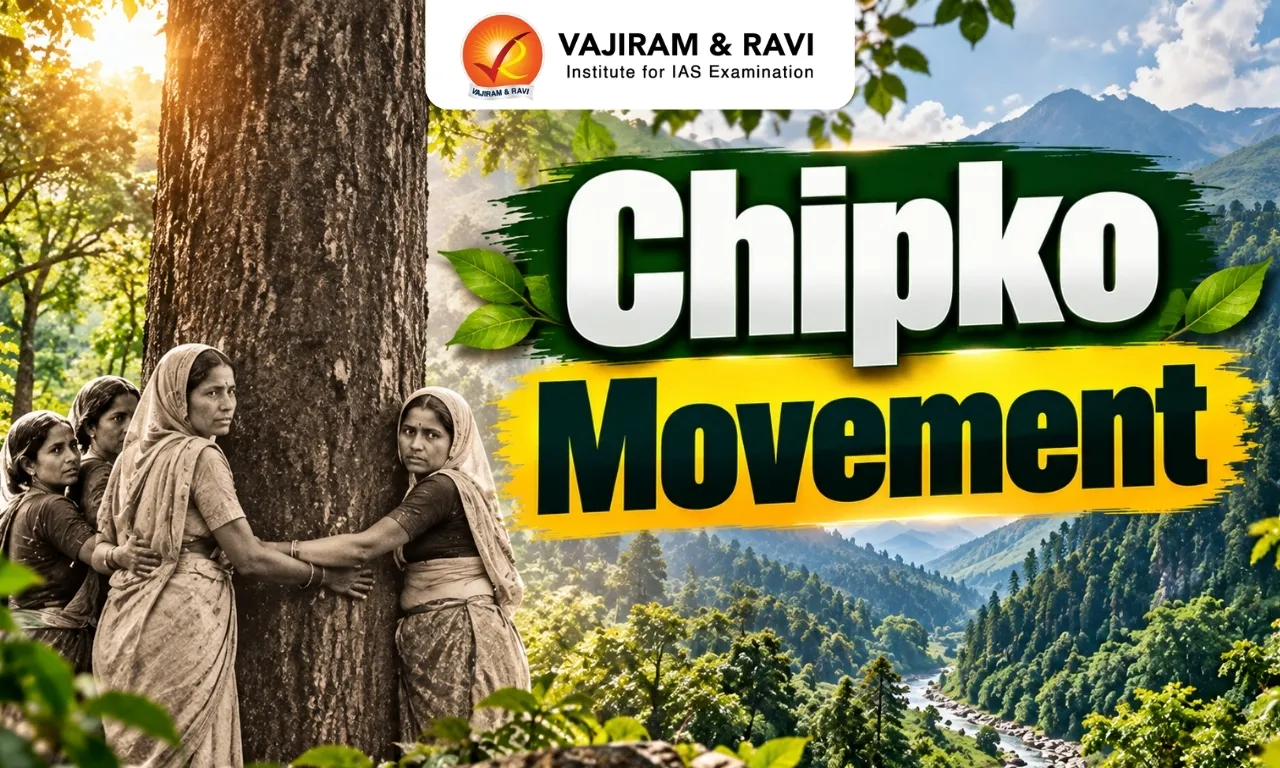
The Chipko Movement was a non-violent forest conservation movement that emerged in the Garhwal Himalayas of present-day Uttarakhand in the 1970s. Prominent leaders such as Sunderlal Bahuguna, Chandi Prasad Bhatt, and Gaura Devi led the movement, with significant participation from women. Villagers adopted non-violent resistance by embracing trees to protect them from being felled, drawing inspiration from Gandhian principles.
A pivotal event occurred in 1974 in Reni village, where Gaura Devi led a successful protest. The movement's efforts culminated in the government's decision to impose a ban on commercial logging in the Himalayan forests in 1980.
Chipko Movement About
The Chipko Movement was a forest conservation movement based on Gandhian methods of non-violent resistance. The word Chipko means “to hug” or “to cling to”, referring to the practice of villagers embracing trees to prevent their felling. The movement developed in the Garhwal Himalayan region, which was then part of Uttar Pradesh.
- The main concerns were commercial logging, loss of forest resources, environmental degradation and the impact of deforestation on the livelihoods of local communities.
- The movement was not simply about protecting trees. For Himalayan communities, forests provided fuelwood, fodder, food, water security and other livelihood resources. Therefore, forest conservation was closely connected with their everyday needs.
Chipko Movement Date
The Chipko Movement was started in the early 1970s, with important protests occurring in different parts of the Garhwal Himalayas. A landmark event occurred on 26 March 1974 at Reni village in Chamoli district, when Gaura Devi and other village women confronted people who had come to cut trees. The women used non-violent resistance and physically protected the trees.


Chipko movement Origin
The roots of the Chipko Movement can be traced to forest-related conflicts in the Himalayan region. India’s forests, vital for rural and forest-dwelling communities, faced extensive exploitation under British colonial rule due to the Indian Forest Acts of 1878 and 1927, which gave the government exclusive control over these resources.
- This led to severe deforestation in the early 20th century for timber demands, causing environmental degradation, soil erosion, and biodiversity loss, adversely affecting local communities.
- In response, the Chipko Movement began in 1973 in the Himalayan region, where villagers, led by women, hugged trees to prevent their felling.
- Inspired by Gandhian non-violent protest methods, the movement spread across India, emphasising environmental protection and the rights of indigenous communities.
- It brought significant attention to sustainable development and the role of women in conservation, leading to policy reforms and inspiring global grassroots activism.
Preceding Movements: Before Chipko Andolan
Before Chipko, movements like the Bishnoi Movement (1730) and Forest Satyagrahas (1930s) laid the foundation for environmental activism in India. The Silent Valley Movement (1970s) paralleled Chipko, opposing a dam project in Kerala's biodiversity-rich forests.
- Bishnoi Movement (1730): In Rajasthan, the Bishnoi community protested the king's men's cutting of Khejri trees. Amrita Devi and over 360 Bishnois sacrificed their lives, making it one of the earliest documented environmental movements, inspiring later campaigns.
- Forest Satyagrahas (1930s): Inspired by Mahatma Gandhi’s nonviolent resistance, forest Satyagrahas spread across Maharashtra, Karnataka, and Tehri (a princely state). Local communities protested British colonial policies that denied them access to forest resources.
- Silent Valley Movement (1970s): Born out of opposition to the building of a hydroelectric dam in Kerala's Silent Valley forest, a biodiversity hotspot, the movement was contemporaneous with the early years of the Chipko Movement.
Chipko Movement Causes
The Chipko Movement was driven by a confluence of environmental, economic, and social factors that highlighted the urgent need for forest conservation and sustainable development.
- Deforestation and Environmental Degradation: Deforestation from the government's commercial logging led to soil erosion, reduced water retention, and increased landslides. These changes threatened local agriculture and water supply, worsening socio-economic issues. The Chipko Movement responded by advocating for sustainable forest management.
- Livelihood Threats and Economic Exploitation: Forest destruction endangered villagers' livelihoods, dependent on agriculture, grazing, and forest products. While contractors benefited from forest exploitation, locals received minimal economic returns, heightening discontent.
- Gender Dynamics and Women's Role: Women, closely tied to forest resources, were central to the Chipko Movement. Deforestation directly impacted their lives as household managers. The movement empowered them to assert their rights and promote environmental conservation.
- Inadequate Government Policies: Government policies favoured commercial interests over local needs. The Indian Forest Acts of 1878 and 1927 restricted community access. The Chipko Movement emerged to demand community-led conservation and sustainable development.
Chipko Movement Leaders
The Chipko Movement was started by a diverse group of individuals who played significant roles in advancing its objectives and advocating for environmental conservation. These leaders and participants were instrumental in shaping the movement's direction and impact, reflecting their commitment to social and ecological justice.
- Sunderlal Bahuguna: Sunderlal Bahuguna was a prominent leader of the Chipko Movement, known for his unwavering commitment to environmental conservation and sustainable development. Born in 1927 in Maroda, Tehri Garhwal, Uttarakhand, he was deeply influenced by Gandhian principles of non-violence and social justice.
- His leadership in the movement focused on non-violent resistance and community involvement, which played a crucial role in raising awareness about the ecological degradation of the Himalayan region.
- His persistent engagement with policymakers led to policy reforms prioritising forest conservation. In recognition of his contribution, he was awarded the Padma Vibhushan in 2009.
- Gaura Devi: Gaura Devi was a central figure in the Chipko Movement, particularly during the Reni village protest. Her leadership in organising women to protect trees from felling demonstrated the critical role of women in the movement. Her actions became a symbol of collective resistance for environmental conservation.
- Chandi Prasad Bhatt: Chandi Prasad Bhatt, an environmental activist and founding member of the Chipko Movement, was instrumental in mobilising grassroots support. His emphasis on sustainable development and community-driven initiatives significantly shaped the direction of the movement, reinforcing the importance of environmental preservation at the local level.
Chipko Movement Events
The Chipko Andolan Movement gained widespread attention in the 1970s, with several significant events underscoring the power of collective action and grassroots activism.
- Initial Spark: In April 1973, in Mandal village, Alaknanda Valley, a contractor received permission to cut trees vital to the villagers. Led by Chandi Prasad Bhatt and inspired by Gandhian principles, villagers, especially women, embraced the trees to stop their felling.
- Reni Village Incident: In March 1974, in Reni village, Chamoli district, women, under Gaura Devi’s leadership, protested against tree felling in a nearby forest. They physically embraced the trees, preventing loggers and highlighting women’s key role in environmental conservation.
- Mobilisation and Awareness: The Reni incident spurred wider support across the Himalayan region. Villagers held rallies and protests against deforestation, gaining attention from environmentalists like Sunderlal Bahuguna. Media coverage raised national awareness about sustainable forest management.
- Government Response and Policy Changes: In 1980, in response to Chipko's success, Prime Minister Indira Gandhi imposed a 15-year ban on commercial logging in the Himalayas. This victory for Chipko influenced future environmental policies focusing on conservation and community-led development.
- Global Recognition: The Chipko Movement gained international recognition for its grassroots activism. Sunderlal Bahuguna received the Right Livelihood Award in 1987, often referred to as the “Alternative Nobel Prize". The movement inspired global conservation efforts and highlighted the impact of community-driven environmental initiatives.
Chipko Andolan's Impacts
The Chipko Movement significantly impacted India's environmental policies and global conservation efforts. It addressed deforestation's effects on local livelihoods, especially for women, while promoting sustainable forest management. The movement inspired global initiatives like Kenya’s Green Belt Movement and led to key Indian policy changes, including a ban on commercial logging and the 1988 National Forest Policy.
- Impact on Livelihoods: Deforestation harmed local communities, especially women, who relied on forest resources. Increased travel for essentials and declining agricultural productivity led to greater hardships, prompting the Chipko Movement for forest conservation.
- Environmental Conservation: The Chipko Movement significantly advanced environmental conservation by preventing deforestation and raising awareness of ecological damage from logging. It emphasised community-driven conservation, influencing future sustainable resource management policies.
- Ecofeminism: The movement empowered women by involving them in forest protection, challenging gender roles, and highlighting their critical role in resource management. It became a symbol of gender equality and inspired initiatives for women's inclusion in development.
- Global Influence: Chipko inspired global movements, including Kenya's Green Belt Movement led by Wangari Maathai. Its success fueled discussions on sustainability and social justice, showcasing grassroots activism's impact on global environmental issues.
- Policy and Legislative Changes: The Chipko Movement led to key policy changes in India, including a 15-year ban on commercial logging in Himalayan forests by Prime Minister Indira Gandhi in 1980, and the National Forest Policy of 1988, which prioritised sustainable forest management and community-led conservation.

 Last updated on Oct, 2026
→ UPSC 2027 Notification will be released on 13 January 2027 at upsconline.nic.in.
→ Check Nobel Prize 2026 Winners List here.
→ Download PIB PRiSM Monthly Magazine 2026 here.
→ Check UPSC Monthly Current Affairs Magazine The Recitals here.
→ Check out the latest UPSC Syllabus here.
→ Download UPSC Model Answers for Mains 2026
→ UPSC Mains Question Paper 2026 is out now for Essay & GS Paper 1, 2, 3 & 4.
→ UPSC Calendar 2027 has been released.
→ Enroll in Vajiram & Ravi’s UPSC Mains Test Series 2027 for structured answer writing practice, expert evaluation, and exam-oriented feedback.
→ Join Vajiram & Ravi’s UPSC Mentorship Program 2027 for personalized guidance, strategy planning, and one-to-one support from experienced mentors.
→ Go through the UPSC Mains Previous Year Papers to enhance your preparation.
→ UPSC has released UPSC Toppers List 2025 with the Civil Services final result on its official website.
→ Also check Best UPSC Coaching in India
Chipko Movement FAQs
Q1. What is Chipko Movement?+
Q2. Who has started the Chipko Movement?+
Q3. Was the Chipko Movement started in 1970 or 1973?+
Q4. Which lady started the Chipko Movement?+
Q5. Which village first witnessed the Chipko Movement?+
Tags: chipko movement quest UPSC Environment and Ecology Notes