Food security in India is the foundation of human well-being, economic productivity and inclusive development. Food security in India extends beyond mere availability of foodgrains to ensuring that every person has regular physical and economic access to sufficient, safe and nutritious food. The Indian food-security architecture has therefore evolved from increasing agricultural production through the Green Revolution to creating legal entitlements under the National Food Security Act (NFSA), 2013, supported by procurement, buffer stocks, the Public Distribution System (PDS) and digital reforms.
However, India faces a persistent food-nutrition paradox: substantial foodgrain production and buffer stocks coexist with undernutrition, micronutrient deficiencies and unequal access. Consequently, contemporary food security requires an integrated approach combining availability, access, etc., alongside sustainable agriculture and resilient delivery systems.
Food Security in India Meaning
Food security is a multidimensional concept that goes beyond producing enough food at the national level. It requires food to be accessible, properly utilised and continuously available over time. Therefore, both adequate production and equitable distribution are essential.
- Food security means that all people, at all times, have physical and economic access to sufficient, safe and nutritious food that meets their dietary needs and food preferences for an active and healthy life.
- Thus, food security in India depends not only on food production but also on purchasing power, nutrition, healthcare, sanitation, social entitlements and resilience to shocks.
Four Pillars of Food Security in India
- Availability: Food security requires sufficient food to be available through domestic production, government stocks and imports.
- Agricultural productivity, government procurement, buffer stocks and food imports therefore strengthen food availability.
- Access: Food security requires individuals and households to have the physical and economic ability to obtain food.
- Income, employment, purchasing power, market access, social entitlements and the Public Distribution System determine effective access.
- Utilisation: Food must be properly utilised by the body to ensure adequate nutrition.
- This depends on dietary diversity, safe drinking water, sanitation, healthcare, food safety and appropriate nutrition practices.
- Stability: Food availability, access and utilisation must be maintained consistently over time.
- Climate change, droughts, floods, conflicts, pandemics, inflation and other economic shocks can disrupt this stability.
Food Security in India Government Measures
Food Security in India combines agricultural production, farmer support, procurement, storage, distribution, nutrition interventions and technology-enabled governance. These measures aim to ensure not only adequate food availability but also affordability, accessibility, nutritional adequacy and stability.
Production-Side Interventions for Food Security in India
- National Food Security & Nutrition Mission (NFSNM): The erstwhile National Food Security Mission (NFSM), launched in 2007, has been renamed NFSNM.
- It focuses on increasing the area and productivity of rice, wheat, pulses, coarse cereals and commercial crops, while since 2024–25 also integrating production with nutritional security, soil-fertility improvement and farmer-income enhancement.
- Pradhan Mantri Dhan-Dhaanya Krishi Yojana (PM-DDKY), 2025: The scheme targets 100 low-performing agricultural districts and focuses on irrigation, crop diversification, post-harvest infrastructure and credit access. As of April 2026, coverage of approximately 1.7 crore farmers was recorded.
- Mission for Aatmanirbharta in Pulses: The mission seeks to increase domestic pulse production and reduce import dependence, thereby strengthening protein availability and dietary diversification.
- National Mission on Edible Oils: NMEO-Oilseeds (NMEO-OS) and NMEO-Oil Palm (NMEO-OP) aim to increase domestic edible-oil production, reduce import dependence and protect food security from international price volatility and external supply shocks.
- Minimum Support Price (MSP): MSP is announced for 22 mandated crops to provide farmers with remunerative prices and incentivise production; since 2018–19, MSP has been fixed at at least 1.5 times the all-India weighted average cost of production based on the government's announced cost concept.
Distribution-Side Interventions for Food Security in India
- Pradhan Mantri Garib Kalyan Anna Yojana (PMGKAY): Initially introduced during the COVID-19 pandemic, the scheme provided additional free food grains through seven phases up to December 2022.
- From January 2023, NFSA foodgrains were made free of cost; this arrangement was continued under PMGKAY for five years from 1 January 2024, covering eligible AAY and Priority Household beneficiaries.
- Targeted Public Distribution System (TPDS): TPDS is the principal mechanism for delivering foodgrain entitlements under the National Food Security Act, 2013, operating through a joint Centre–State framework in which the Centre undertakes procurement and allocation while States/UTs manage distribution.
- One Nation One Ration Card (ONORC): ONORC enables beneficiaries to access their foodgrain entitlements from any Fair Price Shop across the country, supporting migrant and mobile populations.
- It is operational across all 36 States/UTs, covers approximately 81 crore beneficiaries, and uses Aadhaar authentication and ePoS devices to facilitate portability.
- Direct Benefit Transfer (DBT): The Cash Transfer of Food Subsidy Rules 2015 provide a framework for transferring food-subsidy amounts directly to eligible beneficiaries' bank accounts in notified areas.
- Physical foodgrain distribution through the TPDS remains the principal delivery mechanism under the NFSA.
- Open Market Sale Scheme–Domestic (OMSS-D): OMSS-D enables the government to sell surplus Central Pool foodgrains in the open market, thereby helping manage excess stocks, stabilise prices and moderate food inflation.
- Bharat Atta and Bharat Rice: Bharat Atta, launched on 6 November 2023, and Bharat Rice, launched on 6 February 2024, provide subsidised wheat flour and rice to consumers through agencies such as NAFED, NCCF and Kendriya Bhandar.
- Rice Fortification Initiative: Fortified rice kernels containing iron, folic acid and vitamin B12 are blended with regular rice at approximately 1%.
- The initiative began under ICDS and PM POSHAN in 2021–22, achieved 100% fortified-rice supply under major central schemes by March 2024, and has been approved for continuation up to December 2028 with an allocation of approximately ₹17,082 crore.
- PM POSHAN: PM POSHAN provides hot-cooked meals to eligible children in Bal Vatika and Classes I–VIII in government and government-aided schools.
- It supports nutritional improvement, school attendance and food security.
- The scheme's 2021–22 to 2025–26 approval carried a total outlay of ₹1,30,794.90 crore.
- Supplementary Nutrition: Mission Saksham Anganwadi and POSHAN 2.0 provide supplementary nutrition and related services to eligible children, pregnant women and lactating mothers through Anganwadi Centres. The Scheme for Adolescent Girls also covers eligible girls aged 14–18 in specified areas.
- POSHAN Abhiyaan: Launched in March 2018, POSHAN Abhiyaan adopts a convergence-based approach to reduce stunting, wasting and anaemia among children and women, with more than 10.13 crore beneficiaries covered by December 2024.
Digital and Technology-Driven PDS Reforms for Food Security in India
- Ration Card Digitisation: Ration cards have been 100% digitised across States and UTs, improving transparency, beneficiary identification and reducing duplication.
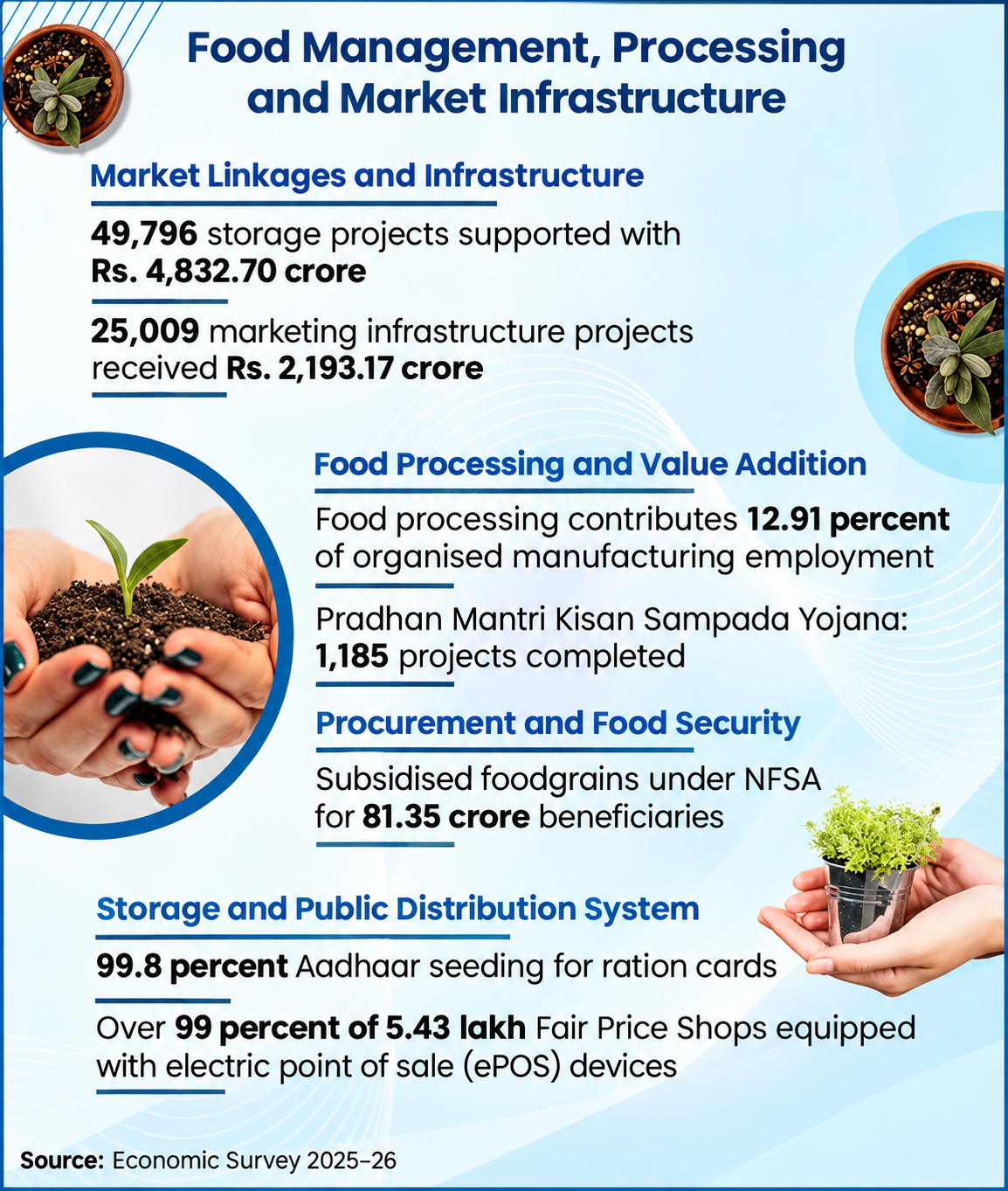
- Aadhaar Seeding: Approximately 99.9% of ration cards have been seeded with Aadhaar according to the cited data, facilitating authentication and portability of foodgrain entitlements.
- ePoS-Enabled Fair Price Shops: Around 99.6–99.8% of Fair Price Shops have been automated through ePoS devices, covering approximately 5.50 lakh of 5.51 lakh FPSs.
- Biometric and Aadhaar Authentication: More than 97–98% of PDS transactions are authenticated through biometric or Aadhaar-linked mechanisms, strengthening transparency and accountability.
- Mera Ration 2.0: Launched on 20 August 2024, the application enables beneficiaries to access entitlement information and locate nearby Fair Price Shops and has crossed 1 crore downloads, according to the cited data.
- Anna Mitra App: The application provides field functionaries with digital tools for stock management, inspection and compliance monitoring and is operational in 15 States/UTs according to the cited information.
- ASHA Platform: The platform provides AI-driven grievance redressal under the IndiaAI Mission through Bhashini-based multilingual NLP, WhatsApp and IVRS, while also using sentiment analysis of beneficiary feedback.
- SMART-PDS: The Scheme for Modernisation and Reforms through Technology in PDS seeks to modernise the PDS through modules covering procurement, supply-chain and allocation, ration-card and FPS management, and biometric e-KYC.
- Depot Darpan Portal: The portal enables geo-tagged monitoring of FCI and CWC storage depots through IoT sensors, CCTV and AI-based tools, thereby improving storage monitoring and performance assessment.
- Anna Chakra: Developed with IIT Delhi and the UN World Food Programme, Anna Chakra uses route optimisation to improve warehouse-to-FPS transportation; it can reduce transportation distance by up to 50% and CO₂ emissions by around 35%, with reported savings of approximately ₹238 crore.
- PDS Helpline: Toll-free grievance mechanisms, including the 1967 and state-specific 1800-series helplines, provide beneficiaries with channels to report problems related to foodgrain distribution and Fair Price Shop services.
Procurement, Storage and Buffer Stock Management for Food Security in India
- Procurement Systems: Under Decentralised Procurement (DCP), States procure, store and distribute foodgrains within their respective areas, while under the Centralised/Non-DCP system, FCI and State agencies procure foodgrains for the FCI/Central Pool system and subsequent allocation.
- Central Pool Stocks: As on 1 July 2025, rice stocks stood at 377.83 LMT against a norm of 135.40 LMT, while wheat stocks stood at 358.78 LMT against a norm of 275.80 LMT, keeping stocks substantially above prescribed buffer norms.
- Wheat Procurement in Rabi Marketing Season 2026–27: As of August 2026, approximately 357.35 LMT of wheat was procured.
- NFSA Foodgrain Allocation: The total foodgrain allocation under the NFSA for FY 2025-26 was 554.99 lakh tonnes, supporting the delivery of statutory foodgrain entitlements.
- Storage Infrastructure: The government is promoting steel silos under the PPP model and the Hub-and-Spoke model to modernise storage and transportation, with pilot rice silos developed at Kaimur and Buxar in Bihar.
Farmer-Side Support for Food Security in India
- PM-KISAN: PM-KISAN provides eligible farmer families with ₹6,000 annually through DBT, with approximately ₹4.28 lakh crore disbursed through 22 instalments and more than 9.44 crore farmer families benefiting.
- Pradhan Mantri Fasal Bima Yojana (PMFBY): PMFBY provides crop insurance against specified agricultural risks under the principle of "One Nation, One Crop, One Premium"; more than 4 crore farmers are insured annually, while approximately ₹1.96 lakh crore in claims had been disbursed up to 31 December 2025.
- Kisan Credit Card (KCC): KCC provides timely institutional credit for crop and allied activities, with operative accounts increasing from 6.46 crore in 2013–14 to 7.81 crore in 2024–25, while credit outstanding reached approximately ₹10.20 lakh crore.
- PM-Kisan Maandhan Yojana: The scheme provides an assured pension of ₹3,000 per month after the age of 60, subject to eligibility and contribution conditions, with approximately 24.95 lakh farmers enrolled as of February 2026.
- Agriculture Infrastructure Fund (AIF): AIF supports post-harvest infrastructure and agricultural logistics, with approximately ₹84,202 crore sanctioned for 1.68 lakh projects by March 2026, strengthening storage, processing and supply-chain capacity.
- e-NAM: The National Agriculture Market integrates agricultural markets through an electronic platform; according to the cited figures, 1,656 mandis, more than 1.80 crore farmers and 4,724 FPOs have been brought onto the platform, improving price discovery and market access.


Food Security in India and NFSA, 2013
The National Food Security Act (NFSA), 2013 marks a shift from a welfare-based approach to a rights-based approach by converting food assistance into legal entitlements. It also adopts a life-cycle approach to nutrition, extending support beyond food grains to vulnerable groups and strengthening food security in India.
- Coverage and Population Base: The Act provides for coverage of up to 75% of the rural population and 50% of the urban population, together covering approximately two-thirds of India's population. The statutory coverage is based on the 2011 Census, corresponding to around 81.35 crore persons.
- Legal Entitlement and Current Coverage: The NFSA converts food assistance into a statutory entitlement rather than a discretionary welfare measure.
- Around 79.40 crore beneficiaries were receiving free food grains as of 1st March 2026.
- Delivery Mechanism: Foodgrain entitlements under the Act are primarily delivered through the Targeted Public Distribution System (TPDS), which operates through a joint Centre–State framework.
- Antyodaya Anna Yojana (AAY): AAY covers the poorest of the poor households and provides 35 kg of food grains per household per month.
- AAY categories include vulnerable households headed by widows, terminally ill persons, persons with disabilities or elderly persons without assured livelihoods, along with primitive tribal households, landless agricultural labourers, marginal farmers, rural artisans, slum dwellers, informal-sector daily-wage earners and eligible BPL families of HIV-positive persons.
- Priority Households (PHH): PHH beneficiaries are entitled to 5 kg of foodgrains per person per month, making the entitlement dependent on the number of eligible household members.
- Free Foodgrains: Since 1 January 2023, NFSA foodgrains for AAY and PHH beneficiaries have been provided free of cost.
- This arrangement was extended for five years from 1 January 2024, with an estimated financial outlay of ₹11.80 lakh crore, fully funded by the Centre.
- Pregnant Women and Lactating Mothers: They are entitled to meals according to prescribed nutritional norms through Saksham Anganwadi and PM POSHAN, along with a maternity benefit of not less than ₹6,000, subject to the applicable provisions and scheme framework.
- Children and Malnourished Children: The NFSA provides age-appropriate nutritional support to children aged 6 months to 6 years through the relevant Anganwadi framework and to eligible schoolchildren through prescribed school-meal arrangements. Children below six years who are malnourished are entitled to higher nutritional norms.
Food Security in India Achievements
India's food-security framework has evolved from a predominantly foodgrain-oriented system to a broader framework covering production, nutrition, legal entitlements, digital delivery, agricultural diversification and farmer welfare.
- Foodgrain Production: According to the third advance estimates, foodgrain production increased from 265.05 million tonnes in 2013–14 to 376.56 million tonnes in 2025–26, significantly strengthening India's domestic food availability and reducing vulnerability to external food dependence.
- Rice Production: According to the third advance estimates, rice production reached a record 154.024 million tonnes in 2025–26, representing an increase of approximately 42.38% over 2014–15.
- India has also emerged as the world's largest rice producer/exporter, according to the cited data.
- Wheat Production: According to the third advance estimates, wheat production reached 120.67 million tonnes in 2025–26, approximately 36% higher than in 2014–15, strengthening the country's staple-food supply and procurement capacity.
- Maize Production: According to the third advance estimates, maize production reached 55.093 million tonnes in 2025–26, registering an increase of approximately 79% over 2014-15 and supporting both food and feed security.
- Oilseed Production: Oilseed production increased to 43.059 million tonnes in 2025–26, representing approximately 56% growth over 2014-15.
- Horticultural Diversification: Horticultural production increased from 280.70 million tonnes in 2013-14 to 377.776 million tonnes in 2025–26 (second advanced estimates), demonstrating growing diversification beyond traditional cereals and strengthening the availability of fruits, vegetables and other nutrient-rich foods.
- Milk Production: Milk production reached 248 million tonnes in 2024–25, registering approximately 69.4% growth since 2014–15. India remains the world's largest milk producer, accounting for around 25% of global production, while per-capita milk availability reached 485 g/day, compared with a global average of around 328 g/day.
- Fish Production: Fish production increased from 9.58 million tonnes in 2013–14 to 19.78 million tonnes in 2024-25, strengthening the availability of affordable animal protein and contributing to nutritional security.
- ONORC Portability: The One Nation One Ration Card system is operational across all 36 states/UTs, enabling beneficiaries to access foodgrain entitlements across the country.
- Agricultural Exports: Agricultural exports increased from USD 37.29 billion in 2013-14 to USD 52.55 billion in 2025–26, while the share of processed food in agricultural exports increased from 13.7% to 20.4%, indicating greater value addition and diversification in the agricultural sector.
- Agricultural GVA: Agricultural and allied Gross Value Added (GVA) increased from approximately ₹20.9 lakh crore in 2014–15 to ₹52.08 lakh crore in 2025–26, reflecting significant expansion of the agricultural and allied sectors. The cited data indicate a CAGR of approximately 8.83%.
Food Security in India Challenges
Despite significant gains in agricultural production, procurement and food distribution, challenges to food security in India have increasingly shifted from producing sufficient food to ensuring affordable, nutritious, sustainable and stable access to food for every household.
- Availability–Nutrition Paradox: High foodgrain stocks coexist with undernutrition, micronutrient deficiencies and a rising burden of overweight and obesity, highlighting gaps in dietary diversity and nutrition.
- Global Hunger and Malnutrition: India ranked 102nd with a score of 25.8 in the 2025 Global Hunger Index, reflecting persistent challenges in undernourishment, child stunting and wasting.
- Exclusion and Last-Mile Gaps: NFSA coverage based on the 2011 Census risks excluding newly eligible households, while identification errors and logistical constraints hinder delivery in remote areas.
- PDS Leakages and Governance: Despite digitisation and ePoS, residual diversion, implementation gaps and foodgrain-quality issues affect delivery in some areas.
- Cereal-Centric Agriculture: The emphasis on rice and wheat procurement can discourage diversification towards pulses, millets, oilseeds and other nutritious crops, aggravating nutritional and ecological concerns.
- Climate and Resource Stress: Erratic rainfall, extreme weather, groundwater depletion and soil degradation threaten agricultural productivity, particularly in water-intensive rice–wheat regions.
- Import Dependence and Fragmented Holdings: Dependence on edible-oil imports and exposure to global pulse prices coexist with small, fragmented landholdings that constrain mechanisation and investment.
- Post-Harvest Losses: Inadequate storage, cold chains, processing and transport reduce food availability, especially for perishable commodities.
- Fiscal and Stock-Management Burden: Free foodgrain distribution and excess stocks entail high storage and carrying costs, necessitating efficient stock rotation and mechanisms such as OMSS-D.
- Centre–State Coordination: Gaps in coordination over beneficiary identification, allocation and last-mile delivery can weaken TPDS implementation.
- Affordability of Nutritious Diets: Subsidised cereals do not necessarily ensure access to affordable proteins, fruits, vegetables and micronutrient-rich foods.
Food Security in India Way Forward
Food security must move beyond cereal availability towards affordable, nutritious, sustainable and resilient food systems.
- Update NFSA Coverage: Revise the 75% rural and 50% urban coverage limits using the latest Census or appropriate demographic data to reduce exclusion arising from the 2011 population base.
- Diversify PDS and Procurement: Gradually include pulses, millets (Shree Anna), fortified foods and other nutritious commodities in the PDS.
- Align MSP and procurement with nutritional and ecological priorities by strengthening support and infrastructure for pulses, oilseeds and nutri-cereals.
- Promote Climate-Resilient Agriculture: Encourage resilient crop varieties, water-efficient crops, micro-irrigation, natural farming and sustainable practices to tackle extreme weather and water scarcity.
- The release of 2,996 climate-resilient crop varieties during 2014–2025 provides a foundation.
- Improve Storage and Reduce Losses: Align procurement with scientific buffer-stock norms while expanding decentralised storage, modern silos, cold chains and processing facilities, alongside efficient stock rotation.
- Strengthen Digital PDS Governance: Expand SMART-PDS, ePoS, Aadhaar-enabled systems, ASHA grievance redressal, Depot Darpan and Anna Chakra, while retaining accessible human grievance-redressal mechanisms to prevent digital exclusion.
- Integrate Food and Nutrition Policies: Strengthen convergence among NFSA, POSHAN Abhiyaan, PM POSHAN, ICDS and food fortification.
- The transition from NFSM to NFSNM offers a basis for linking agricultural production with nutritional security.
- Reduce Import Dependence: Boost domestic pulses and edible-oil production through the Mission for Aatmanirbharta in Pulses, NMEO-OS and NMEO-OP, while using international trade as a buffer against supply shocks and price volatility.
- Strengthen Economic Access: Apply Amartya Sen’s entitlement approach by complementing food availability with purchasing power through employment and income support, including VB-G RAM G and PM-KISAN, so that adequate national production translates into household food security.
Food Security in India UPSC PYQs
Q1. Describe the various Technology Missions initiated in India agriculture and examine their role in food security. (UPSC Mains 2026)
Q2. How Indian agriculture has been transformed from food scarcity to food surplus level? Explain the various government policies implemented for diversification of Indian agriculture. (UPSC Mains 2026)
Q3. The Food Security Bill is expected to eliminate hunger and malnutrition in India. Critically discuss various apprehensions in its effective implementation along with the concerns it has generated in the WTO. (UPSC Mains 2013)

 Last updated on Oct, 2026
→ UPSC 2027 Notification will be released on 13 January 2027 at upsconline.nic.in.
→ Check Nobel Prize 2026 Winners List here.
→ Download PIB PRiSM Monthly Magazine 2026 here.
→ Check UPSC Monthly Current Affairs Magazine The Recitals here.
→ Check out the latest UPSC Syllabus here.
→ Download UPSC Model Answers for Mains 2026
→ UPSC Mains Question Paper 2026 is out now for Essay & GS Paper 1, 2, 3 & 4.
→ UPSC Calendar 2027 has been released.
→ Enroll in Vajiram & Ravi’s UPSC Mains Test Series 2027 for structured answer writing practice, expert evaluation, and exam-oriented feedback.
→ Join Vajiram & Ravi’s UPSC Mentorship Program 2027 for personalized guidance, strategy planning, and one-to-one support from experienced mentors.
→ Go through the UPSC Mains Previous Year Papers to enhance your preparation.
→ UPSC has released UPSC Toppers List 2025 with the Civil Services final result on its official website.
→ Also check Best UPSC Coaching in India
Food Security in India FAQs
Q1. What is meant by food security?+
Q2. What are the 4 pillars of food security?+
Q3. What is the food security Act in India?+
Q4. Why is food security important for India?+
Q5. What are the benefits of food security?+
Tags: food security in india quest UPSC Social Justice Notes