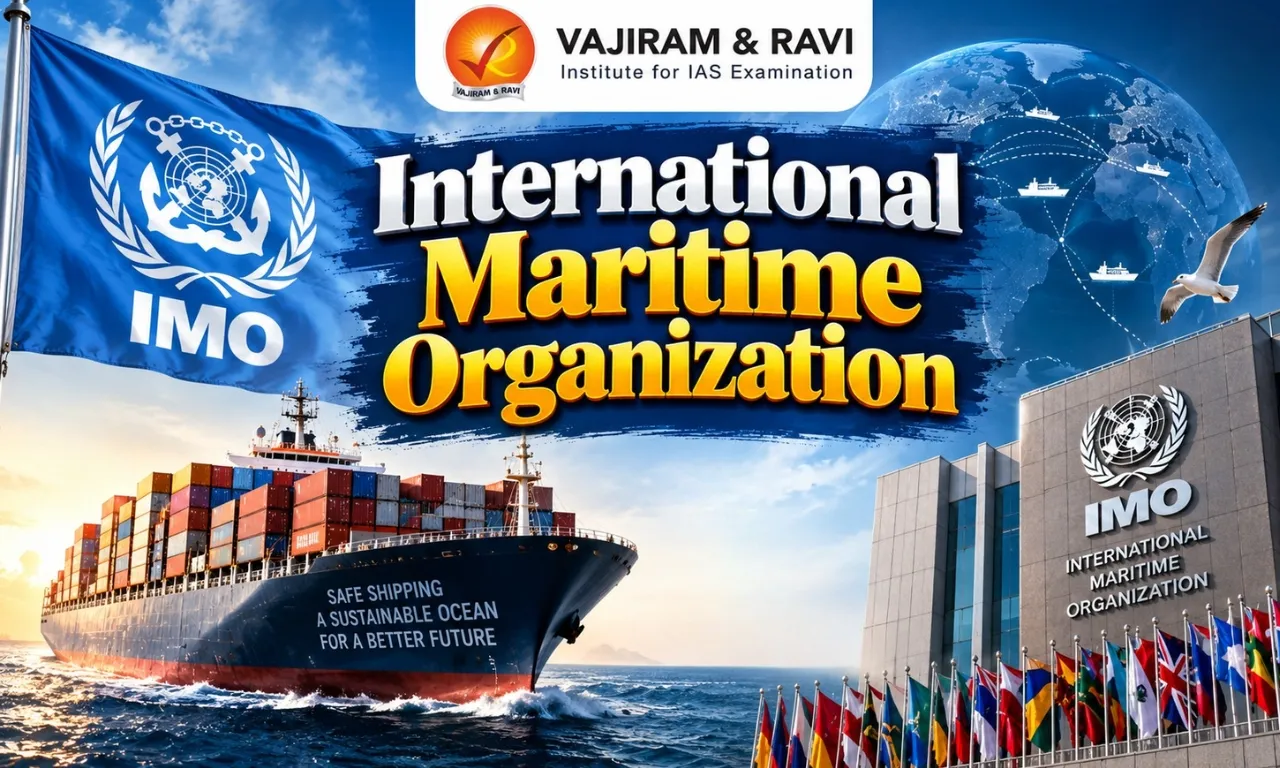
The International Maritime Organization (IMO) is a specialised agency of the United Nations responsible for developing global standards for safe, secure, efficient and environmentally sustainable shipping. Established to promote cooperation among maritime nations, the IMO works on issues including maritime safety, navigation, pollution prevention, maritime security and the regulation of international shipping.
The framework of the International Maritime Organization helps harmonise rules across countries, reducing risks and improving the reliability of global maritime transport. Since shipping carries a substantial share of international trade, IMO regulations are vital for protecting seafarers, ships, marine ecosystems and coastal communities while supporting the smooth functioning of global supply chains and sustainable economic development.
International Maritime Organization (IMO) History
The history of the International Maritime Organization can be traced to the growing recognition that maritime safety and navigation require common international standards, rather than separate national rules.
- International shipping expanded significantly with industrialisation and global commerce, leading to treaties on issues such as ship measurement, collision prevention and signalling. Major stages in the evolution of IMO are
- 1948 – Creation of the organisation: The IMO Convention was adopted in Geneva, laying the institutional foundation for international cooperation on maritime affairs.
- 1958 – Convention enters into force: The IMO Convention became operational, and the organisation began functioning as the international forum for maritime regulation.
- 1960s – Maritime safety: IMO concentrated heavily on improving ship and navigation safety, including the development of the 1960 version of the SOLAS Convention.
- 1967 onwards – Marine pollution: The Torrey Canyon oil spill highlighted the scale of maritime pollution risks and encouraged IMO to strengthen international measures against pollution from ships.
- 1970s–1990s – Safety, communication and seafarers: IMO expanded its work into search and rescue communications, safety management and standards for seafarer training and certification.
- 2000s – Maritime security and environmental protection: The organisation increasingly addressed maritime security, ship recycling, ballast water, anti-fouling systems and other environmental concerns.
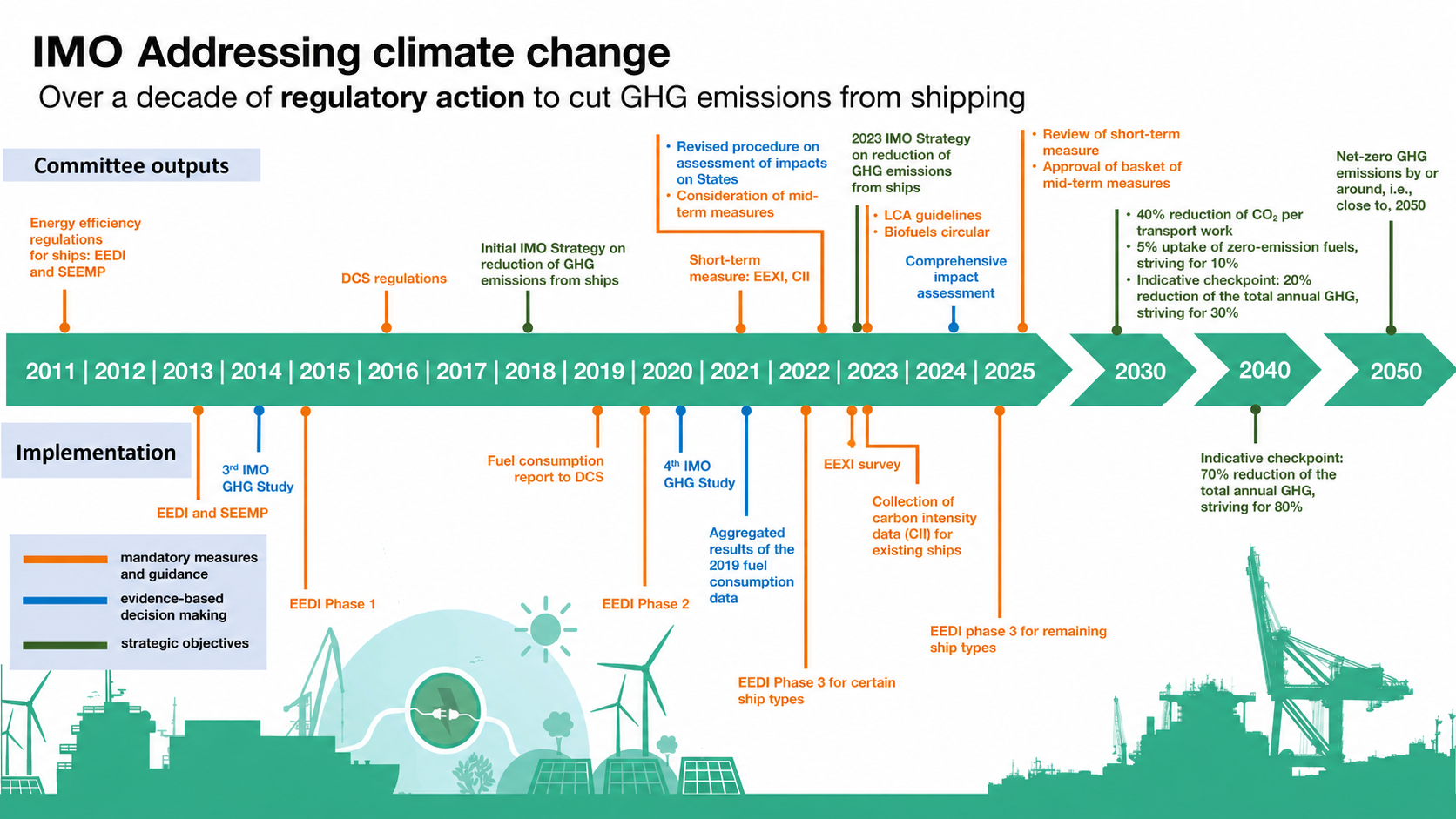
- Recent phase – Climate and sustainable shipping: Reducing greenhouse gas emissions from international shipping has become a major part of IMO's agenda. The organisation adopted an initial GHG strategy in 2018 and a revised strategy in 2023.
International Maritime Organization (IMO) Overview
The International Maritime Organization was formally established through a convention adopted at an international conference in Geneva in 1948. Its original name was the Inter-Governmental Maritime Consultative Organization (IMCO). The convention establishing the organisation entered into force in 1958, and IMO held its first meeting the following year. The organisation adopted its present name, International Maritime Organization, in 1982.
- IMO Members: The International Maritime Organization currently has 176 Member States and three Associate Members. It also records 68 intergovernmental organisations with observer status and 98 international NGOs in consultative status.
- The organisation also works with international organisations and non-governmental bodies. In IMO, 68 intergovernmental organisations have observer status, while 98 international NGOs have consultative status.
- IMO Headquarters: The headquarters of the International Maritime Organization (IMO) is in London, United Kingdom.
- IMO is also the only United Nations specialised agency headquartered in London.


International Maritime Organization (IMO) Objectives
The objectives of the International Maritime Organization centre on developing common international standards that make shipping safer, cleaner and more efficient. Major objectives of IMO are
- Enhancing maritime safety: The International Maritime Organization aims to develop international standards for ships, navigation, equipment and operational safety.
- Improving maritime security: The International Maritime Organization aims to address threats such as piracy and unlawful acts against ships and port facilities.
- Preventing marine pollution: The International Maritime Organization aims to help establish international measures to reduce pollution caused by ships.
- Promoting efficient navigation: The International Maritime Organization aims to support standards that facilitate safe and efficient movement of vessels.
- Improving shipping efficiency: The International Maritime Organization aims to reduce unnecessary administrative barriers and facilitate international maritime traffic.
- Strengthening legal cooperation: IMO aims to develop international rules dealing with maritime liability and related legal matters.
- Supporting sustainable shipping: IMO aims to promote measures to reduce greenhouse-gas emissions and other environmental impacts.
- Building capacity: IMO aims to provide technical cooperation and assistance so developing countries can effectively implement international maritime standards.
International Maritime Organization (IMO) Functions
The International Maritime Organization (IMO) performs several functions to promote cooperation among member states and strengthen international maritime governance. Functions are
- Consider and recommend on maritime matters: The International Maritime Organization examines issues related to its objectives that are referred to it by Member States, UN bodies, specialised agencies and other intergovernmental organisations.
- Develop international conventions and agreements: The International Maritime Organization facilitates the preparation of conventions, agreements and other appropriate international instruments and recommends them to governments and relevant intergovernmental organisations.
- Organise international conferences: Where necessary, IMO convenes international conferences to develop and advance agreements concerning maritime affairs.
- Promote consultation among Member States: The International Maritime Organization provides a platform for governments to consult each other on matters falling within its area of responsibility.
- Facilitate information exchange: The International Maritime Organization enables Member States and governments to share relevant information, supporting greater international cooperation in maritime affairs.
- Implement functions under international maritime instruments: The International Maritime Organization carries out responsibilities assigned to it under international agreements dealing with maritime matters and the impact of shipping on the marine environment.
- Promote technical cooperation: The International Maritime Organization facilitates technical cooperation among Member States, particularly in areas falling within its mandate, helping countries strengthen their capacity to implement international maritime standards.
International Maritime Organization (IMO) Structure
The structure of the International Maritime Organization (IMO) consists of the Assembly, Council, five main committees, supporting sub-committees and the Secretariat.
- Assembly: The Assembly is the highest governing body of IMO and comprises all Member States. It normally meets every two years.
- It approves the organisation's work programme, determines financial arrangements, votes on the budget and elects the Council.
- Council: The Council is the executive organ of IMO and supervises the organisation's work between Assembly sessions. It coordinates the activities of IMO bodies, considers work programmes and budgets, receives committee reports and appoints the Secretary-General subject to Assembly approval.
- For the 2026–2027 biennium, India is among the 10 countries in Category B, representing states with major interests in international seaborne trade. The Council has 40 elected members under the current arrangement.
- Maritime Safety Committee: The Maritime Safety Committee (MSC) is IMO's principal technical body for maritime safety.
- Its work covers areas such as navigation, ship construction and equipment, dangerous cargoes, collision prevention, casualty investigation, salvage and rescue.
- Marine Environment Protection Committee: The Marine Environment Protection Committee (MEPC) deals with preventing and controlling pollution from ships. It plays a central role in developing and amending environmental regulations.
- Legal Committee: The Legal Committee handles legal matters falling within IMO's mandate, including issues arising from maritime accidents, liability and compensation.
- Technical Cooperation Committee: The Technical Cooperation Committee deals with IMO's technical cooperation programmes and supports countries in implementing maritime standards.
- Facilitation Committee: The Facilitation Committee focuses on reducing unnecessary formalities and administrative barriers in international maritime traffic while maintaining an appropriate balance between maritime security and efficient trade.
- Secretariat: The Secretariat consists of the Secretary-General and international staff based at IMO headquarters in London. The current Secretary-General is Arsenio Dominguez, who took office on 1 January 2024.
International Maritime Organization (IMO) Conventions
The IMO conventions form the core of the organisation's regulatory framework. IMO develops new conventions and updates existing ones so that international maritime rules remain relevant to technological and operational changes. Major IMO Conventions.
- SOLAS – Safety of Life at Sea: The International Convention for the Safety of Life at Sea (SOLAS) is one of the most important international treaties on maritime safety. It establishes standards relating to ship construction, equipment and operation.
- MARPOL – Prevention of Pollution from Ships: The MARPOL Convention addresses pollution from ships, covering areas including oil, chemicals, harmful substances, sewage, garbage and air pollution.
- STCW Convention: The International Convention on Standards of Training, Certification and Watchkeeping for Seafarers (STCW) establishes international standards for the training and certification of seafarers.
- Ballast Water Management Convention: The Ballast Water Management Convention seeks to prevent the transfer of harmful aquatic organisms and pathogens through ships' ballast-water systems.
- Hong Kong Convention: The Hong Kong International Convention for the Safe and Environmentally Sound Recycling of Ships addresses environmental and safety concerns associated with ship recycling.
- Anti-Fouling Systems Convention: The Anti-Fouling Systems Convention addresses harmful substances used in ships' anti-fouling systems and seeks to reduce their environmental impact.
- Facilitation Convention: The Convention on Facilitation of International Maritime Traffic seeks to simplify and reduce unnecessary formalities and administrative procedures affecting international maritime transport.
International Maritime Organization (IMO) and India
India joined the International Maritime Organization as a member state in 1959, making it one of the organisation's early members. India has also consistently been elected to Category B of the IMO Council, reflecting its significant interests in international seaborne trade. India was most recently re-elected to Category B for the 2026–27 biennium at the 34th IMO Assembly held in London in 2025. India’s contributions to the International Maritime Organisation are as below.
- Leadership in IMO: Dr C. P. Srivastava of India served as IMO Secretary-General from 1974 to 1989 and played an important role in expanding IMO's engagement with developing countries.
- He was also associated with the establishment of the World Maritime University in Sweden and the International Maritime Law Institute in Malta.
- Implementation of IMO standards: India has implemented the major safety, environmental and labour conventions of the International Maritime Organization and the International Labour Organization.
- India also participates in the IMO Member State Audit Scheme (IMSAS) and completed its audit in March 2024.
- Ship recycling: India is an important global destination for ship recycling, particularly through the facilities at Alang-Sosiya in Gujarat.
- It is among the early parties to the Hong Kong Convention on the safe and environmentally sound recycling of ships, which entered into force in June 2025.
- India has also enacted the Recycling of Ships Act, 2019.
- Marine pollution control: As of August 2026, India is the largest contributor to the International Oil Pollution Compensation Fund (IOPC Fund), which provides compensation for qualifying major oil-pollution incidents involving ships.
- Green shipping: India is a lead pilot country in IMO's GreenVoyage2050 project, which supports efforts to reduce greenhouse-gas emissions from shipping.
- India has identified five projects under the initiative, including work relating to passenger ferries using alternative fuels.
- Marine plastic pollution: India is a Lead Partnering Country in IMO's GloLitter project, which focuses on reducing marine plastic pollution originating from ships and maritime activities.
- Seafarer development: India has one of the world's largest pools of professional seafarers. The country has over 170 approved maritime training establishments that provide pre-sea and post-sea training aligned with international maritime standards.
- Maritime safety and security: Indian maritime agencies contribute to search-and-rescue operations in the Arabian Sea, the Indian Ocean, and the Bay of Bengal.
- Since 2008, the Indian Navy has maintained anti-piracy deployments in the Gulf of Aden and has undertaken escort and rescue operations to protect merchant shipping in the region.
International Maritime Organization (IMO) and UNCLOS
The United Nations Convention on the Law of the Sea (UNCLOS) and the International Maritime Organization (IMO) form complementary parts of the international maritime governance framework.
- While UNCLOS establishes the broader legal framework governing the world's oceans, IMO develops detailed international rules and standards for shipping, maritime safety, navigation and marine environmental protection.
- Relationship Between UNCLOS and IMO: The relationship between UNCLOS and IMO is complementary rather than hierarchical.
- UNCLOS establishes broad rights, obligations and jurisdictional principles for States, while IMO develops specialised technical and regulatory instruments for international shipping.
- Several provisions of UNCLOS refer to a “competent international organization” for developing international rules and standards concerning areas such as maritime safety, navigation efficiency and prevention of pollution from ships.
- IMO Supports UNCLOS: IMO's conventions and regulatory instruments help translate broad principles of UNCLOS into specific operational standards for ships and maritime activities.
- Important IMO instruments such as SOLAS, MARPOL and STCW provide detailed rules covering ship safety, pollution prevention and seafarer training.
International Maritime Organization (IMO) UPSC PYQs
Q1. Sea is an important component of the Cosmos’. Discuss in the light of the above statement the role of the IMO (International Maritime Organisation) in protecting environment and enhancing maritime safety and security. (UPSC Mains 2023)
Q2. With reference to the United Nations Convention on the Law of Sea, consider the following statements: (UPSC Prelims 2022)
- A coastal state has the right to establish the breadth of its territorial sea up to a limit not exceeding 12 nautical miles, measured from baseline determined in accordance with the convention.
- Ships of all states, whether coastal or land-locked, enjoy the right of innocent passage through the territorial sea.
- The Exclusive Economic Zone shall not extend beyond 200 nautical miles from the baseline from which the breadth of the territorial sea is measured.
Which of the statements given above are correct?
a) 1 and 2 only
b) 2 and 3 only
c) 1 and 3 only
d) 1, 2 and 3
Ans: (d)

 Last updated on Oct, 2026
→ UPSC 2027 Notification will be released on 13 January 2027 at upsconline.nic.in.
→ Check Nobel Prize 2026 Winners List here.
→ Download PIB PRiSM Monthly Magazine 2026 here.
→ Check UPSC Monthly Current Affairs Magazine The Recitals here.
→ Check out the latest UPSC Syllabus here.
→ Download UPSC Model Answers for Mains 2026
→ UPSC Mains Question Paper 2026 is out now for Essay & GS Paper 1, 2, 3 & 4.
→ UPSC Calendar 2027 has been released.
→ Enroll in Vajiram & Ravi’s UPSC Mains Test Series 2027 for structured answer writing practice, expert evaluation, and exam-oriented feedback.
→ Join Vajiram & Ravi’s UPSC Mentorship Program 2027 for personalized guidance, strategy planning, and one-to-one support from experienced mentors.
→ Go through the UPSC Mains Previous Year Papers to enhance your preparation.
→ UPSC has released UPSC Toppers List 2025 with the Civil Services final result on its official website.
→ Also check Best UPSC Coaching in India
International Maritime Organization (IMO) FAQs
Q1. Where is the IMO headquarters located?+
Q2. When was IMO established?+
Q3. How many members does IMO have?+
Q4. Is India a member of IMO?+
Q5. Who is the current Secretary-General of IMO?+
Tags: international maritime organization quest UPSC International Relations and Institutions Notes