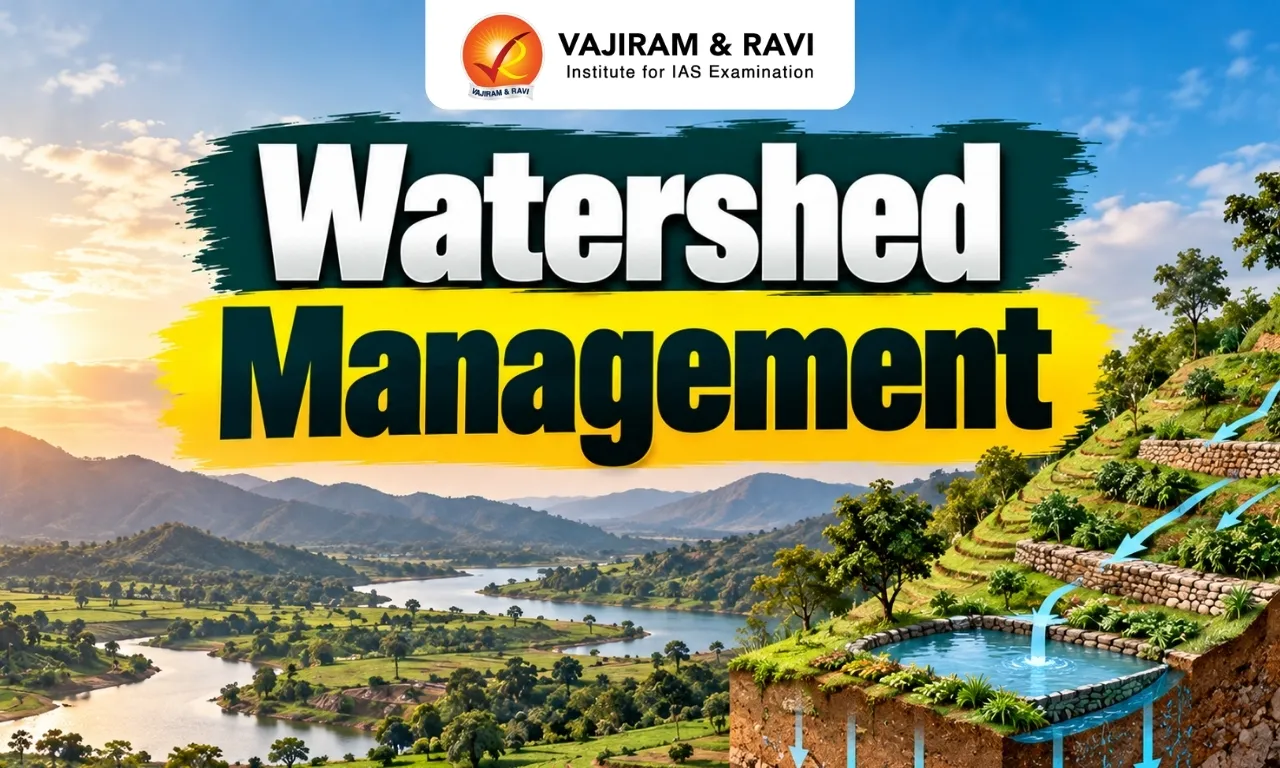
Watershed management is a holistic approach to land, water, and biomass conservation within a distinct hydrological boundary of a watershed. By treating the entire drainage basin as a unified ecosystem, it integrates natural resource management with rural development. This process focuses on capturing rainwater, controlling runoff, and mitigating topsoil erosion while enhancing agricultural productivity.
Modern watershed strategies balance ecological conservation with socio-economic growth, relying heavily on community participation to create climate-resilient rural livelihoods and ensure sustainable water security.
Watershed Management Meaning
Watershed management refers to the organised utilisation and conservation of natural resources within a watershed. It aims to protect land, water, and vegetation cover while fulfilling human and ecological requirements.
- Watershed: A watershed is a topographically bounded land and water area where surface runoff collects and drains through a single outlet into a larger body of water like a river or lake.
- Classification of Watershed: Watersheds are classified by size as follows:
- Macro watershed: > 50,000 hectares
- Sub-watershed: 10,000 to 50,000 hectares
- Milli-watershed: 1,000 to 10,000 hectares
- Micro watershed: 100 to 1,000 hectares
- Mini watershed: 1 to 100 hectares
Watershed Management Need
Watershed management plays a crucial role in safeguarding ecosystems, enhancing water security, and strengthening rural livelihoods against climate vulnerabilities.
- Water Conservation: It captures surface runoff to recharge depleted aquifers and raise groundwater tables.
- Soil & Quality Protection: Practices like terracing limit topsoil erosion, while vegetation filters sediments to improve water quality.
- Flood Mitigation: Regulated runoff velocities reduce peak flood surges downstream.
- Drought Resilience: It captures surface runoff through localised structures like check dams and Johads to recharge depleted aquifers, raise groundwater tables, and buffer dryland agricultural systems against recurrent droughts in India's semi-arid regions.
- Livelihood Security: Stable water availability enhances agricultural yields, fodder availability, and community livelihoods.
- Biodiversity Restoration: Re-establishing natural plant cover protects indigenous flora and fauna habitats.


Watershed Management Principles
The principles for sustainable watershed management establish a framework to balance natural resource conservation, soil health, and land productivity across the hydrological basin.
- Land Use Capability: Utilising land according to its inherent capability class prevents long-term environmental degradation and resource depletion.
- In-Situ Conservation: Conserving rainwater where it falls through measures such as contour farming, bunding and vegetative barriers improves soil-moisture retention and infiltration and can enhance groundwater recharge.
- Safe Runoff Disposal: Channelling surplus runoff through grassed waterways directs excess flow into storage structures at non-erosive velocities.
- Erosion Control: Check dams, contour barriers, vegetative cover and gully-plugging measures reduce soil erosion, slow runoff and help control gully formation.
- Holistic Community Planning: Participatory planning involving local communities and stakeholders helps manage the watershed as an integrated socio-ecological unit.
Watershed Management Objectives
Watershed management aims to restore ecological balance, enhance ecosystem resilience, and maximise natural resource utility. By integrating soil, water, and vegetation conservation within a unified hydrological unit, it seeks to drive long-term socio-economic prosperity, secure sustainable livelihoods, and strengthen climate adaptation for riverine and rural communities.
- The primary objective is to manage land and water resources to prevent environmental degradation and rehabilitate degraded ecosystems.
- It seeks to improve agricultural productivity and rural incomes through soil-moisture conservation, water harvesting, improved water productivity and sustainable agricultural practices.
- It promotes decentralised water security by improving local availability of water for domestic, livestock and agricultural needs and encouraging equitable resource use.
- It promotes decentralised water security by improving local availability of water for domestic, livestock and agricultural needs and encouraging equitable resource use.
- It strives to empower local communities through participatory decision-making and sustainable resource governance.
Watershed Management Methods
Watershed management methods integrate soil engineering, agronomic practices, and hydrological structures within a drainage basin. These techniques slow surface runoff, prevent severe topsoil erosion, enhance groundwater recharge, and filter pollutants to restore overall ecosystem health.
- Soil and Water Conservation:
- Contour farming involves ploughing along field contours to reduce runoff speed and retain topsoil.
- Terracing transforms steep slopes into stepped land to prevent downhill soil erosion and capture water.
- Check dams and gully plugs reduce runoff velocity, trap sediment and help control channel and gully erosion.
- Vegetation & Water Harvesting:
- Afforestation, mulching, and strip cropping protect topsoil, retain soil moisture, and improve water infiltration.
- Rainwater-harvesting structures, percolation tanks and farm ponds store or infiltrate runoff and can enhance groundwater recharge, depending on site conditions.
- Pollution & Urban Management: Buffer strips filter agricultural pollutants, while retention ponds regulate urban stormwater flow.
Watershed Management in India
Watershed management in India focuses on restoring degraded rainfed ecosystems through integrated land, water, and vegetation conservation. Driven by central schemes and active community participation, it aims to enhance groundwater recharge, prevent severe topsoil erosion, and ensure sustainable rural livelihoods.
- WDC-PMKSY 2.0 (Watershed Development Component - Pradhan Mantri Krishi Sinchayee Yojana): It focuses on treating degraded land, rainfed agriculture, and springshed rejuvenation across states.
- Emphasises biological soil-water conservation measures over heavy civil engineering structures.
- Integrates digital monitoring, GIS mapping, and community-based maintenance models.
- REWARD (Rejuvenating Watersheds for Agricultural Resilience through Innovative Development): A World Bank-assisted project leveraging scientific watershed planning and digital soil mapping across states.
- ABY (Atal Bhujal Yojana) & Jal Shakti Abhiyan - Catch the Rain: Focus on community-led groundwater budgeting and mass public participation (Jan Bhagidari).
- Haryali Watershed Development Project: It promotes water conservation in rural areas for household needs, agriculture, fisheries, and afforestation. Gram Panchayats implement activities with active community participation, encouraging decentralised management of local water resources.
- Neeru-Meeru (Water and You) Programme: The Neeru-Meeru Programme in Andhra Pradesh promotes community participation in water conservation through check dams, percolation tanks, and ponds. These structures store rainwater, enhance groundwater recharge, and strengthen local water-resource management.
- Community Models: Grassroots initiatives like Ralegan Siddhi and Hiware Bazar showcase successful community-driven water governance and socio-economic transformation.
Integrated Watershed Management Programme (IWMP)
The Integrated Watershed Management Programme (IWMP) was implemented as a Centrally Sponsored Scheme by the Department of Land Resources, Ministry of Rural Development, from 2009 to 2010. It aimed to restore ecological balance by conserving and developing degraded land and natural resources such as soil, water and vegetation.
- Objectives: Conserve soil, water and vegetation; control erosion and runoff; harvest rainwater, recharge groundwater and improve rural livelihoods.
- Amalgamation: In 2015-16, the IWMP was absorbed into the Pradhan Mantri Krishi Sinchayee Yojana (PMKSY) as the Watershed Development Component.
- Funding Pattern: The Centre-State funding ratio is 60:40 for most States, while it is 90:10 for Northeastern and hilly States. Union Territories without a legislature receive 100% Central funding.
- Target: It has a physical target of 49.50 lakh hectares (4.95 million hectares) for the 2021–2026 project period, with an indicative Central financial outlay of ₹8,134 crore.
- Institutional Framework: Implemented through a tiered framework that includes the State Level Nodal Agency (SLNA), the Watershed Cell Cum Data Centre (WCDC) at the district level, Project Implementing Agencies (PIAs), and village-level Watershed Committees.
- Strategy: Employs a cluster micro-watershed strategy (usually covering 1,000 to 5,000 hectares) based on the ridge-to-valley treatment principle.
Watershed Management Significance
Watershed management promotes sustainable use of soil and water resources, controls pollution and erosion, improves agricultural productivity, strengthens livelihoods, enhances ecosystem health, and supports climate resilience.
- Controls Pollution: Watershed management reduces pollution entering rivers and lakes by controlling runoff from rainfall, snowmelt, agricultural fields, settlements, and other surrounding land sources.
- Regulates Hazardous Activities: Watershed planning identifies activities that may harm water quality and natural resources, recommending measures to minimise their ecological impacts and risks.
- Enhances Stakeholder Partnerships: Watershed management promotes cooperation among communities, governments, farmers, industries, and other stakeholders, enabling coordinated resource management and effective implementation.
- Promotes Inclusive Growth: Watershed management supports equitable economic growth by improving water availability, agricultural productivity, livelihood opportunities, and income diversification, particularly in vulnerable rural communities.
- Improves Agricultural Productivity: In drought-prone rainfed regions, watershed management can increase water availability, support diversified cropping systems, enhance farm productivity, and strengthen rural livelihoods.
Watershed Management Challenges
Watershed management aims to integrate soil, land, and water resource conservation to sustain rural livelihoods, enhance agricultural productivity, mitigate land degradation, address climate risks, and resolve upstream-downstream resource conflicts in water-scarce regions.
- Institutional & Policy Gaps: Lack of integration across government departments, weak local governance, and ineffective participatory institutional mechanisms hinder long-term sustainability.
- Resource Conflicts & Equity: Unbalanced upstream-downstream water distribution creates trade-offs, marginalising downstream users, smallholders, and tribal communities.
- Common Property Resource (CPR) Management: Poor regulation and overexploitation of unmanaged common land and groundwater lead to severe land degradation and resource depletion.
- Economic & Livelihood Pressures: Low agricultural productivity, livestock feed shortages in water-scarce areas, and erratic rainfall force distress-driven seasonal migration.
- Climate Vulnerability & Adaptability: Intensifying droughts and shifting weather patterns demand resilient rainwater harvesting technologies, capacity development, and scaling of integrated conservation models across vulnerable catchments.
Watershed Management Way Forward
The way forward for watershed management requires shifting from isolated asset creation to comprehensive, community-led, and climate-resilient resource planning.
- Ensure Post-Project Maintenance: Establish dedicated Watershed Development Funds and define clear maintenance responsibilities for Gram Panchayats, Watershed Committees, and local user groups to ensure the long-term sustainability of completed projects.
- Promote Scheme Convergence: Integrate watershed development with complementary schemes such as MGNREGA for labour-intensive works, PMKSY for improving irrigation efficiency, and Jal Shakti Abhiyan for strengthening water conservation efforts.
- Harness Technology: Use GIS, remote sensing, and other digital tools for hydrological mapping, assessment of water resources, and evidence-based planning, particularly in drought-prone and water-stressed regions.
- Community Participation: Empower local communities, farmers, and women’s Self-Help Groups (SHGs) through participatory planning, capacity building, and decentralised decision-making to improve ownership and effectiveness.
- Promote Wastewater Reuse: Combine decentralised rainwater harvesting with the treatment and reuse of wastewater to recharge local water bodies, improve water availability, and revive seasonal streams and rivers.
Watershed Management UPSC PYQs
Q1: Elaborate the impact of the National Watershed Project in increasing agricultural production from water-stressed areas. (UPSC Mains 2019)
Q2: In what way micro-watershed development projects help in water conservation in drought-prone and semi-arid regions of India? (UPSC Mains 2016)
Q3: What are the benefits of implementing the 'Integrated Watershed Development Programme'?(UPSC Prelims 2014)
- Prevention of soil runoff
- Linking the country's perennial rivers with seasonal rivers
- Rainwater harvesting and recharge of groundwater table
- Regeneration of natural vegetation
Select the correct answer using the code given below.
(a) 1 and 2 only
(b) 2, 3 and 4 only
(c) 1, 3 and 4 only
(d) 1, 2, 3 and 4
Ans: (c)

 Last updated on Oct, 2026
→ UPSC 2027 Notification will be released on 13 January 2027 at upsconline.nic.in.
→ Check Nobel Prize 2026 Winners List here.
→ Download PIB PRiSM Monthly Magazine 2026 here.
→ Check UPSC Monthly Current Affairs Magazine The Recitals here.
→ Check out the latest UPSC Syllabus here.
→ Download UPSC Model Answers for Mains 2026
→ UPSC Mains Question Paper 2026 is out now for Essay & GS Paper 1, 2, 3 & 4.
→ UPSC Calendar 2027 has been released.
→ Enroll in Vajiram & Ravi’s UPSC Mains Test Series 2027 for structured answer writing practice, expert evaluation, and exam-oriented feedback.
→ Join Vajiram & Ravi’s UPSC Mentorship Program 2027 for personalized guidance, strategy planning, and one-to-one support from experienced mentors.
→ Go through the UPSC Mains Previous Year Papers to enhance your preparation.
→ UPSC has released UPSC Toppers List 2025 with the Civil Services final result on its official website.
→ Also check Best UPSC Coaching in India
Watershed Management FAQs
Q1. What is watershed management?+
Q2. What is the concept of a watershed?+
Q3. What are 7 methods of water conservation?+
Q4. What are the current watershed management schemes in India?+
Q5. What are the key principles of watershed management?+
Tags: quest UPSC Environment and Ecology Notes watershed management