Strategy for Environmental Economic Accounts 2026-2030

Strategy for Environmental Economic Accounts 2026–2030

Ministry of Statistics and Programme Implementation (MoSPI) released the Strategy for Environmental Economic Accounts in India 2026-2030 in October 2026. The strategy aims to strengthen environmental accounting in India by expanding the coverage of natural resources, addressing data gaps and improving the integration of environmental information with economic planning.

Strategy for Environmental Economic Accounts 2026-2030

Strategy for Environmental-Economic Accounts in India 2026-2030 is a roadmap prepared by MoSPI to improve the way India measures its natural resources and their relationship with economic activities. It builds on the progress made under the previous strategy for 2022-2026.

The document provides an action-oriented framework for developing environmental accounts, identifying potential data sources, addressing information gaps and setting priorities for the period 2026-2030.

What is Environmental-Economic Accounting?

Environmental-economic accounting is a system of collecting and organising information about the environment and the economy together. It helps measure natural resources, their use in economic activities and changes in the environment over time.

Traditional economic indicators, such as Gross Domestic Product (GDP), measure economic production but do not fully show the condition of natural resources or the environmental costs associated with economic growth. Environmental-economic accounting helps bridge this gap by connecting environmental data with economic statistics.

Key Components of Environmental-Economic Accounting

  • Natural resources: Measures resources such as forests, minerals, land, soil and water.
  • Resource use: Tracks how natural resources are used by households, industries and other economic activities.
  • Ecosystem services: Examines benefits provided by nature, such as pollination, carbon storage and water regulation.
  • Environmental changes: Records changes in the quantity, condition and use of natural resources.
  • Economic-environmental linkages: Connects environmental information with economic statistics to support sustainable planning.

Major Focus Areas Under the Strategy

The Strategy for Environmental Economic Accounts 2026-2030 identifies several areas for developing and expanding India's environmental accounts.

  • Forest accounts: Measure forest resources, their condition and their contribution to the economy and ecosystem services.
  • Mineral resources: Improve information on mineral resources and their role in economic activities.
  • Soil resources: Develop better information on soil resources and their condition to support sustainable land management.
  • Land accounts: Track land use and changes in land cover to support planning and resource management.
  • Water accounts: Improve information on water resources, their availability and their use across different sectors.
  • Carbon stock: Assess carbon stored in natural systems, helping improve understanding of their role in climate change mitigation.
  • Biodiversity: Strengthen the measurement of biodiversity and the benefits provided by ecosystems.
  • Environment-related activities: Improve accounting for activities associated with environmental protection and resource management.

What is the System of Environmental-Economic Accounting (SEEA)?

The System of Environmental-Economic Accounting (SEEA) is an internationally agreed framework endorsed by the United Nations Statistical Commission. It provides standard methods to connect environmental data with economic statistics. India has been developing environmental accounts under this framework since 2018 through MoSPI.

The SEEA Central Framework (SEEA-CF) covers environmental assets, natural resource flows and economic activities related to the environment.

Previous Strategy 2022-2026

The earlier strategy focused on expanding India's environmental accounts and developing new areas of measurement. Its initiatives included Material Flow Accounts, Ocean Accounts, Energy Accounts and thematic accounts related to biodiversity and urban areas.

The 2026-2030 strategy builds on this progress, with greater emphasis on expanding coverage, addressing data gaps and identifying future priorities.

Importance of the Strategy for India

  • Better policymaking: Helps governments consider environmental impacts while planning economic development.
  • Sustainable resource management: Supports the conservation and efficient use of forests, water, minerals and land.
  • Climate change assessment: Improves information on carbon stored in natural ecosystems.
  • Natural capital assessment: Provides a broader understanding of the economic and environmental value of natural resources.
  • Improved planning: Helps States and Union Territories develop environmental accounts suited to their regional priorities.
  • Sustainable development: Supports a balance between economic growth and environmental protection.

Challenges in Environmental-Economic Accounting

  • Data gaps: Environmental information may be incomplete or unavailable for some resources.
  • Measurement difficulties: Assessing biodiversity, soil quality and ecosystem services can be complex.
  • Different standards: Institutions may use different methods and classifications.
  • Valuation challenges: Assigning monetary values to ecosystem services is not always straightforward.
  • Limited technical capacity: Environmental accounting requires trained personnel and reliable statistical systems.

Way Forward

  • Improve data collection: Strengthen environmental surveys and monitoring systems.
  • Standardise methods: Adopt consistent accounting practices across institutions.
  • Strengthen coordination: Improve data sharing among central and State government agencies.
  • Use technology: Apply remote sensing and geographic information systems for environmental monitoring.
  • Integrate accounts into planning: Use environmental data in economic and natural resource management decisions.
  • Monitor progress: Review implementation and address data gaps regularly.

Strategy for Environmental Economic Accounts 2026-2030 FAQs

Q1: Who released the Strategy for Environmental Economic Accounts 2026-2030?

Ans: The Ministry of Statistics and Programme Implementation (MoSPI) released it on 7 October 2026.

Q2: What is the main objective of the strategy?

Ans: Its main objective is to expand environmental accounts, improve data quality and support evidence-based policymaking.

Q3: What is the SEEA framework?

Ans: The System of Environmental-Economic Accounting (SEEA) is a United Nations-endorsed framework that connects environmental information with economic statistics.

Q4: What are the major focus areas of the strategy?

Ans: The major areas include forests, minerals, soil, land, water, carbon stock, biodiversity and environmental statistics.

Q5: How is environmental accounting different from GDP?

Ans: GDP measures economic production, while environmental accounting provides additional information about natural resources, their use and changes in environmental conditions.

Great Indian Bustard Conservation: Rewilding and Recovery Challenges

Great Indian Bustard conservation

Great Indian Bustard conservation Latest News

  • Recently, India achieved a conservation milestone — two captive-bred male Great Indian Bustards (GIBs) were released into the wild for the first time, at Desert National Park, near Jaisalmer, Rajasthan. 
  • This rewilding pilot is part of Project GIB, run by the Centre, Wildlife Institute of India (WII), and the governments of Rajasthan and Gujarat. While historic, experts caution that population recovery remains a long-term challenge.

The Great Indian Bustard: Why It Matters

  • The GIB is a large, ground-dwelling bird found in savannahs, grasslands, and deserts. 
  • Until the late 19th/early 20th century, it was spread across 11 states — from Haryana in the north to Tamil Nadu in the south, and Rajasthan in the west to Odisha in the east.

Causes of Decline

  • Hunting and egg poaching.
  • Conversion of open habitats into croplands and mining areas.
  • Collisions with renewable energy power lines — the GIB’s poor frontal vision and heavy body make it hard to detect or avoid overhead wires.

Population Collapse

  • From an estimated 1,260–1,400 birds in the early 1970s, numbers have crashed to just around 150 today.
  • Of these, around 130 (±20) are in Rajasthan — the rest scattered across Gujarat, Maharashtra, Karnataka, Telangana, and Andhra Pradesh, facing local extinction risk.

Project GIB: The Conservation Breeding Effort

  • A long-term bustard and lesser florican conservation project was launched by the Centre and Rajasthan government in 2012–13, expanded from 2014 with funding for a conservation breeding programme.
  • From 2019, wild GIB eggs were collected from Desert National Park and nearby areas, artificially incubated at two centres — Sam and Ramdevra (Rajasthan) — and hand-reared.
  • These hand-reared birds have since bred at the centres, producing 98 birds so far.
  • Of these: 2 released (Oct 4, 2026); 11 earmarked for future wild release; the rest remain in captivity for continued breeding.

What Does Rewilding Involve?

  • Rewilding means transitioning captive-bred birds back into natural habitats. 
  • Key steps taken:
    • A rewilding aviary was set up at Ramdevra Centre, and a soft-release facility developed by WII inside Desert National Park.
    • Unlike hand-reared adult birds (used to humans), chicks aged 3–4 months were released here, allowing them to adapt naturally without human imprinting.
    • Released birds are fitted with transmitters, sending location/movement alerts three times daily; teams also monitor them remotely.
    • Release sites were chosen for their grassland cover and freedom from human/technological interference.

Challenges to Long-Term Recovery

  • Scaling Beyond Rajasthan: Similar rewilding efforts will be needed in Maharashtra, Madhya Pradesh, Karnataka, and Andhra Pradesh — but only after habitat improvement. 
  • Experts noted that grassland restoration and protection outside Rajasthan is crucial for wider revival, with Gujarat likely to follow if the Rajasthan pilot succeeds.

The Grassland Protection Gap

  • Unlike forests, grasslands are not traditionally treated as “protected areas” in public or policy perception, making them vulnerable to land-use conversion.
  • This also affects livelihoods of pastoralists and livestock-rearing communities.
  • Bustard expert had flagged this concern as early as 2008 in Hornbill magazine — warning that forest departments, not graziers, posed the bigger threat by converting grasslands into forests through afforestation and artificial waterhole creation, misunderstanding the bustard’s actual habitat needs.

Legal Safeguards and Persistent Threats

  • Following a landmark Supreme Court case on GIB protection, the Court accepted an expert panel’s recommendations and ordered:
    • Demarcation of “priority areas” — 14,013 sq km in Rajasthan and 740 sq km in Gujarat.
    • Undergrounding of 80 km of power lines in Rajasthan, to be completed between 2027 and 2028.
    • Creation of “powerline corridors” to accommodate re-routed overhead lines.

Remaining Threats

  • Experts warn rewilding won’t be sustainable unless power lines are undergrounded soon.
  • Limestone mining threatens the open, flat terrain bustards need — the Supreme Court did not order specific anti-mining measures, and mining operations are proposed on the northern side of Desert National Park, near the release site itself.

Conclusion

  • The release of two captive-bred bustards marks a symbolic breakthrough, but survival of the species hinges on far more than breeding success — it depends on protecting grasslands long dismissed as “wastelands,” undergrounding power lines on schedule, and curbing mining in critical habitats. 
  • Unless these systemic threats are addressed with the same urgency as captive breeding, rewilding risks becoming a short-lived experiment rather than a lasting recovery.

Source: IE

Great Indian Bustard Conservation FAQ

Q1: Why is Great Indian Bustard conservation important?

Ans: Great Indian Bustard conservation is critical because the species has declined from an estimated 1,260–1,400 birds in the early 1970s to around 150 today.

Q2: What is Project GIB?

Ans: Project GIB is a long-term conservation initiative involving the Centre, Wildlife Institute of India and Rajasthan and Gujarat governments to support breeding and recovery.

Q3: What does rewilding involve in Great Indian Bustard conservation?

Ans: Rewilding involves transitioning captive-bred birds into natural habitats, using soft-release facilities, young birds and transmitters for monitoring their movements.

Q4: What are the major threats to Great Indian Bustard conservation?

Ans: Major threats include habitat conversion, hunting, egg poaching, collisions with overhead power lines and limestone mining near critical grassland habitats.

Q5: What measures are needed to strengthen Great Indian Bustard conservation?

Ans: Great Indian Bustard conservation requires grassland restoration, timely undergrounding of power lines, control of mining and expansion of rewilding beyond Rajasthan.

Right to Protest in India: Constitutional Safeguards and Legal Remedies

Right to Protest

Right to Protest Latest News

  • The Delhi Police recently denied permission to the Cockroach Janta Party (CJP) to protest at Jantar Mantar, citing short notice — the group had applied just three days before the march, against a required 10-day notice period. 
  • The protest sought the resignation of Chief Election Commissioner Gyanesh Kumar over alleged irregularities in the Special Intensive Revision (SIR) exercise. 
  • This episode brings back a recurring constitutional question: how far does the right to protest extend, and what can organisers do when police deny permission?

The Constitutional Right to Protest

  • The right to protest flows from Article 19(1)(a) and 19(1)(b) of the Constitution:
    • Article 19(1)(a): Protects freedom of speech and expression.
    • Article 19(1)(b): Guarantees the right to assemble peacefully and without arms.
  • However, neither right is absolute:
    • Article 19(2) permits restrictions on speech, including on grounds of public order.
    • Article 19(3) allows “reasonable restrictions” on peaceful assembly in the interest of public order.

Key Supreme Court Precedent

  • Mazdoor Kisan Shakti Sangathan (2018): The apex court held that holding peaceful demonstrations is a fundamental right, essential for citizens to air grievances. 
  • The Court found that authorities had failed to adequately regulate demonstrations and permitted a system of prior permission, to be sought from the Police Commissioner or a delegated authority.

How the Permission System Works

  • Delhi Police guidelines for protests at Jantar Mantar require:
    • Applications submitted to the Deputy Commissioner of Police (DCP), ordinarily at least 10 days before the event.
    • Late applications “may also be considered” depending on space availability and time for arrangements — the 10-day rule is not an absolute bar.
    • Applications assessed on a “first-come, first-serve” basis, reviewed by the Special Branch, traffic police, and New Delhi district police.
    • The DCP weighs whether the protest could obstruct traffic, endanger safety, or disturb public tranquillity.
    • Permission may be revoked for unforeseen reasons (VIP security, intelligence inputs), but reasons must be recorded and conveyed to organisers.
    • Protests are capped at 1,000 people at Jantar Mantar; larger gatherings must shift to Ramlila Ground (capacity: 50,000).
  • Experts noted that the permission mechanism is meant to be facilitative, not prohibitive.

Recourse When Permission Is Denied

  • Step 1 — Approach Police Again: Organisers can seek reconsideration, respond to the stated reasons, or propose a smaller gathering, shorter duration, or alternative venue.
  • Step 2 — No Formal Appeal Exists: The DCP’s decision is “final and binding” under the standing order — there is no built-in appeal against refusal (as distinct from revocation, which requires recorded reasons).
  • Step 3 — Judicial Remedy: If refusal appears arbitrary, unsupported by guidelines, or inconsistent with the right to peaceful assembly, organisers can approach the Delhi High Court under Article 226 of the Constitution.
  • Consequences of Defying Denial: Protesting despite denial can attract Section 223 of the Bharatiya Nyaya Sanhita (BNS) (formerly Section 188 IPC) — disobeying a lawful order by a public servant, inviting imprisonment or fine. 
    • However, this must be read alongside the constitutional right to protest; the absence of a genuine alternative venue could be challenged as an unreasonable restriction.

Prohibitory Orders: A Separate Legal Track

  • A prohibitory order is a magistrate’s order barring specified activities (e.g., assembly of five or more persons) under Section 163 of the BNSS (earlier Section 144 CrPC).
  • Remedies against such orders:
    • Section 163(5): An aggrieved person can apply to the issuing magistrate to rescind or alter the order.
    • Section 163(7): The magistrate must give the applicant an early opportunity to be heard; if rejected, reasons must be recorded in writing.

Key Judicial Precedents

  • Babulal Parate v. State of Maharashtra (1961): Constitution Bench held affected persons have a right to challenge such orders, even if passed without a hearing.
  • Ramlila Maidan Incident (2012): The Court held that preventive orders must be based on “actual and prominent threat” to public order, and the power must be exercised with “great caution and free from arbitrariness.”
  • Mazdoor Kisan Shakti Sangathan (2018): Reaffirmed that permission requirements cannot become a tool to reject every protest. In the Court’s words: “Total extinction is not balancing.”

The Core Legal Tension

  • Legal experts argue that blanket restrictions without offering an alternative venue amount to a constitutional violation. 
  • They emphasised that any alternative location must be in the vicinity of those in authority — protest sites far from decision-makers defeat the purpose of dissent. 
  • Blocking without providing an alternative is illegal, he argued, even when done under Section 163.

Source: IE

Right to Protest FAQs

Q1: Which constitutional provisions protect the right to protest in India?

Ans: The right to protest derives from Article 19(1)(a), protecting free expression, and Article 19(1)(b), guaranteeing peaceful assembly without arms.

Q2: What are the Delhi Police guidelines for protests at Jantar Mantar?

Ans: Delhi Police guidelines ordinarily require applications at least ten days beforehand, with permissions assessed according to space, traffic, safety and public tranquillity.

Q3: What can organisers do if permission to protest is denied?

Ans: Organisers can seek reconsideration, propose changes to the gathering or venue, or approach the Delhi High Court under Article 226 if refusal appears arbitrary.

Q4: How can citizens challenge prohibitory orders restricting protests?

Ans: Under Section 163(5) of the BNSS, affected persons can request the issuing magistrate to rescind or modify an order restricting assembly.

Q5: What limits has the Supreme Court placed on restrictions on protests?

Ans: The Supreme Court has held that restrictions must address genuine public-order concerns and cannot arbitrarily eliminate peaceful demonstrations or deny meaningful opportunities for dissent.

US Section 301 Investigation – Impact on India’s Trade and Tariffs

US Section 301 Investigation

US Section 301 Latest News

  • India has joined a joint statement by 14 countries and the European Union acknowledging concerns over global structural overcapacity, a development that could influence the outcome of the US Section 301 investigation and proposed tariffs on Indian goods.

Understanding Global Manufacturing Overcapacity

  • Global manufacturing overcapacity refers to a situation in which an economy or industry produces more goods than domestic and international markets can absorb at prevailing prices.
  • It can emerge because of excessive investment, government support, weak demand, inefficient allocation of capital or the expansion of production beyond sustainable market requirements. Overcapacity may lead to:
    • Price distortions: Excess supply can depress international prices and affect competing producers.
    • Trade tensions: Countries may accuse competitors of using subsidies or other non-market practices to gain an unfair advantage.
    • Industrial disruption: Domestic manufacturers may struggle to compete with cheaper imports, potentially affecting employment and investment.
    • Trade protectionism: Governments may introduce tariffs or other restrictions to protect domestic industries.
  • Sectors identified as areas of concern in the recent international discussions include automobiles, electric vehicles, batteries, chemicals, foundational semiconductors and solar panels. China is frequently accused of having excess capacity in several of these sectors.
  • However, determining whether excess capacity exists, and whether it results from unfair trade practices, requires sector-specific evidence and careful economic assessment.

US Section 301 Investigation

  • Section 301 of the US Trade Act of 1974 provides a mechanism through which the United States investigates foreign government practices that it considers unreasonable, discriminatory or restrictive to US commerce.
  • The process can have significant implications for international trade because it may lead to trade restrictions or additional tariffs, depending on the findings and actions taken by the US authorities.

Key Developments

  • International consultations: At the G20 Trade Ministers’ Meeting held in Milwaukee on September 30 and October 1, 2026, participating countries discussed the impact of global overcapacity.
  • Joint statement: The United States announced on October 7 that participating countries had acknowledged the challenges posed by structural excess capacity and production.
  • Technical discussions: The countries committed to meeting before December 2026 to develop terms of reference, exchange non-confidential information and identify gaps in available data.
  • Potential tariff implications: Experts cited in the report suggested that India's participation could influence the US Trade Representative's decision on proposed tariffs. However, this outcome remains uncertain pending the investigation's results.
  • The investigation covers multiple economies, including China, India, Japan, South Korea, several Southeast Asian countries and members of the European Union.

Why Is India’s Position Significant?

  • India's participation reflects an attempt to engage with international concerns over manufacturing while protecting its domestic industrial interests.
  • Commerce Minister Piyush Goyal has maintained that India's manufacturing capacity in the sectors identified by the G20 Presidency serves domestic and global demand, and that the country does not have structural excess capacity in these sectors.
  • India's position is significant for three reasons.
    • First, tariff exposure: Cooperation with the United States could potentially reduce the likelihood of additional trade restrictions, although this is not guaranteed.
    • Second, export competitiveness: More favourable tariff treatment could help Indian exporters compete with manufacturers from China and ASEAN economies in the US market.
    • Third, industrial policy: India must ensure that international cooperation does not undermine legitimate efforts to expand domestic manufacturing, attract investment and develop strategic industries.

Challenges and Concerns for India

  • Despite the potential benefits of cooperation, the investigation raises several concerns.
  • Risk of collateral damage
    • Measures designed to address global overcapacity may affect countries beyond those primarily associated with the problem. India's industrial expansion could come under scrutiny if production growth is interpreted as creating excess capacity.
  • Conflict between industrialisation and trade restrictions
    • Developing economies often expand manufacturing to generate employment, improve productivity and reduce import dependence. Restrictions based on broad interpretations of overcapacity could constrain these objectives.
  • Unequal treatment of subsidies
    • The report raises the concern that international discussions should also examine agricultural overcapacity and subsidised exports in developed economies, particularly their effects on farmers and rural livelihoods in developing countries.
  • Impact on domestic industrial corridors
    • An August 2026 US report criticised several global manufacturing hubs, including the Pune-Gujarat-Chennai industrial corridor. 
    • Such criticism highlights the potential for trade investigations to become connected with wider competition over industrial capacity and manufacturing investment.

Way Forward

  • Evidence-based assessment: Use sector-specific production, demand, capacity utilisation and export data to demonstrate that manufacturing expansion is commercially justified.
  • Constructive negotiations: Engage with the United States to seek clarity on the criteria used to identify structural overcapacity and the potential consequences for Indian exporters.
  • Protect policy space: Ensure that international cooperation does not automatically imply acceptance of allegations against Indian manufacturing or restrict legitimate industrial development.
  • Strengthen competitiveness: Improve logistics, infrastructure, skills, technology adoption and productivity to make Indian manufacturing competitive without relying on trade distortions.
  • Promote multilateral solutions: Use platforms such as the G20 and OECD-related forums to develop transparent and balanced approaches to global trade imbalances.

Source: IE

US Section 301 FAQs

Q1: What is the US Section 301 investigation?

Ans: It is a US trade investigation examining foreign government practices considered unreasonable, discriminatory or restrictive to US commerce, with the current probe focusing on structural manufacturing overcapacity.

Q2: What does global manufacturing overcapacity mean?

Ans: It refers to a situation in which production exceeds the demand that domestic and international markets can absorb at prevailing prices.

Q3: Why is India participating in discussions on global overcapacity?

Ans: India is engaging in international discussions that could influence trade relations and tariff decisions while maintaining that its manufacturing capacity serves domestic and global demand.

Q4: Which sectors are under scrutiny in the overcapacity discussions?

Ans: The sectors identified include automobiles, electric vehicles, batteries, chemicals, foundational semiconductors and solar panels.

Q5: Could the investigation lead to additional tariffs on India?

Ans: Additional tariffs remain a possibility, but India's participation in the joint statement could influence the US decision; the final outcome depends on the investigation and subsequent action.

India’s Bilateral Investment Treaties (BITs) – Balancing Investor Protection with State Sovereignty

Bilateral Investment Treaties

Bilateral Investment Treaties (BITs) Latest News

  • After terminating several bilateral investment treaties (BITs) in 2016–17, India is revamping its investment treaty framework to attract sustained foreign direct investment (FDI) while safeguarding its regulatory autonomy. 
  • Following the announcement in the Union Budget 2025–26 to review the 2016 Model BIT, the government is preparing a revised template, with four to five investment agreements expected to be finalised by the end of 2026.
  • India has already concluded agreements with countries such as Saudi Arabia, Israel and the UAE, reflecting a gradual shift towards a more investor-friendly approach.

What is a Bilateral Investment Treaty (BIT)?

  • A BIT is an agreement between two countries that establishes the rules for protecting and promoting investments made by investors of one country in the territory of the other.
  • Key objectives:
    • Provide legal certainty and protection against discriminatory or arbitrary treatment.
    • Build investor confidence and encourage cross-border investment.
    • Establish mechanisms for resolving investment disputes.
    • Balance investor protection with the host country's right to regulate in the public interest.
  • Evolution of India’s BIT framework:
    • 1993 Model BIT: India began concluding BITs under its original model, subsequently amended in 2003.
    • 2016 Model BIT: 
      • India adopted a revised framework emphasising the State's right to regulate and imposing stricter conditions on access to ISDS - Investor-State Dispute Settlement.
      • ISDS allows foreign investors to bring claims against host governments for alleged violations of investment treaty obligations.
      • India had signed BITs with 83 countries, of which 74 were ratified (as per data presented in Parliament in March 2023).
    • 2016–17: India issued termination notices to numerous treaty partners (~68 countries) and sought renegotiation under the revised model. 
  • Recent developments: India has signed BITs with countries including Belarus, Kyrgyz Republic, Brazil, UAE, Uzbekistan, and Taiwan.

India’s Evolving Approach to Investment Treaties

  • Relaxation of the Exhaustion of Local Remedies (ELR) requirement:
    • ELR requires foreign investors to approach the host country's domestic courts or administrative authorities before initiating international arbitration.
    • India’s 2016 Model BIT introduced a five-year local-remedies requirement, which was criticised by investors for delaying access to international dispute settlement.
    • Recent agreements indicate greater flexibility - 
      • UAE: The 2024 BIT reduced the local-remedies period to three years.
      • Saudi Arabia: The recently concluded agreement provides for a two-year period before investors can approach international arbitration.
    • Some trading partners have sought a one-year period, but India has not accepted such demands so far.
    • The Saudi agreement is particularly significant amid expectations of investment in India's refinery sector. 
    • The government argues that the revised approach improves investor access to dispute settlement while preserving the State's regulatory authority.
  • Need for a Consistent Treaty Framework:
    • India should adopt a more uniform approach to ELR provisions. 
    • A period of one to two years for pursuing domestic remedies could improve investor confidence. 
    • The overall limitation period for initiating investor-state claims should also be practical rather than excessively restrictive.

Investor Rights versus State Sovereignty

  • India's decision to terminate several BITs followed concerns that adverse international arbitral awards could constrain domestic policymaking. 
  • Developing countries like South Africa and Indonesia have also withdrawn from or restructured investment treaty arrangements to preserve regulatory autonomy.
  • Key concerns associated with BITs and ISDS:
    • Erosion of policy space: Treaty obligations may constrain governments' ability to regulate in the public interest.
    • High litigation costs: Defending international investment claims can impose a substantial financial burden on governments.
    • Regulatory chilling effect: Governments may hesitate to introduce legitimate regulations for fear of costly arbitration.
    • Constraints on technology transfer: Treaty protections may limit the policy instruments available to developing countries seeking to strengthen domestic productive capabilities through FDI.
    • These concerns have fuelled demands for reforming the international investment regime, particularly in the Global South.
  • Changing international practices:
    • The debate is not confined to developing countries. For example,
    • These developments illustrate growing scrutiny of the balance between investment protection, climate action and domestic regulatory autonomy.

Importance of Domestic Dispute Resolution

  • Requiring investors to exhaust domestic remedies can give governments an opportunity to understand grievances and resolve disputes before they escalate to international arbitration.
  • However, this approach will work only if investor disputes are resolved efficiently. A treaty provision alone cannot compel domestic courts to prioritise foreign investors over Indian investors.
  • A possible way forward is to establish a statutory, time-bound grievance-redressal mechanism accessible to both domestic and foreign investors. 
  • Faster dispute resolution could prevent disputes from escalating, reduce litigation costs and improve India's investment climate.

Conclusion

  • India's investment treaty reform must strike a careful balance between investor confidence and sovereign regulatory autonomy. 
  • A predictable, transparent and time-bound dispute-resolution framework, supported by a modern and consistent Model BIT, can help attract long-term FDI without compromising legitimate public-interest regulation.

Source: IE

Bilateral Investment Treaties (BITs)

Q1: What are Bilateral Investment Treaties (BITs)?

Ans: BITs establish rules for protecting cross-border investments, provide legal certainty, facilitate dispute resolution and strengthen investor confidence.

Q2: Why did India revise its Model BIT in 2016?

Ans: India revised its Model BIT in 2016 to protect regulatory autonomy and prevent excessive investor claims.

Q3: What is Investor-State Dispute Settlement (ISDS)?

Ans: ISDS enables foreign investors to bring treaty-based claims against host governments.

Q4: How does the Exhaustion of Local Remedies (ELR) requirement affect foreign investment disputes?

Ans: ELR requires investors to seek domestic remedies before international arbitration.

Q5: How can India balance investor protection with its sovereign right to regulate?

Ans: India should adopt a predictable Model BIT, establish statutory time-bound grievance redressal, etc.

Daily Editorial Analysis 10 October 2026

Daily-Editorial-Analysis

BRICS in a Fragmented World Order, A Test of Relevance

Context

  • The 18th BRICS Summit, held in New Delhi on September 12–13, 2026, demonstrated the grouping’s ability to reconcile divergent interests through the unanimous adoption of the New Delhi Declaration.
  • Under India’s chairmanship, the summit reinforced strategic autonomy, multipolarity and consensus-building.
  • However, institutional weaknesses, geopolitical rivalries and economic inequalities continue to limit BRICS’ effectiveness.

The New Delhi Declaration: Major Achievements

  • The declaration addressed global governance, trade, finance, energy, climate change, technology, health and agriculture. Its major objectives included:
    • Promoting local-currency trade and interoperable cross-border payment systems.
    • Implementing the BRICS Economic Partnership Strategy 2030 and the Global Value Chain Action Plan for 2026–2030.
    • Reforming the United Nations and international financial institutions to improve developing countries’ representation.
    • Supporting de-escalation in West Asia and humanitarian access to Gaza.
    • Strengthening cooperation in artificial intelligence, food security and sustainable development.
  • The declaration also defended the World Trade Organization (WTO) and its rules-based trading system.
  • Nevertheless, the success of these initiatives depends on translating commitments into practical outcomes.

The Message and the Approach

  • Reforming Global Governance

    • Existing international institutions inadequately reflect contemporary economic and demographic realities.
    • India advocated reforms to the United Nations, International Monetary Fund (IMF) and World Bank to provide emerging and developing economies with greater representation.
    • Prime Minister Narendra Modi urged BRICS leaders to develop ten proposals for global governance reform.
    • The emphasis on multi-polarity reflected the demand for a more inclusive international order.
    • However, meaningful reform requires sustained negotiations and political commitment.
  • Strategic Autonomy and Diplomatic Engagement

    • India’s approach reflected strategic autonomy and multi-alignment, allowing cooperation with competing powers without excessive dependence on any single country.
    • The participation of Chinese President Xi Jinping, Russian President Vladimir Putin, the UAE and Iran demonstrated BRICS’ potential to facilitate dialogue.
    • However, diplomatic cordiality does not necessarily resolve underlying disputes.
    • Sustained cooperation requires members to manage differences while pursuing common interests.
  • Artificial Intelligence and Sustainable Development

    • The declaration recognised artificial intelligence (AI) as a driver of economic growth, improved public services and sustainable development.
    • It encouraged cooperation in computing resources, research, skills and innovation.
    • Collaboration in technology, healthcare, energy and agriculture could help developing countries address shared challenges and reduce technological inequalities.

What a More Sober Assessment Shows

  • The Limits of Multilateral Cooperation

    • Since the first BRIC summit in 2009, major demands for reforming the IMF, World Bank and United Nations have remained substantially unfulfilled.
    • BRICS has also failed to achieve sufficient economic integration to challenge the dominance of the Bretton Woods institutions effectively.
    • This reveals a persistent gap between declared ambitions and practical achievements.
    • Consensus has limited value without implementation, institutional capacity and measurable results.
  • From Multilateralism to Pragmatic Coalitions

    • The contemporary world increasingly favours ad hoc cooperation and interest-based partnerships over permanent alliances.
    • BRICS members differ in political systems, economic priorities and strategic objectives.
    • Consequently, the grouping is better understood as a flexible platform for consultation and selective cooperation than as a unified geopolitical bloc.

The China Factor

  • Growing Economic Asymmetry

    • China’s economic and political influence has expanded considerably relative to other BRICS members, creating an imbalance of power within the grouping.
    • Such dominance risks reproducing the concentration of power that BRICS seeks to challenge internationally.
    • China’s growing influence also complicates its claim to represent the diverse interests of the Global South.
  • India–China Strategic Rivalry

    • Relations between India and China remain uneasy despite diplomatic efforts following the 2020 Galwan Valley clash.
    • Strategic mistrust between two leading BRICS members constrains collective decision-making.
    • India must ensure that BRICS remains a platform for cooperation rather than an instrument of disproportionate influence by any single member.

Implications for India

  • The summit enhanced India’s diplomatic visibility and demonstrated its ability to facilitate dialogue.
  • Nevertheless, BRICS membership does not automatically guarantee economic benefits or political leverage.
  • India should pursue a balanced foreign policy, combining engagement with BRICS, cooperation with Western economies and partnerships across the developing world.
  • Its influence will ultimately depend on domestic economic strength, diplomatic credibility and effective international coalitions.

The Way Forward

  • Institutional reform: Advance realistic proposals for more representative global governance.
  • Economic integration: Strengthen local-currency trade, payment systems, investment and value chains.
  • Conflict management: Develop consultation mechanisms to prevent bilateral disputes from obstructing cooperation.
  • South-South cooperation: Deliver measurable benefits through healthcare, agriculture, renewable energy and technology.
  • Strategic autonomy: Enable India to pursue national interests through diversified international partnerships.

Conclusion

  • The New Delhi Summit reaffirmed the demand for a more inclusive and multipolar international order while strengthening India’s diplomatic profile.
  • However, institutional weaknesses, limited economic integration, geopolitical rivalries and China’s growing dominance continue to constrain BRICS.
  • Its future relevance depends on converting consensus into concrete outcomes. India should engage actively with BRICS while preserving strategic autonomy and diversified partnerships.
  • The true measure of BRICS’ success lies in practical cooperation and meaningful global reforms, not merely unanimous declarations.

BRICS in a Fragmented World Order, A Test of Relevance FAQs

Q1. What was the major achievement of the 18th BRICS Summit?

Ans. The summit unanimously adopted the New Delhi Declaration.

Q2. What is the main objective of BRICS’ global governance reforms?

Ans. BRICS seeks greater representation for developing countries in global institutions.

Q3. What is the major challenge facing BRICS?

Ans. BRICS faces geopolitical rivalries, limited economic integration and internal power imbalances.

Q4. How does China affect BRICS’ unity?

Ans. China’s economic dominance and rivalry with India complicate collective decision-making.

Q5. What should India’s approach towards BRICS be?

Ans. India should engage with BRICS while preserving strategic autonomy and diversified international partnerships.

Source: The Hindu


India’s ‘WorldSkills’ Medals Reflect Patient Investment

Context

  • The Bhagavad Gita (Verse 18.46) teaches that a person attains perfection by performing their work with dedication and devotion.
  • This principle emphasises the dignity of labour and recognises craftsmanship as a virtue.
  • India’s performance at the 48th WorldSkills Competition in Shanghai in September 2026 reflects the growing potential of its skilled workforce.
  • Securing 10th position globally with 26 medals, including six silver medals, India demonstrated that vocational skills are essential for economic productivity and national development.

Skilled Talent on the World Stage

  • The WorldSkills Competition, held every two years, is considered the Olympics of vocational skills.
  • It brings together over 1,400 participants from approximately 70 countries to demonstrate expertise in welding, robotics, cybersecurity, industrial design and other trades.
  • India’s performance has improved significantly, rising from 39th position in 2011 to 19th in 2017 and 13th in 2019 and 2024.
  • In Shanghai, India achieved its best-ever performance, winning six silver medals and 20 Medallions for Excellence. Its 70-member team competed across 63 skills.
  • Mohammed Salam won silver in dental prosthetics, Kovid Gangrade in digital interactive media design, and Saniya Joshi in retail sales.
  • Smriti Nambiar, Parth Vohra and Mehrunissa Begum also secured silver medals in bakery, industrial design technology, and logistics and freight forwarding, respectively.
  • These achievements challenge the traditional preference for academic qualifications over vocational careers.
  • Skill-based professions deserve recognition equal to academic achievements, as economic development requires both theoretical knowledge and practical expertise.

Humble Beginnings to Excellence

  • India’s medal winners demonstrate how talent can flourish through determination and appropriate opportunities.
  • Kaif Khan from Lucknow developed his car-painting skills while working in a private automobile workshop after Class 10.
  • Following success in IndiaSkills competitions, he received industry training and international exposure before earning a Medallion for Excellence in Shanghai.
  • Mohammed Salam from Tamil Nadu won silver in dental prosthetics, a discipline requiring exceptional precision.
  • Other Indian participants received recognition in automobile technology, additive manufacturing, Industry 4.0 and robot systems integration.
  • These achievements demonstrate that talent exists across diverse social and geographical backgrounds, but access to quality training remains crucial.
  • Identifying promising candidates, providing practical instruction and offering industry exposure can transform local talent into internationally competitive professionals.

From Capex and Opex to Skill-Ex

  • Economic development traditionally emphasises capital expenditure (Capex), which creates infrastructure, and operational expenditure (Opex), which maintains it.
  • However, factories, machinery and infrastructure cannot deliver their full potential without trained workers.
  • Skill-Ex, or deliberate investment in human skills, must therefore become the third pillar of development.
  • It improves productivity, strengthens industrial competitiveness and enables workers to operate advanced technologies effectively.
  • The PM-SETU scheme, or Pradhan Mantri Skilling and Employability Transformation through Upgraded ITIs, reflects this approach.
  • With an allocation of ₹60,000 crores, it aims to upgrade 1,000 government Industrial Training Institutes into 200 hubs and 800 spokes, with industry partners managing the clusters.
  • Its success will depend on modern equipment, qualified instructors, updated curricula and measurable employment outcomes.

There Must Be a Focus on ‘Skill-Ex’

  • Government initiatives alone cannot establish a sustainable skilling ecosystem.
  • Industry participation is essential because employers understand evolving technological requirements and workplace needs.
  • Businesses should invest in workforce training as seriously as they invest in machinery and infrastructure.
  • Industry-linked apprenticeships, practical training, recognised certifications and continuous reskilling can reduce the gap between educational qualifications and employment requirements.
  • India must also address the social stigma surrounding vocational occupations, uneven training quality and limited career progression.
  • Skilled workers need fair wages, safe working conditions and opportunities for advancement.
  • The dignity of labour must translate into practical recognition, rather than remaining a symbolic ideal.

Conclusion

  • India’s WorldSkills 2026 performance demonstrates the potential of its young workforce when talent receives systematic training and institutional support.
  • The priority now is to convert competitive achievements into large-scale employability, higher productivity and inclusive growth.
  • Strengthening vocational institutions, expanding industry partnerships and investing in Skill-Ex can prepare India’s workforce for technological transformation.
  • Ultimately, national progress depends not only on policymakers and infrastructure developers but also on those who weld, bake, paint, repair and manufacture with precision.
  • As the Bhagavad Gita teaches, dedicated work is a source of excellence and service to society.

India’s ‘WorldSkills’ Medals Reflect Patient Investment FAQs

Q1. What position did India secure at WorldSkills 2026?

Ans. India secured 10th position with 26 medals.

Q2. What does Skill-Ex mean?

Ans. Skill-Ex means deliberate investment in human skills.

Q3. What is the objective of the PM-SETU scheme?

Ans. The PM-SETU scheme aims to upgrade 1,000 government ITIs.

Q4. Why is industry participation important in skill development?

Ans. Industry participation aligns vocational training with workplace requirements.

Q5. How can India become a global skilling leader?

Ans. India can become a global skilling leader by improving vocational education, industry partnerships and workforce training.

Source: The Hindu

Daily Editorial Analysis 2026 FAQs

Q1: What is editorial analysis?

Ans: Editorial analysis is the critical examination and interpretation of newspaper editorials to extract key insights, arguments, and perspectives relevant to UPSC preparation.

Q2: What is an editorial analyst?

Ans: An editorial analyst is someone who studies and breaks down editorials to highlight their relevance, structure, and usefulness for competitive exams like the UPSC.

Q3: What is an editorial for UPSC?

Ans: For UPSC, an editorial refers to opinion-based articles in reputed newspapers that provide analysis on current affairs, governance, policy, and socio-economic issues.

Q4: What are the sources of UPSC Editorial Analysis?

Ans: Key sources include editorials from The Hindu and Indian Express.

Q5: Can Editorial Analysis help in Mains Answer Writing?

Ans: Yes, editorial analysis enhances content quality, analytical depth, and structure in Mains answer writing.

Election Commission of India (ECI), Structure, Framework, Composition

Election Commission of India

The Election Commission of India (ECI) is an autonomous constitutional authority responsible for administering elections to the Parliament, state legislatures, and the offices of the President and Vice-President of India. Established on 25 January 1950, the Commission ensures that elections are conducted freely, fairly, and transparently across the country. Its work upholds the democratic principle of universal adult suffrage guaranteed by the Constitution under Article 326. The ECI’s independence and credibility are vital to maintaining India’s democratic integrity.

Election Commission of India

The Election Commission of India derives its powers and responsibilities from Article 324 of the Indian Constitution. It is a constitutional body, independent of government influence, tasked with supervising the entire electoral process. Initially a single-member body, it became a multi-member Commission in 1993, consisting of the Chief Election Commissioner (CEC) and two Election Commissioners. The ECI manages over 97 crore registered voters (as per 2024 data) and conducts elections in more than 10 lakh polling stations nationwide.

Election Commission of India Structure

The Election Commission of India (ECI) is a constitutional body established under Article 324 of the Indian Constitution. It is a multi-member commission responsible for supervising elections to Parliament, State Legislatures, and the offices of the President and Vice President. Originally, it had only one Chief Election Commissioner (CEC), but since October 1993, it became a three-member body. The Commission operates as a collegiate body, ensuring collective decision-making. It has a permanent secretariat at Nirvachan Sadan, New Delhi, and functions independently of government control. Its structure ensures autonomy, impartiality, and accountability in the electoral process as mandated by the Constitution.

Election Commission of India Composition

The ECI comprises the Chief Election Commissioner (CEC) and two Election Commissioners (ECs), as provided under Article 324(2) of the Constitution. The President of India determines the number of Commissioners from time to time. All three members enjoy equal powers, salaries, and status, and decisions are taken collectively through majority vote. The Chief Election Commissioner acts as the head of the institution, ensuring smooth coordination. The administrative staff is drawn from central and state government services. This composition aims to maintain checks and balances within the Commission, upholding transparency and non-partisanship in the conduct of elections.

As of 2026 the members of Election Commission of India are:

  • Chief Election Commissioner (CEC): Shri Gyanesh Kumar
  • Election Commissioners: Dr. Sukhbir Singh Sandhu and Dr. Vivek Joshi

Chief Election Commissioner (CEC)

The Chief Election Commissioner is the head of the Election Commission of India and ensures the independence and integrity of the electoral process.

  • The CEC is appointed by the President of India under Article 324(2) of the Constitution.
  • The CEC’s role is crucial in enforcing the Model Code of Conduct (MCC), supervising voter rolls, and ensuring impartial conduct of elections.
  • The Supreme Court in T.N. Seshan vs Union of India (1995) upheld that all Election Commissioners are equal in power and status, ensuring collective functioning.
  • The CEC is considered the guardian of India’s electoral democracy, accountable only to Parliament and the Constitution.

Election Commissioners Appointment

The Chief Election Commissioner and other Election Commissioners are appointed by the President of India under Article 324(2). Though the Constitution does not specify a detailed procedure, the appointment is made on the advice of the Council of Ministers. However, several legal experts and the Supreme Court (in March 2023) have recommended a collegium system involving the Prime Minister, Leader of Opposition, and Chief Justice of India to ensure transparency until Parliament enacts law. Their appointment order is issued by the President, and their terms, conditions, and service benefits are defined under the Election Commission (Conditions of Service) Rules 1992.

Election Commissioners Tenure

Under the Election Commission (Conditions of Service of Election Commissioners and Transaction of Business) Act 1991, each Election Commissioner, including the CEC, holds office for six years or until attaining the age of 65 years, whichever is earlier. This fixed tenure provides functional independence and stability. Their salaries and allowances are equivalent to those of Judges of the Supreme Court, ensuring parity with other high constitutional offices. Article 324(5) protects their tenure by stating that their service cannot be varied to their disadvantage after appointment. Such constitutional safeguards ensure autonomy and prevent arbitrary interference by the executive branch.

Election Commissioners Resignation and Removal

Election Commissioners may resign from office by submitting a written resignation to the President of India. However, the Chief Election Commissioner (CEC) enjoys stronger constitutional protection. Under Article 324(5), the CEC can be removed only in the same manner and on the same grounds as a Judge of the Supreme Court, that is, by a special majority of both Houses of Parliament on proven misbehavior or incapacity. Other Election Commissioners can be removed only on the recommendation of the CEC. This system ensures the Commission’s independence, preventing misuse of executive power and preserving the institution’s credibility and neutrality in elections.

Election Commission of India Powers

The Commission enjoys wide-ranging powers to ensure the integrity, neutrality, and transparency of the electoral process across India.Key Powers:

  • Administrative Powers: Control over election schedules, polling arrangements, and the deployment of polling staff.
  • Advisory Powers: Advises the President and Governors on matters related to disqualification of members.
  • Quasi-Judicial Powers: Decides disputes regarding political party recognition and symbols under the Election Symbols (Reservation and Allotment) Order, 1968.
  • Regulatory Powers: Enforces the Model Code of Conduct (MCC) and monitors election expenditure.
  • Disciplinary Powers: Can direct transfers or suspension of officials for election-related misconduct.

Election Commission of India Functions

The ECI performs multiple functions to ensure free, fair, and periodic elections in accordance with democratic principles. Major Functions:

  • Conduct of Elections: Supervises, directs, and controls elections to Parliament, State Legislatures, and high offices.
  • Delimitation: The Election Commission of India (ECI) does not directly have delimitation powers; instead, it oversees the process, which is conducted by a separate, temporary Delimitation Commission established by the Central Government.
  • Electoral Rolls: Prepares, revises, and updates voter lists through continuous revision and SIR (Special Intensive Revision).
  • Registration of Political Parties: Recognizes parties and allots election symbols.
  • Voter Education: Promotes awareness under the Systematic Voters’ Education and Electoral Participation (SVEEP) program.
  • Monitoring Expenditure: Ensures transparency through election expenditure audits and monitoring teams.

Election Commission of India Constitutional Provisions

The Election Commission of India is established under Article 324 of the Constitution to ensure free and fair elections in India. Key Constitutional Provisions:

  • Article 324(1): Grants the ECI the power to conduct elections to Parliament, State Legislatures, and the offices of President and Vice-President.
  • Article 324(2): Empowers the President to appoint the Chief Election Commissioner and other Election Commissioners.
  • Article 324(5): Provides protection to the tenure and service conditions of the CEC, ensuring independence.
  • These provisions ensure the ECI acts as an autonomous constitutional authority, not subordinate to any executive or legislature.

Election Commission of India Legal Safeguards

The legal framework guarantees the Commission’s independence and shields it from executive or political influence during elections. Major Legal Provisions:

  • Article 324(5): Protects the CEC’s tenure and prevents arbitrary removal.
  • Election Commission (Conditions of Service of Election Commissioners and Transaction of Business) Act, 1991: Defines tenure, salaries, and conditions of service.
  • Representation of the People Acts (1950 & 1951): Provide detailed election procedures, voter eligibility, and dispute resolution.
  • Indian Penal Code & Conduct of Election Rules, 1961: Penalize malpractices like bribery, booth capturing, and false nominations.
  • These legal safeguards collectively ensure institutional autonomy and operational transparency.

Election Commission of India Government Policies

To strengthen electoral integrity, several policy measures and reforms have been introduced by the government in consultation with the ECI. Key Policies and Their Impact:

  • Electoral Bond Scheme (2018): Introduced to improve transparency in political funding, though under judicial scrutiny.
  • One Nation, One Election (Proposal): Aims to synchronize national and state elections, reducing expenditure and administrative burden.
  • Voter ID-Aadhaar Linking Drive (Proposal): Ensures cleaner voter rolls by removing duplicate entries.
  • Remote Voting Prototype (Proposal): Designed to allow migrant workers to vote from other locations.
  • Awareness Campaigns (SVEEP): Promotes voter education and participation, increasing turnout rates to over 67% in 2019 Lok Sabha polls.

Election Commission of India Independence

The independence of the Election Commission is fundamental to Indian democracy. The Constitution grants it autonomy, but its accountability mechanisms ensure transparency.

Accountability Measures:

  • Judicial review of Commission decisions.
  • Parliamentary oversight through questions and debates.
  • Media transparency and publication of detailed election reports.

Measures Ensuring Independence:

  • Fixed Tenure: CEC and ECs hold office for six years or till the age of 65.
  • Security of Tenure: CEC can be removed only by parliamentary impeachment similar to a Supreme Court judge.
  • Equal Status: All commissioners enjoy equal decision-making power.
  • Financial Autonomy: ECI’s budget is charged on the Consolidated Fund of India, ensuring executive non-interference.
  • Neutrality in Appointments: Recent Supreme Court directives advocate a collegium-based selection process for transparency.

Election Commission of India Case Laws

Several judicial decisions have strengthened the constitutional position and functioning of the ECI:

  • S. Subramaniam Balaji v. State of Tamil Nadu (2013): Directed the ECI to enforce the Model Code of Conduct more stringently.
  • Union of India v. Association for Democratic Reforms (2002): Mandated disclosure of candidates’ criminal, educational, and financial backgrounds.
  • PUCL v. Union of India (2003): Recognized the Right to Vote as part of the freedom of expression under Article 19(1)(a).
  • A.C. Jose v. Sivan Pillai (1984): Affirmed that the ECI has plenary powers under Article 324 to ensure free elections.
  • ADR vs. Election Commission (2024): The Supreme Court emphasized transparency in voter list revisions under SIR, ensuring uniform procedures across states.

Election Commission of India Challenges

Despite its achievements, the ECI faces several operational and institutional challenges:

  • Political Pressure and Allegations of Bias: Increasing accusations of partisanship affect its credibility.
  • Voter Exclusion: Issues in electoral roll verification, especially during Special Intensive Revisions (SIR), lead to disenfranchisement.
  • Election Expenditure: Unchecked campaign spending and unaccounted political donations undermine transparency.
  • Fake News and Electoral Manipulation: Social media misinformation impacts voter behavior.
  • Digital Divide: Limited accessibility of digital services in rural areas hinders full participation.

Way Forward:

  • Establish a collegium system for appointment of Election Commissioners.
  • Provide statutory backing for the Model Code of Conduct.
  • Expand voter education programs in marginalized communities.
  • Enhance cyber resilience through AI-based monitoring.
  • Strengthen coordination with social media platforms to curb misinformation.

Election Commission of India Technology Integration

The ECI has significantly integrated technology into election management, ensuring faster, more secure, and transparent processes. Key Digital Initiatives:

  • EVMs and VVPATs: Ensure tamper-proof voting and verifiable paper trails.
  • cVIGIL App: Allows citizens to report Model Code violations in real time.
  • ERONet and NVSP Portal: Facilitate online voter registration and roll management.
  • Suvidha and Samadhan Portals: Streamline candidate permissions and grievance redressal.
  • Garuda App: Enables Booth Level Officers (BLOs) to conduct door-to-door verification digitally.

Election Commission of India Significance

The Election Commission acts as the foundation of India’s democracy, ensuring the people’s mandate is exercised freely, fairly, and periodically.

  • Democratic Legitimacy: Upholds citizens’ right to vote under Article 326, maintaining public confidence in electoral outcomes.
  • Institutional Stability: Ensures smooth transitions of power without conflict, protecting the essence of parliamentary democracy.
  • Inclusivity: Implements initiatives like SVEEP and Accessible Elections Project to include marginalized groups, PwDs, and senior citizens.
  • Technological Reforms: Adoption of EVMs, VVPAT, and digital voter roll systems enhances transparency and reduces human error.
  • Global Recognition: India’s ECI is often cited as a model for electoral management by international organizations like the UNDP and International IDEA.

Election Commission of India Recent Developments

The Election Commission of India (ECI) has announced Phase 2 of its nationwide “Special Intensive Revision” (SIR) of electoral rolls, covering 12 states and Union Territories from November 4, 2025.

  • The exercise will affect around 51 crore electors, aiming for a final roll publication on February 7, 2026.
  • States involved include major poll-bound regions such as Tamil Nadu, Kerala, West Bengal and Puducherry. 
  • The ECI clarified that Aadhaar card and 13 other documents may be used for identity proof, though concerns over potential disenfranchisement have been raised by opposition parties. 
  • The revision follows the earlier SIR pilot in Bihar, where the ECI reported zero appeals or complaints relating to deletions. 
  • Some states have questioned the timeline and scope of the exercise, arguing that it should not proceed in a short span of 2-3 months given migration and administrative challenges.

Election Commission of India FAQs

Q1: What is the Election Commission of India?

Ans: It is a constitutional body established under Article 324 to supervise elections in India.

Q2: Who appoints the Chief Election Commissioner?

Ans: The President of India appoints the Chief Election Commissioner and other Election Commissioners.

Q3: What is the tenure of Election Commissioners?

Ans: They hold office for six years or until the age of 65, whichever is earlier.

Q4: What are the major powers of the Election Commission of India?

Ans: The ECI conducts elections, enforces the Model Code, and regulates political parties and expenditure.

Q5: How does the Election Commission of India ensure free and fair elections?

Ans: Through technology use, strict monitoring, legal powers, and transparent processes under constitutional safeguards.

World Migratory Bird Day 2026, Date, Theme, Significance

World Migratory Bird Day 2026

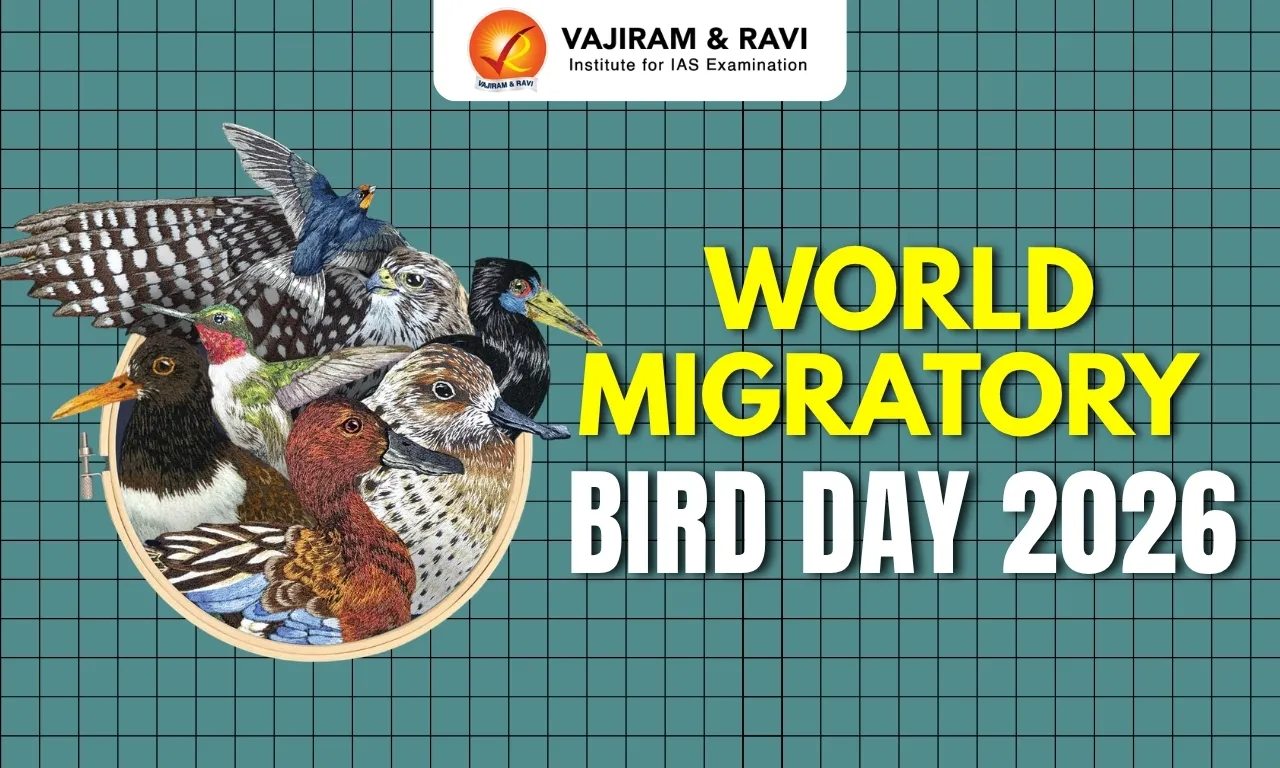
World Migratory Bird Day 2026 highlights the importance of protecting migratory birds through scientific monitoring, habitat conservation and international cooperation. The 2026 campaign encourages people to record bird sightings and contribute to conservation efforts. It also marks the 60th anniversary of the International Waterbird Census (IWC).

About World Migratory Bird Day 2026

World Migratory Bird Day is a global awareness campaign that highlights the importance of migratory birds, the threats they face and the need to protect their habitats.

  • World Migratory Bird Day 2026 will be observed on 9 May and 10 October. It is celebrated twice a year because migratory birds move at different times in different parts of the world.
  • The campaign was launched in 2006 by the Convention on the Conservation of Migratory Species of Wild Animals (CMS) and the Agreement on the Conservation of African-Eurasian Migratory Waterbirds (AEWA), building on earlier migratory bird awareness initiatives in the Americas.
  • It brings together governments, conservation organisations, researchers and local communities to promote migratory bird conservation.

World Migratory Bird Day 2026 Theme

The theme of World Migratory Bird Day 2026 is “Every Bird Counts – Your Observations Matter!” It highlights how observations recorded by individuals and communities can support scientific research and migratory bird conservation.

The theme emphasises community science, also known as citizen science, in which members of the public contribute observations to scientific research.

Public observations can help scientists:

  • Track migration routes and seasonal movements.
  • Monitor changes in bird populations and distribution.
  • Identify important breeding, feeding and resting habitats.
  • Detects threats such as habitat loss and pollution.
  • Develop evidence-based conservation strategies.

Platforms such as eBird allow birdwatchers to record sightings and contribute to scientific research. Accurate identification, consistent recording and data verification are essential for reliable results.

International Waterbird Census 60th Anniversary

The year 2026 marks 60 years of the International Waterbird Census (IWC), an international programme that monitors waterbird populations and their distribution.

  • The census began in 1967 under the International Waterfowl Research Bureau, a predecessor of Wetlands International.
  • Volunteers and researchers count waterbirds across wetlands and other important sites.
  • Long-term data helps scientists track population trends, identify important wetlands and set conservation priorities.

The census demonstrates how sustained public participation can generate scientific evidence to support biodiversity conservation.

What Are Migratory Birds?

Migratory birds move seasonally between geographical areas to find suitable breeding conditions, food and climate.

Their journeys may cover thousands of kilometres and cross several countries. Many follow established routes called flyways, which connect breeding grounds, stopover sites and wintering areas.

  • Flyways: Major routes used by birds during seasonal migration.
  • Stopover sites: Places where birds rest and feed during their journeys.
  • Wintering grounds: Areas where birds spend the non-breeding season.
  • Examples in India: The bar-headed goose, demoiselle crane and northern pintail are migratory birds that visit India during particular seasons.

Migratory birds depend on connected habitats throughout their journeys. Damage to one important stopover site can affect birds travelling across multiple countries.

Ecological Significance of Migratory Birds

Migratory birds support ecosystem functioning and provide important ecological benefits.

  • Pest control: Insect-eating birds help regulate insect populations, including some agricultural pests.
  • Pollination: Certain bird species transfer pollen while feeding on nectar.
  • Seed dispersal: Fruit-eating birds help spread seeds and support plant regeneration.
  • Nutrient cycling: Birds transfer nutrients between ecosystems.
  • Environmental monitoring: Changes in bird populations can indicate changes in habitat quality and environmental conditions.

Birdwatching and ecotourism can also support environmental education and provide livelihood opportunities for local communities.

India and Migratory Bird Conservation

India is an important destination and stopover region for migratory birds, particularly those using the Central Asian Flyway.

Central Asian Flyway

The Central Asian Flyway connects breeding areas in northern Eurasia with wintering areas in the Indian subcontinent and other regions. Birds use wetlands, lakes, grasslands and coastal habitats along this route.

Examples of migratory birds found in India include the bar-headed goose, demoiselle crane and northern pintail.

Wetlands and Ramsar Sites

Wetlands provide feeding, resting and breeding habitats for many migratory waterbirds. Protecting these ecosystems is therefore essential for conserving migration routes.

  • Ramsar Convention: An international treaty adopted in 1971 in Ramsar, Iran, for the conservation and wise use of wetlands.
  • Wetlands (Conservation and Management) Rules, 2017: Establish a regulatory framework for wetland conservation and management in India.
  • National Wildlife Action Plan 2017-2031: Provides a national framework for wildlife conservation and habitat protection.

Ramsar designation recognises a wetland's international importance, but effective management and protection of its ecological character remain essential.

International Frameworks for Migratory Bird Conservation

International cooperation is necessary because migratory birds depend on habitats spread across several countries.

  • Convention on the Conservation of Migratory Species of Wild Animals (CMS): A United Nations treaty that provides a framework for international cooperation to conserve migratory species and their habitats.
  • Agreement on the Conservation of African-Eurasian Migratory Waterbirds (AEWA): An agreement under the CMS framework focused on migratory waterbirds and their habitats across the African-Eurasian region.
  • Convention on Wetlands (Ramsar Convention): Promotes the conservation and wise use of wetlands, including habitats important for migratory birds.
  • East Asian-Australasian Flyway Partnership (EAAFP): Promotes cooperation to conserve migratory waterbirds and their habitats along the East Asian–Australasian Flyway.

These frameworks complement one another by addressing species conservation, international cooperation and habitat protection.

Major Threats to Migratory Birds

Migratory birds face threats across their breeding grounds, migration routes and wintering habitats.

  • Habitat loss: Wetland drainage, deforestation, coastal development and grassland conversion reduce suitable habitats.
  • Climate change: Changes in temperature and seasonal patterns can affect migration timing, food availability and breeding success.
  • Pollution: Plastics, pesticides and industrial pollutants can harm birds and degrade their habitats.
  • Infrastructure-related mortality: Glass buildings and power lines can cause collisions or electrocution.
  • Illegal hunting and trapping: These activities threaten bird populations along migration routes.
  • Human disturbance: Noise, artificial lighting and excessive activity near nesting or feeding sites can disrupt bird behaviour.

Since migratory birds cross international boundaries, conservation measures in one country may be undermined by habitat destruction or other threats elsewhere along the same route.

Way Forward: Strengthening Migratory Bird Conservation

Effective conservation requires habitat protection, reliable scientific data and cooperation among governments and communities.

  • Protect critical habitats: Conserve and restore wetlands, grasslands and coastal ecosystems along migration routes.
  • Strengthen community science: Encourage public participation in bird counts and systematic recording of sightings.
  • Reduce infrastructure risks: Incorporate bird-sensitive planning into buildings, power lines and renewable-energy projects.
  • Control pollution: Reduce plastic waste, pesticide misuse and other pollutants affecting bird habitats.
  • Improve international cooperation: Share scientific data and coordinate conservation measures among countries along the same flyway.
  • Involve local communities: Promote responsible birdwatching, environmental awareness and community-led habitat protection.

For India, protecting wetlands along the Central Asian Flyway and strengthening long-term monitoring are important steps towards conserving migratory bird populations.

World Migratory Bird Day 2026, Date, Theme, Significance FAQs

Q1: When is World Migratory Bird Day 2026 observed?

Ans: World Migratory Bird Day 2026 is observed on 9 May and 10 October 2026.

Q2: What is the main focus of World Migratory Bird Day 2026?

Ans: World Migratory Bird Day 2026 focuses on community science and the contribution of public observations to migratory bird conservation.

Q3: What is the International Waterbird Census?

Ans: International Waterbird Census is an international programme that monitors waterbird populations and their distribution, with contributions from volunteers and researchers.

Q4: What is the Central Asian Flyway?

Ans: Central Asian Flyway is a major migratory route connecting breeding areas in northern Eurasia with wintering areas in the Indian subcontinent and other regions.

Q5: Which international convention focuses on migratory species?

Ans: The Convention on the Conservation of Migratory Species of Wild Animals (CMS) provides a framework for international cooperation to conserve migratory species and their habitats.

World Mental Health Day 2026, Theme, History, Importance

World Mental Health Day 2026

World Mental Health Day 2026 will be observed on 10 October 2026 to raise awareness about mental health and encourage global efforts to improve mental health care. The theme highlights the importance of listening to people who have experienced mental health conditions and involving them in decisions that affect their lives. The World Health Organization (WHO) and the World Federation for Mental Health (WFMH) are among the organisations supporting the global campaign. 

World Mental Health Day 2026 Theme

World Mental Health Day 2026 highlights lived experiences and their role in shaping mental health policies, services and care. 

  • The theme of World Mental Health Day 2026: “Lived Experiences Heard: Real Voices, Real Change” highlights the importance of listening to people with lived experience of mental health conditions and involving them in shaping mental health policies, services and decisions.
  • Recognising lived experience: The theme recognises that people who have experienced mental health conditions have valuable knowledge about treatment, recovery and the challenges of accessing care.
  • Involving people in decision-making: People with lived experience should not only be invited to share their stories but should also help shape mental health policies, healthcare services and support programmes.
  • Moving from listening to action: Meaningful participation means giving people real opportunities to influence decisions, design services, reduce stigma and hold institutions accountable.
  • Promoting person-centred care: Mental health services should respect individual needs, choices, dignity and human rights rather than following a one-size-fits-all approach.
  • Supporting community-based mental health care: The theme also highlights the need to move away from long-stay psychiatric institutions towards quality mental health services within communities, where people can live with dignity and remain connected to their families.
  • Global campaign: The campaign encourages governments, healthcare providers and organisations to work with people with lived experience and build mental health systems with them, not merely for them.

World Mental Health Day 2026 History and Objectives

World Mental Health Day was first observed in 1992 to raise global awareness of mental health issues and promote better access to mental health care. 

  • History: World Mental Health Day was first observed on 10 October 1992, following an initiative by the World Federation for Mental Health (WFMH). It later gained wider global recognition with the support of the WHO and other organisations.
  • Main objective: The primary objective of World Mental Health Day is to raise awareness of mental health issues worldwide and encourage collective efforts to improve mental health care and support for people who need it.
  • Promoting access to care: The day encourages governments, healthcare professionals and organisations to work towards making affordable, accessible and quality mental health services available to everyone.
  • Reducing stigma and discrimination: World Mental Health Day helps challenge common misconceptions about mental health conditions and encourages people to discuss their concerns without fear of judgement or discrimination.
  • Encouraging global cooperation: The observance provides an opportunity for governments, health organisations, communities and individuals to share their work, identify gaps in mental health services and discuss ways to improve care.
  • Supporting human rights: The campaign promotes dignity, freedom of choice and equal participation for people with mental health conditions. It also highlights the need to replace isolating institutional care with appropriate, community-based support.

World Mental Health Day 2026 Importance of Mental Health Awareness

Mental health awareness helps reduce stigma, encourage early support and improve access to quality mental health care for everyone. 

  • Recognising mental health as part of overall health: Mental health affects how people manage stress, build relationships, learn, work and participate in society. Giving it equal importance to physical health is essential for overall well-being.
  • Understanding the value of lived experience: People who have experienced mental health conditions understand many challenges associated with seeking treatment, receiving support and recovering. Their knowledge can help identify problems that professional training and research alone may not fully capture.
  • Making mental health services more inclusive: People with lived experience should be involved in planning, delivering and evaluating mental health programmes. Their participation can help make services more person-centred, rights-based and responsive to people's actual needs.
  • Highlighting gaps in participation: According to the WHO Mental Health Atlas 2024, among the countries that responded to the survey, 37% included people with lived experience in mental health training for primary healthcare workers, while 45% reported ongoing collaboration with lived-experience and family or caregiver advocacy groups in mental health services.
  • Strengthening mental health policies: The same WHO survey found that 59% of responding countries reported that their mental health legislation had been developed in consultation with people with lived experience. Among countries with a mental health policy or plan, 80% reported consultation with these individuals during its development.
  • Addressing the slow shift towards community care: The WHO Mental Health Atlas 2024 found that only 9% of countries had completed the transition from psychiatric hospitals to community-based mental health care, while 53% remained in the early stages. This highlights the need to expand quality services and support within communities.
  • Protecting dignity and human rights: People with mental health conditions should have access to appropriate treatment, housing, education, employment and social support. Community-based care can help them exercise greater choice, maintain relationships and participate more fully in society.

World Mental Health Day 2026 Ways to Promote Mental Well-Being

Promoting mental well-being involves healthy habits, emotional support, open conversations and access to quality mental health care. 

  • Encourage open conversations: Families, schools, workplaces and communities should create safe spaces where people can discuss their mental health concerns without fear of stigma or discrimination.
  • Listen to people with lived experience: Their views should be included in decisions about mental health policies and services. They should be treated as equal partners, rather than being asked only to share personal stories.
  • Build healthy daily habits: Regular physical activity, adequate sleep, balanced meals, meaningful activities and time for relaxation can support mental well-being. Staying connected with friends and family can also help people manage stress.
  • Promote peer support: People who have faced similar challenges can share practical experiences, offer encouragement and help others feel less isolated. Peer-led initiatives can also improve understanding of recovery and available support.
  • Improve access to professional help: Mental health services should be affordable, accessible and available without discrimination. People experiencing ongoing emotional distress should be encouraged to seek support from qualified healthcare professionals.
  • Support community-based care: Governments and healthcare organisations should strengthen mental health services in local communities and ensure access to treatment, housing, education, work and social support. The transition away from long-stay psychiatric institutions must be carefully planned and respect people's rights, dignity and choices.
  • Organise awareness campaigns: Schools, colleges, workplaces and community organisations can conduct discussions, educational programmes and awareness activities to explain mental health issues, challenge misconceptions and encourage people to seek help when needed.
  • Move from awareness to meaningful action: World Mental Health Day 2026 calls for more than simply listening to people. Its central message is to ensure that their experiences influence decisions, improve mental health services and bring lasting change.

World Mental Health Day 2026 FAQs

Q1: When is World Mental Health Day 2026 observed?

Ans: World Mental Health Day 2026 will be observed on 10 October 2026 to raise awareness of mental health issues worldwide.

Q2: What is the theme of World Mental Health Day 2026?

Ans: The theme is “Lived Experiences Heard: Real Voices, Real Change”, which highlights the role of people with lived experience in shaping mental health policies and services.

Q3: Who started World Mental Health Day?

Ans: World Mental Health Day was first observed in 1992 following an initiative by the World Federation for Mental Health (WFMH).

Q4: What is the main objective of World Mental Health Day?

Ans: Its main objective is to raise global awareness of mental health issues, reduce stigma and improve access to quality mental health care.

Q5: Why is mental health awareness important?

Ans: Mental health awareness helps reduce discrimination, encourages people to seek support and promotes better understanding of mental health conditions.

Enquire Now