UPSC Daily Quiz 27 October 2026

UPSC Daily Quiz

[WpProQuiz 287]

UPSC Daily Quiz FAQs

Q1: What is the Daily UPSC Quiz?

Ans: The Daily UPSC Quiz is a set of practice questions based on current affairs, static subjects, and PYQs that help aspirants enhance retention and test conceptual clarity regularly.

Q2: How is the Daily Quiz useful for UPSC preparation?

Ans: Daily quizzes support learning, help in revision, improve time management, and boost accuracy for both UPSC Prelims and Mains through consistent practice.

Q3: Are the quiz questions based on the UPSC syllabus?

Ans: Yes, all questions are aligned with the UPSC Syllabus 2025, covering key areas like Polity, Economy, Environment, History, Geography, and Current Affairs.

Q4: Are solutions and explanations provided with the quiz?

Ans: Yes, each quiz includes detailed explanations and source references to enhance conceptual understanding and enable self-assessment.

Q5: Is the Daily UPSC Quiz suitable for both Prelims and Mains?

Ans: Primarily focused on Prelims (MCQ format), but it also indirectly helps in Mains by strengthening subject knowledge and factual clarity.

Greater Flamingos Spotted at Veeranam Lake in Tamil Nadu, Researchers Point to Changing Rainfall

Greater Flamingo

Greater Flamingo Latest News

Greater flamingos, usually found in coastal wetlands, have been recently spotted at Veeranam Lake in Cuddalore district, Tamil Nadu, in a rare occurrence that researchers say could be linked to altered rainfall patterns.

About Greater Flamingo

  • It is the most widespread and largest species of the flamingo family.  
  • Scientific Name: Phoenicopterus roseus 

Greater Flamingo Habitat and Distribution

  • The Greater flamingo inhabits Africa, the Middle East, southern Europe, and the Indian subcontinent. 
  • They occur in relatively shallow water bodies, such as saline lagoons, salt pans, large alkaline or saline lakes, and estuaries. 
  • Breeding takes place on sandbanks, mudflats, sandy or rocky islands, or open beaches. 

Greater Flamingo Features

  • It is a large bird with an elegant body, a long and slender neck, and extremely long legs. 
  • Its plumage is predominantly pale pink, with more intense shades on the wings and black wingtips. 
  • The beak is thick, downward-curved, and pink with a black tip. 
  • The legs are long, thin, and bright pink, perfectly adapted for moving through shallow waters. 
  • Juveniles have a gray-brown coloration, with some pink on their underparts, tail and wings, with the legs and beak being mainly brown. 
  • They are a highly social species, nesting in large, dense colonies. 
  • They feed by filtering water with their specialized beaks, consuming crustaceans, algae, and small invertebrates.
  • Greater Flamingo Conservations Status:
    • It is classified as 'Least Concern' under the IUCN Red List. 

Key Facts about Veeranam Lake

  • Veeranam Lake (Veeranarayanan Lake) is a man-made lake located in the Cuddalore district of Tamil Nadu. 
  • It is among the oldest and largest man-made lakes in Tamil Nadu.  
  • The lake is about 16 km long and 8 km broad with a waterspread of about 15 sq. km.  
  • Built during the 10th century CE by Rajaditya Chola, the son of Parantaka Chola I, the lake stands as a remarkable example of the Chola Empire’s engineering excellence and irrigation planning. 
  • It was constructed to strengthen irrigation and support the northern territories of the Chola kingdom. 
  • The lake is fed by Vadavar river and Sengal stream. 
  • It continues to serve as a lifeline for agriculture in the region and is also an important source of drinking water for Chennai through the New Veeranam Water Supply Scheme. 
  • Veeranam Lake is closely associated with Kalki Krishnamurthy’s celebrated historical novel Ponniyin Selvan. 

News: TH

Greater Flamingo FAQs

Q1: In which regions is the Greater Flamingo found?

Ans: Africa, the Middle East, southern Europe and the Indian subcontinent.

Q2: Which is the largest species in the flamingo family?

Ans: The Greater Flamingo.

Q3: What are the major physical characteristics of the Greater Flamingo?

Ans: A large body, long slender neck, extremely long legs and predominantly pale-pink plumage.

Q4: What is the colour of the Greater Flamingo’s plumage?

Ans: Predominantly pale pink, with more intense shades on the wings and black wingtips.

Q5: What is the conservation status of the Greater Flamingo according to the IUCN Red List?

Ans: Least Concern (LC).

India’s Immersive Technology Market Projected to Reach $7.82 Billion by 2030

Immersive Technologies

Immersive Technologies Latest News      

According to figures cited in a government backgrounder, India’s immersive technology market generated revenue of about $1.26 billion in 2023 and is projected to reach approximately $7.82 billion by 2030.

About Immersive Technologies    

  • Immersive technologies are an emerging suite of technologies that create interactive, engaging and realistic digital experiences.
  • Features
    • These can combine the physical and digital worlds.
    • They enable users to interact with digital content in ways that feel more natural and experiential.
    • Users can interact with digital objects and respond to simulated situations.
    • Unlike conventional digital media, these technologies can engage multiple senses and create a stronger sense of presence.
    • Examples
      • A student can explore a virtual laboratory instead of only viewing diagrams on a screen.
      • A tourist can virtually explore a heritage site before visiting it physically.
  • The three most common forms of immersive technology are Virtual Reality (VR), Augmented Reality (AR), and Mixed Reality (MR). Collectively, these technologies are often referred to as Extended Reality (XR).
  • Extended Reality (XR)
    • It refers to technologies that combine real and digital environments through computer systems and wearable devices.
    • It creates different levels of interaction between people and digital content. XR includes Virtual Reality (VR), Augmented Reality (AR) and Mixed Reality (MR).
  • Virtual Reality (VR)
    • It creates a completely digital environment that surrounds the user.
    • It mainly engages sight and sound to create a strong sense of presence.
    • Users can explore and interact with this simulated environment using specialised devices.
  • Augmented Reality (AR)
    • It adds digital information to the user’s existing physical surroundings. It can engage sight and sound, while keeping the real-world environment visible.
    • For example, AR can display directions, information or digital objects over the physical world.
  • Mixed Reality (MR)
    • It combines the physical and digital worlds in an interactive environment.
    • It can engage sight and sound, while allowing digital objects to interact with physical surroundings. Users can see and interact with digital objects as if they were part of the real environment.

Source: PIB

Immersive Technologies FAQs

Q1: What is Immersive Technologies?

Ans: Immersive technologies are an emerging suite of technologies that create interactive, engaging and realistic digital experiences.

Q2: What is the feature of Immersive Technologies?

Ans: They enable users to interact with digital content in ways that feel more natural and experiential. Users can interact with digital objects and respond to simulated situations.

Study Examines SGLT2 Inhibitor Benefits and Risks in Adults Aged 80 and Above

SGLT2 Inhibitors

SGLT2 Inhibitors Latest News

New research uncovers the potential benefits and risks of sodium-glucose cotransporter 2 (SGLT2) inhibitors for adults aged 80 years or older with chronic kidney disease (CKD).

About SGLT2 Inhibitors

  • SGLT2 (Sodium-Glucose Cotransporter-2) inhibitors are a class of medications primarily used to treat Type 2 diabetes (T2D). 
  • T2D, the most common type of diabetes, is a disease that occurs when your blood glucose, also called blood sugar, is too high. 
  • SGLT2 Inhibitors manage your blood sugar by helping your kidneys remove extra glucose through your pee. 
  • How do SGLT2 inhibitors work?
    • SGLT2 is a protein in your kidneys that reabsorbs glucose. 
    • Typically, when glucose in your blood flows through your kidneys, some glucose goes back into your bloodstream. 
    • SGLT2 inhibitors block that process, so your kidneys don’t reabsorb glucose. 
    • Instead, it comes out in your pee. This means the glucose doesn’t get into your bloodstream and raises your blood sugar. 
  • The use of SGLT2 inhibitors goes beyond managing blood sugar. 
    • They also help improve kidney and heart health for people with chronic kidney disease (CKD) or heart failure. 
    • They can slow the progression of kidney disease and reduce the risk of needing dialysis. 
    • SGLT2 inhibitors also lower the risk of heart failure flare-ups. 
  • Common SGLT2 inhibitors
    • Dapagliflozin
    • Empagliflozin
    • Canagliflozin
    • Ertugliflozin
  • Some of the side effects include:
    • Higher risk of developing genital and urinary tract infections
    • Urinating more frequently
    • Flu like symptoms
    • Nausea
    • Joint pain

News: NM

SGLT2 Inhibitors FAQs

Q1: What does SGLT2 stand for?

Ans: Sodium-Glucose Cotransporter-2.

Q2: What are SGLT2 inhibitors?

Ans: They are a class of medications primarily used to treat Type 2 diabetes.

Q3: How do SGLT2 inhibitors help manage blood sugar levels?

Ans: They help the kidneys remove excess glucose from the body through urine.

Q4: How do SGLT2 inhibitors work?

Ans: They block the SGLT2 protein, reducing glucose reabsorption and increasing glucose excretion through urine.

Tata Steel Introduces Hydroseeding to Restore Mining Slopes in Jharkhand

Hydroseeding

Hydroseeding Latest News

Recently, Tata Steel has introduced hydroseeding technology at its West Bokaro Division in Jharkhand.

About Hydroseeding

  • It is a modern technique for sowing seeds by spraying a slurry mixture of seeds, water, fertilizers, mulch, and soil stabilizers onto the soil surface using specialized equipment.
  • It aims to stabilise dump slopes, prevent soil erosion and accelerate green restoration through modern technology.
  • It ensures uniform seed distribution, improved seed-to-soil contact, and better moisture retention, which enhances germination and early plant establishment.
  • Process of Hydroseeding
    • Preparing Slurry: It involves preparing slurry made up of seed, mulch, fertiliser and water. This mixture is loaded into a hydroseeder.
    • The slurry is then sprayed onto the prepared soil surface using a hose or cannon.
    • Equipment and Technology: It is carried out using purpose-built hydroseeders available in a range of tank sizes and output capacities to suit different project scales.
    • These machines are designed to properly mix fibre mulch, seed and additives while delivering an even, controlled spray pattern.
    • The machine can spray up to 50 metres and cover dump slopes up to 80 metres.
  • Applications: It is widely used for lawn development, slope stabilization, erosion control, and ecological restoration in difficult or uneven terrains.
  • Advantages
    • Compared to traditional seeding methods, it is faster, cost-effective, and suitable for large areas.
    • It is especially useful on mine overburden dumps and rugged terrain where conventional plantation is difficult and time-consuming.
    • It controls erosion on open slopes, strengthens slopes, reduces landslide risks, promotes faster plant growth and natural greenery, retains soil moisture for germination.

Source: NIE

Hydroseeding FAQs

Q1: What is Hydroseeding?

Ans: It is a modern technique for sowing seeds by spraying a slurry mixture of seeds, water, fertilizers, mulch, and soil stabilizers onto the soil surface using specialized equipment.

Q2: What is the aim of Hydroseeding?

Ans: It aims to stabilise dump slopes, prevent soil erosion and accelerate green restoration through modern technology.

Delhi-NCR Gets New Laboratory to Identify Air Pollution Sources and Toxicity

Integrated Atmospheric Chemistry and Aerosol Toxicity Analysis Laboratory

Integrated Atmospheric Chemistry and Aerosol Toxicity Analysis Laboratory Latest News

Union Minister of State for Science and Technology and Earth Sciences inaugurated the world's first- of -its-kind 'Air Pollution Analysis' facility for Delhi NCR known as 'Integrated Atmospheric Chemistry and Aerosol Toxicity Analysis Laboratory (AATAL).

About Integrated Atmospheric Chemistry and Aerosol Toxicity Analysis Laboratory

  • It is a specialised facility aimed at identifying the sources, composition and potential health impacts of air pollution in Delhi-NCR.
  • It is established under Mission Mausam.
  • It is designed to provide real-time information on pollution sources and their relative contributions, helping authorities move beyond Air Quality Index (AQI) readings to develop targeted pollution-control measures.

Features of AATAL

  • It is equipped to analyse atmospheric gases, aerosols, fine particulate matter (PM2.5), metals, toxic elements and other pollutants.
  • Its capabilities will help distinguish between pollution sources, including vehicular emissions, industrial activity, biomass and crop-residue burning, construction and road dust, and pollution transported from neighbouring regions.
  • It will also examine the chemical characteristics of pollutants to improve scientific understanding of their potential toxicity and implications for public health.
  • AATAL has been integrated with IITM’s AIRWISE, or Air Quality Warning and Integrated Decision Support System for Emissions, which combines air-quality observations, forecasts and source-apportionment information.
    • AIRWISE provides forecasts at a spatial resolution of 400 metres for the next 72 hours, enabling authorities to assess how pollution levels and their likely sources may vary across different parts of Delhi.
  • The system is intended to help identify locations likely to experience deteriorating air quality and provide advance information for preventive action.
  • It would help the Commission for Air Quality Management (CAQM) and other agencies plan targeted interventions and assess their effectiveness.

Source: PIB

Integrated Atmospheric Chemistry and Aerosol Toxicity Analysis Laboratory FAQs

Q1: What is Integrated Atmospheric Chemistry and Aerosol Toxicity Analysis Laboratory ?

Ans: It is a specialised facility aimed at identifying the sources, composition and potential health impacts of air pollution in Delhi-NCR.

Q2: Under which mission Integrated Atmospheric Chemistry and Aerosol Toxicity Analysis Laboratory is established?

Ans: It is established under Mission Mausam.

Flash Floods Hit Thailand’s Phuket Island, Inundating Several Areas

Phuket Island

Phuket Island Latest News

Flash floods recently inundated several areas of the island of Phuket in Thailand, one of the country’s major tourist destinations.

About Phuket Island

  • It is Thailand's largest island and sits on the Andaman Sea, a marginal sea of the northeastern Indian Ocean. 
  • Located in southern Thailand, it lies off the country's western coast. 
  • It is known as the ‘’Pearl of the Andaman Sea’’. 
  • History:
    • It was settled as early as the 1st century BCE. 
    • Located on trading routes between India and China, Phuket was subjected to foreign influences long before many other parts of Thailand. 
    • Phuket first became part of a Thai state during the thirteenth century when Thai armies from Sukhothai wrestled control of the island from the Sirivijaya Empire based in Sumatra. 
    • Phuket is first mentioned as a major source of tin in the sixteenth century when the island became an important source of revenue for the Thai kingdom at Ayutthaya, as well as an important trading post. 
    • It was also during this period that the first Europeans arrived on Phuket. 
    • Due to Phuket's abundant supply of tin and its importance as a trading port, the island's economy continued to prosper. 
    • The British secured a tin mining concession and nearly claimed Phuket as part of the British Empire.
  • The residents of Phuket comprise Thais who have migrated from the mainland, ethnic Chinese, Malays, and Chao Leh or ‘sea-gypsies’ who are the original inhabitants of Phuket. 
  • Spanning 48 km in length and 21 km at its widest point, the island features a hilly and mountainous landscape, with forests and agricultural plantations covering parts of its interior. 
  • It is reached by bridge (Sarasin Bridge) from the mainland to the north across a narrow strait. 
  • Phuket city, located in the southeastern portion of the island, is a major port and commercial centre.  
  • The island has also become a major seaside resort.

News: TH

Phuket Island FAQs

Q1: In which sea is Phuket Island located?

Ans: The Andaman Sea.

Q2: Phuket Island is part of which country?

Ans: Thailand

Q3: What is Phuket Island popularly known as?

Ans: The “Pearl of the Andaman Sea.”

Q4: Which mineral played a major role in Phuket’s historical economy?

Ans: Tin.

Why India’s Infrastructure Investment Trusts Are Attracting More Investors

Infrastructure Investment Trust

Infrastructure Investment Trust Latest News

India’s infrastructure investment trusts (InvITs) are attracting more investors, creating a potential avenue to channel domestic savings into roads, power transmission networks and other income-generating infrastructure assets.

About Infrastructure Investment Trust  

  • It is a Collective Investment Scheme similar to a mutual fund, which enables direct investment of money from individual and institutional investors in infrastructure projects. 
  • These are like mutual funds in structure which can be established as a trust and registered with Sebi.
  • Objective: To provide retail investors with access to investment opportunities in infrastructure projects, which were previously only available to large institutional investors.

Features of the Infrastructure Investment Trust (InvIT)

  • Structure: An InvIT has 4 parties namely; Trustee, Sponsor(s) and Investment Manager and Project Manager.
  • INVITs are created by sponsors, who are typically infrastructure companies or private equity firms.
  • The sponsor sets up the INVITs and transfers ownership of the underlying infrastructure assets to the trust.
  • The trust then issues units to investors, which represent an ownership stake in the trust and thus the underlying assets.
  • While the trustee (certified by Sebi) has the responsibility of inspecting the performance of an InvIT, sponsor(s) are promoters of the company that set up the InvIT.
  • InvITs are regulated by the SEBI (Infrastructure Investment Trusts) Regulations, 2014.

Source: BL

Infrastructure Investment Trust FAQs

Q1: What is Infrastructure Investment Trust?

Ans: It is a Collective Investment Scheme similar to a mutual fund, which enables direct investment of money from individual and institutional investors in infrastructure projects. 

Q2: Infrastructure Investment Trust are regulated under which act?

Ans: InvITs are regulated by the SEBI (Infrastructure Investment Trusts) Regulations, 2014.

Translocated Tigress Crosses from Buxa to Assam’s Raimona National Park

Raimona National Park

Raimona National Park Latest News

A tigress brought from Bihar and released into West Bengal’s Buxa Tiger Reserve earlier this month has crossed into Assam’s Raimona National Park within three weeks.

About Raimona National Park   

  • Location: It is located in the state of Assam.
  • The park lies along the India-Bhutan border and is situated at the foothills of the Eastern Himalayas. 
  • It is connected with Phibsoo Wildlife Sanctuary and Jigme Singye Wangchuck National Park.
  • Topography: The Park has diverse terrain and vegetation.
  • Major Rivers: The Sankosh River flows along the western boundary, Saralbhanga River lies on the eastern side and Pekua River forms the southern boundary.
  • Vegetation: It mainly consists of Moist sal forests, Sub-Himalayan semi-evergreen forests, moist mixed deciduous forests, savannah forests and riverine and khoir-sisoo forests
  • Flora: Many orchid species, riverine grasslands and about 380 species of plants.
  • Fauna: It is famous for the Golden Langur, Asian Elephant, Bengal Tiger, Clouded Leopard, Wild Water Buffalo and Spotted Deer

Source: IT

Raimona National Park FAQs

Q1: Where is Raimona National Park?

Ans: Assam

Q2: What type of vegetation is found in Raimona National Park?

Ans: It mainly consists of Moist sal forests, Sub-Himalayan semi-evergreen forests

Kerala’s Spinal Muscular Atrophy Treatment Initiative Faces Controversy

Spinal Muscular Atrophy

Spinal Muscular Atrophy Latest News

An initiative launched by the Keralam government to make the treatment for Spinal Muscular Atrophy (SMA) accessible to more patients is now courting controversy.

About Spinal Muscular Atrophy 

  • It represents a group of genetic (inherited) neuromuscular disorders that cause certain muscles to become weak and waste away.
  • It is a progressive disorder that can cause life-threatening complications. 

What Happens in Spinal Muscular Atrophy?

  • In SMA, the nerves that control muscle strength and movement break down. 
  • These nerves (called motor neurons) are in the spinal cord and lower part of the brain. 
  • They can't send signals from the brain to the muscles to make them move. 
  • Because the muscles don't move, they get smaller (or atrophy).
  • The weakness in SMA tends to be more severe in the muscles that are close to the center of your body (proximal muscles) than in the muscles farther away from your body’s center (distal muscles). 
  • Muscle weakness tends to worsen with time.

What Causes Spinal Muscular Atrophy?

  • Motor neurons need a protein called SMN (survival motor neuron) to work. 
  • Most kinds of SMA are caused by a problem with a gene that makes this protein, called the SMN1 gene. 
  • When this gene mutates (changes in some way), it can’t make enough protein for the motor neurons to work properly.
  • The motor neurons break down and can't send signals to the muscles. 
  • It's the second most common severe hereditary disease of infancy and childhood after cystic fibrosis. 

Types of Spinal Muscular Atrophy

  • It is classified as type 1, 2, 3, or 4 depending on age of onset. 
    • SMA type 1 (infantile-onset SMA or Werdnig-Hoffman disease): It is the most severe type. It is also the most common. Babies with this type usually show signs of the disease before 6 months of age.   
    • SMA type 2 (intermediate SMA): It is a moderate to severe type of SMA. It is usually first noticed between 6 and 18 months of age. 
    • SMA type 3 (juvenile SMA, Kugelberg Welander syndrome): It is the mildest type that affects children. The signs of the disease usually show up after age 18 months.  
    • SMA type 4 (adult SMA):  It is rare and often mild.  It usually causes symptoms after 21 years of age.  
  • The term "5q SMA" is often used to refer to all 4 common types of SMA. 
  • Healthcare providers classify them based on the age of onset, as well as the severity and life expectancy.

Spinal Muscular Atrophy Symptoms

  • Symptoms of SMA may include:
    • Muscle weakness and decreased muscle tone
    • Limited mobility
    • Breathing problems
    • Problems eating and swallowing
    • Delayed gross motor skills
    • Spontaneous tongue movements
    • Scoliosis (curvature of the spine)

Spinal Muscular Atrophy Treatment 

  • There isn’t a cure for SMA. 
  • Treatment for SMA mainly seeks to manage symptoms and prevent complications. 

News: TH

Spinal Muscular Atrophy FAQs

Q1: What is Spinal Muscular Atrophy (SMA)?

Ans: It is a group of inherited neuromuscular disorders that cause muscles to become weak and waste away.

Q2: Which cells are primarily affected in Spinal Muscular Atrophy?

Ans: Motor neurons.

Q3: Which gene is primarily associated with Spinal Muscular Atrophy?

Ans: The SMN1 gene.

Q4: How does a mutation in the SMN1 gene cause Spinal Muscular Atrophy?

Ans: It reduces the production of functional SMN protein, leading to motor neuron dysfunction and degeneration.

Defence Acquisition Council Clears ₹2.12 Lakh Crore Procurement Proposals

Defence Acquisition Council

Defence Acquisition Council Latest News

The Defence Acquisition Council (DAC) recently accorded Acceptance of Necessity (AoN) for capital acquisition proposals worth approximately ₹2.12 lakh crore for the three services, with about 82% of the procurements to be sourced from the domestic industry.

About Defence Acquisition Council

  • It is the highest decision-making body of India's Ministry of Defence on procurement.
  • Main Objective: To ensure expeditious procurement of the approved requirements of the armed forces in terms of capabilities sought and time frame prescribed by optimally utilizing the allocated budgetary resources.
  • Formation: It was formed after the Group of Minister’s recommendations on ‘Reforming the National Security System’, in 2001, post-Kargil War (1999).
  • Composition:
    • The defence minister is the chairman of DAC. 
    • Its members include senior civil and military leaders of the Ministry of Defence, among them the Chief of Defence Staff (CDS) and chiefs of the Army, Navy, and Air Force; the Defence Secretary; and other senior officials responsible for finance, production, and acquisition. 
  • Functions:
    • Give in principle approval of a 15-year Long Term Integrated Perspective Plan (LTIPP) for defence forces.
    • Accord of acceptance of necessity to acquisition proposals. 
    • Categorisation of the acquisition proposals relating to ‘Buy’, ‘Buy & Make’, and ‘Make’. 
    • Look into issues relating to single vendor clearance.
    • Take decisions regarding ‘offset’ provisions in respect of acquisition proposals above Rs 300 crore.
    • Take decisions regarding the Transfer of Technology under the ‘Buy & Make’ category of acquisition proposals. 
    • Field trial evaluation.
  • The categorisation decisions taken by the DAC are especially significant, because they influence whether contracts flow to Indian designers and manufacturers or to foreign suppliers.  
  • Through its approvals, the DAC effectively sets the direction of India's military modernisation.

News: TH

Defence Acquisition Council FAQs

Q1: What is the Defence Acquisition Council (DAC)?

Ans: It is the highest decision-making body of India’s Ministry of Defence on defence procurement.

Q2: What is the main objective of the Defence Acquisition Council?

Ans: To ensure the timely procurement of approved requirements of the armed forces while optimally utilising allocated budgetary resources.

Q3: Following which event was the Defence Acquisition Council established?

Ans: The Kargil War of 1999 and the subsequent recommendations of the Group of Ministers on reforming the national security system.

Q4: Who is the chairman of the Defence Acquisition Council?

Ans: The Union Defence Minister.

Climate Justice and India’s Energy Transition – Explained

Climate Justice

Climate Justice Latest News

  • The debate on global climate policy has renewed attention to the need for India to prioritise energy justice, equitable energy consumption and nationally driven climate action alongside global emissions targets.

Understanding Climate Justice

  • Climate justice links climate action with fairness, development and the unequal distribution of responsibilities and resources. 
  • It recognises that countries differ in their historical energy consumption, development levels, financial capacities and ability to cope with climate-related disasters.
  • The central argument is that climate policy should not focus exclusively on reducing global carbon dioxide emissions. 
  • It should also examine how energy use contributes to national well-being and whether countries have equitable access to the resources needed for development.
  • For developing countries such as India, the challenge is to expand access to reliable energy while pursuing a transition towards cleaner sources.

The Limitations of Global Climate Consensus

  • International climate policy has largely been shaped by global scientific assessments, emissions projections, multilateral negotiations and common rules. 
  • However, a uniform framework may not adequately reflect the different energy requirements and development priorities of individual countries.
  • The critics argue that the gap between ecological limits and the growing energy needs of urbanising developing countries has not been adequately addressed. They also highlight shortcomings in the delivery of climate finance and technology transfer to the Global South.
  • These concerns raise important questions about the implementation of climate commitments and the fairness of the international climate regime.

Unequal Energy Consumption and Development

  • Developed countries historically achieved high levels of industrialisation and living standards through substantial energy consumption. Emerging economies must now improve living standards while managing environmental constraints.
  • The argument is that developing countries may undergo a phase of increased fossil-fuel use, or carbonisation, before achieving substantial decarbonisation. 
  • This transition reflects the challenge of meeting growing energy demand without reproducing the resource-intensive development pathways followed by earlier industrialisers.
  • The policy objective should therefore include reducing the energy intensity of economic activity and improving well-being with lower resource consumption.

Electrification and Renewable Energy

  • Electrification offers an important pathway for transforming energy systems. Replacing internal combustion engines with electric vehicles and meeting additional electricity demand through renewable sources can reduce dependence on fossil fuels.
  • Experts highlight China’s approach, including its expansion of solar and wind capacity and the adoption of new energy vehicles. They argue that renewable energy development requires more than declining technology costs.
  • Solar and wind power are intermittent, decentralised sources of electricity. Integrating them into national energy systems requires strategic public policy, suitable infrastructure and decisions about how electricity generation and consumption should evolve.
  • For India, the broader policy priorities include:
    • Expanding solar, wind and hydropower capacity.
    • Encouraging electrification of transport and other energy-intensive activities.
    • Meeting rising energy demand while improving energy efficiency.
    • Aligning renewable energy deployment with national development needs.

Reframing Global Climate Policy

  • Experts propose shifting the focus of climate discussions from aggregate emissions and production patterns towards national energy use, consumption and well-being.
  • They question whether global models sufficiently account for changing lifestyles, demographic trends, technological progress and the different energy requirements of emerging economies.
  • A more practical approach would combine international cooperation with nationally driven policies. 
  • It would also assess climate action through improvements in energy access, economic development and resilience, rather than relying exclusively on global emissions indicators.
  • This does not eliminate the importance of reducing emissions. Instead, it highlights the need to consider emissions reduction alongside development needs and differences in national circumstances.

Climate Finance and Disaster Resilience

  • Climate justice also concerns the ability of vulnerable countries to respond to extreme weather events. Developing countries often face significant disaster risks while having limited insurance coverage and financial resources.
  • Experts call for a review of the adequacy of climate finance and suggest practical cooperation through global early-warning systems and regional technical collaboration in disaster relief.
  • Effective climate cooperation should therefore extend beyond negotiations and declarations to implementation, technology access, financial support and institutional capacity-building.

Significance for India

  • India must balance three interconnected priorities: economic development, reliable and affordable energy, and environmental sustainability.
  • A climate strategy centred on energy justice would recognise that expanding energy access is essential for improving living standards. At the same time, investments in renewable energy, electrification and efficiency can help limit the environmental costs of development.
  • India’s international engagement could place greater emphasis on equitable access to clean technologies, predictable climate finance, national policy flexibility and practical cooperation on climate adaptation and disaster management.
  • The central challenge is to ensure that climate action supports development while distributing responsibilities and resources more fairly.

Source: TH

Climate Justice FAQs

Q1: What is climate justice?

Ans: Climate justice connects climate action with fairness, recognising differences in countries’ development needs, energy consumption, financial capacities and vulnerability to climate impacts.

Q2: Why does energy consumption matter in climate policy?

Ans: Energy consumption influences emissions and economic development. Examining consumption and energy efficiency helps assess how countries can improve well-being while reducing environmental impacts.

Q3: What is carbonisation before decarbonisation?

Ans: It refers to the possibility that developing economies may initially increase fossil-fuel use to meet growing energy needs before shifting towards cleaner energy systems.

Q4: Why is electrification important for the energy transition?

Ans: Electrification can replace fossil-fuel use in activities such as transport. Its environmental benefits depend partly on how electricity is generated and how effectively renewable sources are integrated.

Q5: What role does climate finance play in climate justice?

Ans: Climate finance can help developing countries adopt cleaner technologies, adapt to climate impacts and strengthen disaster resilience, particularly where domestic resources are limited.

Special Executive Magistrates: Powers, Limits and Legal Safeguards

Special Executive Magistrates

Special Executive Magistrates Latest News

  • The detention and subsequent bail of Cockroach Janta Party (CJP) activists Saurav Das and Ashutosh Ranka, along with a notice to AISA president Neha Bora, has brought the powers of Special Executive Magistrates (SEMs) under sharp scrutiny. 
  • Arrested on October 14, 2026, for allegedly breaching security at Jantar Mantar during protests against the Special Intensive Revision (SIR) of electoral rolls, their case has reopened a long-running debate: how much power should non-judicial officials wield over personal liberty?

Who Are SEMs, and How Do They Differ from Judicial Magistrates?

  • State governments appoint SEMs for specific areas, periods, or purposes, granting them powers of Executive Magistrates under Section 15 of the BNSS (Bharatiya Nagarik Suraksha Sanhita), 2023.
  • In Delhi, the Delhi Police Act empowers the Centre to authorise the Police Commissioner and officers not below ACP rank to exercise district/executive magistrate powers.

Key Distinction

  • Executive Magistrates/SEMs function under the government, performing administrative and preventive roles. Their career progression depends on executive superiors, not the judiciary.
  • Judicial Magistrates (BNSS Section 9) are appointed by High Courts, form part of the judicial system, and can conduct trials, grant bail, and impose sentences.
  • SEMs cannot conduct criminal trials or convict — their role is strictly preventive, aimed at intervening before a disturbance occurs rather than punishing after an offence.

What Powers Do SEMs Actually Exercise?

  • Peace Bonds (Section 126, BNSS): An SEM can require someone likely to breach peace to show cause why they shouldn’t execute a bond to maintain peace, for up to one year.
  • Inquiry Process (Section 135): The magistrate inquires into the matter and may order a person to furnish security during the inquiry, recording reasons in writing.
  • Breach Consequences (Section 141(1)(b)): If a peace bond is breached, the magistrate can order arrest or detention for the bond’s remaining period.
  • Urgent Preventive Orders: SEMs can act against nuisance or apprehended danger — preventing obstruction, injury, threat to life, or public disturbance/riot.
  • Preventive Arrest (Section 170): This is actually a police power, not exclusive to SEMs — police can arrest to prevent a cognisable offence.

Colonial Roots of Preventive Powers

  • Preventive arrest provisions trace back to England’s Justices of the Peace Act, 1361, empowering “justices of peace” to restrain “offenders, rioters and barrators” via sureties of good behaviour.
  • These provisions entered Indian law in 1861, continued through the CrPC, and now form part of the BNSS (enacted 2023, in force from July 1, 2024, replacing the CrPC).

A Recurring Pattern of Judicial Concern

  • 1984 — Sunil Batra’s case: Death-row prisoner’s Tihar Jail application exposed unjustified arrests under old Section 107 CrPC, with cyclostyled (copy-pasted) proformas and no proper procedure. The Delhi HC directed individuals be informed of bond reasons, with warrants accompanying detention orders.
  • 2018 — Delhi HC (Justices Muralidhar & Goel): Found nothing much appears to have changed since 1984 — cyclostyled proformas still in use. The court: 
    • Called for an oversight mechanism, possibly including retired district judges.
    • Suggested renaming SEMs as “Special Executive Officers” to avoid confusion with judicial magistrates (not implemented).
    • Recommended separate jail spaces for preventive detainees.
    • Found “palpable bias” — a disproportionate share of detainees from minority communities and economically weaker sections unable to furnish sureties.
  • 2018 — Delhi HC order: Capped preventive judicial custody at seven days at a time, requiring weekly SEM review of continued detention need.
  • 2007 — Delhi HC (endorsing MP HC ruling): SEMs must record statements before initiating proceedings under Sections 107/116/151 CrPC, and orders must be well-reasoned, not mechanical.
  • 2008 — Narmada Bachao Andolan case: MP High Court held that arresting Medha Patkar and 120 other protesters without due process violated their fundamental right to peaceful protest; ordered ₹10,000 compensation each for wrongful detention.

Can SEM Actions Be Challenged?

  • Yes — SEM orders are subject to judicial review and administrative oversight, and can be challenged before appropriate courts/authorities depending on the order’s nature.

Conclusion

  • The SEM controversy reflects a deeper constitutional tension that India has grappled with since the colonial era: the risk of blending executive and judicial functions in matters touching personal liberty. 
  • Despite repeated judicial interventions — from the 1984 Sunil Batra case to the 2018 Delhi High Court directions — courts have found the same procedural lapses recurring decades apart, including cyclostyled orders and disproportionate impact on marginalised groups. 
  • As the CJP case shows, SEMs continue to wield significant preventive power over protesters, even as their orders remain subject to judicial review. 
  • Until recommendations like independent oversight mechanisms and renaming SEMs are actually implemented, the gap between constitutional safeguards and ground-level practice is likely to persist.

Source: TH | IE

Special Executive Magistrates FAQs

Q1: Who are Special Executive Magistrates?

Ans: Special Executive Magistrates are government-appointed officials empowered to exercise preventive and administrative magistrate functions under Section 15 of the Bharatiya Nagarik Suraksha Sanhita, 2023.

Q2: What powers do Special Executive Magistrates have under the BNSS?

Ans: Special Executive Magistrates can initiate peace-bond proceedings, require security during inquiries and issue preventive orders against apprehended dangers, nuisance or public disturbances.

Q3: Can Special Executive Magistrates conduct criminal trials?

Ans: Special Executive Magistrates cannot conduct criminal trials, convict accused persons or impose sentences; their role is preventive, unlike judicial magistrates who exercise judicial powers.

Q4: Can orders issued by Special Executive Magistrates be challenged?

Ans: Yes, orders of Special Executive Magistrates are subject to judicial review and administrative oversight, and affected individuals can challenge them before appropriate courts or authorities.

Q5: Why has the CJP protest controversy raised concerns about Special Executive Magistrates?

Ans: The CJP protest controversy has renewed concerns about preventive detention, procedural safeguards and personal liberty, particularly following allegations involving activists detained during protests against electoral-roll revision.

Private Citizens for Census Duty: Legal Powers and Limits

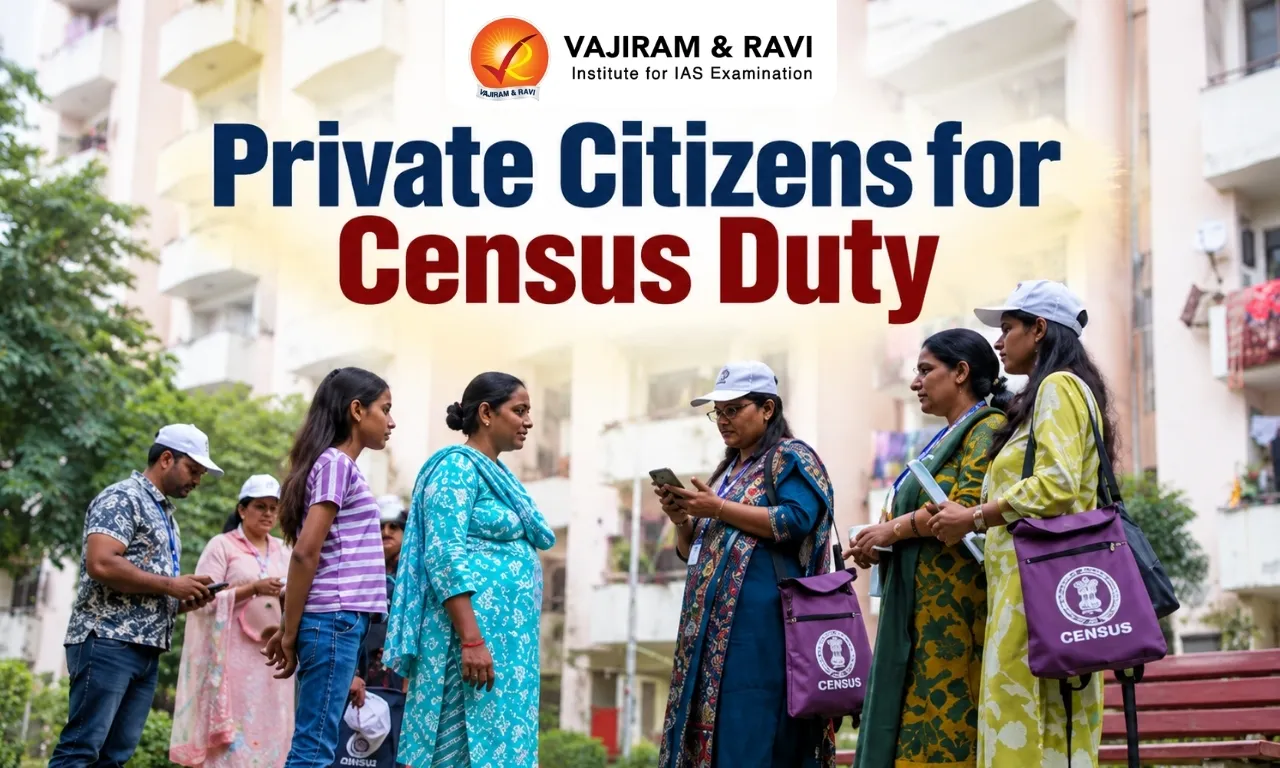
Private Citizens for Census Duty

Private Citizens for Census Duty Latest News

  • Recently, the Centre amended the Census Rules, 1990, to explicitly include teachers of private educational institutions and employees of private establishments (banks, companies, societies, trusts) as eligible Census enumerators. 
  • This has reignited a legal debate: can the government legally compel private individuals to perform Census duties — and why was this amendment needed if the old rules already allowed “any person” to be appointed?

What the Amendment Actually Changes

  • The amended rules now expressly name teachers of government, local authority, aided, and unaided private institutions as eligible enumerators.
  • It also retains the broader category: any person whom a state/UT government considers suitable.
  • Crucially, this isn’t very different from before — the earlier Rule 3 already allowed enumerators to be chosen from “Teachers, Clerks or any official or any person.”
  • MHA’s stated reason: to remove ambiguity and ensure smooth conduct of the Census, which needs lakhs of enumerators.

The Legal Backdrop That Triggered This

  • May 2026: The Bombay High Court gave interim protection to over 500 private unaided and minority schools in Maharashtra, holding that Sections 6 and 7 of the Census Act did not confer authority to compulsorily requisition staff of private unaided schools, unlike Section 4A, which binds local authorities.
  • The court rejected the government’s argument that “any person” under the old rules covered private teachers, warning this interpretation could extend unrestricted even to doctors, advocates, and chartered accountants. It held, prima facie, that subordinate legislation (rules) cannot exceed its parent statute (the Act).
  • October 2026: The Punjab and Haryana High Court stayed Haryana government communications seeking private-school teacher details for Census duty.
  • Later, the Centre issued the amendment — seen as a response to these judicial setbacks.

What the Census Act, 1948 Actually Says

  • Section 4(2): Gives state governments power to “appoint persons as census-officers,” adding that such persons “shall be bound to serve.” This broad wording (“persons”) is the government’s strongest legal basis.
  • Section 4A: Requires local authorities (when Centre-directed) to provide necessary staff.
  • Sections 6 and 7: Allow seeking assistance from private establishments, but in limited, defined circumstances — mainly counting people within their premises, not deploying employees as general door-to-door enumerators.

Key Judicial Precedents

  • 2010 — LIC Jalandhar case: Punjab & Haryana HC quashed an order requiring LIC to provide 150 employees as enumerators, ruling Section 7(c) only permits assistance for counting persons within an establishment — directions were “beyond the scope” of the Act. However, it left states free to invoke Section 4(2) instead.
  • 2019 — Gujarat HC (LIC case): Similarly ruled against requisitioning LIC employees under Section 7; now under challenge before the Supreme Court.
  • Census 2011 precedent: Bombay HC initially gave interim protection to private school teachers (Jan 2011), but later modified this (Feb 2011) — allowing deployment of private school teachers before/after school hours, exempting Class X/XII teachers, and letting school managements decide who could be spared.

Does the Constitution Permit Compulsory Public Service?

  • Yes, in principle. Article 23(1) bans forced labour (begar), but Article 23(2) explicitly permits “compulsory service for public purposes” — provided it’s non-discriminatory.

Precedents For Compulsory Civilian Service

  • Police Act, 1861: Allows appointing residents as special police officers in public-order situations — upheld as valid under Article 23(2) in Dulal Samanta v District Magistrate, Howrah (1958).
  • National Service Act, 1972: Allowed calling up qualified doctors and engineers, but with an elaborate statutory framework — registration, hardship postponement, prescribed remuneration, employer release/reinstatement obligations.
  • Key gap: The Census Act lacks this kind of detailed statutory machinery, making its compulsory-service basis legally weaker by comparison.

Why the Census Needs Such a Massive Workforce

  • Despite digitisation, Census enumeration remains highly manpower-intensive.
  • June 2025 estimate: ~34 lakh Enumerators and Supervisors needed; recent figures show ~31 lakh currently being trained.
  • Enumerators are mainly drawn from school teachers and government/local-body officials — India has over 50 lakh government teachers.
  • A former RGI official noted the issue is uneven availability, not a national shortage — remote/tribal areas often lack sufficient government teachers even as cities have a surplus. 
  • He added that substantial honoraria now encourage voluntary participation, potentially reducing the need for compulsion.

Conclusion

  • The Census Rules amendment illustrates a recurring tension in Indian governance — between administrative necessity (deploying lakhs of enumerators for a nationwide exercise) and statutory limits on compulsory service. 
  • Courts have consistently signalled that while Section 4(2) may offer the government a legally sound path to requisition “any person,” the narrower Sections 6 and 7 cannot be stretched to justify blanket deployment of private employees. 
  • With the Gujarat High Court’s LIC ruling still pending before the Supreme Court, the ultimate legal clarity on this question — and the balance between citizen obligation and individual livelihood — remains to be settled before Census 2027 rolls out.

Source: IE

Private Citizens for Census Duty FAQs

Q1: Can the government compel private citizens for Census duty?

Ans: Private citizens for Census duty may be appointed under Section 4(2) of the Census Act, 1948, though the precise legal scope remains contested.

Q2: What does the Census Rules amendment change?

Ans: The amendment expressly includes private-school teachers and employees of private establishments among eligible enumerators, clarifying the rules governing private citizens for Census duty.

Q3: What is the role of Section 4(2) of the Census Act?

Ans: Section 4(2) empowers state governments to appoint persons as census officers, who are bound to serve, providing a key legal basis for private citizens for Census duty.

Q4: Can private employees be requisitioned under Sections 6 and 7?

Ans: Private citizens for Census duty cannot automatically be deployed under Sections 6 and 7, which permit limited assistance, primarily for counting people within establishments.

Q5: Does the Constitution permit compulsory service for public purposes?

Ans: Article 23(2) permits non-discriminatory compulsory service for public purposes, but the legal framework for private citizens for Census duty remains subject to statutory interpretation.

Daily Editorial Analysis 27 October 2026

Daily-Editorial-Analysis

Beyond Kudankulam’s Fence, A Cybersecurity Challenge

Context

  • The data breach involving files related to the Kudankulam Nuclear Power Project in Tamil Nadu, reported on July 15, 2026, has exposed weaknesses in India's cybersecurity framework.
  • Protecting critical infrastructure requires securing not only physical facilities but also the sensitive information held by contractors, subcontractors, and commercial data centres.
  • As India expands its digital infrastructure and private-sector participation, a comprehensive cybersecurity framework has become essential for national security.

The Perimeter Beyond the Plant

  • In July 2026, the ransomware group World Leaks began publishing portions of an alleged breach involving nearly 19,000 files totalling 14.3 GB related to
  • The documents, covering 2016–2025, reportedly included engineering drawings, supplier information, inspection records, meeting minutes, and insurance documents.
  • Reliance Infrastructure, the contractor for Kudankulam Units 3 and 4, confirmed that the data was stored on a server operated by third-party data centre provider Yotta.
  • Yotta reported ransomware activity on May 29 and stated that it had contained the incident.
  • The Nuclear Power Corporation of India Limited (NPCIL) clarified that the documents concerned non-nuclear infrastructure and were unrelated to nuclear safety systems.
  • No publicly available evidence establishes that the reactors or critical control systems were compromised.
  • The incident recalls the 2019 discovery of Dtrack malware on a computer connected to Kudankulam's Internet-facing administrative network.
  • Although the critical internal network reportedly remained unaffected, both incidents demonstrate vulnerabilities beyond the plant's core systems.

A Cyber Blind Spot

  • Vulnerabilities Across the Supply Chain

    • Modern nuclear plants, electricity grids, and defence establishments depend on networks of private engineering firms, equipment suppliers, software providers, cloud platforms, and subcontractors.
    • These organisations often possess sensitive documents that may not receive the same protection as systems inside the main facility.
    • Consequently, supply-chain cybersecurity has become essential. Attackers can exploit stolen information to identify contractors, conduct phishing attacks, and discover potential entry points into larger systems.
    • Even without direct access to operational controls, sensitive documents can create significant strategic security risks.
  • Gaps in Cybersecurity Governance

    • The Indian Computer Emergency Response Team (CERT-In) coordinates incident responses, while the National Critical Information Infrastructure Protection Centre (NCIIPC) protects critical information infrastructure under Section 70A of the Information Technology Act.
    • CERT-In's 2022 directions also require the reporting of specified cybersecurity incidents.
    • However, protection across the supply chain remains uneven. Legal obligations may focus on infrastructure operators, while contractors and data centres depend heavily on contractual arrangements.
    • The Digital Personal Data Protection Act does not generally cover technical documents without personal data.
    • This creates an accountability gap: operators, contractors, and service providers may each disclaim responsibility while sensitive information remains exposed.
    • India needs clear rules defining responsibility for protecting critical infrastructure information wherever it is stored.

Expansion and Risks

  • India is expanding Kudankulam towards 6,000 MW, developing smart grids, strengthening digital public infrastructure, and encouraging private participation in defence and space under Atmanirbhar Bharat.
  • Government services are also increasingly moving to commercial cloud platforms.
  • Although these developments promote investment and efficiency, they increase the number of organisations handling sensitive information.
  • A cybersecurity model designed primarily for government-controlled systems is inadequate for an environment dependent on private contractors and commercial infrastructure.

Measures for Strengthening Cybersecurity

  • Enforceable security obligations: Contractors, subcontractors, and cloud providers handling sensitive information must follow defined cybersecurity standards, contractual liability provisions, and independent audit requirements.
  • Data classification: External agencies should receive only essential information, retain it for limited periods, and provide access exclusively to authorised personnel.
  • Independent risk assessments: Regular audits, penetration testing, and red-team exercises should evaluate the entire vendor ecosystem rather than only the main operator's network.
  • Zero-trust architecture: Every user, device, and access request must be verified, with permissions restricted according to operational requirements.
  • Unified national framework: CERT-In, NCIIPC, sectoral regulators, and infrastructure operators should establish clear responsibilities and coordinated standards for critical-infrastructure supply-chain security.

Conclusion

  • The Kudankulam breach demonstrates that securing a facility is not equivalent to securing its information.
  • Although no public evidence establishes that nuclear control systems were compromised, exposed documents can create serious strategic risks.
  • India must integrate cybersecurity into procurement, project management, and regulatory oversight.
  • Data classification, zero-trust security, independent audits, and vendor accountability are essential to protecting critical infrastructure.

Beyond Kudankulam’s Fence, A Cybersecurity Challenge FAQs

Q1. What was the Kudankulam data breach?
Ans. The breach involved the alleged leak of nearly 19,000 files related to the Kudankulam nuclear power project.

Q2. Which group claimed responsibility for the breach?
Ans. The ransomware group World Leaks claimed responsibility for the breach.

Q3. What is supply-chain cybersecurity?
Ans. Supply-chain cybersecurity protects sensitive information handled by contractors, subcontractors, and service providers.

Q4. What are CERT-In and NCIIPC responsible for?
Ans. CERT-In coordinates cybersecurity incident responses, while NCIIPC protects critical information infrastructure.

Q5. How can India strengthen critical infrastructure cybersecurity?
Ans. India can strengthen cybersecurity through zero-trust architecture, independent audits, data classification, and vendor accountability.

Source: The Hindu


A Ready Solution to Tackle Anaemia

Context

  • Despite economic progress and sustained public health efforts, anaemia remains a major public health challenge in India.
  • Affecting over half of Indian women and nearly three-fourths of children, it contributes to maternal mortality, intergenerational malnutrition, impaired cognitive development and economic losses.
  • The revised 7X7X7 Anaemia Mukt Bharat (AMB) strategy addresses prevention, screening, treatment, dietary diversification and behavioural change.
  • However, Double Fortified Salt (DFS), containing both iron and iodine, remains underutilised despite its potential to reduce iron deficiency and advance Viksit Bharat 2047.

The Promise of Fortification

  • Double Fortified Salt as a Population-Level Intervention

    • Double Fortified Salt (DFS) combines iron and iodine in an everyday food consumed by households across income groups and geographical regions.
    • It offers a convenient way to deliver essential nutrients without relying entirely on regular supplementation or dietary changes.
    • India's Universal Salt Iodisation programme provides an established foundation, with approximately 95% of households consuming iodised salt.
    • Building on this infrastructure, DFS already reaches an estimated 76 million people across four States through government safety-net programmes.
  • Scientific Evidence and Public Health Benefits

    • Research supports DFS as an effective intervention against iron deficiency. A global review indicates that it can reduce anaemia by up to 21%.
    • Trials in Bengaluru, Darjeeling and Punjab, alongside implementation in Uttar Pradesh, have demonstrated improvements in iron status.
    • When manufactured according to validated specifications, DFS is acceptable to consumers and can help reduce iron deficiency.
    • The Food Safety and Standards Authority of India (FSSAI) has established standards for DFS, while its inclusion is mandated under PM POSHAN and the Integrated Child Development Services (ICDS) programme.

Economic Viability and Manufacturing Capacity

  • DFS is highly affordable, costing an estimated ₹14–₹20 per person annually. Its estimated benefit-cost ratio of 4.2:1 reflects potential gains from improved health and labour productivity.
  • India possesses the manufacturing capacity, established fortification technologies and laboratory infrastructure necessary for large-scale production and quality assurance.
  • DFS therefore combines affordability, scientific effectiveness and scalability, making it a promising public health investment.

What the Barriers Are

  • Institutional Challenges and Uneven Implementation

    • DFS adoption remains uneven, primarily because of institutional and administrative barriers, rather than technological limitations.
    • Although recommended under PM POSHAN and ICDS, its integration into the Public Distribution System (PDS) varies across States.
    • The PDS reaches approximately 800 million beneficiaries, offering an extensive channel for distributing fortified salt to vulnerable households.
    • Nationwide adoption requires dedicated financing, stronger Centre-State coordination, political commitment, wider commercial availability and consumer awareness.
    • A central flagship scheme could promote uniform implementation, strengthen distribution networks and ensure equitable access across States.
  • Regulatory Safeguards and Integration with Existing Policies

    • DFS must complement, rather than replace, existing interventions under Anaemia Mukt Bharat.
    • It should operate within a robust regulatory framework that ensures product quality, appropriate monitoring and nutritional safety.
    • Implementation must align with sodium reduction goals. Fortification should improve the nutritional quality of salt already consumed without encouraging increased salt intake.
    • Moreover, anaemia has multiple causes. Thalassaemia and sickle cell disease require appropriate screening and clinical management.
    • Iron supplementation is not universally suitable, particularly when iron deficiency has not been established.
    • DFS must therefore complement medical screening, dietary diversification and targeted treatment.

Potential to Be a Global Model

  • Building on the Success of Universal Salt Iodisation

    • India's success with Universal Salt Iodisation demonstrates how scientific evidence, government policy, distribution infrastructure and public awareness can address widespread nutritional deficiencies.
    • Nationwide DFS adoption could build on this experience by using existing distribution systems to reach vulnerable populations efficiently.
    • India's approach could provide a valuable model for low- and middle-income countries seeking affordable solutions to iron deficiency.
  • Advancing Anaemia Mukt Bharat and Viksit Bharat 2047

    • The revised AMB strategy offers an opportunity to strengthen preventive nutrition.
    • DFS can support this objective by improving iron intake while complementing supplementation, screening and treatment.
    • Effective implementation will require reliable quality control, adequate funding, public awareness and regular monitoring.
    • These measures can help maximise benefits while safeguarding public health.

Conclusion

  • Anaemia remains a serious health and economic challenge in India, particularly for women and children.
  • Double Fortified Salt offers an affordable, evidence-based and scalable preventive intervention.
  • The priority is to overcome implementation barriers by integrating DFS into the PDS, strengthening quality assurance and ensuring equitable access.
  • With appropriate safeguards and sustained government commitment, DFS can advance Anaemia Mukt Bharat, improve productivity and support Viksit Bharat 2047, while establishing India as a global model for combating nutritional deficiencies.

A Ready Solution to Tackle Anaemia FAQs

Q1. What is Double Fortified Salt (DFS)?
Ans. Double Fortified Salt contains both iron and iodine.

Q2. How does DFS help combat anaemia?
Ans. DFS helps reduce iron deficiency and improve iron status.

Q3. What is the annual cost of DFS per person?
Ans. DFS costs approximately ₹14–₹20 per person annually.

Q4. What is the major barrier to nationwide DFS adoption?
Ans. Institutional and administrative barriers limit its nationwide adoption.

Q5. How can India expand DFS distribution?
Ans. India can expand DFS distribution by integrating it into the Public Distribution System (PDS).

Source: The Hindu


India’s Civil Justice Crisis - When Judicial Delay Creates Parallel Justice

Context

  • India’s civil justice system suffers from prolonged delays, procedural hurdles and inadequate judicial capacity.
  • A striking example is a civil suit filed in the Bombay High Court in 1947 that was settled out of court only in 2026, after 79 years.
  • While exceptional, legal practitioners estimate that many civil suits in the Bombay High Court take over two decades to conclude.

Judicial Overload and Shortage of Judges

  • A major reason for judicial delay is too many cases for too few judges.
  • For example, Maharashtra had a population of about 112 million according to the 2011 Census, yet has only around 15 judges per million people.
  • The Bombay High Court has approximately 1.9 judges per million people, compared with around 157 judges per million in New York State.
  • The National Judicial Data Grid shows 648,725 cases pending before the Bombay High Court, including about 9,454 civil suits.
  • With only a small number of judges handling original civil jurisdiction, clearing the existing backlog while dealing with fresh filings becomes extremely difficult.

When Civil Disputes Become Criminal Cases

  • Judicial delay can encourage litigants with money and influence to seek alternative ways of enforcing claims.
  • A growing concern is the criminalisation of civil disputes, particularly monetary and contractual disagreements.
  • A mere failure to honour a contractual obligation does not ordinarily constitute offences such as cheating or criminal breach of trust.
  • Yet, some complainants approach the police alleging criminal conduct against debtors or business opponents.
  • In certain cases, financial incentives and informal arrangements may encourage police intervention even when the dispute is essentially civil.

The Police as a ‘Parallel’ Justice System

  • Once the police become involved, the process can be much faster and more intimidating than civil litigation.
  • The alleged debtor may be summoned to the police station at short notice and subjected to prolonged questioning and pressure to settle.
  • The threat of arrest, reputational damage and poor prison conditions can become powerful tools for extracting settlements.
  • For example, nearly 50% of such cases may end at the preliminary-inquiry stage, without even an FIR being registered.
  • Thus, a litigant who may otherwise have to wait years for a civil decree can obtain a quick settlement through police pressure.

Law on the Books vs Law in Action

  • This phenomenon highlights the distinction between formal law and its actual implementation.
  • The Supreme Court has repeatedly cautioned against using criminal proceedings to settle essentially civil disputes and has regarded such criminalisation as an abuse of process.
  • Yet, the gap between “law on the books” and “law in action” allows coercive practices to continue.

Structural Problems in Civil Justice

  • The problem cannot be attributed solely to an inadequate number of judges.
  • India’s civil justice system also rests on archaic and cumbersome procedural structures that allow defendants considerable scope to delay proceedings.
  • The famous observation of the Privy Council in 1872 remains relevant: “The difficulties of a litigant in India begin when he has obtained a decree.”
  • Even after winning a case, execution and enforcement of decrees can remain lengthy and difficult.

Way Forward

  • India needs a comprehensive civil justice reform strategy involving -
    • Increasing judicial capacity and filling vacancies.
    • Simplifying and modernising civil procedures to reduce unnecessary adjournments and delays.
    • Strengthening case management and court administration.
    • Ensuring faster execution of decrees.
    • Preventing the criminalisation of purely civil disputes.
    • Strengthening police accountability and ensuring that criminal law is not used as a tool of coercion.
    • Expanding mediation, arbitration and other Alternative Dispute Resolution (ADR) mechanisms for suitable disputes.
  • Therefore, judicial reform must address not only pendency but also procedural complexity, case management, enforcement of decrees and accountability across institutions.

Conclusion

  • Judicial delay does more than undermine access to justice; it can create incentives for litigants to bypass formal institutions.
  • When courts become excessively slow, informal and coercive mechanisms can emerge as a parallel civil justice delivery system.
  • Restoring faith in the formal justice system therefore requires not merely more judges, but structural, procedural and institutional reforms that make civil justice timely, accessible and enforceable.

India’s Civil Justice Crisis FAQs

Q1. What are the major causes of delay in India’s civil justice system?

Ans. Judicial vacancies, high case load, archaic procedures, repeated adjournments and difficulties in executing decrees.

Q2. What is meant by the ‘criminalisation of civil disputes’?

Ans. It refers to using criminal complaints and police action to pressure parties into settling essentially civil or contractual disputes.

Q3. How does judicial delay encourage parallel justice mechanisms?

Ans. Prolonged litigation pushes frustrated and influential litigants towards informal or coercive mechanisms.

Q4. What is the significance of the phrase ‘law on the books versus law in action’?

Ans. It highlights the gap between formally prescribed legal rules and their actual implementation.

Q5. What reforms are needed to improve India’s civil justice delivery?

Ans. India needs more judges, simpler procedures, effective case management, faster decree execution, etc.

Source: IE

Daily Editorial Analysis 2026 FAQs

Q1: What is editorial analysis?

Ans: Editorial analysis is the critical examination and interpretation of newspaper editorials to extract key insights, arguments, and perspectives relevant to UPSC preparation.

Q2: What is an editorial analyst?

Ans: An editorial analyst is someone who studies and breaks down editorials to highlight their relevance, structure, and usefulness for competitive exams like the UPSC.

Q3: What is an editorial for UPSC?

Ans: For UPSC, an editorial refers to opinion-based articles in reputed newspapers that provide analysis on current affairs, governance, policy, and socio-economic issues.

Q4: What are the sources of UPSC Editorial Analysis?

Ans: Key sources include editorials from The Hindu and Indian Express.

Q5: Can Editorial Analysis help in Mains Answer Writing?

Ans: Yes, editorial analysis enhances content quality, analytical depth, and structure in Mains answer writing.

List of Government Schemes in India 2026, Centre and State, Benefits

Important Government Schemes

Government Schemes in India are important policy tools used to improve social welfare, economic growth, infrastructure, education, healthcare, employment, and financial inclusion. These schemes are launched by different ministries to address specific national priorities and support various sections of society. From housing and healthcare to entrepreneurship and renewable energy, government schemes play a major role in improving living standards and promoting inclusive development across urban and rural India. This article provides detailed List of Government Schemes in India 2026.

What are Government Schemes?

Government schemes are organized programmes launched by the Central Government to achieve specific developmental goals. These initiatives provide financial assistance, infrastructure support, social security, skill development, healthcare services, and livelihood opportunities to targeted beneficiaries. Schemes are implemented through ministries, departments, state governments, and local bodies. They help bridge development gaps, strengthen public services, encourage economic participation, and support sustainable growth while addressing the needs of vulnerable and underprivileged communities.

List of Government Schemes in India 2026

Below in the table including newly launched and strategically Important Government Schemes List 2026:

List of Government Schemes in India 2026

Scheme Name

Launch Date

Department

Key Features

Budget

Beneficiaries

PM Awas Yojana

2015

Ministry of Housing & Urban Affairs

Affordable housing for all by 2022

₹6.85 lakh crore

Urban and rural poor

Model Skill Loan Scheme

2015

Ministry of Skill Development

Provides loans for skill development courses

N/A

Students pursuing skill development

Mudra Yojana

2015

Ministry of Finance

Financial support to small businesses

₹3 lakh crore

Small entrepreneurs

PMGSY (Pradhan Mantri Gram Sadak Yojana)

2000

Ministry of Rural Development

Rural road connectivity

₹1.8 lakh crore

Rural population

Urban 2.0 Initiative

2021

Ministry of Housing & Urban Affairs

Urban renewal and smart city development

₹2.05 lakh crore

Urban residents

PM Vishwakarma Scheme

2023

Ministry of MSME

Skill enhancement for traditional artisans

₹13,000 crore

Traditional artisans

Amrit Bharat Station Scheme

2023

Ministry of Railways

Redevelopment of railway stations

₹10,000 crore

Railway passengers

Mission LiFE (Lifestyle for Environment)

2022

Ministry of Environment

Promoting sustainable living practices

N/A

General public

National Logistics Policy (NLP)

2022

Ministry of Commerce & Industry

Improve efficiency in logistics sector

N/A

Logistics companies

PM Gati Shakti National Master Plan

2021

Ministry of Commerce & Industry

Integrated infrastructure planning

₹100 lakh crore

Infrastructure sector

PM Schools for Rising India (PM SHRI)

2022

Ministry of Education

Strengthen schools with modern facilities

₹27,360 crore

Students and educators

Rashtriya Udyamita Vikas Pariyojana

2024

Ministry of Skill Development

Entrepreneurship development for youth

N/A

Young entrepreneurs

Pradhan Mantri Janjatiya Unnat Gram Abhiyan

2024

Ministry of Tribal Affairs

Development of tribal villages

₹7,000 crore

Tribal communities

Vatsalya Scheme

2024

Ministry of Women & Child Development

Child welfare and protection

N/A

Children in need

Purvodaya

2024

Ministry of Steel

Boosting Eastern India's steel sector

N/A

Steel industry

Pradhan Mantri Surya Ghar Yojana

2024

Ministry of New & Renewable Energy

Solar energy adoption in households

₹75,000 crore

Residential households

Electric Mobility Promotion Scheme

2024

Ministry of Heavy Industries

Promotion of electric vehicles

₹10,000 crore

EV manufacturers and buyers

Pradhan Mantri Swasthya Suraksha Nidhi

2021

Ministry of Health & Family Welfare

Health infrastructure funding

₹64,180 crore

Health institutions

Ayushman Bharat Pradhan Mantri Jan Aarogya Yojana

2018

Ministry of Health & Family Welfare

Health insurance for the poor

₹64,180 crore

Low-income families

National Digital Health Mission

2020

Ministry of Health & Family Welfare

Digital health records for all citizens

₹1,600 crore

General public

Pradhan Mantri Swasthya Suraksha Yojna

2006

Ministry of Health & Family Welfare

Establish AIIMS-like institutions across India

₹14,970 crore

Medical students, patients

Intensified Mission Indradhanush 3.0

2021

Ministry of Health & Family Welfare

Immunization drive for children and pregnant women

N/A

Children and pregnant women

STARS Project

2020

Ministry of Education

Strengthening teaching-learning outcomes

$500 million (World Bank)

School students

Institutions of Eminence Scheme

2018

Ministry of Education

Promote world-class higher education institutions

₹10,000 crore

Universities

Mid-Day Meal

1995

Ministry of Education

Free meals to school children

₹11,000 crore

School students

Swach Vidyalaya Abhiyan

2014

Ministry of Education

Build separate toilets for boys and girls in schools

N/A

School students

Kala Utsav

2015

Ministry of Education

Promote art and cultural activities in schools

N/A

School students

Shikshav Parv Initiative

2020

Ministry of Education

Discuss and implement NEP 2020

N/A

Educators, students

Scheme for Promotion of Academic and Research Collaboration (SPARC)

2018

Ministry of Education

Promote research collaboration between Indian and foreign institutions

₹418 crore

Researchers

Higher Education Financing Agency (HEFA)

2017

Ministry of Education

Finance infrastructure projects in higher education

₹1 lakh crore

Educational institutions

Pradhan Mantri Matru Vandana Yojna

2017

Ministry of Women & Child Development

Maternity benefit scheme for pregnant and lactating women

₹12,661 crore

Pregnant women

Poshan Abhiyan

2018

Ministry of Women & Child Development

Improve nutritional outcomes for children, pregnant women, and lactating mothers

₹9,046 crore

Women and children

Rashtriya Poshan Maah

2018

Ministry of Women & Child Development

Nutrition awareness campaign

N/A

General public

Pradhan Mantri Kaushal Vikas Yojna

2015

Ministry of Skill Development

Skill development and certification

₹12,000 crore

Youth

Unique Land Parcel Identification Number (ULPIN) Scheme

2021

Ministry of Rural Development

Assign unique IDs to land parcels

N/A

Landowners

National Social Assistance Programme (NSAP)

1995

Ministry of Rural Development

Social pensions for elderly, widows, and disabled persons

₹9,200 crore

Vulnerable groups

Mahatma Gandhi National Rural Employment Guarantee Scheme (MGNREGS)

2006

Ministry of Rural Development

Guarantee 100 days of wage employment to rural households

₹1.11 lakh crore

Rural workers

Rashtriya Aajivika Mission

2011

Ministry of Rural Development

Promote self-employment and skilled wage employment

₹5,000 crore

Rural poor

Gram Panchayat Development Plans

2015

Ministry of Panchayati Raj

Bottom-up planning at Gram Panchayat level

N/A

Rural population

Startup Village Entrepreneurship Programme

2016

Ministry of Rural Development

Promote entrepreneurship in rural areas

₹700 crore

Rural entrepreneurs

DDU Grameen Kaushalya Yojna

2014

Ministry of Rural Development

Skill training for rural youth

₹1,500 crore

Rural youth

Global Housing Technology Challenge

2019

Ministry of Housing & Urban Affairs

Promote innovative construction technologies

N/A

Construction sector

Safaimitra Suraksha Challenge

2020

Ministry of Housing & Urban Affairs

Promote mechanized cleaning of sewers

N/A

Sanitation workers

PM SVANIDI

2020

Ministry of Housing & Urban Affairs

Micro-credit scheme for street vendors

₹10,000 crore

Street vendors

Climate-Smart City Assessment Framework

2021

Ministry of Housing & Urban Affairs

Evaluate climate actions in cities

N/A

Urban residents

Swachh Sarvekshan

2016

Ministry of Housing & Urban Affairs

Annual cleanliness survey

N/A

Urban population

Rashtriya Swachhta Kendra

2020

Ministry of Housing & Urban Affairs

National center for cleanliness awareness

N/A

General public

Grand ICT Challenge

2020

Ministry of Electronics & IT

Promote innovative ICT solutions

N/A

Tech startups

Ambekar Social Innovation & Incubation Mission

2019

Ministry of Social Justice & Empowerment

Promote social entrepreneurship

N/A

Social entrepreneurs

Saral Jeevan Bima

2021

IRDAI

Standard term life insurance policy

N/A

Insurance buyers

One District One Product Scheme

2018

Ministry of Commerce & Industry

Promote district-specific products

₹6,000 crore

Local entrepreneurs

PRARAMBH: Startup India International Summit

2021

Ministry of Commerce & Industry

Global platform for startups

N/A

Startups

Merchandise Export From India Scheme

2015

Ministry of Commerce & Industry

Incentives for goods exporters

₹40,000 crore

Exporters

SAMARTH Scheme

2017

Ministry of Textiles

Skill development in textile sector

₹1,300 crore

Textile workers

National Technical Textile Mission

2020

Ministry of Textiles

Promote technical textiles

₹1,480 crore

Textile industry

Sagarmala Sea Plane Services

2020

Ministry of Ports, Shipping & Waterways

Enhance coastal and inland water connectivity

N/A

Tourists, travelers

Atal Beemit Vyakti Kalyan Yojna

2018

Ministry of Labour & Employment

Provide financial support to unemployed insured persons

₹6,500 crore

Unemployed persons

Nation Career Service Project

2015

Ministry of Labour & Employment

Employment services and career counseling

₹1,000 crore

Job seekers

Vision 2035

2020

NITI Aayog

Long-term policy vision for India

N/A

Policy makers

NPMPF (‘National Program and Project Management Policy Framework’)

2020

NITI Aayog

Improve project management practices

N/A

Government agencies

Aatmanirbhar Bharat ARISE-Atal New India Challenge

2020

Atal Innovation Mission

Support startups with innovative solutions

₹500 crore

Startups

Startup India Seed Fund Scheme (SISFS)

2021

Department for Promotion of Industry & Internal Trade

Financial support to early-stage startups

₹945 crore

Startups

Government Schemes in India 2026 UPSC

List of Government Schemes in India 2026 are an important part of UPSC CSE preparation because they explain how the government addresses development and welfare challenges.

  • Government Schemes for UPSC Prelims: UPSC Prelims frequently asks questions on scheme objectives, launch year, target beneficiaries, implementing ministry, funding pattern, and major features announced through government policy updates.
  • Government Schemes for UPSC Mains: Government schemes strengthen answers in Governance, Social Justice, Economy, Agriculture, Health, and Environment topics by providing relevant examples, policy measures, and practical solutions.
  • Government Schemes for UPSC Interview: Interview questions often focus on recent schemes, their impact, implementation challenges, and relevance to the candidate’s state, background, or current national issues.
  • Benefits of Government Schemes in UPSC: Government schemes help aspirants understand public administration, welfare delivery, social inclusion, transparency, accountability, and the functioning of different ministries and departments.
  • How to Prepare Government Schemes for UPSC? Aspirants should study schemes from PIB releases, Union Budget, Economic Survey, Yojana, Kurukshetra, and official ministry reports for accurate and updated information. In addition to this candidates are also suggested to go through the Prelims Pointer, Mains Article, Daily Editorial and Monthly Current Affairs curated by Vajiram and Ravi Experts.
  • Government Schemes Study Strategy: Focus on objectives, beneficiaries, features, achievements, challenges, and recent updates. Preparing short notes, tables, and mind maps helps quick revision before exams.

List of Government Schemes in India 2026 FAQs

Q1: How many government schemes should I study for UPSC 2026?

Ans: Focus on 80–100 current and flagship schemes, especially those mentioned in PIB, Budget, and Economic Survey.

Q2: Which government source is best for reading about schemes?

Ans: Use PIB, Yojana magazine, Kurukshetra, and ministry websites. Avoid relying solely on coaching material.

Q3: How to remember so many List of Government Schemes in India 2026 effectively?

Ans: Use short notes, categorization (GS Paper-wise), and visual tools like flowcharts or tables for memory retention.

Q4: Should I quote schemes in Ethics and Essay papers?

Ans: Yes, referring to schemes in Ethics case studies or Essay themes like social justice enhances answer quality.

Q5: Are schemes relevant for all UPSC stages?

Ans: Absolutely. Schemes play a key role in Prelims (MCQs), Mains (GS, Essay, Ethics), and even in Interview discussions.

Enquire Now