Field Marshal in India, History, Appointment, Powers, Insignia

Field Marshal in India

The Field Marshal in India is the highest military rank in the Indian Army, placed above the four-star rank of General. It is a prestigious five-star rank awarded for exceptional military leadership and distinguished service to the nation. Unlike regular military ranks, it is honorary, ceremonial and held for life. Since Independence, only two Indian Army officers, Sam Manekshaw (1973) and K. M. Cariappa (1986), have been awarded this rank. It represents the highest recognition of military excellence and outstanding contributions to India's defence and national security.

Field Marshal in India History

The Field Marshal rank originated in Europe during the 16th century and was formally introduced into the British Army in 1736. India retained this military rank structure after Independence in 1947.

  • British India: Several British military officers, including Lord Kitchener, Lord Roberts and Sir Claude Auchinleck, held this rank.
  • First Indian Field Marshal: Sam Manekshaw was awarded the rank on January 1, 1973, for his outstanding leadership during the 1971 Indo-Pakistan War.
  • Second Indian Field Marshal: K. M. Cariappa was awarded the rank on January 15, 1986, in recognition of his exceptional contribution to the Indian Army.
  • Rare Military Honour: Since 1986, no other Indian Army officer has been awarded this prestigious rank.

Field Marshal in India Appointment and Eligibility

The Field Marshal in India is appointed by the President of India on the recommendation of the Central Government. It is a special military honour awarded for exceptional leadership and distinguished service.

  • Constitutional Basis: Under Article 53(2) of the Indian Constitution, the President is the Supreme Commander of the Indian Armed Forces.
  • Appointment Authority: The President confers the rank on the recommendation of the government.
  • Eligibility Criteria: There are no specific statutory eligibility criteria for appointment as a Field Marshal.
  • Military Leadership: Historically, the rank has been awarded to officers who served as Army Chiefs and demonstrated exceptional military leadership.
  • Outstanding Contribution: Distinguished service during major wars and significant contributions to the development of the Indian Army are important considerations.
  • Lifetime Appointment: A Field Marshal holds the rank for life and never formally retires.

Field Marshal in India Rank and Insignia

The Field Marshal is the highest rank in the Indian Army, placed above the four-star rank of General. It is primarily an honorary and ceremonial military rank.

  • Rank: Five-star military rank.
  • Insignia: The National Emblem of India above a crossed baton and sabre, enclosed within a lotus-blossom wreath.
  • Ceremonial Baton: A specially designed baton represents the officer's distinguished military status.
  • Uniform: Field Marshals are entitled to wear their military uniform on ceremonial occasions.
  • Tenure: The rank is retained throughout the officer's lifetime.

Five-Star Ranks in the Indian Armed Forces

Armed Force Five-Star Rank Officers Awarded

Indian Army

Field Marshal

Sam Manekshaw and K. M. Cariappa

Indian Air Force

Marshal of the Indian Air Force

Arjan Singh (2002)

Indian Navy

Admiral of the Fleet

Never conferred

Field Marshal in India List

India has awarded the rank of Field Marshal to only two Army officers since Independence. Both played an important role in strengthening India's military capabilities and national security.

Particulars Sam Manekshaw K. M. Cariappa

Full Name

Sam Hormusji Framji Jamshedji Manekshaw

Kodandera Madappa Cariappa

Rank Conferred

January 1, 1973

January 15, 1986

Position

First Indian Field Marshal

Second Indian Field Marshal

Tenure as Army Chief

1969-1973

1949-1953

Major Contribution

Leadership during the 1971 Bangladesh Liberation War

Leadership during the 1947-48 Kashmir operations and Indianisation of the Army

Nickname

Sam Bahadur

Kipper

Death

June 27, 2008

May 15, 1993

Army Day in India is celebrated annually on January 15 to commemorate K. M. Cariappa taking charge as the first Indian Commander-in-Chief of the Indian Army in 1949.

Field Marshal in India Powers and Responsibilities

Although the Field Marshal holds the highest military rank in the Indian Army, it does not carry independent operational or administrative command. The rank is mainly ceremonial and recognises exceptional military service.

  • Ceremonial Role: Represents the Indian Army at important military and national occasions.
  • Lifetime Status: Retains military rank and associated privileges throughout life.
  • Pay and Allowances: Entitled to pay and allowances associated with the rank of a serving General.
  • Operational Authority: Does not exercise active command over the Indian Army by virtue of the rank.
  • Military Representation: Symbolises military excellence, leadership and distinguished service.

Difference Between Field Marshal, CDS and Army Chief

Particulars Field Marshal Chief of Defence Staff (CDS) Chief of the Army Staff (COAS)

Rank

Five-star

Four-star

Four-star

Nature

Honorary and ceremonial

Functional appointment

Operational and administrative appointment

Tenure

Lifetime

Fixed tenure

Fixed tenure

Role

Recognition of exceptional military service

Promotes tri-service integration and heads the Department of Military Affairs

Commands the Indian Army

Field Marshal in India Significance

The Field Marshal rank in India represents the highest recognition of military leadership, courage and dedication to national security.

  • Military Excellence: Recognises extraordinary leadership and distinguished service in the Indian Army.
  • National Security: Honours officers who have made significant contributions to India's defence and territorial integrity.
  • Military Heritage: Preserves the traditions, achievements and legacy of the Indian Armed Forces.
  • Inspiration: Motivates military personnel to demonstrate courage, discipline and dedication towards the nation.
  • Historical Importance: Highlights the contributions of legendary military leaders in shaping India's defence capabilities.
  • Prestigious Honour: Its rare conferment reflects the exceptional nature of the rank and its importance in India's military history.

Field Marshal in India FAQs

Q1: What is the rank of Field Marshal in India?

Ans: Field Marshal is the highest five-star rank in the Indian Army, above the rank of General.

Q2: Who was the first Field Marshal of India?

Ans: Sam Manekshaw was the first Field Marshal of India, appointed on January 1, 1973.

Q3: How many Field Marshals are there in Indian history?

Ans: India has had only two Field Marshals, Sam Manekshaw and K. M. Cariappa.

Q4: Who appoints the Field Marshal in India?

Ans: The President of India confers the rank of Field Marshal on the recommendation of the Central Government.

Q5: Does a Field Marshal retire in India?

Ans: No, a Field Marshal holds the rank for life and never formally retires.

Pattern of Rural Settlement, Classification, Types, Distribution

Pattern of Rural Settlement

The Pattern of Rural Settlement refers to the way houses, roads, agricultural fields and other structures are arranged within a village. It is influenced by various factors such as topography, climate, water availability, soil fertility, economic activities and social traditions. Rural settlements may have different patterns, including linear, rectangular, circular, radial and star-like patterns. In India, these patterns vary across regions due to diverse geographical and socio-economic conditions. Studying rural settlement patterns helps in understanding the relationship between human habitation, the natural environment and rural development. 

Pattern of Rural Settlement Classification

The Pattern of Rural Settlement refers to the geographical arrangement of houses, roads, agricultural fields and other structures within a village. Rural settlements are classified based on the concentration of houses, geographical shape, population size and land area.

Classification Based on the Concentration of Houses

  • Compact Settlements: In these settlements, houses are built close to one another around a central location, while agricultural fields generally surround the residential area. They are common in fertile plains with adequate water availability.
  • Semi-Compact Settlements: These settlements consist of a main village surrounded by smaller residential clusters connected through roads and footpaths. They generally develop due to population growth and the expansion of agricultural activities.
  • Hamleted Settlements: In this type, a village is divided into several smaller residential clusters called hamlets. These clusters may develop due to geographical barriers, caste, kinship, occupation or community differences.
  • Dispersed Settlements: Houses are scattered across a large geographical area, often separated by agricultural fields, forests or hills. Such settlements are commonly found in mountainous and tribal regions.

Classification Based on Geographical Shape

  • Geometric Patterns: These settlements have a clearly identifiable geographical shape, influenced by factors such as roads, rivers, water bodies and land division. Examples include linear, rectangular, circular and radial patterns.
  • Non-Geometric Patterns: These settlements do not have a definite shape because several physical and socio-economic factors influence their development. Examples include amorphous, perforated and sprinkled settlement patterns.

Classification Based on Village Size

Village Type Description

Pura

An ancient settlement that forms the central nucleus of surrounding settlements.

Khas

The main village from which people gradually move to establish nearby settlements.

Kalan

A term used for relatively large villages, generally added to the village name.

Khurd

A term used to identify relatively small villages.

Khera

A small residential colony or elevated portion of a village, often used for social and cultural activities.

Nanglay

A group of small satellite villages surrounding a main village.

Note: Settlement type refers to the degree of concentration or dispersion of houses, whereas settlement pattern refers to their geographical shape.

Pattern of Rural Settlement Types

The Pattern of Rural Settlement differs from region to region depending on terrain, water availability, transportation networks and agricultural practices. The major patterns of rural settlements are discussed below.

  • Linear Pattern: Houses are constructed in one or two rows along roads, railway lines, rivers, canals or coastlines to ensure easy access to transportation and water resources. This pattern is common in the Ganga plains, coastal regions and northeastern India.
  • Rectangular Pattern: Houses and streets are arranged in a rectangular shape, with roads intersecting at right angles. These settlements generally develop in fertile agricultural plains and are widely found in Punjab, Haryana and Uttar Pradesh.
  • Checkerboard Pattern: This pattern develops when two major roads intersect at right angles and smaller streets run parallel to them, creating a grid-like structure. It is common in the northern plains, Tamil Nadu, Karnataka and Andhra Pradesh.
  • Radial Pattern: Several roads and streets converge at a central point, such as a market, temple or village centre, with houses developing along these routes. Such settlements are commonly found in the northern plains and Marathwada.
  • Star-Like Pattern: It is an extended form of radial settlement in which houses gradually occupy the spaces between roads extending from a central point. This pattern is common in Punjab, Haryana and western Uttar Pradesh.
  • Circular Pattern: Houses are built around a central feature such as a pond, lake, temple or mosque, providing easy access to shared resources and community facilities. Such settlements are found in the upper Ganga-Yamuna Doab.
  • Semi-Circular Pattern: Villages develop along river meanders, oxbow lakes or lakes situated near hill slopes, giving them a semi-circular appearance. This pattern is commonly observed along the Ganga and its tributaries.
  • Triangular Pattern: Settlements develop near the confluence of two rivers or roads, where physical or human-made barriers restrict their expansion in different directions. Such patterns are found in parts of northern Bihar and Assam.
  • Arrow Pattern: Houses develop near the tip of a cape or at a sharp bend of a river or lake, gradually decreasing in number towards the pointed end. Examples include Kanniyakumari, Chilika Lake and the Gulf of Khambhat.
  • Nebular Pattern: These settlements have circular or spiral roads that generally lead towards a central nucleus, resembling the shape of a nebula. They are commonly found in the undulating regions of Himachal Pradesh and Uttarakhand.
  • Terraced Pattern: Houses are constructed along terraces developed on hill slopes for cultivation and habitation. Such settlements are common in Himachal Pradesh, Uttarakhand, Sikkim, Arunachal Pradesh, Mizoram and the Western Ghats.
  • T-Shaped Pattern: This settlement develops where two roads meet to form a T-junction, with houses gradually constructed along all three directions. Accessibility to transport routes encourages the growth of such settlements.
  • Hilltop Pattern: Houses are constructed along mountain ridges or hilltops, traditionally providing security and protection from external threats. Such settlements are particularly common in Nagaland.
  • Irregular Pattern: These settlements do not have a definite geographical shape and develop according to uneven terrain, land ownership, social structure and available resources. They are found in parts of Rajasthan, Malwa and the Chota Nagpur Plateau.

Factors Influencing the Pattern of Rural Settlement

The Pattern of Rural Settlement is influenced by several physical, economic, social and historical factors. These factors determine the location, size, shape and distribution of houses within a village.

  • Topography: Flat and fertile plains generally encourage compact and rectangular settlements, while mountainous and undulating regions favour dispersed, terraced and hilltop settlements due to limited availability of suitable land.
  • Water Availability: Access to rivers, lakes, ponds and groundwater plays an important role in determining settlement locations. Villages often develop near reliable water sources to meet domestic and agricultural requirements.
  • Soil Fertility: Regions with fertile soil support intensive agriculture, higher population density and compact settlements. In contrast, areas with poor soil fertility generally have smaller and scattered settlements.
  • Climatic Conditions: Temperature, rainfall and extreme climatic conditions influence the location, distribution and construction of rural houses. Areas with favourable climatic conditions generally support larger settlements.
  • Transport Networks: Roads, railway lines and canals influence the expansion and geographical shape of villages. Settlements often develop along transport routes, resulting in linear, radial, checkerboard and star-like patterns.
  • Social and Cultural Factors: Caste, kinship, occupation, religious beliefs and community relationships influence the internal arrangement of villages. Different social groups may reside in separate residential clusters or hamlets.
  • Economic Activities: Agriculture, fishing, forestry, animal husbandry and other livelihood activities influence settlement development. People generally prefer to live close to their agricultural fields and sources of employment.
  • Security and Defence: Historically, communities developed compact, circular and hilltop settlements to protect themselves against external threats. Shared residential spaces also encouraged cooperation and collective security.
  • Land Ownership: The size, shape and distribution of agricultural holdings influence the arrangement of rural houses and roads. Rectangular agricultural fields, particularly in northern India, have encouraged rectangular settlement patterns.
  • Modern Development: Road construction under schemes such as the Pradhan Mantri Gram Sadak Yojana (PMGSY), electrification, migration, housing schemes and expanding markets have gradually transformed traditional rural settlement patterns.

Pattern of Rural Settlement Geographical Distribution

The geographical distribution of rural settlements in India reflects regional differences in topography, climatic conditions, water resources, agricultural productivity and transportation networks.

Geographical Region Major Rural Settlement Patterns

Northern Plains

Compact, rectangular, radial and checkerboard patterns due to fertile soil and intensive agriculture.

Punjab, Haryana and Western Uttar Pradesh

Rectangular, radial and star-like patterns influenced by agricultural fields and road networks.

Middle and Lower Ganga Plains

Linear, semi-circular and triangular patterns influenced by rivers and their tributaries.

Himalayan Region

Dispersed, terraced, nebular and linear patterns due to mountainous terrain.

Northeastern India

Hilltop, dispersed and linear settlements along ridges, valleys and roads.

Peninsular India

Rectangular, checkerboard and radial settlements influenced by agriculture and transport routes.

Coastal Regions

Linear and arrow-shaped settlements developing along coastlines and water bodies.

Rajasthan and Desert Regions

Compact settlements near water sources and dispersed settlements in dry areas.

Bengal Delta and Sundarbans

Linear and perforated settlements influenced by rivers, waterlogging and salinity.

Distribution of Rural Settlements in India

According to the Census of India 2011, rural settlements accommodate a significant proportion of India's population and remain important centres of agricultural and economic activities.

  • Total Villages: India had approximately 6,40,867 villages, including both inhabited and uninhabited villages, according to the 2011 Census.
  • Rural Population: Approximately 68.84% of India's total population lived in rural areas, accounting for more than two-thirds of the country's population.
  • Highest Number of Villages: Uttar Pradesh recorded the largest number of villages, accounting for more than 16.6% of the total villages in India.
  • Lowest Number of Villages: Chandigarh recorded the lowest number of villages, with only five villages according to the 2011 Census.

Density of Rural Settlements in India

The density of rural settlements refers to the number of villages per 100 square kilometres of geographical area. It varies across regions depending on physical conditions, agricultural development and population distribution.

  • National Average: India has an average rural settlement density of approximately 19 villages per 100 square kilometres of geographical area.
  • Highest Density Among Larger States: Bihar has a high rural settlement density of approximately 48 villages per 100 sq. km, followed by Uttar Pradesh, West Bengal and Jharkhand.
  • Low Settlement Density: Regions such as Kashmir, Kerala and Sikkim have fewer than 10 villages per 100 sq. km, reflecting differences in terrain and settlement organisation.
  • Highest Density Among Union Territories: Lakshadweep records approximately 65 villages per 100 sq. km, largely due to its small geographical area.

Pattern of Rural Settlement FAQs

Q1: What is the Pattern of Rural Settlement?

Ans: The Pattern of Rural Settlement refers to the geographical arrangement of houses, roads, agricultural fields and other structures within a village.

Q2: What are the four major types of rural settlements?

Ans: The four major types are compact, semi-compact, hamleted and dispersed settlements.

Q3: What are the major patterns of rural settlement in India?

Ans: The major patterns include linear, rectangular, circular, radial, star-like, triangular and terraced settlements.

Q4: What factors influence the Pattern of Rural Settlement?

Ans: Topography, climate, water availability, soil fertility, transport networks, economic activities and social structure influence rural settlement patterns.

Q5: What is the difference between compact and dispersed settlements?

Ans: In compact settlements, houses are closely grouped, whereas in dispersed settlements, houses are scattered over a large geographical area.

Domestic Systemically Important Banks: RBI Retains SBI, HDFC and ICICI in 2026 List

Domestic Systemically Important Banks

Domestic Systemically Important Banks (D-SIBs) Latest News

A purported video showing an excavator deployed near the high-altitude Sheshnag Lake, a high-risk glacial lake, in Jammu and Kashmir’s Anantnag district has sparked widespread outrage recently.

About Domestic Systemically Important Banks (D-SIBs)

  • D-SIBs are those considered too big to fail due to their size, cross-jurisdictional activities, complexity, lack of substitutability and interconnectedness.
  • The disorderly failure of these banks has the potential to cause significant disruption to the essential services they provide to the banking system and, in turn, to overall economic activity.
  • The D-SIB framework, issued in 2014 by the RBI, requires the central bank to disclose the names of banks designated as D-SIBs and place these banks in appropriate buckets depending on their Systemic Importance Scores (SISs).
  • Based on the bucket in which a D-SIB is placed, an additional common equity requirement has to be applied to it, with higher buckets attracting larger additional capital requirements.
  • It means that these banks have to earmark additional capital and provisions to safeguard their operations.
  • The RBI had designated SBI and ICICI Bank as D-SIBs in 2015 and 2016, respectively.
  • Further, in 2017, HDFC Bank was classified as a D-SIB along with SBI and ICICI Bank.
  • The RBI has retained SBI, HDFC Bank, and ICICI Bank in its 2026 list of D-SIBs, keeping their classification and additional capital requirements unchanged from the previous year.
    • SBI remains in bucket 4, attracting an additional Common Equity Tier 1 (CET1) capital requirement of 0.80 percent of risk-weighted assets (RWAs).
    • HDFC Bank continues to be placed in bucket 2, with an additional CET1 requirement of 0.40 per cent, while ICICI Bank remains in bucket 1, with a requirement of 0.20 per cent.
    • These additional capital requirements will be over and above the capital conservation buffer.

Source: TH

Domestic Systemically Important Banks (D-SIBs) FAQs

Q1: What are Domestic Systemically Important Banks (D-SIBs)?

Ans: D-SIBs are those considered too big to fail due to their size, cross-jurisdictional activities, complexity, lack of substitutability and interconnectedness.

Q2: When was D-SIB framework issued?

Ans: D-SIB framework, issued in 2014

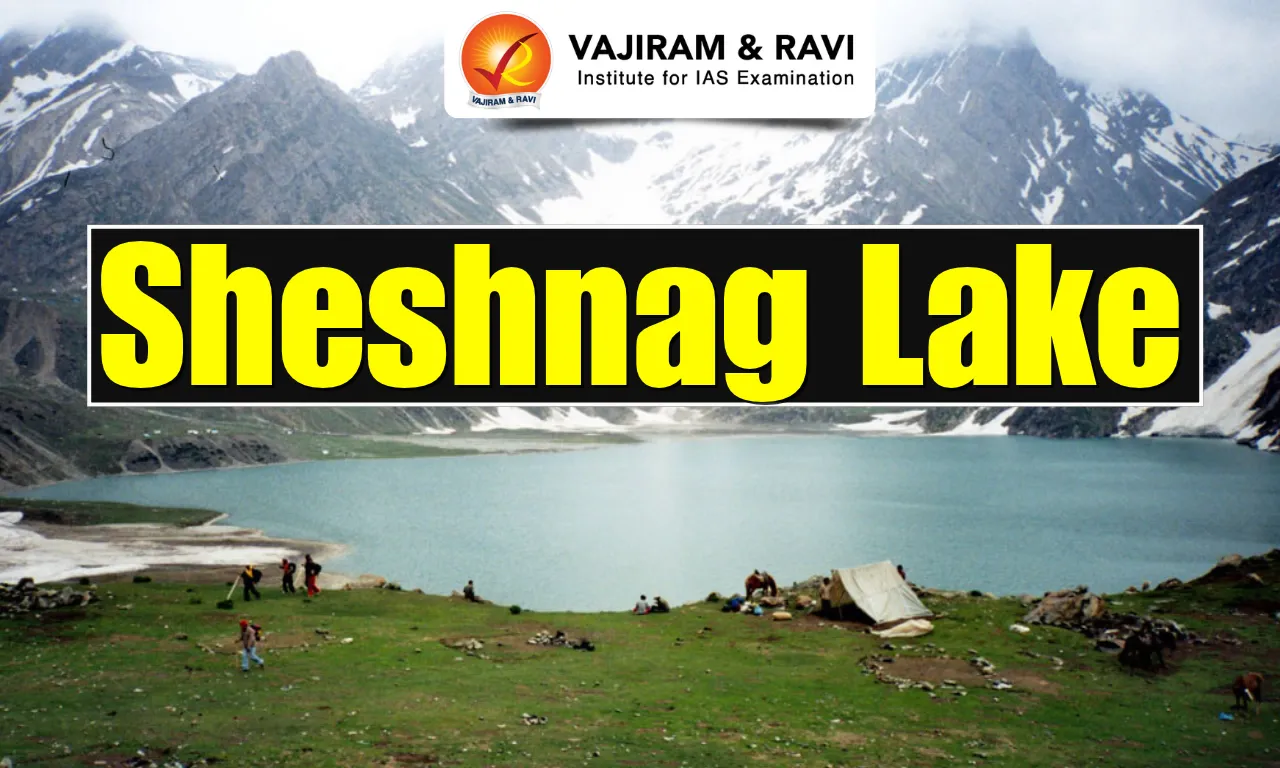
Sheshnag Lake: Excavator Video Sparks Outrage Near High-Risk Glacial Lake in Kashmir

Sheshnag Lake

Sheshnag Lake Latest News

A purported video showing an excavator deployed near the high-altitude Sheshnag Lake, a high-risk glacial lake, in Jammu and Kashmir’s Anantnag district has sparked widespread outrage recently. 

About Sheshnag Lake

  • It is located near Pahalgam in Anantnag district, Jammu and Kashmir.
  • It lies on the Pahalgam to Amarnath pilgrimage route. 
  • It is an oligotrophic alpine lake – a high-altitude lake that is naturally low in nutrients. The water of the lake is clean and clear due to its low algae production.  
  • It lies at an altitude about 3,590 metres above sea level.
  • It is spread over an area of 1.1 kilometers in length and 0.1 kilometers in width.
  • The lake is fed by glaciers and surrounded by steep slopes and loose moraine deposits, which are a mix of rocks, stones, gravel, sand and fine soil.
  • Kunyirhayan, a group of three mountain peaks standing tall at 16,850 ft, 16,570 ft, and 16,310 ft surrounds Sheshnag Lake. 
  • It completely freezes over during the winter months.
  • It drains into a tributary of the Lidder River.
  • It is among the 14 high-risk glacial lakes identified across Jammu and Kashmir that are closely monitored for environmental vulnerabilities.

Source: TP

Sheshnag Lake FAQs

Q1: Where is Sheshnag Lake ?

Ans: It is located near Pahalgam in Anantnag district, Jammu and Kashmir.

Q2: What is unique about Sheshnag Lake?

Ans: It is an oligotrophic alpine lake – a high-altitude lake that is naturally low in nutrients. The water of the lake is clean and clear due to its low algae production.  

Ashank- Anti-Submarine Warfare Shallow Water Craft

Ashank- Anti-Submarine Warfare Shallow Water Craft

Ashank- Anti-Submarine Warfare Shallow Water Craft Latest News

Recently, the Ashank- Anti-Submarine Warfare Shallow Water Craft was delivered to the Indian Navy at Visakhapatnam.

About Ashank- Anti-Submarine Warfare Shallow Water Craft

  • It is an indigenously designed anti-submarine warfare shallow water craft (ASW SWC).
  • It is built by Garden Reach Shipbuilders and Engineers (GRSE), Kolkata.
  • The ASW SWCs have been designed and constructed in accordance with the Classification Rules of Indian Register of Shipping (IRS).
  • Key Features
    • Armaments: It is equipped with state-of-the-art lightweight torpedoes, indigenous rocket launchers and advanced sonar systems,
    • Propulsion: These ships are among the largest Indian Naval warships propelled by waterjets.
  • Significance
    • The ship will further strengthen the Navy’s Anti- submarine, coastal surveillance and mine-laying capabilities. 
    • It is a potent platform designed to strengthen the Navy’s underwater surveillance and Anti-Submarine Warfare capabilities, particularly in coastal water.
    • It has over 80 percent indigenous content, the ship stands as a testament to the growing strength of the domestic defence manufacturing ecosystem and reducing dependency on imports.

Source: PIB

Ashank- Anti-Submarine Warfare Shallow Water Craft FAQs

Q1: Which organisation built Ashank- Anti-Submarine Warfare Shallow Water Craft?

Ans: It is built by Garden Reach Shipbuilders and Engineers (GRSE), Kolkata.

Q2: Ashank- Anti-Submarine Warfare Shallow Water Craft is equipped with which armaments?

Ans: It is equipped with state-of-the-art lightweight torpedoes, indigenous rocket launchers and advanced sonar systems,

Pyrene Pollution: Scientists Develop New Light-Driven Material to Break Down Toxic Pollutants

Pyrene

Pyrene Latest News

A novel material developed by scientists through incorporating metallic nanowires into metal–organic framework (MOF), can harness a broad range of light wavelengths to efficiently degrade environmental pollutants like pyrene.

About Pyrene

  • It is a persistent polycyclic aromatic hydrocarbon (PAH).
  • It belongs to the highly toxic class of PAHs, with carcinogenic and mutagenic properties.
  • Structure: It is an ortho- and peri-fused polycyclic arene consisting of four fused benzene rings, resulting in a flat aromatic system.
  • Pyrene is formed from incomplete combustion of organic chemicals. 
  • It is primarily found in the distillate of coal tar pitch.
  • Properties
    • It is a pale yellow crystalline powder that possesses an aromatic odor, is flammable, insoluble in water, and readily soluble in ethanol and diethyl ether.
    • It can undergo electrophilic substitution reactions such as halogenation, nitration, and sulfonation.
    • Pyrene has excellent properties such as thermal stability, high fluorescence quantum efficiency and high carrier mobility. 
  • Applications
    • Pyrene serves as a raw material for organic synthesis.
    • It can be oxidized to produce 1,4,5,8-naphthalenetetracarboxylic acid, which is used in the production of dyes, synthetic resins, disperse dyes, and engineering plastics.
  • Impact on Environment: It gets lodged into the environmental matrices like soil, water and atmosphere, resulting in widespread environmental pollution.

Source: PIB

Pyrene FAQs

Q1: What is Pyrene ?

Ans: It is a persistent polycyclic aromatic hydrocarbon (PAH).

Q2: What are the properties of Pyrene ?

Ans: Pyrene has excellent properties such as thermal stability, high fluorescence quantum efficiency and high carrier mobility. 

Triple Star System, Formation, Characteristics, Significance

Triple Star System

A Triple Star System is a group of three stars that are gravitationally bound to one another. In most such systems, two stars orbit closely together, while the third revolves around them at a greater distance. These stars may differ in size, mass, temperature and stage of evolution. Recently, astronomers discovered a rare triple star system named Welopōʻai, located just 28 light-years from Earth, consisting of two white dwarfs and one red dwarf. The discovery offers new insights into star formation, stellar evolution and gravitational interactions. 

Triple Star System Latest News

Recently, astronomers discovered a rare Triple Star System named Welopōʻai, located just 28 light-years from Earth. The discovery was led by the Trottier Institute for Research on Exoplanets (IREx) at the Université de Montréal and published in the journal Astronomy & Astrophysics on November 19, 2026.

  • Unique Composition: The system consists of two white dwarfs and one red dwarf, making it the closest known triple star system containing two white dwarfs.
  • Discovery: Astronomers detected unusual changes in the red dwarf's velocity using the SPIRou instrument at the Canada-France-Hawaii Telescope.
  • Confirmation: The 'Alopeke instrument aboard the Gemini North Telescope confirmed the presence of a faint white dwarf companion.
  • Rare Configuration: No similar triple star system is known within 100 light-years of Earth.
  • Scientific Mystery: The system challenges existing theories of stellar evolution, as the red dwarf survived the expansion of its neighbouring star into a red giant.

Triple Star System Formation

A Triple Star System consists of three stars that are gravitationally bound to one another. Such systems can form when a large cloud of gas and dust breaks into multiple fragments during star formation.

  • Fragmentation: A molecular cloud collapses under gravity and breaks into multiple dense regions, leading to the formation of stars.
  • Gravitational Interaction: The three stars remain connected through their mutual gravitational attraction.
  • Orbital Arrangement: Generally, two stars orbit close to each other, while the third star revolves around the inner pair at a greater distance.
  • Stellar Evolution: Over time, stars evolve at different rates depending on their masses and may become stellar remnants.

Triple Star System Characteristics

A Triple Star System is characterised by complex gravitational interactions, different orbital arrangements and varying stages of stellar evolution.

  • Three Stellar Components: Consists of three gravitationally bound stars that may differ in mass, size, brightness and age.
  • White Dwarfs: Extremely dense stellar remnants formed when low- and intermediate-mass stars exhaust their nuclear fuel.
  • Red Dwarfs: Small, relatively cool and faint stars that consume their nuclear fuel slowly and have long lifespans.
  • Orbital Stability: Depends on the masses, distances and gravitational interactions between the three stars.
  • Stellar Evolution: The expansion or death of one star can influence the orbits and evolution of its companions.

Triple Star System Significance in Astronomy

The study of Triple Star Systems helps astronomers understand the formation, evolution and gravitational behaviour of stars. The discovery of Welopōʻai provides a valuable opportunity to examine existing astronomical theories.

  • Stellar Evolution: Helps scientists understand how stars evolve, interact and eventually become stellar remnants.
  • White Dwarf Physics: Allows researchers to study extremely dense matter and electron degeneracy pressure, which prevents white dwarfs from collapsing under gravity.
  • Precise Mass Measurement: Astronomers measured the newly discovered white dwarf's mass with an uncertainty of just 0.7%, helping test stellar evolution models.
  • Gravitational Interactions: Provides insights into orbital stability and gravitational relationships in multiple-star systems.
  • Challenges Existing Theories: The survival of the red dwarf in a stable orbit despite its companion's earlier expansion into a red giant remains unexplained.
  • Exoplanet Research: Highlights how techniques used to detect planets, such as the radial velocity method, can also uncover hidden stellar companions.

Triple Star System FAQs

Q1: What is a Triple Star System?

Ans: A Triple Star System is a group of three stars gravitationally bound to one another.

Q2: How is a Triple Star System formed?

Ans: It can form when a cloud of gas and dust collapses under gravity and fragments into three stars.

Q3: What is the recently discovered Triple Star System?

Ans: Welopōʻai is a rare triple star system consisting of two white dwarfs and one red dwarf.

Q4: How far is the Welopōʻai Triple Star System from Earth?

Ans: The Welopōʻai Triple Star System is located approximately 28 light-years from Earth.

Q5: What is the difference between a white dwarf and a red dwarf?

Ans: A white dwarf is a dense stellar remnant, while a red dwarf is a small, cool and long-lived star.

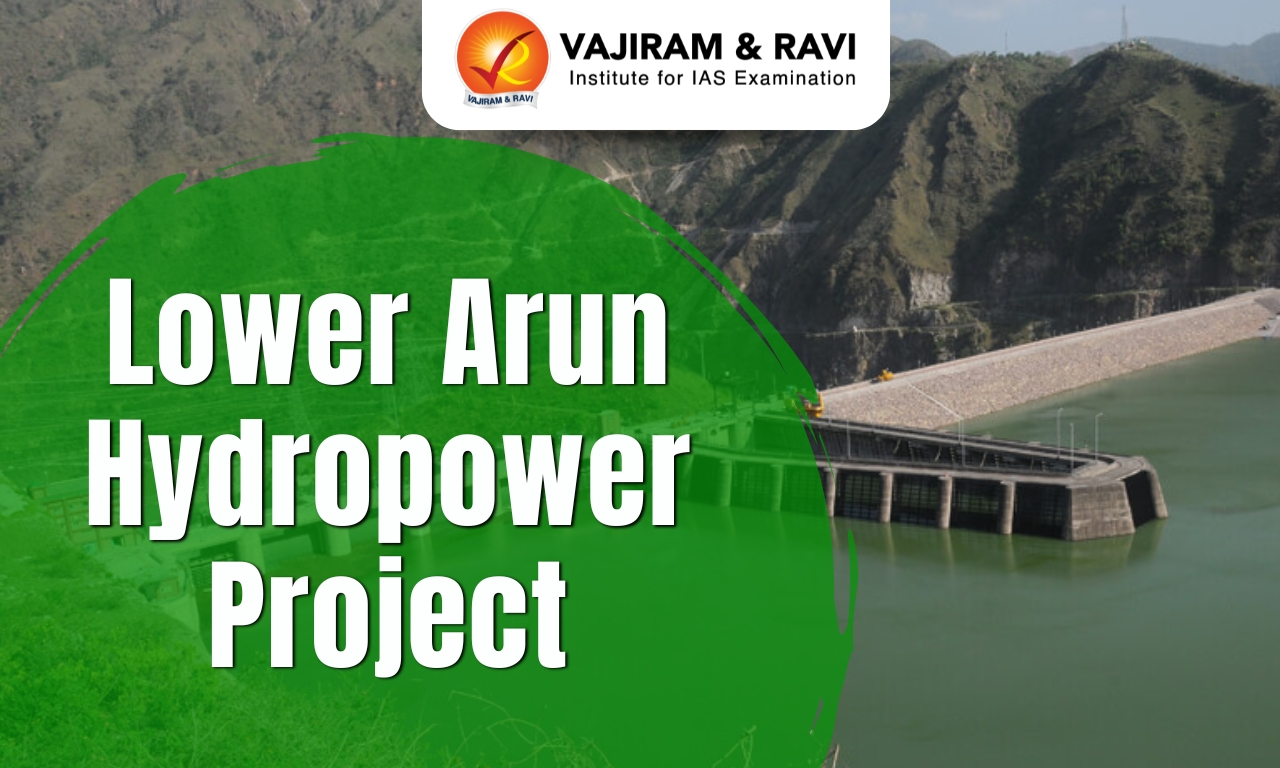
Lower Arun Hydroelectric Project: India and Nepal Lay Foundation Stone for ₹5,792 Crore Project

Lower Arun Hydropower Project

Lower Arun Hydroelectric Project Latest News

Prime Minister Narendra Modi and Nepal Prime Minister Balendra Shah recently laid the foundation stone of SJVN's 669 MW Lower Arun hydroelectric project in Nepal, which is estimated to cost ₹5,792.36 crore.

About Lower Arun Hydroelectric Project

  • It is a 679 MW run-of-river project planned on the Arun River (a tributary of the Koshi River) in the Sankhuwasabha and Bhojpur districts of Eastern Nepal.
  • The project will be built under the build, own, operate, and transfer (BOOT) model.
  • The project is being developed by SJVN Lower Arun Power Development Company Pvt. Ltd. (SLPDC), a wholly owned subsidiary of SJVN (formerly Satluj Jal Vidyut Nigam).
    • SJVN Limited is a Navratna Central Public Sector Enterprise under the Ministry of Power, Government of India.
  • A key feature of the Lower Arun project is its integration with SJVN's 900 MW Arun-3 Hydroelectric Project, located upstream on the same river.
  • Both projects will operate under a tandem operation system, under which water discharged from Arun-3 will be used to generate electricity at Lower Arun.
  • The arrangement is designed to optimise the use of available water resources and enable additional renewable energy generation without the construction of a separate storage reservoir.
  • The Lower Arun project will comprise four generating units of 167.25 MW each, a 17.4-km head race tunnel and a surface powerhouse.
  • Once operational, the project is expected to generate approximately 2,901 million units of electricity annually.
  • Under the Project Development Agreement, 21 percent of the electricity generated will be provided free of cost to the Government of Nepal. 

Key facts about Arun-3 Hydropower Project

  • It is a 900 MW run-of-the-river hydropower project being developed on the Arun River in Sankhuwasabha District in Nepal.
  • It will include the construction of a 70 m-tall and 466 m-long concrete gravity dam.
  • Once completed, it will be the biggest hydroelectric facility in Nepal. It will produce 4,018.87 million units of electricity a year.
  • SJVN Arun-III Power Development Company (SAPDC), a wholly owned subsidiary of India’s SJVN, is developing the project on a build-own-operate-transfer (BOOT) basis.
  • SAPDC will operate the facility for a period of 25 years, excluding the construction period of five years, before transferring the ownership to the Nepal government.
  • The project will provide surplus power to India, strengthening economic linkages with Nepal.
  • The power from the project shall be exported from Dhalkebar in Nepal to Muzaffarpur in India.

Source: ET

Lower Arun Hydroelectric Project FAQs

Q1: Where is Lower Arun Hydroelectric Project located?

Ans: It is a project planned on the Arun River (a tributary of the Koshi River) in the Sankhuwasabha and Bhojpur districts of Eastern Nepal.

Q2: Which company is developing Lower Arun Hydroelectric Project located?

Ans: The project is being developed by SJVN Lower Arun Power Development Company Pvt. Ltd. (SLPDC).

Santhal Tribe: Jharkhand High Court Rules Daughters Cannot Be Denied Property Rights

Santhal Tribe

Santhal Tribe Latest News

In a significant ruling on the inheritance rights of women in the Santhal Adivasi community, the Jharkhand High Court held that daughters cannot be excluded from their father's property solely on the basis of traditional beliefs.

About Santhal Tribe

  • Santhals are the third largest scheduled tribe community in India after Gonds and Bhils.
  • They mainly reside in the states of Bihar, Jharkhand, West Bengal, and Orissa.
  • Language: They speak Santhali, a dialect of Kherwari, a Munda (Austroasiatic) language.
    • Santhali, written in OI-Chiki script, is recognised as one of the scheduled languages in the Eighth Schedule to the Constitution.
  • Belief System 
    • They are nature worshippers and could be seen paying obeisance at Jaher (sacred groves) in their villages.
    • Divorce is not a taboo in Santhal society. Either of the couple could divorce the other.
  • Their traditional dress includes dhoti and gamuchha for men and a short-check saree, usually blue and green, for women, who generally put on tattoos.
  • Occupation
    • Most Santhals are agriculturists, depending on their farmlands or forests.
    • Seasonal forest collection is one of the important sources of their subsidiary income.
  • Dance (enej) and music (sereng) are integral parts of the Santal life.
  • Their homes, called Olah, have a particular three-colour pattern on the outer walls. The bottom portion is painted with black soil, the middle with white, and the upper with red.

Source: NIE

Santhal Tribe FAQs

Q1: Where do Santhal Tribe reside?

Ans: They mainly reside in the states of Bihar, Jharkhand, West Bengal, and Orissa.

Q2: What is the occupation of Santhal Tribe?

Ans: Most Santhals are agriculturists, depending on their farmlands or forests.

Manjeera River Covered in Thick White Foam as Industrial Pollution Raises Concerns

Manjeera River

Manjeera River Latest News

Recently, it was observed that thick white foam has covered the Manjeera after Nakkavagu carried industrial effluents and residential wastewater into the river.

About Manjeera River

  • It is a tributary of the river Godavari. 
  • It passes through the states of Maharashtra, Karnataka and Telangana. 
  • Course
    • Origin: It originates in the Balaghat range of hills near Ahmednagar District, Maharashtra, at an altitude of 823 metres (2,700 ft).
    • The final stretch of the River forms the border between Maharashtra to the West and Telangana to the East.
    • It drains into Godavari River at Basara near Nizamabad, Telangana.
    • The confluence is traditionally known as the Triveni Sangamam, associated with the meeting of the Manjira, Godavari and Haridra rivers. 
  • It has a total catchment area of 30,844 sq.km.
  • Tributaries: Some of its notable tributaries are Haldi (Haridra), Lendi, Nalla, Manyad, Terna, Tawarja, Gharni, etc.
  • Key Projects on Manjeera
    • Singur Dam/Singur Reservoir
    • Nizam Sagar Project

Source: TT

Manjeera River FAQs

Q1: Manjeera River is a tributary of which river?

Ans: Godavari River

Q2: Where does the river Manjeera originates?

Ans: It originates in the Balaghat range of hills near Ahmednagar District, Maharashtra.

Exercise Suryakiran: India and Nepal Set to Hold 20th Joint Military Exercise

Exercise SURYAKIRAN

Exercise Suryakiran Latest News

India and Nepal are set to hold the 20th edition of exercise Suryakiran.

About Exercise Suryakiran

  • It is a joint bilateral military exercise conducted between India and Nepal.
  • It is conducted annually and alternately hosted by India and Nepal.
  • It is aimed at further strengthening military cooperation and deepening the defence partnership between the two neighbouring countries.
  • This exercise is described as a reflection of the close bond between the two countries, with the tagline, “Two Nations. One Mission. An Enduring Bond.”
  • It is a key bilateral military engagement between India and Nepal, providing an opportunity for the two armies to enhance interoperability, exchange operational experiences and strengthen coordination through joint training.

Source: TH

Exercise Suryakiran FAQs

Q1: What is Exercise Suryakiran ?

Ans: It is a joint bilateral military exercise.

Q2: Exercise Suryakiran is conducted between which two countries?

Ans: It is conducted between India and Nepal.

Guru Nanak Jayanti 2026, Date, History, Significance, Celebration

Guru Nanak Jayanti 2026

Guru Nanak Jayanti 2026, also known as Gurpurab and Prakash Parv, will be celebrated on Tuesday, November 24, 2026. The festival marks the 557th birth anniversary of Guru Nanak Dev Ji, the founder of Sikhism and the first of the ten Sikh Gurus. Observed on Kartik Purnima, the occasion highlights his teachings of one God, equality, honest living, compassion and selfless service.

Guru Nanak Jayanti 2026

Guru Nanak Jayanti is observed annually on Kartik Purnima, the full moon day of the Hindu lunar month of Kartik. In 2026, the festival falls on November 24 (Tuesday), marking the 557th birth anniversary of Guru Nanak Dev Ji. Also called Gurpurab and Prakash Parv, the occasion commemorates his teachings on spiritual devotion, social equality, religious harmony and humanity. His philosophy challenged caste-based discrimination and religious divisions while promoting faith in one universal God.

Guru Nanak Dev Ji Biography

Guru Nanak Dev Ji was born in 1469 at Rai Bhoi Ki Talwandi, now known as Nankana Sahib in present-day Pakistan. He was the founder of Sikhism and the first of its ten human Gurus. His parents were Mehta Kalu and Mata Tripta. He travelled extensively to spread the message of one God, equality and truthful living. He established Kartarpur in 1522 and spent his final years there. His compositions include 974 hymns incorporated into the Guru Granth Sahib. He passed away at Kartarpur on September 22, 1539.

Guru Nanak Jayanti 2026 Celebrations

Guru Nanak Jayanti is celebrated with deep devotion across India and in Sikh communities worldwide. The celebrations usually last for three days, beginning with Akhand Path, a continuous 48-hour reading of the Guru Granth Sahib.

On the day preceding the Gurpurab, a Nagar Kirtan (religious procession) is carried out. The procession is led by the Panj Pyare (Five Beloved Ones) and accompanied by hymn singing, martial art displays (Gatka), and spiritual chants.

On the main day, devotees gather at Gurdwaras to offer prayers, listen to hymns (Kirtan), and participate in Langar, a community meal open to all, symbolizing equality and humility. Prominent Gurdwaras like Golden Temple (Amritsar), Gurdwara Bangla Sahib (Delhi), and Nankana Sahib (Pakistan) host grand celebrations attended by thousands of devotees.

Guru Nanak Jayanti Historical Background

Guru Nanak Jayanti commemorates the birth and teachings of Guru Nanak Dev Ji, who established the foundations of Sikhism in the 15th century. His teachings emphasised devotion to one God, equality among human beings, honest work and service to society. The annual observance on Kartik Purnima became an important religious tradition among Sikh communities.

The celebration also reflects the importance of Sangat (congregation) and Pangat (sitting together to share meals) in Sikhism. These institutions promote collective worship, community participation and equality by bringing people from different social backgrounds together.

Guru Nanak Dev Ji Teachings

Guru Nanak’s teachings remain timeless and globally relevant. His spiritual philosophy promotes universal brotherhood and moral integrity. His verses, enshrined in the Guru Granth Sahib, form the core of Sikh philosophy and continue to guide followers globally. Some of his major teachings include:

  • Oneness of God: There is only one universal creator.
  • Equality of Humanity: All humans are equal irrespective of caste, creed, gender, or religion.
  • Service to Humanity: True worship lies in serving others.
  • Rejection of Superstition: Faith should be rooted in truth, not rituals.
  • Environmental Respect: Guru Nanak regarded air, water, and earth as sacred elements of creation.
  • Honest Living: Earning through righteous means is an act of worship.

Guru Nanak Jayanti 2026 FAQs

Q1: When will Guru Nanak Jayanti 2026 be celebrated?

Ans: Guru Nanak Jayanti 2026 will be celebrated on Wednesday, November 24, 2026, marking the 557th birth anniversary of Guru Nanak Dev Ji.

Q2: Why is Guru Nanak Jayanti celebrated?

Ans: The day honors the birth and teachings of Guru Nanak Dev Ji, the founder of Sikhism and the first of the ten Sikh Gurus.

Q3: How is Guru Nanak Jayanti 2026 celebrated in India?

Ans: Devotees participate in Akhand Path, Nagar Kirtans, community Langars, and prayers at Gurdwaras across India and worldwide.

Q4: What was the main message of Guru Nanak Dev Ji?

Ans: Guru Nanak preached equality, truth, service, and remembrance of God while rejecting caste and ritual-based divisions.

Q5: What are the main places associated with Guru Nanak Dev Ji?

Ans: Important sites include Nankana Sahib (birthplace), Kartarpur Sahib, and Golden Temple, which are central to Sikh heritage.

Portugal Parliamentary Delegation Meets Rajya Sabha Deputy Chairman to Strengthen India Ties

Portugal

Portugal Latest News

Recently, India and Portugal reviewed the full range of their bilateral relations and reaffirmed their commitment to finalising a comprehensive Five-Year Roadmap for India-Portugal Relations for 2027–2032.

About Portugal

  • Location: It is the westernmost country of mainland Europe, located on the Iberian Peninsula.
  • Bordering Countries: It shares land border with Spain (north and east),
  • Maritime border: It is bounded by the North Atlantic Ocean to the south and west.
    • It also administers two autonomous regions: the Madeira and Azores archipelagos, located in the Atlantic Ocean.
  • Capital city: Lisbon

Geographical Features of Portugal

  • Climate: Its climate is very much like that of most Mediterranean countries. This means it’s hot in the summer and temperate in the winter.
  • Rivers: The Tagus River, flowing west into the Atlantic ocean, divides Portugal into mountainous northern regions and rolling plains in the south.
  • Highest Point: Ponta do Pico (Pico Alto), located in the Azores.
  • Natural Resources: It mainly consists of iron ore, copper, zinc, tin, tungsten, silver, gold, uranium, marble, clay, gypsum.

Source: DD India

Portugal FAQs

Q1: What is the capital of Portugal ?

Ans: Lisbon

Q2: Where is Portugal located?

Ans: It is located on the Iberian Peninsula.

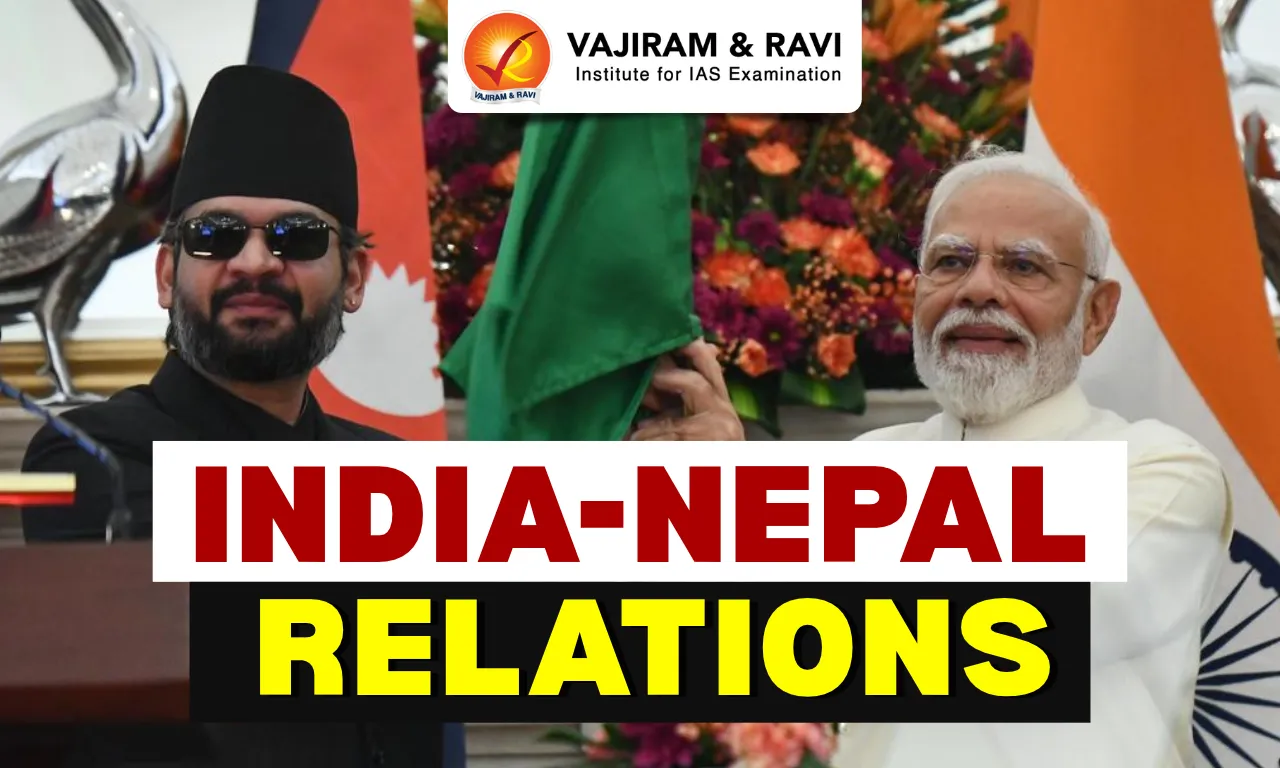
India-Nepal Relations – Resetting the Himalayan Partnership

India-Nepal Relations

India-Nepal Relations Latest News

  • India and Nepal have sought to revitalise bilateral relations after a period of diplomatic strain, particularly over the boundary dispute involving Kalapani, Lipulekh and Limpiyadhura.
  • During Nepal PM Balendra Shah's first bilateral visit to India, the Indian PM announced a 24,000 crore Nepalese rupee (approximately $1.63 billion or Rs 15,000 crore) development cooperation package. 
  • The two countries also signed eight MoUs and adopted a 10-pillar Joint Vision Document titled Viksit Bharat and Samunnat Nepal: Re-imagining the Partnership.
  • The initiative aims to transform traditional cultural and geographical ties into a modern, mutually beneficial development partnership.

Economic Partnership - From Aid to Shared Growth

  • Development package: Includes grant assistance and a line of credit, focusing on reconstruction, infrastructure and energy-sector development.
  • Cross-border economic zones: Cooperation to establish Special Economic Zones (SEZs), export-oriented manufacturing facilities and IT parks near the border.
  • Trade and transit: India will facilitate Nepal's access to its Kandla and Paradip ports, strengthening Nepal's connectivity with international markets.
  • Air connectivity: Agreement to operationalise the Kathmandu–Bhairahawa–Lucknow route as a two-way air corridor.
  • Significance: Promotes Nepal's economic diversification, trade competitiveness and regional economic integration.

Phygital (Physical+Digital) Connectivity - Backbone of Cooperation

  • Initiatives:
    • Saryu-Kamala Express: Connects Ayodhya with Janakpur, promoting religious tourism.
    • Dharchula–Darchula bridge: Strengthens cross-border road connectivity.
    • Banbasa Integrated Check Post: Facilitates smoother movement of goods and people. Both sides also agreed to expedite Integrated Check Posts at Bhairahawa, Sunauli, and Dodhara Chandani.
    • Jayanagar–Bardibas and Jogbani–Biratnagar rail links: Strengthen cross-border railway connectivity.
    • Siliguri–Jhapa pipeline: Expands petroleum infrastructure.
    • UPI linkage: Facilitates cross-border digital payments.
  • Significance: Reduces trade costs, improves logistical efficiency and strengthens people-to-people connectivity.

Energy Partnership - Turning Rivers into Economic Assets

  • Nepal's enormous hydropower potential complements India's growing energy demand.
  • Major initiatives include:
    • Lower Arun Hydroelectric Project: Foundation stone laid for the 669-MW project.
    • Arun-3 Project: Commitment to its timely completion.
    • Petroleum security: Inauguration of Phase II of the Motihari–Amlekhgunj petroleum pipeline and advancement of the Jhapa petroleum terminal.
    • New pipeline: Proposed Siliguri–Jhapa petroleum pipeline. 
    • Other supplies: India also reiterated its commitment to maintaining supplies of fuel, fertilisers and essential commodities to Nepal.
  • Significance: Creates an interdependent energy ecosystem through hydropower development, electricity trade and energy security.

Beyond Traditional Diplomacy - Emerging Areas of Cooperation

  • The 10-pillar vision document expands bilateral cooperation into newer domains.
  • For example,
    • Technology and AI: Startup partnerships, digital parks, data centres and AI cooperation.
    • Space: Satellite development, remote sensing and disaster management.
    • Education: Exploring an IIT campus in Nepal, scholarships and academic exchanges.
    • Healthcare: Jan Aushadhi Kendras, medical institutional linkages and laboratory upgradation.
    • Agriculture: Agro-Industrial Park in Chitwan and ICAR Centre of Excellence.
    • Sports: Cricket academy and sports infrastructure development.
    • Governance: Training of Nepali civil servants and exchange of administrative practices.
  • Additionally, cooperation between Nalanda University and Lumbini Buddhist University will be strengthened through a Nalanda Centre at Lumbini.

Culture and Tourism - Leveraging Civilisational Bonds

  • India and Nepal share deep religious and cultural connections associated with Ram, Sita and Buddha.
  • Both countries will develop three major religious tourism circuits, for instance, Ramayana Circuit (Ayodhya–Janakpur), Buddhist Circuit (Lumbini–Bodh Gaya–Sarnath–Kushinagar), and Shiv-Shakti Circuit [Kathmandu (Pashupatinath)–Varanasi].
  • These initiatives can strengthen cultural diplomacy, tourism revenues and cross-border social ties.

Unresolved Issues - Managing Differences through Dialogue

  • Despite renewed cooperation, certain structural challenges remain, for instance,
    • Boundary dispute: Kalapani, Lipulekh and Limpiyadhura remain contentious.
    • 1950 Treaty of Peace and Friendship: Both sides recognise the need to review the existing bilateral legal framework in accordance with contemporary realities.
    • Water-sharing issues: Differences concerning water resources and hydropower projects require sustained negotiations.
    • Trust deficit: Nepal's concerns regarding sovereignty, unequal economic dependence and India's perceived interference need sensitivity.
    • Trade asymmetry: Nepal's dependence on Indian transit infrastructure and trade (India accounts for ~62% of Nepal's total merchandise trade) highlights the need for greater economic diversification.
  • Institutional mechanism: A High-Level Monitoring Group, led by Nepal's Foreign Secretary and India's Ambassador to Nepal, will meet at least once every six months to monitor implementation.

Way Forward - From Neighbourhood to Interdependence

  • Respect sovereignty: Address Nepal's concerns through equality, mutual trust and non-interference.
  • Resolve disputes: Institutionalise dialogue on boundary and water-sharing issues.
  • Deliver projects: Ensure timely completion of cross-border infrastructure and energy projects.
  • Promote economic integration: Encourage private investment, manufacturing and regional value chains.
  • Strengthen people-to-people ties: Expand educational, cultural and youth exchanges.

Conclusion

  • India–Nepal relations are rooted in geography, history and civilisational bonds but must evolve through economic interdependence and mutual respect. 
  • The success of the new vision will depend not merely on announcements and agreements but on their timely implementation.
  • A prosperous Nepal and a developed India can emerge as complementary partners in building a peaceful, connected and economically integrated South Asia.

Source: ToI | IE | IE

India-Nepal Relations FAQs

Q1: How does the India-Nepal Joint Vision Document seek to transform bilateral relations?

Ans: It seeks to move beyond traditional ties towards a comprehensive partnership encompassing trade, technology, healthcare, etc.

Q2: Why is hydropower cooperation strategically important for India and Nepal?

Ans: It combines Nepal's vast hydropower potential with India's growing energy demand.

Q3: What is the significance of cross-border connectivity in India-Nepal relations?

Ans: Railways, roads, Integrated Check Posts, petroleum pipelines and digital payment linkages can reduce trade costs.

Q4: What are the major challenges in India–Nepal bilateral relations?

Ans: Boundary disputes, concerns over the 1950 Treaty, water-sharing issues, trade asymmetry, etc.

Q5: How can cultural diplomacy strengthen India–Nepal relations?

Ans: Developing Ramayana, Buddhist and Shiv-Shakti tourism circuits can leverage shared civilisational heritage.

Memorandum of Procedure for Judicial Appointments: SC Notice Explained

Memorandum of Procedure for judicial appointments

Memorandum of Procedure for judicial appointments Latest News

  • The Supreme Court has issued notice to the Union government and the Chief Justice of India (CJI) in a public interest litigation (PIL) filed by the NGO Lok Prahari, seeking directions to finalise the revised Memorandum of Procedure (MoP) for appointing judges to the Supreme Court and High Courts. 
  • The plea highlights that this revision has remained pending since December 2015, when the Supreme Court struck down the National Judicial Appointments Commission (NJAC) and left the task to the Centre.

What Is the Case About?

  • A bench of Justices M M Sundresh and P B Varale issued notice to the Centre and, notably, to the Supreme Court itself (in its administrative capacity).
  • The Court must respond on two fronts: 
    • Finalising the pending MoP.
    • Bringing Collegium decisions under the Right to Information (RTI) Act.

What Is the Memorandum of Procedure (MoP)?

  • The MoP is a document of mutually agreed conventions laying out the steps for appointment, elevation, and transfer of judges to the High Courts and Supreme Court.
  • It was first drawn up on June 30, 1999, following the: 
    • Second Judges Case (1993)
    • Third Judges Case (1998)
      • — both of which established the Collegium system's primacy in judicial appointments.
  • Process: The CJI initiates proposals for Supreme Court appointments; a High Court Chief Justice, in consultation with the two senior-most puisne judges, initiates proposals for that High Court.
  • As per the Law Ministry, appointments continue to be governed by the original 1999 MoP — the "revised" version has never been finalised.

The 2015 NJAC Judgment: Where It All Began

  • In October 2015, a five-judge Constitution Bench declared the 99th Constitutional Amendment (which created the NJAC) unconstitutional, restoring the Collegium system.
  • The proposed NJAC would have comprised: the CJI, two senior judges, the Law Minister, and two eminent persons.
  • The Court then invited suggestions to improve Collegium functioning, receiving around 11,500 pages of input, grouped under four heads: transparency, a Collegium secretariat, eligibility criteria, and complaints.
  • In its December 2015 order, the Court accepted the government's position (as per then-AG Mukul Rohatgi) that drafting the MoP is an executive function, directing the government to finalise it "in consultation with the CJI" — but set no time limit.

What Has Happened Since 2015? A Decade of Delay

  • 2016–2017: Consultations continued; a draft MoP was reportedly sent to the judiciary in March 2016. Two sticking points remained unresolved: 
    • The Centre's demand for power to reject a judicial nominee on "national security" grounds.
    • A proposal for a permanent Collegium secretariat.
  • December 2016: A parliamentary standing committee flagged that the lack of Centre-judiciary consensus on the MoP was delaying appointments.
  • 2023: Then Law Minister wrote to then-CJI D Y Chandrachud, suggesting Centre/State nominees be included in search-cum-evaluation committees — seen by some as an attempt to revisit the Collegium system. The government later clarified in the Rajya Sabha that this was merely a "facilitator" role, with the Collegium retaining final say.
  • February 2026: Law Minister Arjun Ram Meghwal told the Rajya Sabha the MoP revision was "under consideration."

Where Things Stand Informally

  • Secretariat Issue: Effectively resolved — successive CJIs have established internal systems tracking judges' performance data.
  • National Security Veto: Never formally accepted, but exercised in practice — e.g., the Centre delayed/blocked the Collegium's recommendation for Senior Advocate Saurabh Kirpal's appointment to the Delhi High Court, citing concerns raised via the Research & Analysis Wing (RAW) about his sexual orientation and his partner's nationality.

Judicial Attempts to Push for Resolution

  • October 2017: Justices A K Goel and U U Lalit sought the Centre's response on the delay, noting the issue couldn't remain pending indefinitely — but this order was later recalled by a bench headed by then-CJI Dipak Misra.
  • RTI responses revealed the finalised MoP (as per the Collegium) was sent to the government in March 2017, remaining "under consideration" ever since.
  • What Happens Next - The Centre and the Secretary General of the Supreme Court must now file their responses before the matter is heard again — reopening a question that has lingered for over a decade.

Conclusion

  • A decade after the NJAC's demise, the absence of a finalised MoP reflects an unresolved tug-of-war between executive oversight and judicial independence. 
  • The Supreme Court's latest notice signals renewed urgency — but with "national security" and secretariat disputes still simmering beneath the surface, a lasting resolution remains uncertain.

Source: IE

Memorandum of Procedure for judicial appointments FAQs

Q1: What is the Memorandum of Procedure for judicial appointments?

Ans: The Memorandum of Procedure for judicial appointments outlines conventions governing the appointment, elevation and transfer of judges to High Courts and the Supreme Court.

Q2: Why has the revised Memorandum of Procedure remained pending?

Ans: The Memorandum of Procedure for judicial appointments remains unresolved due to disagreements over national security veto powers and a permanent Collegium secretariat.

Q3: How did the NJAC judgment affect the Memorandum of Procedure?

Ans: After striking down the NJAC in 2015, the Supreme Court directed the government to finalise the Memorandum of Procedure for judicial appointments in consultation with the CJI.

Q4: What are the major disagreements over the revised MoP?

Ans: The Memorandum of Procedure for judicial appointments faces disagreements regarding executive involvement, national security-based rejection of nominees and institutional transparency.

Q5: Why is finalising the Memorandum of Procedure important?

Ans: Finalising the Memorandum of Procedure for judicial appointments could clarify selection procedures, improve transparency and address longstanding tensions between judicial independence and executive oversight.

FSSAI vs Maharashtra FDA: Centre-State Food Safety Jurisdiction Dispute

FSSAI vs Maharashtra FDA

FSSAI vs Maharashtra FDA Latest News

  • Maharashtra's Food and Drug Administration (FDA) Commissioner Tukaram Mundhe had filed a petition in the Bombay High Court in September 2026, accusing the Centre and the Food Safety and Standards Authority of India (FSSAI) of creating a parallel enforcement system that usurped State powers. 
  • The petition has now been withdrawn, raising questions about the Centre-State jurisdictional dynamics in food safety regulation.

What Was the Petition About?

  • The core dispute centred on jurisdiction — whether the FSSAI had overstepped its authority under the Food Safety and Standards (FSS) Act, 2006.
  • Maharashtra argued that: 
    • The FSS Act envisaged a decentralised framework, delegating executive implementation powers to State authorities.
    • FSSAI's actions amounted to centralisation of enforcement, contradicting this original design.
    • The Act's Statement of Objects and Reasons explicitly intended decentralised licensing, empowering States to issue registrations and State licences.
  • The FDA claimed this centralisation hindered its ability to protect public health and consumer interests, including stopping FDA officials from independently raiding centrally-licensed establishments.

Provisions Challenged in the Petition

  • The petition contested the constitutional validity of multiple regulations:
    • Regulations 1.2.1(1), 1.2.1(3), 1.2.1(6), and 2.1.5(2) of the Food Safety and Standards (Licensing and Registration of Food Businesses) Regulations, 2011.
    • Creation of Food Analysts and Central Food Safety Officers posts under the FSSAI (Recruitment and Appointment) Regulation, 2018.
    • Rule 2.1.2(1)(i) of the Food Safety and Standards Rules, 2011.
    • The 2026 Amendment to the Licensing and Registration Regulations.

Timeline of Centralisation (As Alleged by Maharashtra)

  • August 2011: FSSAI framed regulations creating the "Central Licensing Authority" and "State Licensing Authority" — going beyond Section 36(1) of the 2006 Act, which recognised only State-appointed Designated Officers.
  • November 2018: FSSAI created Central Food Safety Officers (FSOs) and Food Analysts (FAs), building independent field machinery for the central regulator.
  • October 2020: FSSAI launched the Food Safety Compliance System (FoSCoS) portal — replacing the earlier Food Licensing and Registration System (FLRS) — for issuing licences and registrations.
  • March 2026: FSSAI revised turnover thresholds for licensing: 
    • Up to ₹1.5 crore → Registration only.
    • ₹1.5 crore to ₹50 crore → State Licence.
    • Above ₹50 crore → Central Licence.

The 'Clandestine' Allegation

  • The FDA alleged that FSSAI framed the 2011 Regulations without prior Central Government approval.
  • It claimed stakeholder objections were finalised internally by FSSAI, never placed before the Central Government — allegedly violating Section 92(1) of the FSS Act and Section 23 of the General Clauses Act, 1897.

Impact on Businesses and Consumers

  • For consumers: Certain establishments fall under Central jurisdiction, others under State jurisdiction — but the core mandate (ensuring food safety) remains unchanged for both.
  • For businesses: Experts argue uniform regulation benefits businesses operating across States, since inconsistent State-wise interpretation of the same law often causes confusion and harassment.
  • Experts’ view: The petition reflected a "narrow way of looking at food safety." Better Centre-State coordination, not confrontation, serves consumers best. Notably, newer legislation has raised the threshold for Central licensing, meaning fewer businesses now fall under central purview.

Conclusion

  • The withdrawal leaves the underlying jurisdictional ambiguity between the FSSAI and State food authorities unresolved, even as the political controversy fades. 
  • The episode underscores a recurring federal governance challenge: balancing uniform national standards with meaningful State-level enforcement powers — a tension likely to resurface unless the Centre and States build genuine institutional coordination.

Source: TH | BS

FSSAI vs Maharashtra FDA FAQs

Q1: What was the dispute between FSSAI and Maharashtra FDA about?

Ans: The FSSAI vs Maharashtra FDA dispute concerned whether the central regulator had centralised enforcement powers that Maharashtra claimed belonged primarily to State authorities.

Q2: Why did Maharashtra challenge FSSAI's regulatory framework?

Ans: Maharashtra argued that the FSSAI vs Maharashtra FDA dispute arose from regulations allegedly undermining decentralised enforcement envisaged under the Food Safety Act.

Q3: Which regulations were challenged in the FSSAI vs Maharashtra FDA case?

Ans: The FSSAI vs Maharashtra FDA petition challenged licensing regulations, central food safety officer appointments, relevant rules and the 2026 licensing amendments.

Q4: Why is centralisation of food safety regulation controversial?

Ans: The FSSAI vs Maharashtra FDA controversy highlights concerns that centralised enforcement could weaken State authority, although uniform regulation may benefit businesses operating nationwide.

Q5: What does the FSSAI vs Maharashtra FDA dispute reveal about Indian federalism?

Ans: The FSSAI vs Maharashtra FDA dispute illustrates the challenge of balancing uniform national standards with State enforcement autonomy and effective Centre-State coordination.

Katarniaghat Wildlife Sanctuary: Leopard Attack Kills Man in Uttar Pradesh’s Bahraich

Katarniaghat Wildlife Sanctuary (KWS)

Katarniaghat Wildlife Sanctuary Latest News

A 45-year-old man was recently killed in a leopard attack in the Sujauli area of the Katarniaghat Wildlife Sanctuary in Uttar Pradesh's Bahraich district. 

About Katarniaghat Wildlife Sanctuary

  • It is located in the Terai belt of the Upper Gangetic Plains in the Bahraich district of Uttar Pradesh, close to the Indo-Nepal border. 
  • In 1987, it was brought under the purview of the ‘Project Tiger’, and together with the Kishanpur Wildlife Sanctuary and the Dudhwa National Park, it forms the Dudhwa Tiger Reserve.
  • Area: Approximately 400 sq. km
  • It provides strategic connectivity between the tiger habitats of Dudhwa and Kishanpur in India and the Bardia National Park in Nepal.
  • Vegetation: Katarniyaghat’s vegetation consists of grasslands, mixed deciduous forests, and moist deciduous forests.
  • Flora
    • Primarily composed of dense sal forests, mixed with teak, jamun, and other deciduous trees.
    • The sanctuary is also home to numerous medicinal plants, adding to its ecological significance.
  • Fauna
    • It is home to a number of endangered species, including the gharial, tiger, rhino, Gangetic dolphin, Swamp deer, Hispid hare, Bengal florican, the White-backed and Long-billed vultures.
    • The Gairwa River (tributary of the Ghaghara River), which flows in the area, is declared a sanctuary for Mugger and Gharial. It is also home to rare turtles, freshwater fish, and a host of aquatic life.
    • It is among the few places in India where freshwater dolphins, also known as Gangetic dolphins, are found in their natural habitat.

Source: Rediff

Katarniaghat Wildlife Sanctuary FAQs

Q1: Where is Katarniaghat Wildlife Sanctuary is located?

Ans: It is located in the Terai belt of the Upper Gangetic Plains in the Bahraich district of Uttar Pradesh, close to the Indo-Nepal border. 

Q2: What type of vegetation is found in Katarniaghat Wildlife Sanctuary?

Ans: Katarniyaghat’s vegetation consists of grasslands, mixed deciduous forests, and moist deciduous forests.

Daily Editorial Analysis 24 November 2026

Daily-Editorial-Analysis

Indian Science Needs Fewer Borders

Context

  • Modern science is founded on independent scrutiny, intellectual freedom and the universal exchange of knowledge.
  • Scientific credibility depends on rigorous evaluation by independent experts, irrespective of their geographical location.
  • Therefore, seeking assessments from researchers outside India cannot automatically be considered colonial subordination.
  • The debate surrounding international academic publishing raises important questions about commercial concentration, institutional inequalities and India's research ecosystem.

Understanding the Research Publishing System

  • Academic publishing is essential for scientific advancement. Researchers submit manuscripts to journals, where editors assess them before sending suitable papers to independent experts for peer review.
  • Reviewers evaluate their originality, methodology, evidence and contribution to knowledge. Journals subsequently accept, reject or seek revisions.
  • This process promotes scientific verification, intellectual debate and knowledge dissemination.
  • Published research also becomes part of the permanent academic record.
  • However, academic publishing has acquired considerable influence over researchers' careers, university appointments, institutional rankings and research funding.
  • The number of publications and the reputation of journals often become measures of professional success.
  • Nevertheless, publishing platforms cannot be held responsible for every weakness in the research ecosystem.
  • Inadequate funding, bureaucratic interference and institutional shortcomings require broader reforms.

Structural Problems in Global Academic Publishing

  • A few major publishers exercise considerable control over prestigious journals, creating an imbalance between commercial interests and scientific objectives.
  • The gold open-access model, under which researchers pay substantial article-processing charges to publish their work, creates additional financial barriers, particularly for researchers from developing countries.
  • India's One Nation, One Subscription (ONOS) initiative improves access to international research publications through a common subscription arrangement.
  • However, it does not adequately address the high publication charges imposed by participating journals.
  • China offers an alternative approach.
  • Its Academy of Sciences has refused to pay publishing charges for 30 open-access journals, demonstrating the possibility of challenging expensive publishing practices through institutional decisions.

Reforming Research Assessment Practices

  • A major weakness in academia is evaluating researchers through the number of publications and journal reputation rather than the actual quality of their work.
  • This encourages excessive competition, fragmented research and the prioritisation of publication records over meaningful scientific contributions.
  • The San Francisco Declaration on Research Assessment (DORA) recommends evaluating research according to its intellectual contribution rather than journal-based indicators.
  • Originality, methodology, quality and societal relevance should determine academic value.
  • The nationality of a journal should not determine the credibility of research.

What the Enterprise Needs

  • Meaningful reform requires strengthening the institutional environment in which research takes place.
  • Researchers need time, resources and independence to evaluate scientific work objectively.
  • Important institutional reforms include:
    • Adequate and timely funding for research infrastructure, laboratories and skilled personnel.
    • Institutional autonomy to determine academic priorities and research policies.
    • Better incentives to balance teaching and research responsibilities.
    • Transparent leadership appointments and institutional accountability.
    • Reduced administrative burdens so researchers can concentrate on scientific investigations.
  • Ethical research practices supported by incentives and sanctions against conflicts of interest and quid pro quo

China’s Model

  • Its Ministries of Education and Science and Technology prohibited assessors from using journal reputation as the basis for academic admissions or rewards.
  • Simultaneously, China increased its research and development expenditure to 7% of GDP in 2024, compared with India's 0.84% in 2023-24.
  • This demonstrates that assessment reforms must accompany substantial financial investment.
  • Research excellence requires institutional freedom and financial commitment.

International Peer Review and the Question of Colonialism

  • Publishing research internationally does not necessarily subordinate Indian scholarship to foreign priorities.
  • Scientific knowledge is inherently international, and independent evaluation strengthens research credibility.
  • Nevertheless, international publishing is not free from structural inequalities.
  • Some journals favour particular theoretical approaches, while a 2024 study of an ecology journal found that reviewers and editors frequently favoured researchers from wealthier countries.
  • Researchers from the Global South also face disadvantages arising from inadequate resources, limited research infrastructure and the preference of prestigious journals for sensational findings.
  • These inequalities require transparent editorial practices, fair representation and stronger international research standards.
  • Discriminatory practices should be reformed rather than using them to reject independent international scrutiny.

Strengthening India's Research Ecosystem

  • India's principal challenge is not the geographical location of academic journals but the structural weaknesses of its research institutions.
  • Establishing domestic journals will not automatically improve research quality or international recognition.
  • India must strengthen research infrastructure, financial support, interdisciplinary collaboration and editorial standards.
  • Universities and research institutions should enjoy greater freedom to determine research priorities without excessive political, administrative or commercial interference.
  • Financial strength, institutional autonomy and academic trust are essential for building a globally competitive research ecosystem.

Conclusion

  • The debate surrounding academic publishing raises important concerns about commercial concentration, unequal access and research assessment.
  • However, equating international peer review with colonialism confuses structural inequalities with the universal principles of scientific inquiry.
  • India must promote affordable publishing, equitable editorial practices, adequate research funding and institutional independence.

Indian Science Needs Fewer Borders FAQs

Q1. Why is international peer review important?

Ans. International peer review ensures independent scrutiny, scientific credibility and global knowledge exchange.

Q2. What are the major problems in global academic publishing?

Ans. Commercial concentration, high publication fees and unequal access are major problems.

Q3. What does the San Francisco Declaration on Research Assessment recommend?

Ans. It recommends evaluating research based on its quality and contribution rather than journal reputation.

Q4. How does China provide an example of research reform?

Ans. China has reduced reliance on journal rankings in research assessment and increased R&D expenditure to 2.7% of GDP in 2024.

Q5. What reforms are needed to strengthen India's research ecosystem?

Ans. India needs adequate funding, institutional autonomy, ethical practices and transparent research assessment.

Source: The Hindu

Daily Editorial Analysis 2026 FAQs

Q1: What is editorial analysis?

Ans: Editorial analysis is the critical examination and interpretation of newspaper editorials to extract key insights, arguments, and perspectives relevant to UPSC preparation.

Q2: What is an editorial analyst?

Ans: An editorial analyst is someone who studies and breaks down editorials to highlight their relevance, structure, and usefulness for competitive exams like the UPSC.

Q3: What is an editorial for UPSC?

Ans: For UPSC, an editorial refers to opinion-based articles in reputed newspapers that provide analysis on current affairs, governance, policy, and socio-economic issues.

Q4: What are the sources of UPSC Editorial Analysis?

Ans: Key sources include editorials from The Hindu and Indian Express.

Q5: Can Editorial Analysis help in Mains Answer Writing?

Ans: Yes, editorial analysis enhances content quality, analytical depth, and structure in Mains answer writing.

Enquire Now