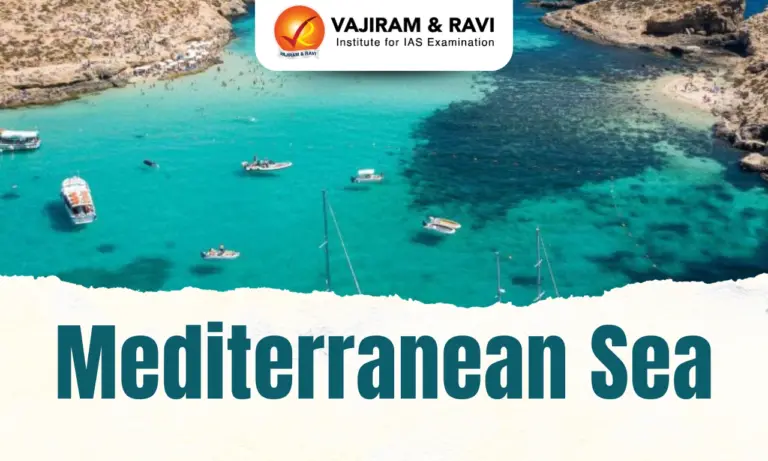
The Mediterranean Sea is one of the world’s most important intercontinental seas, linking Europe, Asia and Africa. For thousands of years, it has supported trade, cultural exchange, agriculture, navigation and the rise of major civilizations. Its strategic location, rich biodiversity, busy shipping routes and historical importance make it a key geographical region with continuing economic, environmental and geopolitical relevance.
Mediterranean Sea
The Mediterranean Sea is an almost landlocked sea with unique physical features, strategic connections and diverse natural characteristics.
- Location: The Mediterranean Sea lies between Europe in the north, Asia in the east and Africa in the south.
- Extent: It stretches between latitudes 30°-46° N and longitudes 5°50′ W-36° E, extending nearly 4,000 km from the Strait of Gibraltar to the Gulf of Iskenderun.
- Area and Shape: The sea covers approximately 2.5 million sq km (about 970,000 sq miles). It is a deep, elongated basin that is almost completely surrounded by land, making it one of the world’s largest enclosed seas.
- Connectivity: The Mediterranean connects with the Atlantic Ocean through the Strait of Gibraltar, the Black Sea through the Dardanelles Strait, Sea of Marmara and Bosporus Strait and the Red Sea through the Suez Canal, giving it exceptional strategic importance.
- Depth: The Mediterranean has an average depth of about 1,500 metres, while its deepest point is the Calypso Deep in the Ionian Sea, reaching 5,267 metres, making it one of the deepest enclosed seas globally.
- Coastline: The sea possesses an extensive 46,000 km coastline, supporting numerous ports, cities, tourism centres, fisheries and agricultural regions across three continents.
- Climate: The region experiences the famous Mediterranean climate, characterised by hot, dry summers and mild, wet winters, which supports olive cultivation, vineyards, citrus fruits and dense human settlements.
- Salinity: Mediterranean waters are significantly more saline than the Atlantic Ocean because evaporation exceeds freshwater inflow. Surface salinity averages around 38 parts per thousand.
- Water Circulation: Continuous water exchange occurs through the Strait of Gibraltar. Atlantic surface water flows into the Mediterranean, while denser, saltier Mediterranean water exits beneath the surface, maintaining its hydrological balance.
- Major Rivers: Several important rivers discharge into the Mediterranean, including the Nile, Ebro, Rhône, Po and Tiber. These rivers provide freshwater, sediments and nutrients that support coastal ecosystems and agriculture.
- Major Islands: Important islands include Sicily, Sardinia, Corsica, Crete, Cyprus, Rhodes, Mallorca, Lesbos, Chios and Euboea. Sicily is the largest island in the Mediterranean Sea.
- Marginal Seas: Around 15 marginal seas form part of the Mediterranean system, including the Balearic Sea, Adriatic Sea, Tyrrhenian Sea, Ionian Sea, Libyan Sea, Levantine Sea, Aegean Sea, Sea of Sicily and Cilician Sea, each having distinct geographical characteristics.
- Historical Importance: Often called the birthplace of Western civilization, the Mediterranean supported the rise of the Phoenicians, Ancient Greeks, Roman Empire, Ancient Egypt and Carthaginian civilization, becoming a centre of trade, navigation, culture and political power.
- Geological Background: The Mediterranean originated from the ancient Tethys Ocean. Around 5-6 million years ago, major geological changes transformed the basin before Atlantic waters refilled it through the Strait of Gibraltar.
Mediterranean Sea Bordering Countries
The Mediterranean Sea is bordered by 22 countries and one territory, making it one of the world’s most internationally shared marine regions.
- European Countries: Eleven European countries border the Mediterranean: Spain, France, Italy, Malta, Monaco, Slovenia, Croatia, Bosnia and Herzegovina, Montenegro, Albania and Greece, forming much of the northern coastline.
- West Asian Countries: The eastern Mediterranean touches Turkey, Syria, Lebanon, Israel, the Palestine Gaza Strip and the divided island of Cyprus, making the region strategically significant for West Asia.
- North African Countries: The southern coastline includes Morocco, Algeria, Tunisia, Libya and Egypt, connecting North Africa with Europe through maritime trade and transportation.
- British Overseas Territory: Gibraltar, located at the entrance of the Strait of Gibraltar, is the only British Overseas Territory on the Mediterranean and controls one of the world’s busiest maritime gateways.
- Three-Continent Interface: The Mediterranean directly links Europe, Asia and Africa, making it one of the world’s most important geographical crossroads for commerce, migration, diplomacy and strategic maritime operations.


Mediterranean Sea Significance
The Mediterranean Sea remains globally important because of its economic, strategic, ecological, historical and geopolitical value.
- Economic Importance: The Mediterranean supports major shipping routes, fisheries, ports, agriculture, offshore energy production and industries. Its coastline attracts more than 220 million tourists annually, making tourism a major contributor to regional economies.
- Strategic Importance: The Strait of Gibraltar and Suez Canal connect the Mediterranean with the Atlantic Ocean and the Red Sea, making it a vital international maritime corridor between Europe, Asia and Africa.
- Trade and Transportation: Since the opening of the Suez Canal in 1869, the Mediterranean has become one of the busiest global sea routes, supporting international trade, petroleum transport, container shipping and commercial connectivity.
- Energy Importance: Offshore reserves of petroleum and natural gas are found mainly near Italy, Libya, Egypt, Algeria, Greece, Spain and Tunisia. The Bouri offshore oil field in Libya is among the region’s most productive fields.
- Ecological Importance: The Mediterranean supports thousands of marine species despite low nutrient availability. It also regulates regional climate, sustains fisheries and provides critical habitats for marine mammals, turtles, seabirds and coastal ecosystems.
- Agricultural Importance: The Mediterranean climate favours cultivation of olives, grapes, citrus fruits, wheat and vegetables. This agricultural system has influenced food production and livelihoods across Southern Europe, North Africa and West Asia.
- Environmental Challenges: Less than 1% of the Mediterranean Sea is protected, while nearly 85% of surrounding forests have disappeared. Pollution, overfishing, coastal urbanisation, invasive species and climate change remain major concerns.
- Conservation Efforts: The Mediterranean Action Plan (1975), Barcelona Convention (1976) and Athens Protocol (1980) encourage regional cooperation for pollution control, marine conservation, sustainable development and environmental monitoring.
- Contemporary Relevance: The Mediterranean remains central to issues including Western Disturbances, Bomb Cyclones, Grand Ethiopian Renaissance Dam (GERD) impacts on the Nile, maritime security, migration, offshore energy exploration and exercises such as the India-Algeria Maiden Navy Exercise.
Mediterranean Sea Biodiversity
The Mediterranean Sea supports exceptional biodiversity with many endemic species despite its relatively nutrient poor waters.
- Biodiversity: The Mediterranean contains nearly 12,000 marine species and about one-third are endemic, meaning they occur nowhere else in the world, making it a globally recognised biodiversity hotspot.
- Flora: Marine plant life mainly includes phytoplankton, seagrass meadows, algae and coastal vegetation. Surrounding landscapes support olive trees, cypress, cork oak and aromatic shrubs, all adapted to Mediterranean climatic conditions.
- Marine Fish: Commercially important fish include bluefin tuna, sardines, anchovies, hake, sea bass, groupers, sea bream, red mullet, soles, flounders, mackerels, bonitos, croakers, gobies and sharks, supporting fisheries across coastal countries.
- Marine Mammals and Reptiles: The sea is home to dolphins, whales, sea turtles and the endangered Mediterranean monk seal, all facing increasing threats from fishing activities, pollution, habitat degradation and accidental capture.
- Shellfish and Corals: Coastal waters contain crabs, shrimps, prawns, sponges and corals, although natural stocks have declined because of pollution, excessive fishing and habitat destruction, increasing dependence on aquaculture.
- Fisheries and Aquaculture: Fisheries remain economically valuable despite limited nutrients. Egypt’s coastal lagoons support extensive aquaculture, while small scale fishing dominates many Mediterranean coastal communities.
- Threats to Biodiversity: Overfishing, plastic pollution, invasive species entering through the Suez Canal, coastal development, reduced river inflow and rising salinity continue to threaten the Mediterranean’s ecological balance and marine biodiversity.
- Conservation Need: Protecting endemic species, expanding marine protected areas, promoting sustainable fisheries and reducing pollution remain essential for preserving the Mediterranean’s unique marine ecosystems for future generations.

 Last updated on Oct, 2026
→ UPSC 2027 Notification will be released on 13 January 2027 at upsconline.nic.in.
→ Check Nobel Prize 2026 Winners List here.
→ Download PIB PRiSM Monthly Magazine 2026 here.
→ Check UPSC Monthly Current Affairs Magazine The Recitals here.
→ Check out the latest UPSC Syllabus here.
→ Download UPSC Model Answers for Mains 2026
→ UPSC Mains Question Paper 2026 is out now for Essay & GS Paper 1, 2, 3 & 4.
→ UPSC Calendar 2027 has been released.
→ Enroll in Vajiram & Ravi’s UPSC Mains Test Series 2027 for structured answer writing practice, expert evaluation, and exam-oriented feedback.
→ Join Vajiram & Ravi’s UPSC Mentorship Program 2027 for personalized guidance, strategy planning, and one-to-one support from experienced mentors.
→ Go through the UPSC Mains Previous Year Papers to enhance your preparation.
→ UPSC has released UPSC Toppers List 2025 with the Civil Services final result on its official website.
→ Also check Best UPSC Coaching in India
Mediterranean Sea FAQs
Q1. Which is the deepest point of the Mediterranean Sea?+
Q2. How many countries border the Mediterranean Sea?+
Q3. Which is the largest island in the Mediterranean Sea?+
Q4. Why is the Mediterranean Sea more saline than the Atlantic Ocean?+
Q5. Which major river drains into the Mediterranean Sea?+
Tags: geography important seas of the world mediterranean sea sea