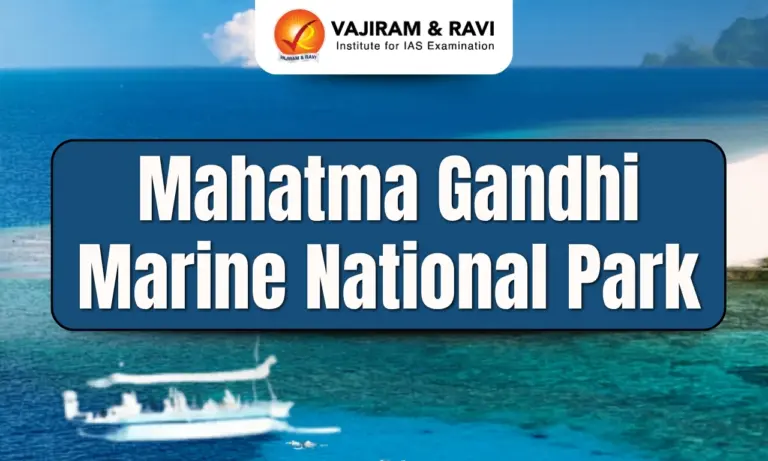
Mahatma Gandhi Marine National Park is one of India’s most significant Marine Protected Areas (MPAs). It was established in 1983 under the Wildlife (Protection) Act, 1972, to protect the rich marine biodiversity of the Andaman Sea. It was created to conserve the region’s unique marine ecosystems, particularly coral reefs, mangroves, seagrass meadows, and the diverse flora and fauna associated with them.
Mahatma Gandhi Marine National Park Location and Geographical Features
- Mahatma Gandhi Marine National Park is located in the Wandoor region of South Andaman district in the Andaman and Nicobar Islands.
- It is located about 29 km southwest of Port Blair.
- It covers an area of about 281.5 sq. km, making it one of the largest marine protected areas in India.
- Nearly 220 sq. km of the park consists of sea, lagoons, and creeks, while about 61.5 sq. km comprises land.
- The park includes 15 islands grouped into the Labyrinth Islands and the Twin Islands.
- The region is characterized by extensive coral reefs, mangrove forests, seagrass beds, sandy beaches, and rocky coastlines.
Mahatma Gandhi Marine National Park Ecological Significance
The ecological importance of Mahatma Gandhi Marine National Park lies in its exceptional marine biodiversity and its role in maintaining the ecological balance of the Andaman Sea.
Coral Reef Ecosystems: Mahatma Gandhi Marine National Park contains nearly 120 species of corals, making it one of the richest coral reef ecosystems in India.
- These coral reefs provide habitat, food, breeding grounds, and shelter to a large variety of marine organisms.
- They also protect coastlines from erosion and reduce the impact of strong waves and storms.
Mangrove and Seagrass Ecosystems: Mahatma Gandhi Marine National Park supports 13 species of mangroves and 5 species of seagrasses.
- Mangrove forests stabilize coastal areas, prevent erosion, and act as nursery grounds for fish and crustaceans.
- Seagrass meadows provide feeding grounds for dugongs and sea turtles and contribute significantly to carbon sequestration.
- The close association of coral reefs, mangroves, and seagrass ecosystems creates a highly productive ecological network that supports numerous species and strengthens ecosystem resilience.
Both mangroves and seagrasses act as important carbon sinks, thereby supporting climate change mitigation efforts.


Mahatma Gandhi Marine National Park Floral Diversity
- The park contains approximately 298 spermatophytic taxa and several rare plant species.
- Mangrove vegetation is dominated by species such as Rhizophora mucronata, Bruguiera gymnorhiza, Avicennia officinalis, Heritiera littoralis, and Xylocarpus granatum.
- Terrestrial vegetation includes Andaman Padauk, Andaman Bullet Wood, Silk Cotton Tree, Dipterocarp species, bamboo, orchids, cycads, and ferns.
- The discovery of the wild rice species Oryza andamanica highlights the importance of the park as a repository of genetic diversity.
The rich floral diversity contributes significantly to ecological stability and habitat formation.
Mahatma Gandhi Marine National Park Faunal Diversity
Mahatma Gandhi Marine National Park is home to an exceptionally rich variety of marine and terrestrial fauna.
- Its waters support around 282 species of fish along with numerous species of molluscs, crustaceans, giant clams, sea cucumbers, sea anemones, and starfish. These organisms form an integral part of the coral reef ecosystem.
- One of the most important species found in the park is the endangered Dugong, also known as the sea cow.
- The park also provides habitat for several species of sea turtles, including the Green Sea Turtle, Leatherback Sea Turtle, Hawksbill Sea Turtle, and Olive Ridley Sea Turtle.
- The Twin Islands are particularly important as turtle nesting and breeding grounds.
- The park also supports saltwater crocodiles, lizards, snakes, dolphins, fruit bats, Andaman wild pigs, and Andaman masked palm civets.
- More than 270 species and subspecies of birds have been recorded, including white-bellied sea eagles, herons, kingfishers, and parakeets.
Mahatma Gandhi Marine National Park Major Threats
Despite its ecological importance, the park faces several environmental challenges.
- Climate Change and Coral Bleaching: Rising sea surface temperatures have caused repeated coral bleaching events, particularly in 1998, 2010, and 2016. Coral bleaching weakens reef ecosystems and can result in large-scale coral mortality.
- Marine Plastic Pollution: Recent studies indicate that plastic constitutes nearly 60 percent of marine litter in the coral reef areas of the Andaman and Nicobar Islands. Abandoned fishing nets and other plastic waste often entangle marine animals or are mistakenly consumed by them.
- Tourism and Human Disturbance: Increasing tourism activities also exert pressure on fragile marine ecosystems. Unregulated snorkeling, diving, and boat anchoring can damage coral reefs and disturb wildlife habitats.
- Sedimentation and Nutrient Enrichment: Agricultural runoff and sedimentation further threaten coral health by reducing water quality and promoting excessive algal growth. In addition, outbreaks of Crown-of-Thorns Starfish can cause extensive destruction of coral reefs.
- Natural Disasters: Natural disasters such as cyclones, earthquakes, and tsunamis periodically affect the region. The 2004 Indian Ocean Tsunami caused significant damage to coastal and marine ecosystems throughout the Andaman Islands.
Mahatma Gandhi Marine National Park Conservation Measures
Several measures have been adopted to protect the ecological integrity of the park.
Legal Protection:
- The park enjoys statutory protection under the Wildlife (Protection) Act, 1972.
- Additional safeguards are provided through the Biological Diversity Act, 2002 and Coastal Regulation Zone (CRZ) regulations.
- Fishing, coral extraction, hunting, and other destructive activities are prohibited within the protected area.
Habitat Restoration and Management:
- Coral restoration initiatives have been undertaken to enhance reef recovery and resilience.
- Artificial reefs have been deployed around islands such as Grub and Tarmugli to support coral regeneration.
- Management efforts focus on maintaining ecological connectivity among coral reefs, mangroves, and seagrass habitats.
Species Conservation:
- Anti-poaching patrols are conducted to prevent illegal fishing and resource exploitation.
- Turtle nesting sites are regularly monitored and protected.
- Rescue and rehabilitation programmes support injured marine animals.
- Special conservation attention is given to dugongs and marine turtles.
Research and Community Participation:
- Scientific institutions undertake biodiversity assessments and ecological monitoring.
- Environmental awareness programmes encourage local participation in conservation efforts.
- Community-based conservation approaches help reduce anthropogenic pressures on marine ecosystems.
International Cooperation:
- India participates in the International Coral Reef Initiative and the Global Coral Reef Monitoring Network.
- Conservation efforts are aligned with the objectives of the Convention on Biological Diversity and the Kunming-Montreal Global Biodiversity Framework.

 Last updated on Oct, 2026
→ UPSC 2027 Notification will be released on 13 January 2027 at upsconline.nic.in.
→ Check Nobel Prize 2026 Winners List here.
→ Download PIB PRiSM Monthly Magazine 2026 here.
→ Check UPSC Monthly Current Affairs Magazine The Recitals here.
→ Check out the latest UPSC Syllabus here.
→ Download UPSC Model Answers for Mains 2026
→ UPSC Mains Question Paper 2026 is out now for Essay & GS Paper 1, 2, 3 & 4.
→ UPSC Calendar 2027 has been released.
→ Enroll in Vajiram & Ravi’s UPSC Mains Test Series 2027 for structured answer writing practice, expert evaluation, and exam-oriented feedback.
→ Join Vajiram & Ravi’s UPSC Mentorship Program 2027 for personalized guidance, strategy planning, and one-to-one support from experienced mentors.
→ Go through the UPSC Mains Previous Year Papers to enhance your preparation.
→ UPSC has released UPSC Toppers List 2025 with the Civil Services final result on its official website.
→ Also check Best UPSC Coaching in India
Mahatma Gandhi Marine National Park FAQs
Q1. Where is Mahatma Gandhi Marine National Park located and why is it important?+
Q2. What are the major ecosystems protected within the Mahatma Gandhi Marine National Park?+
Q3. Which important and endangered species are found in the Mahatma Gandhi Marine National Park?+
Q4. What are the major threats faced by Mahatma Gandhi Marine National Park?+
Q5. What measures are being taken to conserve the Mahatma Gandhi Marine National Park?+
Tags: mahatma gandhi marine national park