Subansiri River Latest News
The Subansiri River in Arunachal Pradesh’s Upper Subansiri district has risen to an unusually high and forceful level despite no rainfall being reported in the area, raising concerns among local residents.
About Subansiri River
- It is a right-bank tributary of the Brahmaputra River, originating in Tibet and flowing through Arunachal Pradesh and Assam.
- It is a trans-Himalayan and antecedent river, meaning it existed before the Himalayas rose and continued its course through the mountains.
- It is also called the “Gold River” because of the gold dust found in its waters.
- Course:
- It originates in the Tibetan Plateau, where it is formed by the confluence of three small streams: Lokong Chu, Chayal Chu, and Tsari Chu.
- It flows eastward in Tibet for about 170 km before turning south and entering India near Taksing in Arunachal Pradesh.
- In Arunachal Pradesh, the Subansiri River flows east and southeast through the Miri Hills, carving deep gorges and creating a rugged landscape.
- After covering about 250 km in the Eastern Himalayas, it descends into the Assam Valley at Dulangmukh in Dhemaji district.
- Here, it slows down and meanders through the plains for about 86 km, passing near Majuli—the world’s largest river island—before merging with the Brahmaputra River at Jamurighat in Lakhimpur district, Assam.
- It is the largest tributary of the Brahmaputra River.
- Its total length is approximately 442 kilometres, with the river draining a basin of roughly 32,000 sq.km.
- The river is fed by a combination of snowmelt from its Tibetan headwaters and the intense southwest monsoon precipitation that falls over the Himalayan foothills between June and September.
- Tributaries: Major tributaries of the river are Laro, Nye, Yume, Tsari, Kamla, Jiyadhol, Ranganadi and Dikrong.
- Lower Subansiri Hydroelectric Project:
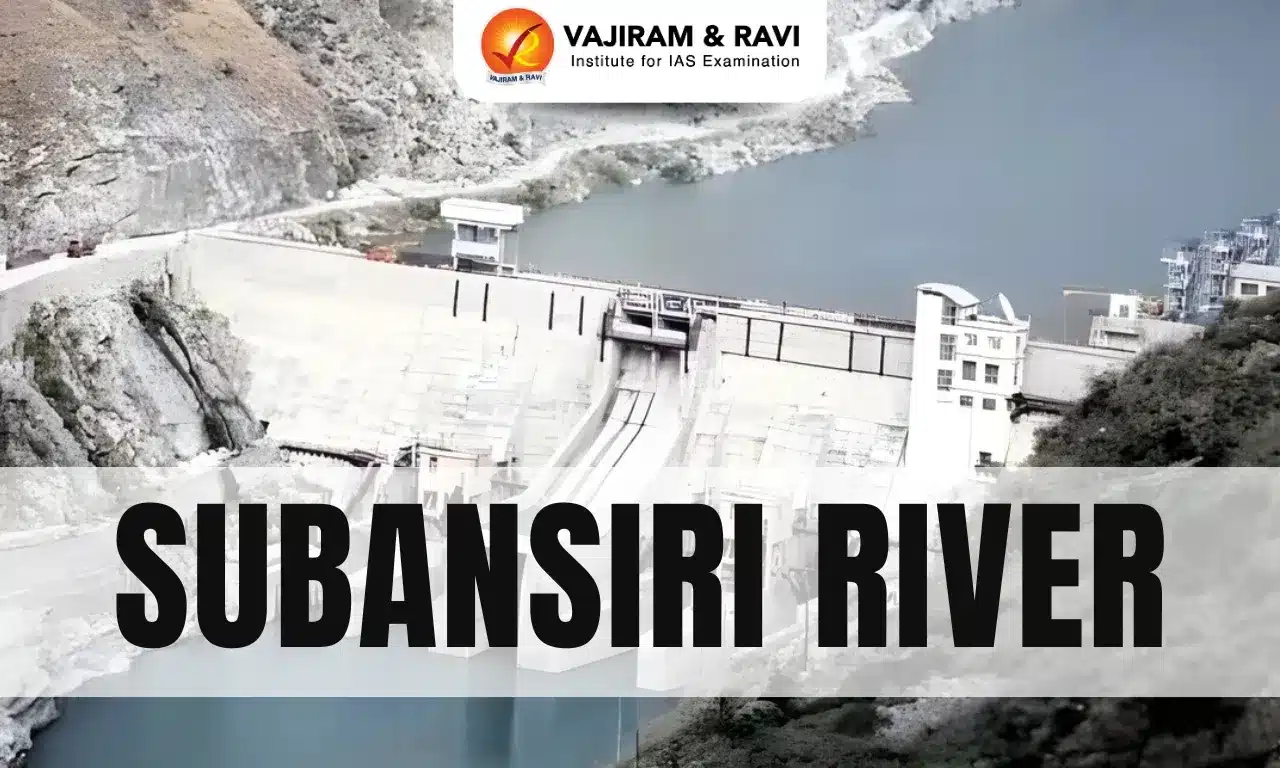
- It is a 2000 MW run-of-the-river hydro project being constructed on the Subansiri River.
- It is located at Gerukamukh on the Arunachal Pradesh–Assam border.
- It will be the single largest hydroelectric plant in India when completed.
News: IT


 Last updated on Oct, 2026
→ UPSC 2027 Notification will be released on 13 January 2027 at upsconline.nic.in.
→ Asian Games 2026 are being held in Aichi-Nagoya, Japan, from 19 September to 4 October.
→ Check Nobel Prize 2026 Winners List here.
→ Download PIB PRiSM Monthly Magazine 2026 here.
→ Check UPSC Monthly Current Affairs Magazine The Recitals here.
→ Check out the latest UPSC Syllabus here.
→ Download UPSC Model Answers for Mains 2026
→ UPSC Mains Question Paper 2026 is out now for Essay & GS Paper 1, 2, 3 & 4.
→ UPSC Calendar 2027 has been released.
→ Enroll in Vajiram & Ravi’s UPSC Mains Test Series 2027 for structured answer writing practice, expert evaluation, and exam-oriented feedback.
→ Join Vajiram & Ravi’s UPSC Mentorship Program 2027 for personalized guidance, strategy planning, and one-to-one support from experienced mentors.
→ Go through the UPSC Mains Previous Year Papers to enhance your preparation.
→ UPSC has released UPSC Toppers List 2025 with the Civil Services final result on its official website.
→ Also check Best UPSC Coaching in India
Subansiri River FAQs
Q1. The Subansiri River is a tributary of which major river?+
Q2. Where does the Subansiri River originate?+
Q3. Through which Indian states does the Subansiri River flow?+
Q4. Why is the Subansiri River called an antecedent river?+
Q5. What is the approximate total length of the Subansiri River?+
Tags: prelims pointers subansiri river upsc current affairs upsc prelims current affairs