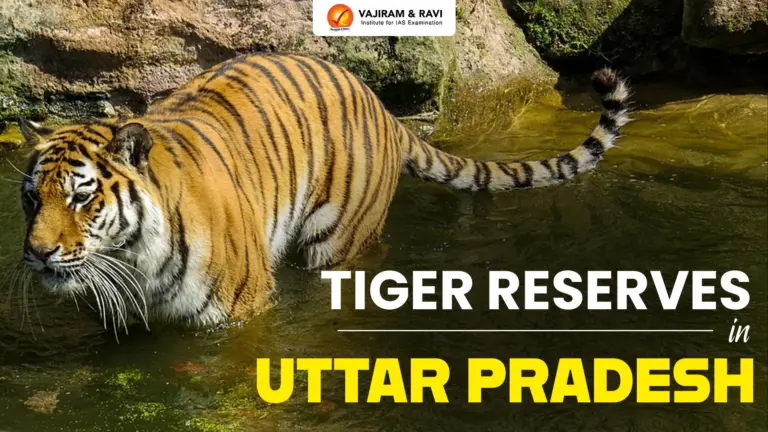
Uttar Pradesh is an important state for tiger conservation in northern India, particularly in the Terai region along the Indo-Nepal border. Its tiger habitats include sal forests, grasslands, wetlands and riverine ecosystems that form part of the wider Terai Arc Landscape.
The Uttar Pradesh Ecotourism Department recognises four tiger reserves in the state: Dudhwa, Pilibhit, Amangarh and Ranipur. The National Tiger Conservation Authority (NTCA), however, lists Dudhwa, Pilibhit and Ranipur as standalone tiger reserves and identifies Amangarh as the buffer area of Corbett Tiger Reserve in Uttar Pradesh.
According to the 2022 All India Tiger Estimation, Uttar Pradesh had an estimated 205 tigers, compared with 173 in 2018.
List of Tiger Reserves in Uttar Pradesh
The following table lists the four tiger reserves recognised by the Uttar Pradesh Ecotourism Department, along with their notification years and geographical areas.
|
Tiger Reserve |
Year of notification |
Area (sq. km.) |
|
Dudhwa |
2007 |
2,201.77 |
|
Pilibhit |
2014 |
730.25 |
|
Amangarh |
2012 |
80.60* |
|
Ranipur |
2022 |
529.36 |
The Amangarh figure of 80.60 sq. km. refers to the buffer area of Corbett Tiger Reserve recorded by the NTCA. The Uttar Pradesh Ecotourism portal describes Amangarh as an area of 95 sq. km.
Note: Dudhwa was included under Project Tiger in 1987-88, although its tiger reserve notification year is 2007. The two dates refer to different administrative milestones.
Tiger Reserves in Uttar Pradesh
Uttar Pradesh’s four tiger reserves represent important parts of the Terai landscape in the north and the Bundelkhand region in the south.
1. Dudhwa Tiger Reserve
Dudhwa Tiger Reserve is located in the Terai region of Uttar Pradesh, along the Indo-Nepal border. It is the largest tiger reserve in the state by total area.
- It is centred in Lakhimpur Kheri district and includes adjoining forest divisions.
- It was brought under Project Tiger in 1987-88 and formally notified as a tiger reserve in 2007.
- Its core area comprises Dudhwa National Park, Kishanpur Wildlife Sanctuary and Katarniaghat Wildlife Sanctuary, along with adjoining forest areas in its wider landscape.
- The reserve is characterised by alluvial plains, sal forests, tall grasslands, marshes and wetlands.
- The Sharda, Mohana and Suheli river systems are important geographical features of the landscape.
- Important wildlife includes Bengal tigers, swamp deer (barasingha), one-horned rhinoceroses, elephants, leopards and several species of birds.
- It is particularly important for the conservation of the endangered swamp deer and the one-horned rhinoceros.
2. Pilibhit Tiger Reserve
Pilibhit Tiger Reserve is situated in the Terai region of northern Uttar Pradesh, close to the Indo-Nepal border.
- It is located in Pilibhit district.
- It was notified as a tiger reserve in 2014.
- The reserve is characterised by sal forests, tall grasslands, wetlands and swampy areas.
- The Sharda River and Sharda Sagar reservoir are important geographical features of the landscape.
- Important wildlife includes Bengal tigers, leopards, swamp deer, hog deer, sambar and several bird species.
- It forms an important part of the Terai Arc Landscape and supports ecological connectivity with forest habitats in Nepal and neighbouring regions.
Pilibhit Tiger Reserve received the TX2 Award in 2020 for doubling its tiger population within the stipulated period. It became the first tiger reserve in India to receive this international recognition.
3. Amangarh Tiger Reserve
Amangarh Tiger Reserve is located in Bijnor district of Uttar Pradesh, near the Uttarakhand border. It forms an important forest habitat connected with the Corbett landscape.
- It was notified in 2012 as the buffer area of Corbett Tiger Reserve.
- It is situated in the Terai-Bhabar landscape at the foothills of the Himalayas.
- The area is characterised by sal forests, grasslands and riverine habitats.
- It supports wildlife such as tigers, elephants, leopards and other species.
- Its location makes it important for ecological connectivity with the adjoining forests of Corbett Tiger Reserve.
Note: The Uttar Pradesh Ecotourism Department recognises Amangarh as one of the state’s four tiger reserves. The NTCA records it as the buffer area of Corbett Tiger Reserve, whose core area lies in Uttarakhand.
4. Ranipur Tiger Reserve
Ranipur Tiger Reserve is located in Chitrakoot district of southern Uttar Pradesh. It is the state’s first tiger reserve in the Bundelkhand region.
- It was notified as a tiger reserve in 2022, becoming India’s 53rd tiger reserve at the time.
- Ranipur Wildlife Sanctuary forms the core area of the reserve.
- Its landscape is characterised by tropical dry deciduous forests, rocky terrain, hills and seasonal streams.
- Important wildlife includes tigers, leopards, sloth bears, chinkara, sambar and spotted deer.
- It forms part of the wider Panna-Ranipur landscape, which is important for tiger movement and habitat connectivity.
Ranipur is significant because it extends tiger conservation beyond the Terai forests of northern Uttar Pradesh into the drier Bundelkhand landscape.


Significance of Tiger Reserves in Uttar Pradesh
Tiger reserves in Uttar Pradesh are important not only for protecting tigers but also for conserving the Terai ecosystem and maintaining ecological connectivity across northern India.
- Biodiversity conservation: Protect tigers, swamp deer, rhinoceroses, elephants and other threatened wildlife.
- Terai ecosystem protection: Conserve sal forests, grasslands, wetlands and riverine habitats along the Himalayan foothills.
- Wildlife corridors: Maintain ecological connectivity between forest habitats in Uttar Pradesh, Uttarakhand and Nepal.
- Watershed protection: Preserve wetlands, river systems, natural water sources and associated ecosystem services.
- Local livelihoods: Support nature-based tourism, employment and conservation-linked livelihood opportunities for nearby communities.
Challenges in Tiger Conservation in Uttar Pradesh
Despite the increase in tiger numbers, Uttar Pradesh faces several challenges in maintaining viable and connected tiger populations.
- Habitat fragmentation: Roads, railways, agricultural expansion and infrastructure projects disrupt wildlife corridors.
- Human-tiger conflict: Encounters involving tigers and local communities create risks for both people and wildlife.
- Habitat degradation: Encroachment, grazing and pressure on forest resources reduce habitat quality and prey availability.
- Poaching: Illegal hunting of tigers and prey species threatens wildlife populations.
- Wetland and grassland loss: Degradation of floodplain habitats affects prey species such as swamp deer and hog deer.
- Corridor disruption: Maintaining connectivity between protected areas in Uttar Pradesh, Uttarakhand and Nepal remains essential for long-term tiger conservation.

 Last updated on Nov, 2026
→ UPSC Interview 2026 is scheduled from 7 December 2026 to 12 February 2027.
→ UPSC Interview Guidance Programme (IGP) 2026 by Vajiram & Ravi helps aspirants prepare confidently for the UPSC Personality Test.
→ UPSC DAF 2026 application form is available from 11 to 25 November 2026, till 6:00 PM.
→ UPSC 2027 Notification will be released on 13 January 2027 at upsconline.nic.in.
→ Download PIB PRiSM Monthly Magazine 2026 here.
→ Check UPSC Monthly Current Affairs Magazine The Recitals here.
→ Check out the latest UPSC Syllabus here.
→ UPSC Calendar 2027 has been released.
→ Enroll in Vajiram & Ravi’s UPSC Mains Test Series 2027 for structured answer writing practice, expert evaluation, and exam-oriented feedback.
→ Join Vajiram & Ravi’s UPSC Mentorship Program 2027 for personalized guidance, strategy planning, and one-to-one support from experienced mentors.
→ Go through the UPSC Mains Previous Year Papers to enhance your preparation.
→ UPSC has released UPSC Toppers List 2025 with the Civil Services final result on its official website.
→ Also check Best UPSC Coaching in India
Tiger Reserves in Uttar Pradesh FAQs
Q1. How many tiger reserves are there in Uttar Pradesh?+
Q2. Which is the largest tiger reserve in Uttar Pradesh?+
Q3. Which is the first tiger reserve in Uttar Pradesh?+
Q4. Which is the newest tiger reserve in Uttar Pradesh?+
Q5. Which tiger reserve in Uttar Pradesh received the TX2 Award?+
Q6. Where is Amangarh Tiger Reserve located?+
Tags: tiger reserves tiger reserves in india tiger reserves in uttar pradesh