Ram Prasad Bismil Birth Anniversary (1897-1927), Early Life, Legacy

Ram Prasad Bismil Birth Anniversary

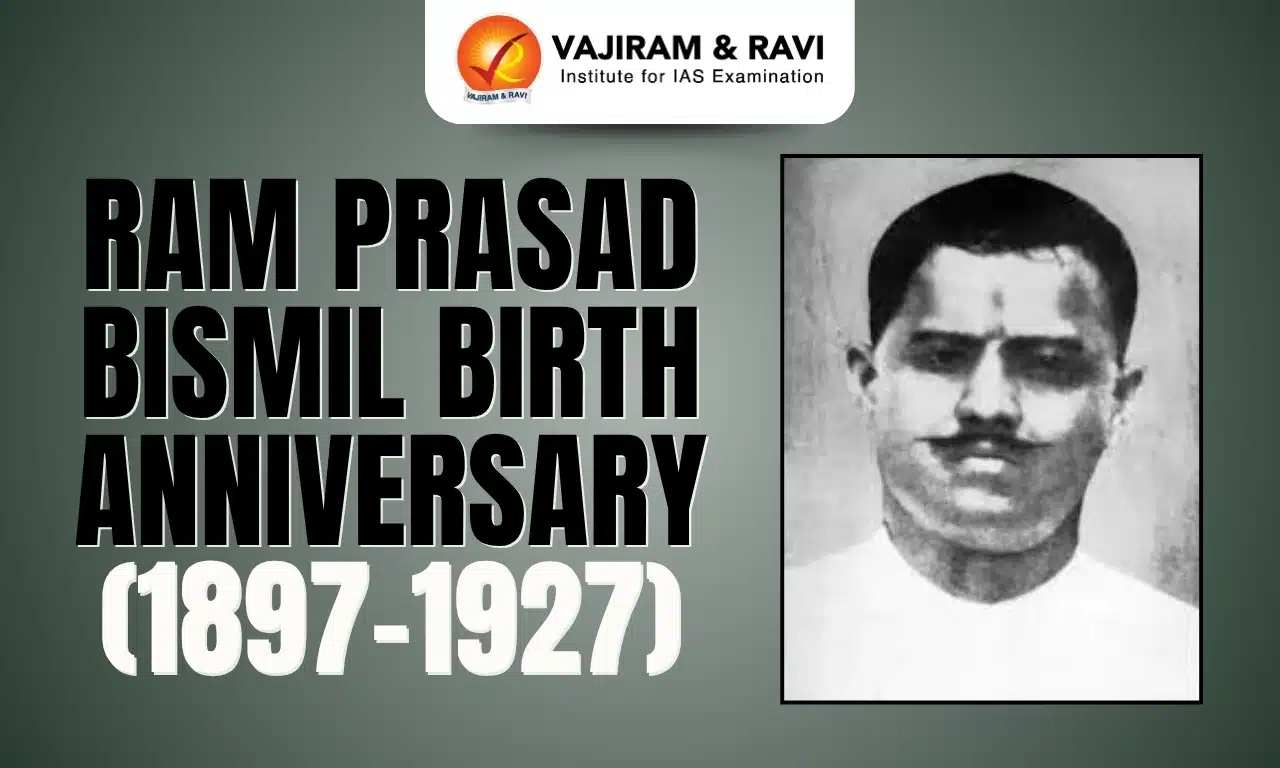
Ram Prasad Bismil Birth Anniversary (1897-1927) is celebrated on 11 June each year. It is a reminder of the courage, patriotism, and sacrifice shown by those who fought for India’s freedom. He was one of the many brave revolutionaries who dedicated his life to the nation at a very young age. This day is observed to remember his strong spirit, love for the country, and commitment to justice. In a general sense, it inspires people, especially the youth, to value freedom, unity, and responsibility in their daily lives.

Overview

  • Ram Prasad Bismil was a great Indian revolutionary, poet, and freedom fighter who played a very important role in the struggle against British rule.
  • He was born in 1897 and became known for his deep love for the country, fearless nature, and strong determination.
  • He believed that India should be free from foreign rule and dedicated his entire life to this goal.
  • Along with revolutionary activities, he also inspired people through his powerful writings and patriotic poems.
  • His life is remembered as a symbol of courage, sacrifice, and commitment to the nation.

Ram Prasad Bismil Birth Anniversary (Ram Prasad Bismil Jayanti)

  • Ram Prasad Bismil Birth Anniversary (1897-1927) is celebrated every year on 11 June to honor his contributions and sacrifices for India’s independence.
  • On this day, people remember his life through events like speeches, cultural programs, and poetry recitations.
  • Educational institutions and organizations conduct activities to spread awareness about his role in the freedom struggle.
  • It is an important occasion to inspire the younger generation to develop patriotism and a sense of responsibility towards the nation.

Ram Prasad Bismil Early Life and Background

  • Ram Prasad Bismil was born on 11 June 1897 in Shahjahanpur, Uttar Pradesh, during the time of British rule in India.
  • From a young age, he showed interest in social issues and the condition of the country.
  • He was influenced by nationalist ideas and reform movements, which shaped his thinking.
  • As he grew older, he became more aware of the injustices of British rule, which motivated him to take action.
  • He gradually developed a strong desire to work for India’s independence.

Ram Prasad Bismil Family Details

  • His father’s name was Murlidhar, and his mother’s name was Moolrani.
  • He came from a simple and disciplined family background, which helped shape his values and character.
  • He had siblings, although detailed information about them is not widely available.
  • He chose to remain unmarried, as he dedicated his entire life to the freedom struggle.
  • His upbringing played an important role in building his strong personality and sense of duty.

Ram Prasad Bismil Revolutionary Activities

  • Ram Prasad Bismil was actively involved in revolutionary movements that aimed to end British rule in India.
  • He believed that strong and direct action was necessary to achieve freedom.
  • Kakori Conspiracy (1925):
    • He was one of the main leaders of the Kakori train action carried out in 1925.
    • The revolutionaries looted government money from a train to fund their activities against British rule.
    • This act showed great courage and planning and became a major event in the freedom struggle.
    • It sent a strong message against British authority and inspired many people.
  • Hindustan Republican Association (HRA):
  • Other Revolutionary Efforts:
    • He was involved in the Mainpuri Conspiracy (1918) and other activities to gather support and resources.
    • He worked to motivate and unite young people for the cause of independence.
    • His leadership and ideas helped in strengthening the revolutionary movement in India.

Ram Prasad Bismil Literary Contributions

  • Ram Prasad Bismil was not only a revolutionary but also a talented poet and writer.
  • He used literature as a way to spread awareness and inspire people to join the freedom struggle.
  • His writings were full of patriotism, emotion, and a strong desire for justice.
  • Important works include:
    • Man Ki Lahar - A collection of emotional and patriotic poems.
    • Swadeshi Rang - Focuses on love for the nation and independence.
    • Kranti Geetanjali - Contains revolutionary songs and ideas.
    • Chetna Ki Baatein - Encourages awakening of national consciousness.
    • Deshvasiyon Ke Naam Sandesh - Messages urging people to join the struggle.
  • The famous poem “Sarfaroshi Ki Tamanna” became closely linked with him and the freedom movement.
  • His writings played a major role in motivating people and spreading revolutionary ideas across the country.

Ram Prasad Bismil Ideology and Inspiration

  • He was influenced by reformist movements like the Arya Samaj, which focused on social reform and national pride.
  • He believed that freedom requires sacrifice, courage, and strong action.
  • He supported revolutionary methods as he felt that they were necessary to fight injustice.
  • His ideas were shaped by the conditions of colonial rule and the suffering of people.
  • He inspired many young individuals to stand up for the country and work towards independence.

Ram Prasad Bismil Arrest and Martyrdom

  • He was arrested by British authorities for his role in the Kakori Conspiracy.
  • After a long legal process, he was sentenced to death along with other revolutionaries.
  • He was executed on 19 December 1927 at Gorakhpur Jail.
  • His martyrdom became a symbol of bravery, sacrifice, and dedication.
  • His sacrifice inspired many others to continue the fight for India’s freedom.

Ram Prasad Bismil Legacy

  • Ram Prasad Bismil is remembered as one of the most courageous revolutionaries in Indian history.
  • His life teaches values like patriotism, courage, sacrifice, and responsibility.
  • He played a key role in shaping the revolutionary movement in India.
  • His writings and actions continue to inspire people to work for justice and national progress.
  • His legacy remains alive in the hearts of people as a symbol of selfless service and love for the nation.

Ram Prasad Bismil Birth Anniversary FAQs

Q1: When is Ram Prasad Bismil Jayanti celebrated?

Ans: Ram Prasad Bismil Jayanti is celebrated every year on 11 June to honor his birth anniversary and remember his contributions to India’s freedom struggle.

Q2: Who was Ram Prasad Bismil?

Ans: He was a revolutionary freedom fighter, poet, and nationalist leader who played a key role in India’s independence movement and inspired people through his actions and writings.

Q3: What are the major contributions of Ram Prasad Bismil to India’s freedom struggle?

Ans: He is best known for his role in the Kakori Conspiracy (1925) and for his patriotic poetry, which motivated many Indians to join the freedom movement.

Q4: What was the Kakori Conspiracy?

Ans: The Kakori Conspiracy was a planned train action in 1925 where revolutionaries looted government funds to support their struggle against British rule.

Q5: What were the literary contributions of Ram Prasad Bismil?

Ans: He wrote several patriotic poems and works like Man Ki Lahar, Swadeshi Rang, and Kranti Geetanjali, which inspired people towards nationalism and freedom.

Constitutional Amendments in India, List, Procedure, Latest Acts & Bills

Constitutional Amendments in India

The Constitution of India, adopted on 26th January 1950, is a dynamic document that has continuously evolved to meet the changing needs of society, politics, and governance. To adapt to shifting social, political, and economic conditions, Constitutional Amendments have been introduced periodically. These amendments reflect the growth of Indian democracy, highlight policy priorities, and mark shifts in power structures. Some amendments have made minor procedural changes, while others like the 42nd and 44th Amendments have fundamentally reshaped the Constitution's spirit and framework.

What are Constitutional Amendments in India?

The Constitutional Amendments in India are formal changes to the text of the Constitution. These changes may modify, add, or remove provisions to adapt to new circumstances. Article 368 of the Indian Constitution grants Parliament the power to amend the Constitution while safeguarding the basic structure. The Total Amendments in Indian Constitution till date are 106 along with several pending bills left for approval.

According to Dr. B.R. Ambedkar:

“The Constitution is a dynamic document. It must be capable of growth and change.”

Constitutional Amendments in India Types

According to Article 368, there are three types of constitutional amendments which are discussed in the table below:

Constitutional Amendments in India Types
Type of Amendment Majority Required Examples

By Simple Majority of Parliament

More than 50% of members present and voting (Not under Article 368)

  • Admission or establishment of new states (Article 2)
  • Alteration of state boundaries or names

By Special Majority of Parliament

Majority of total membership + 2/3 of members present and voting in each House

  • Amendment to Fundamental Rights
  • Directive Principles
  • Election of President

By Special Majority + State Ratification

Special majority + Approval by half of the state legislatures

Major Constitutional Amendments in India

The Constitution of India, as a living document, has evolved over the decades through a series of significant amendments. These constitutional amendments reflect the dynamic needs of governance, societal transformation, and legal reform in a developing democracy. The following table includes all major Constitutional Amendments in India:

List of Constitutional Amendments in India
Constitution Amendment Changes Introduced

1st Amendment Act, 1951

  • Provided for the saving of laws, providing for the acquisition of estates, etc. 
  • Addition of the Ninth Schedule to protect the land reform and other laws included in it from judicial review. 
  • Empowerment of the state to make special provisions for the advancement of socially and economically backward classes. 
  • Added three more grounds of restrictions on freedom of speech and expression, public order, friendly relations with foreign states, and incitement to an offence. Also, it made the restrictions “reasonable” and thus justiciable in nature.
  • The act also provided that state trading and nationalisation of any trade or business by the state is not invalid on the grounds such as violation of the right to trade or business. 
  • Insertion of 31A and 31 B.

2nd Amendment Act, 1952

  • Readjustment of the scale of representation in the Lok Sabha by providing that one member could represent even more than 7,50,000 persons. 

7th Amendment Act, 1956

  • Abolition of the existing classification of states into four categories, i.e., Part A, Part B, Part C, and Part D state, and reorganised them into 14 states and 6 union territories. 
  • Extension of the jurisdiction of high courts to union territories and establishment of a common high court for two or more states. 
  • Provided for the appointment of additional and acting judges of the high court. 
  • Amendment of Second Schedule.
  • Modifications to the lists relating to the acquisition and requisition of property in the seventh schedule of the Constitution.

10th Amendment Act, 1961

  • Incorporation of Dadra and Nagar Haveli in the Indian Union in order to enable the President to make regulations for the peace, progress, and good government of the territory.

15th Amendment Act, 1963 

  • The High Courts were enabled to issue writs to any person or authority, even outside its territorial jurisdiction, if the cause of action arose within its territorial limits. Increase in the retirement age of high court judges from 60 to 62 years. 
  • Amendment in articles 297, 311, and 316.
  • Provision for appointment of retired judges of the high courts as acting judges of the same court.
  • Provided compensatory allowance to judges who are transferred from one high court to another. 
  • Enabling the retired judge of a high court to act as an ad-hoc judge of the Supreme Court. 

24th Amendment Act, 1971

  • Affirmation of the power of Parliament to amend any part of the Constitution, including fundamental rights.
  • It was made compulsory for the president to give his assent to a Constitutional Amendment Bill.
  • The act seeks to amend article 13 of the Constitution to make it inapplicable to any amendment of the Constitution under article 368.

25th Amendment Act, 1971

  • Introduction of new Article 31C.
  • The amendment act aims to overcome the obstacles that stand in the way of putting the Directive Principles of State Policy into action.
  • The act limited the fundamental right to property. 

26th Amendment Act, 1971

  • Omission of Articles 291 and 362 and insertion of new article 363A that states recognition granted to Rulers of Indian States to cease and privy purses to be abolished.

34th Amendment Act, 1974

  • This amendment act proposed to amend the Ninth Schedule to the Constitution to include the revised ceiling laws. 
  • The act also included twenty more land tenure and land reform acts of various states in the Ninth Schedule.

38th Amendment Act, 1975

  • The 38th amendment act of the Constitution seeks to amend articles 123, 213, 239B, 352, 356, 359, and 360 of the Constitution.
  • The emergency was declared as non-justiciable by the president of India. 
  • The promulgation of ordinances by the president, governors, and administrators of union territories was made non-justiciable. 
  • Empowerment of the president to declare different proclamations of national emergency on different grounds simultaneously.

42nd Amendment Act, 1976 (Mini Constitution)

  • Three new words were added in the 42nd Amendment Act, i.e., socialist, secular, and integrity, which were added in the Preamble. 
  • Fundamental Duties were added by the citizens (new Part IV A). 
  • President shall act in accordance with the advice of the Council of Ministers in the discharge of his functions under Article 74.
  • Provided provision for administrative tribunals and tribunals for other matters (Added Part XIV A). 
  • Maintenance of seats in the Lok Sabha and state legislative assemblies on the basis of the 1971 census till 2001. 
  • Constitutional amendments were made beyond judicial scrutiny. 
  • The tenure of Lok Sabha and state legislative assemblies was raised from 5 to 6 years. 
  • As long as certain Fundamental Rights are not violated, laws enacted to implement Directive Principles cannot be deemed invalid by the courts.
  • Added three new Directive Principles of state policy, viz., equal justice and free legal aid, participation of workers in the management of industries, and protection of the environment, forests, and wildlife. 
  • Facilitating the proclamation of national emergency in a part of the territory of India.
  • Extension of the one-time duration of the President’s rule in a state from 6 months to one year. 
  • Five subjects, including education, forests, wild animal and bird protection, weights and measures and administration of justice, Constitution, and organisation of all courts aside from the Supreme Court and the high courts, were moved from the state list to the concurrent list.
  • Establishment of All-India Judicial Service. 

44th Amendment Act, 1978

  • In the 44th Amendment Act, some of the powers of the Supreme Court and high courts were restored.
  • Replacement of the term “internal disturbance” with “armed rebellion” in respect of national emergency. 
  • Made the President declare a national emergency only on the written recommendation of the cabinet.
  • Deletion of the right to property from the list of Fundamental Rights, making it a legal right.
  • Provided that the fundamental rights guaranteed by Articles 20 and 21 cannot be suspended during a national emergency. 

51st Amendment Act, 1984

  • Provision of the reservation of seats in the Lok Sabha for Scheduled Tribes in Meghalaya, Arunachal Pradesh, Nagaland, and Mizoram, as well as in the Legislative Assemblies of Meghalaya and Nagaland.

52nd Amendment Act, 1985

  • This amendment act is also known as Anti Defection Law
  • The act provided for the disqualification of members of Parliament and state legislatures on the grounds of defection
  • Addition of a new Tenth Schedule containing the details in this regard.
61st Amendment Act, 1989
  • Reduced the voting age from 21 years to 18 years for the Lok Sabha and Assembly elections.
65th Amendment Act, 1990
  • Provision for the establishment of a National Commission for Scheduled Castes and Scheduled Tribes in the place of a Special Officer or SCs and STs.

69th Amendment Act, 1991

  • Made Delhi the ‘National Capital Territory of Delhi’ along with the provision of a 70-member assembly and a 7-member Council of Ministers for Delhi.

73rd Amendment Act, 1992

  • Panchayati Raj Institutions were included under the Eleventh Schedule that enumerated the powers and functions of Panchayati Raj Institutions.
  • Provisions for a three-tier model of Panchayati Raj, reservation of seats for SCs and STs in proportion to their population, and one-third reservation of seats for women were granted.

74th Amendment Act, 1992

  • This act granted Constitutional status and protection to the urban local bodies. 
  • For this purpose, the Amendment has added a new Part IX-A entitled “the municipalities.” 
  • A new Twelfth Schedule was added containing 18 functional items of the municipalities.

76th Amendment Act, 1994

  • The act included the Tamil Nadu Reservation Act of 1994, which provides for 69 percent reservation of seats in educational institutions and posts in state services in the Ninth Schedule in order to protect it from judicial review. 
  • In 1992, the Supreme Court ruled that the total reservation should not exceed 50 percent.

77th Amendment Act, 1995

  • The Scheduled Castes and the Scheduled Tribes have been enjoying the reservation in the promotion since 1955.
  • This act provided for reservation in promotions in government jobs for SCs and STs. 
  • Nullification of the Supreme Court ruling with regard to reservation in promotions.

80th Amendment Act, 2000

  • An alternative scheme of devolution of revenue for sharing taxes between the Union and the State was enacted. 

85th Amendment Act, 2001

  • Provided provision for “consequential seniority” in the case of promotion by virtue of the rule of reservation for the government servants belonging to the Scheduled Castes and Scheduled Tribes.

86th Amendment Act, 2002

  • Elementary education was made a fundamental right
  • The newly-added Article 21-A declares that “the State shall provide free and compulsory education to all children of the age of six to fourteen years in such manner as the State may determine.”
  • Changed the subject matter of Article 45 in Directive Principles.
  • Addition of a new fundamental duty under Article 51-A, which reads – It shall be the duty of every citizen of India who is a parent or guardian to provide opportunities for education to his child or ward between the age of six and fourteen years.

91st Amendment Act, 2003

  • Limited the size of the Council of Ministers at the Center and in the States to debar defectors from holding public offices and to strengthen the anti-defection law.

93rd Amendment Act, 2005

  • Reservation for the socially and educationally backward classes in private unaided educational institutions except for the minority educational institutions

97th Amendment Act, 2012

  • This act gave Constitutional status and protection to co-operative societies.

99th Amendment Act, 2014

  • Replacement of the collegium system of appointing judges to the Supreme Court and High Courts with a new body called the National Judicial Appointments Commission (NJAC). 
  • However, in 2015, the Supreme Court declared this amendment act unconstitutional and void. Consequently, the earlier collegium system became operational.

100th Amendment Act, 2015

  • This act amended the Constitution of India to give effect to the acquiring of territories by India and the transfer of certain territories to Bangladesh in pursuance of the agreement and its protocol entered into between the Governments of India and Bangladesh.

101st  Amendment Act, 2016

  • It introduced the Goods and Services Tax (GST) in India.
  • This amendment was passed by the Parliament and the states, and came into effect on July 1, 2017. 

102nd Amendment Act, 2018

  • Provided Constitutional status to the National Commission for Backward Classes.
  • This act relieved the National Commission for Scheduled Castes from its functions with regard to the backward classes. 
  • It also empowered the President to specify the socially and educationally backward classes in relation to a state or union territory. 

103rd Amendment Act, 2019

  • Empowered the state to make any special provision for the advancement of any economically weaker sections (EWS) of citizens. 
  • An EWS Certificate is needed in order to avail benefits of the EWS category. 
  • The state was permitted to set aside up to 10% of seats for certain sections when it came to admission to educational institutions, including private educational institutions that were either assisted or unassisted by the state, with the exception of minority educational institutions. This additional reservation of up to 10% would be made in addition to the ones already made.

104th Amendment Act, 2020

  • Extension of deadline for the cessation of seats for SCs and STs in the Lok Sabha and state assemblies from 70 to 80 years.
  • Removal of the reserved seats for the Anglo-Indian community in the Lok Sabha and state assemblies.

105th Amendment Act, 2020

  • It restored the power of state governments and union territories to identify and recognize Socially and Educationally Backward Classes (SEBCs).
  • The amendment came into effect on August 15, 2021. 

106th Amendment Act, 2020

  • Also known as the Women's Reservation Act.
  • It reserves one-third of seats in the Lok Sabha and state assemblies for women.
  • The amendment was passed in September 2023 and received the President's assent on September 28, 2023. 

Constitutional Amendments in India Scope

The Indian Constitution is designed with enough flexibility to adapt to changing needs while ensuring the preservation of its foundational principles. The scope of Parliament's power to amend the Constitution is broad, yet it is subject to important limitations to safeguard the democratic ethos and integrity of the Constitution.

  • One of the most significant limitations arises from the doctrine of the “Basic Structure,” which was propounded by the Supreme Court in the landmark Kesavananda Bharati case (1973). According to this doctrine, Parliament cannot amend those elements of the Constitution that form its basic structure.
  • Key Features of the Basic Structure Include:
    • Sovereignty of the people
    • Rule of law
    • Separation of powers
    • Judicial review
    • Federalism
    • Republican form of government
    • Secularism
    • Equality
    • Liberty
    • Justice
  • Additional Restrictions on Parliamentary Amendments:
    • Parliament cannot pass an amendment that seeks to extend or curtail its own term of office.
    • The Constitution cannot be amended to abolish key democratic institutions such as the office of the President or the Supreme Court.
    • Amendments that affect federal provisions such as the representation of states in Parliament or the powers of the states, require ratification by at least half of the state legislatures.

Constitutional Amendments in India Procedure

The Procedure for Making Constitutional Reforms in India is provided under Article 368. It ensures that amendments reflect a balance between flexibility and rigidity, preserving the core framework of the Constitution while allowing necessary changes.

The process of carrying out All Constitutional Amendments in India involves the following steps:

  • Initiation of the Bill: An amendment bill can be introduced in either House of Parliament Lok Sabha or Rajya Sabha. It can be proposed by a minister or any private member. However, it cannot be introduced in any of the state legislatures.
  • Parliamentary Approval: The bill must be passed in each House of Parliament by a special majority. This means:
  • A majority of the total membership of the House, and
  • A majority of not less than two-thirds of the members present and voting.
  • State Ratification (if required): In the case of amendments affecting federal provisions such as the distribution of powers between the Centre and the states, or representation of states in Parliament, the bill must be ratified by at least half of the state legislatures through a simple majority.
  • Presidential Assent: Once passed by Parliament and ratified by states (if required), the bill is sent to the President. The President is constitutionally obligated to give assent and cannot withhold or return the bill.
  • Enactment: Upon receiving the President’s assent, the bill becomes a Constitutional Amendment Act. It is then formally incorporated into the Constitution.

Recent Constitutional Amendments in India

One of the Latest Constitutional Amendments in India is 106th Constitutional Amendment Act 2023. It is also known as the Nari Shakti Vandan Adhiniyam. It brought 33% (1/3rd) reservation of women in Lok Sabha, state legislative assemblies and the Legislative Assembly of the NCT of Delhi along with sub-reservations of reserved classes. Several Recent Constitutional Amendment Bills introduced include:

125th Amendment of Indian Constitution Bill 2019

  • Proposed changes to Article 280 and the 6th Schedule to strengthen the functioning of Autonomous District Councils (ADCs) in Assam, Meghalaya, Tripura and Mizoram.
  • Sought greater financial and administrative autonomy for ADCs to improve local governance in tribal areas.
  • Recommended compulsory State Finance Commissions and the creation of Village and Municipal Councils for stronger grassroots democracy.
  • Proposed direct transfer of funds to local bodies for better development outcomes.
  • The Bill was introduced in the Rajya Sabha, examined by the Standing Committee on Home Affairs and remains pending.

126th Amendment of Indian Constitution Bill 2019

  • Extended reservation of seats for Scheduled Castes (SCs) and Scheduled Tribes (STs) in the Lok Sabha and State Legislative Assemblies for ten more years, up to 25 January 2030.
  • Discontinued the constitutional provision for nominated Anglo-Indian members in legislatures.
  • Ensured continued political representation of SC and ST communities through constitutional safeguards.
  • Passed by Parliament, ratified by the required State Assemblies and enacted as the 104th Amendment of Indian Constitution Act 2019.

127th Amendment of Indian Constitution Bill 2021

  • Restored the authority of States and Union Territories to identify and maintain their own lists of Socially and Educationally Backward Classes (SEBCs) or OBCs.
  • Amended Articles 338B, 342A and 366 to clarify the powers of States regarding backward class identification.
  • Removed the requirement for States to rely on the National Commission for Backward Classes (NCBC) for state specific lists.
  • Approved by both Houses of Parliament and became the 105th Amendment of Indian Constitution Act 2021 after receiving Presidential assent in August 2021.

128th Amendment of Indian Constitution Bill 2023

  • Popularly known as the Nari Shakti Vandan Adhiniyam.
  • Provided 33% reservation for women in the Lok Sabha, State Legislative Assemblies and the Legislative Assembly of the National Capital Territory of Delhi.
  • Extended the reservation benefit to seats already reserved for SC and ST communities.
  • Passed by Parliament in September 2023 and came into force as the 106th Amendment of Indian Constitution Act 2023.

129th Amendment of Indian Constitution Bill 2024

  • Introduced the constitutional framework for the "One Nation, One Election" (ONOE) initiative.
  • Aims to synchronize elections to the Lok Sabha and all State Legislative Assemblies.
  • Based on the recommendations of the Kovind Committee and seeks alignment of Assembly terms with the Lok Sabha tenure.
  • Introduced in the Lok Sabha in December 2024 and is currently pending as a proposed constitutional reform measure.

130th Amendment of Indian Constitution Bill 2025

  • Seeks to strengthen political accountability and ethical governance standards.
  • Proposes mandatory resignation or removal of the Prime Minister, Chief Ministers and Ministers if they remain in custody or detention for more than 30 consecutive days.
  • Applies to serious criminal offences carrying a punishment of five years or more of imprisonment.
  • Introduced in the Lok Sabha by Union Home Minister Amit Shah in August 2025 and is under parliamentary committee review.

131st Amendment of Indian Constitution Bill 2026

  • Proposes increasing the maximum strength of the Lok Sabha from 550 to 850 members.
  • Allocates up to 815 seats for States and 35 seats for Union Territories to reflect present population realities.
  • Reintroduces the principle of proportional representation among States and facilitates a post 2026 delimitation process.
  • Introduced by the Union Government in April 2026 and is currently under discussion and review regarding delimitation criteria and implementation.

Constitutional Amendments in India FAQs

Q1: How many constitutional amendments have been made in India till 2026?

Ans: A total of 106 amendments have been enacted as of 2026.

Q2: What is the most significant constitutional amendment?

Ans: The 42nd Amendment Act (1976) is considered the most comprehensive, often called the Mini Constitution.

Q3: Which amendment introduced Fundamental Duties?

Ans: The 42nd Amendment Act inserted Article 51A, introducing Fundamental Duties.

Q4: Which amendment granted constitutional status to Panchayati Raj?

Ans: The 73rd Amendment Act, 1992.

Q5: What is the 103rd Amendment Act?

Ans: It provides 10% reservation to Economically Weaker Sections (EWS) in educational institutions and government jobs.

Sjogren’s Disease

Sjogren’s Disease

Sjogren’s Disease Latest News

Researchers from Japan recently discovered a self-reinforcing loop between different immune cells that sustains autoimmune responses in patients with Sjögren's disease.

About Sjogren’s Disease

  • Sjögren's disease (also called Sjögren’s syndrome) is a chronic autoimmune disorder where the immune system mistakenly attacks its own moisture-producing glands.
  • It typically attacks the glands that produce tears, saliva, and sweat. Other parts of the body may also be affected. 

Sjogren’s Disease Cause

  • The exact cause of Sjögren's syndrome is unknown, though there seems to be a genetic influence. 
  • It is thought that factors such as viral infections, stress, and hormone changes can trigger symptoms of Sjögren's syndrome. 
  • Sjogren syndrome can happen at any age. But most people are older than 40 at the time of diagnosis. 
  • Ninety percent (90%) of adults diagnosed with Sjögren’s are women.
  • Sjogren’s can occur alone or in association with other autoimmune diseases, most commonly lupus and rheumatoid arthritis (RA). 

Sjogren’s Disease Symptoms 

  • People with Sjögren's syndrome can have:
    • dry eyes, which may also feel painful, burning, itchy, or gritty
    • a dry mouth, making it difficult to swallow, speak, or eat dry foods
    • swelling of the glands in the face and neck areas
  • Some people with Sjögren's syndrome also notice:
    • joint pain, swelling and stiffness
    • dry skin or skin rash
    • vaginal dryness
    • persistent dry cough
    • ongoing fatigue
  • Sometimes the liver and kidneys are affected. A few people will also develop lymphoma (cancer of the lymph nodes). 

Sjogren’s Disease Treatment 

  • There is no cure for Sjögren's syndrome. 
  • Treatment for Sjogren’s disease attempts to relieve the effects of chronic dryness of the mouth and eyes by increasing the lubrication and moisturization of the affected tissues. 

Source: NM

Sjogren’s Disease FAQs

Q1: What is Sjögren’s disease?

Ans: It is a chronic autoimmune disorder in which the immune system mistakenly attacks the body's moisture-producing glands.

Q2: Which glands are primarily affected by Sjögren’s disease?

Ans: The glands that produce tears, saliva, and sweat.

Q3: Is there a cure for Sjögren’s syndrome?

Ans: No, there is currently no cure.

Q4: What is the main goal of treatment for Sjögren’s disease?

Ans: To relieve chronic dryness of the mouth and eyes.

Angkor Thom

Angkor Thom

Angkor Thom Latest News

Archaeologists recently uncovered significant remains of a 12th-century hydraulic system and architectural features within the ancient royal palace complex of Angkor Thom.

About Angkor Thom

  • Angkor Thom, located in present-day Cambodia, was the last and longest-lasting capital of the ancient Khmer Empire. 
  • Angkor Thom translates into English as the “Great City”. 
  • The complex is located in the north of Angkor Wat, between West Baray and East Baray.

Angkor Thom History

    • It was established after Jayavarman VII reclaimed the Khmer capital from the Cham invaders in 1181. 
    • Unlike earlier Hindu temples, Angkor Thom was designed as a Buddhist city, reflecting the king’s devotion to Mahayana Buddhism. 
    • However, it also incorporated elements of Hinduism and ancestral worship, showcasing the empire’s religious syncretism. 
    • Angkor Thom witnessed the reign of the greatest Angkor king until 1219 and remained the capital of the Khmer Empire throughout its decline, which probably led to the complete abandonment in the 16th century. 

Angkor Thom Features

  • It covers an area of 9 km, within which are located several monuments from earlier eras as well as those established by Jayavarman and his successors. 
  • It is a square-shaped city with walls approximately 8 metres high and about 3 kilometres long on each side. 
  • A moat surrounds the outside of the city. 
  • Bayon Temple: At its centre stands the famous Bayon, renowned for its numerous giant stone faces. 
  • Other Important Structures:
    • Terrace of the Elephants
    • Terrace of the Leper King
    • Baphuon
    • Phimeanakas
  • Angkor Thom is part of the Angkor Archaeological Park, a UNESCO World Heritage Site inscribed in 1992.

Source: HD

Angkor Thom FAQs

Q1: What is Angkor Thom?

Ans: Angkor Thom was the last and longest-lasting capital of the ancient Khmer Empire.

Q2: In which present-day country is Angkor Thom located?

Ans: Cambodia.

Q3: Who established Angkor Thom?

Ans: King Jayavarman VII.

Q4: Which religion primarily influenced the design of Angkor Thom?

Ans: Mahayana Buddhism.

Q5: Which famous temple stands at the centre of Angkor Thom?

Ans: Bayon Temple.

Marshall Islands

Marshall Islands

Marshall Islands Latest News

The World Bank recently approved an additional US$9 million in financing to help the Republic of the Marshall Islands manage sharply higher energy costs that are affecting households, businesses, public services and the national budget.

About Marshall Islands

  • The Republic of the Marshall Islands (RMI) is a country located in the central Pacific Ocean.
  • It lies northeast of Papua New Guinea and southeast of the Federated States of Micronesia.  
  • It consists of 29 low-lying coral atolls comprising 1,156 individual islands and islets. 
  • These atolls and islands form two parallel chains referred to as the Ratak (Sunrise) chain and Ralik (Sunset) chain that are both oriented in a northwest-southeast direction.   
  • Capital: Majuro
  • Official languages: English and Marshallese
  • Government:
    • It is a presidential republic with a parliamentary system.
    • The President is both the head of state and the head of government.
  • Economy: Agriculture and tourism are the mainstays of the economy.
  • Official Currency: US dollar 
  • In 2018, RMI became the first country to issue its own cryptocurrency and certify it as legal tender.
  • History:
    • The islands have been under the control of various nations throughout the last few centuries, including Spain from the late 1400s to the late 1800s, Germany from 1885 to World War I, and Japan from 1914 to World War II.
    • After World War II, the RMI became a part of the United Nations (UN) Trust Territory of the Pacific Islands under the United States (US) administration.
    • The RMI Government was officially established in 1979, following the signing of the Constitution.
    • The RMI gained its independence in 1986 after signing the Compact of Free Association with the US, ending the UN-US Trusteeship Agreement.
  • Compact of Free Association with the United States:
    • It provides the Marshall Islands with financial assistance, defense protection, and access to U.S. government programs.
    • The Compact recognises RMI’s right to self-government and seeks to promote economic development and budgetary self-reliance.
    • The United States has full authority and responsibility for security and defense of the Marshall Islands.

Source: DEVD

Marshall Islands FAQs

Q1: What is the Republic of the Marshall Islands (RMI)?

Ans: It is a country located in the central Pacific Ocean.

Q2: What are the two parallel island chains of the Marshall Islands called?

Ans: Ratak (Sunrise) Chain and Ralik (Sunset) Chain.

Q3: What is the capital of the Marshall Islands?

Ans: Majuro.

Q4: What form of government does the Marshall Islands have?

Ans: A presidential republic with a parliamentary system.

Q5: Which country has full authority and responsibility for the security and defense of the Marshall Islands?

Ans: The United States.

Doctrine Of Forum Non Conveniens

Doctrine Of Forum Non Conveniens

Doctrine Of Forum Non Conveniens Latest News

The Supreme Court recently held that where the question of pursuing a constitutional remedy is involved, and invocation of writ jurisdiction is traceable to clause (1) of Article 226, the doctrine of forum non conveniens may rarely apply.

About Doctrine Of Forum Non Conveniens

  • It is a common law legal principle that allows a court to dismiss or stay a case when it believes that another forum is more appropriate for hearing the case, even if the court itself has jurisdiction over the case and the parties. 
  • The term “forum non conveniens” is Latin for “inconvenient forum,” and the doctrine has been applied in various legal systems, particularly those with roots in English common law.  
  • This doctrine plays a critical role in private international law (conflict of laws), where courts frequently deal with cross-border disputes that involve multiple jurisdictions. 
  • The application of the doctrine is typically discretionary, meaning that trial courts have significant latitude in deciding whether to dismiss or stay a case based on this principle. 
  • Courts are required to balance several factors in determining whether to apply the doctrine, including both private and public interests. 
    • Courts consider various factors, including the convenience of the parties, the location of evidence and witnesses, the applicable law, and the availability of a fair trial in the alternative forum. 
    • The overriding consideration is whether the interests of justice would be better served by litigating the matter in another jurisdiction. 
  • Generally, the doctrine is invoked by defendants who argue that the current forum is inappropriate and that a different jurisdiction would be more suitable for the case. 
  • The defendant must demonstrate that an alternative forum exists where the case can be adequately heard. 
  • This forum must have jurisdiction over the parties and the subject matter of the case and must provide the plaintiff with an adequate remedy.

Source: VERD

Doctrine Of Forum Non Conveniens FAQs

Q1: What is the Doctrine of Forum Non Conveniens?

Ans: It is a legal principle that allows a court to dismiss or stay a case when another forum is more appropriate for hearing it.

Q2: What does the term "forum non conveniens" mean?

Ans: It is Latin for "inconvenient forum."

Q3: Under what circumstances can a court apply the Doctrine of Forum Non Conveniens?

Ans: When it believes another jurisdiction is more suitable for hearing the case, even if it has jurisdiction itself.

Q4: Why is the Doctrine of Forum Non Conveniens important in cross-border disputes?

Ans: Because such disputes often involve multiple jurisdictions, and the doctrine helps determine the most appropriate forum.

RISA: Timeless Tribal

RISA: Timeless Tribal

RISA: Timeless Tribal Latest News

The Ministry of Tribal Affairs, through the Tribal Cooperative Marketing Development Federation of India (TRIFED), recently unveiled a dedicated premium signature brand, ‘’RISA - Timeless Tribal’’.

About RISA: Timeless Tribal

  • It is a dedicated premium brand for tribal textiles, embroideries, and handicrafts.
  • It was launched by the Ministry of Tribal Affairs, through the Tribal Cooperative Marketing Development Federation of India  (TRIFED).
  • The RISA initiative has been conceptualised 
    • to create a distinct brand identity for tribal products
    • strengthen market linkages for tribal artisans
    • facilitate design development and product diversification, and 
    • promote tribal heritage in premium domestic and international markets. 
  • It seeks to generate enhanced livelihood opportunities for tribal artisans while ensuring the preservation of traditional crafts and indigenous knowledge. 
  • As part of the first phase of implementation, seven tribal textile and embroidery traditions have been identified based on their cultural significance and market potential. 
    • These include Eri Silk and Muga Silk of Assam, Santal Cotton of Jharkhand, Changpa Pashmina of Ladakh, Kotpad Cotton and Dongria Embroidery of Odisha, and Toda Embroidery of Tamil Nadu. 
  • The first phase also includes focused promotion of selected tribal handicrafts, namely Longpi Pottery of Manipur, Turtuk Brass Cutlery of Ladakh, and Dokhra Art of Chhattisgarh.
  • To facilitate design interventions and product development, eminent fashion designers have been associated with the initiative.  
  • The initiative is being implemented through the National Design Centre (NDC), an autonomous organisation under the Ministry of Textiles.  
  • The project encompasses design development, creation of garment prototypes, capacity building of tribal weavers and artisans, establishment of stitching facilities, strengthening of weaving and handicraft clusters, and improvement of product presentation and packaging. 
  • The National Institute of Design (NID), Haryana, has been engaged for the development of premium and environmentally sustainable packaging solutions for products marketed under the RISA brand. 
  • First exclusive RISA Store: Gallery No 2, Rajiv Gandhi Handicrafts Bhawan, Connaught Place, New Delhi.

Source: HT

RISA: Timeless Tribal FAQs

Q1: What is RISA: Timeless Tribal?

Ans: It is a dedicated premium brand for tribal textiles, embroideries, and handicrafts.

Q2: Which Ministry launched the RISA: Timeless Tribal initiative?

Ans: The Ministry of Tribal Affairs.

Q3: What are some key components of the RISA project?

Ans: Design development, garment prototypes, capacity building, stitching facilities, cluster strengthening, and improved packaging.

Q4: Where is the first exclusive RISA Store located?

Ans: Gallery No. 2, Rajiv Gandhi Handicrafts Bhawan, Connaught Place, New Delhi.

International Labour Conference

International Labour Conference

International Labour Conference Latest News

Recently, the Union Minister of State for Labour and Employment Shobha Karandlaje led the Indian delegation at the 114th International Labour Conference (ILC) in Geneva, Switzerland.

About International Labour Conference

  • It is the supreme deliberative and decision making body of the International Labour Organization.
  • The Conference meets annually, bringing together tripartite delegations from the Organization’s 187 Member States and a number of observers.
  • Tripartite Delegation: Each national delegation has a minimal composition of two Government, one Employers’ and one Workers’ delegates (2–1–1). The Government, Employers’ and Workers’ delegates participate and vote independently.
  • Role of the International Labour Conference
    • Crafting and adoption of international labour standards (Conventions and
    • Recommendations);
    • Supervision of the application of standards through its Committee on the Application of  Standards;
    • Approval of the biennial programme and budget of the Organization and the allocation of expenses among Member States;
    • Election of the members of the Governing Body;
    • Admission of new Member States which are not members of the United Nations;
    • Discussion on the reports of the Director-General and the Chairperson of the Governing Body;
    • Adoption of resolutions that provide guidelines for the ILO's general policy and future activities. 
    • Source: News On Air

International Labour Conference FAQs

Q1: Which major declaration was adopted at ILC in 1998?

Ans: Declaration on Fundamental Principles and Rights at Work

Q2: ILC follows which unique structure?

Ans: It follows Tripartite structure which includes: Govt, Employers, Workers

National Parks in India 2026, State Wise List, Map, Facts

National Parks in India

National Parks in India are government-protected areas established to conserve wildlife, natural habitats, and ecological diversity. India currently has 107 National Parks and 544 Wildlife Sanctuaries. These protected areas serve as important centers for biodiversity conservation and wildlife protection. Madhya Pradesh and the Andaman & Nicobar Islands have the highest number of National Parks in India, with nine parks each.

National Parks in India

National Parks in India play a vital role in protecting wildlife and their natural habitats. These areas have strict rules that ban hunting, poaching, industrial activities, and farming to keep the environment undisturbed. With secure boundaries, no outside activities are allowed near or within these parks. The main purpose of National Parks in India is to conserve India’s diverse wildlife. Below is a List of National Parks in India 2026, which is useful for competitive exams and general knowledge.

List of National Parks in India 2026 State-wise

India proudly hosts around 107 national parks, each dedicated to preserving its remarkable biodiversity and distinctive landscapes. Here’s a List of National Parks in India 2026 State-wise, for easy reference.

List of National Parks in India 2026 State-wise

State/Union Territory

Total Parks

National Parks Name

Establishment Year

Andaman & Nicobar Islands

9

Campbell Bay National Park

1992

Galathea Bay National Park

1992

Mahatama Gandhi Marine (Wandoor) National Park

1982

Middle Button Island National Park

1987

Mount Harriett National Park

1987

North Button Island National Park

1987

Rani Jhansi Marine National Park

1996

Saddle Peak National Park

1987

South Button Island National Park

1987

Andhra Pradesh

3

Papikonda National Park

2008

Rajiv Gandhi (Rameswaram) National Park

2005

Sri Venkateswara National Park

1989

Arunachal Pradesh

2

Mouling National Park

1986

Namdapha National Park

1983

Assam

5

Dibru-Saikhowa National Park

1999

Kaziranga National Park

1974

Manas National Park

1990

Nameri National Park

1998

Rajiv Gandhi Orang National Park

1999

Bihar

1

Valmiki National Park

1989

Chhattisgarh

3

Guru Ghasidas (Sanjay) National Park

1981

Indravati (Kutru) National Park

1982

Kanger Valley National Park

1982

Goa

1

Mollem National Park

1992

Gujarat

4

Vansda National Park

1979

Blackbuck (Velavadar) National Park

1976

Gir National Park

1975

Marine (Gulf of Kachchh) National Park

1982

Haryana

2

Kalesar National Park

2003

Sultanpur National Park

1989

Himachal Pradesh

5

Great Himalayan National Park

1984

Inderkilla National Park

2010

Khirganga National Park

2010

Pin Valley National Park

1987

Simbalbara National Park

2010

Jammu and Kashmir

4

City Forest (Salim Ali) National Park

1992

Dachigam National Park

1981

Kishtwar National Park

1981

Jharkhand

1

Betla National Park

1986

Karnataka

5

Anshi National Park

1987

Bandipur National Park

1974

Bannerghatta National Park

1974

Kudremukh National Park

1987

Nagarhole National Park

1988

Kerala

6

Anamudi Shola National Park

2003

Eravikulam National Park

1978

Mathikettan Shola National Park

2003

Pambadum Shola National Park

2003

Periyar National Park

1982

Silent Valley National Park

1984

Madhya Pradesh

9

Bandhavgarh National Park

1968

Fossil National Park

1983

Pench National Park

1975

Kanha National Park

1955

Madhav National Park

1959

Panna National Park

1981

Sanjay National Park

1981

Satpura National Park

1981

Van Vihar National Park

1979

Maharashtra

6

Chandoli National Park

2004

Gugamal National Park

1975

Nawegaon National Park

1975

Pench (Jawaharlal Nehru) National Park

1975

Sanjay Gandhi (Borivali) National Park

1983

Tadoba Andhari National Park

1955

Manipur

1

Keibul-Lamjao National Park

1977

Meghalaya

2

Balphakram National Park

1985

Nokrek Ridge National Park

1986

Mizoram

2

Murlen National Park

1991

Phawngpui Blue Mountain National Park

1992

Nagaland

1

Intanki National Park

1993

Odisha

2

Bhitarkanika National Park

1988

Simlipal National Park

1980

Rajasthan

5

Mukundra Hills National Park

2006

Desert National Park

1992

Keoladeo Ghana National Park

1981

Ranthambhore National Park

1980

Sariska National Park

1992

Sikkim

1

Khangchendzonga National Park

1977

Tamil Nadu

5

Guindy National Park

1976

Gulf of Mannar Marine National Park

1980

Indira Gandhi (Annamalai) National Park

1989

Mudumalai National Park

1990

Mukurthi National Park

1990

Ladakh

1

Hemis National Park

1981

Telangana

3

Kasu Brahmananda Reddy National Park

1994

Mahaveer Harina Vanasthali National Park

1994

Mrugavani National Park

1994

Tripura

2

Clouded Leopard National Park

2007

Bison (Rajbari) National Park

2007

Uttar Pradesh

1

Dudhwa National Park

1977

Uttarakhand

6

Corbett National Park

1936

Gangotri National Park

1989

Govind National Park

1990

Nanda Devi National Park

1982

Rajaji National Park

1983

Valley of Flowers National Park

1982

West Bengal

6

Buxa National Park

1992

Gorumara National Park

1992

Jaldapara National Park

2014

Neora Valley National Park

1986

Singalila National Park

1986

Sunderban National Park

1984

National Parks in India Map

There are 107 National Parks in India as of 2026 covering around 44,403 km2 covering the diverse including the Himalayas to coastal regions. The First National Park in India is Jim Corbett National Park which was initially known as Hailey National Park established in 1936 in Uttarakhand where as South Button Island NP in the Andaman & Nicobar Islands, which is referred as the Smallest National Park in India about 5 km². Below we have provided the National Park of India Map for the reference.

What is a National Park?

A National Park is a protected area established by the government under the Wildlife Protection Act, 1972 to conserve wildlife, flora, and natural ecosystems. These parks aim to safeguard biodiversity and provide a secure habitat for endangered species. Human activities like hunting, poaching, and commercial use of resources are strictly prohibited within their boundaries. National Parks also promote eco-tourism, environmental education, and scientific research to maintain ecological balance and awareness.

National Park in India Features

  • Legal Protection: National Parks are legally protected; activities like hunting, grazing, and forestry are prohibited.
  • Wildlife Conservation: They serve as safe habitats for endangered and native species of animals and birds.
  • Ecological Balance: Helps in preserving ecosystems, biodiversity, and natural landscapes.
  • Public Access: Generally open to visitors for education and eco-tourism under strict rules.
  • Scientific Research: Provide opportunities for research, wildlife monitoring, and conservation studies.

Oldest National Parks in India

Corbett National Park, established in 1936, is the Oldest National Parks in India. Located in the Himalayas in Uttarakhand, it was initially named Hailey National Park. Renowned for its rich biodiversity, the park is especially famous for being the first area to come under the Project Tiger initiative in 1973. Jim Corbett Tiger Reserve is home to Bengal tigers, elephants, leopards, and hundreds of bird species, making it one of the most prominent wildlife sanctuaries in India.

Oldest National Parks in India

S.No

National Parks in India

Location

Year

1

Corbett National Park

Uttrakhand

1936

2

Kanha National Park

Madhya Pradesh

1955

3

Tadoba National Park

Maharashtra

1955

Smallest National Parks in India

South Button Island National Park is the Smallest National Parks in India covering an area of just 5 sq.km. It is located in the Andaman and Nicobar Islands, off the southeastern coast of the Indian mainland. Despite its small size, the park is rich in marine biodiversity, offering vibrant coral reefs, sea turtles, and exotic fish species. It forms part of the Rani Jhansi Marine National Park and is a popular site for scuba diving.

Smallest National Parks in India

Rank

National Park

Location

Area (km^2)

1

South Button Island NP

Andaman and Nicobar Islands

0.03

2

Fossil National Park

Madhya Pradesh

0.3

4

North Button Island National Park

Andaman and Nicobar Islands

0.4

5

Middle Button Island National Park

Andaman and Nicobar Islands

0.9

7

Dinosaur Fossils National Park

Madhya Pradesh

1.4

8

Pambadum Shola National Park

Tamil Nadu

1.4

Newest National Parks in India

Dihing Patkai National Park is the Newest National Parks in India, established in June 2021. It is located in the Dibrugarh and Tinsukia districts of Assam and spans an area of 231.65km2. Known as the "Amazon of the East," the park is rich in biodiversity and forms part of the largest stretch of lowland rainforest in India. It is home to rare and endangered species like the clouded leopard, hoolock gibbon, and several species of hornbills.

Newest National Parks in India

Rank

National Parks 

Location

Year

1

Dihing Patkai National Park

Assam

2021

2

Raimona National Park

Assam

2021

3

Jaldapara National Park

West Bengal

2014

Largest National Parks in India

Hemis National Park is the Largest National Parks in India in India by area. It is located in the eastern part of Ladakh (previously part of Jammu and Kashmir) in northern India and spans an area of approximately 4,400 square kilometers. Nestled in the trans-Himalayan region, this park is renowned for being the highest altitude national park in the country and serves as a vital sanctuary for the elusive snow leopard, along with other rare wildlife like the Tibetan wolf, red fox, and bharal (blue sheep).

Largest National Parks in India

Rank

National Park

Location (State/UT)

Area (km²)

1

Hemis National Park

Ladakh

3,350

2

Desert National Park

Rajasthan

3,162

3

Gangotri National Park

Uttarakhand

2,390

4

Namdapha National Park

Arunachal Pradesh

1,808

5

Khangchendzonga National Park

Sikkim

1,784

6

Guru Ghasidas (Sanjay) National Park

Chhattisgarh

1,441

7

Sundarbans National Park

West Bengal

1,330

8

Indravati (Kutru) National Park

Chhattisgarh

1,258

9

Papikonda National Park

Andhra Pradesh

1,013

10

Kanha National Park

Madhya Pradesh

940

11

Bandipur National Park

Karnataka

874

12

Kaziranga National Park

Assam

859

13

Simlipal National Park

Odisha

846

14

Rajaji National Park

Uttarakhand

820

15

Great Himalayan National Park

Himachal Pradesh

754

16

Khirganga National Park

Himachal Pradesh

710

17

Pin Valley National Park

Himachal Pradesh

675

18

Nagarahole National Park

Karnataka

643

19

Nanda Devi National Park

Uttarakhand

625

20

Kudremukh National Park

Karnataka

600

21

Satpura National Park

Madhya Pradesh

585

22

Panna National Park

Madhya Pradesh

543

23

Corbett National Park

Uttarakhand

521

24

Manas National Park

Assam

500

25

Dudhwa National Park

Uttar Pradesh

490

26

Mouling National Park

Arunachal Pradesh

483

27

Govind National Park

Uttarakhand

472

28

Sanjay National Park

Madhya Pradesh

467

29

Bandhavgarh National Park

Madhya Pradesh

449

30

Campbell Bay National Park

Andaman & Nicobar Islands

426

National Parks in India 2026 Facts

  1. Hemis National Park (Jammu & Kashmir): The largest national park in India, famous for its snow leopard population.
  2. South Button Island National Park (Andaman & Nicobar Islands): The smallest national park in India, known for its coral reefs and marine life.
  3. Rann of Kutch (Gujarat): The largest wildlife sanctuary in India, home to the Indian wild ass and migratory birds.
  4. Bor Tiger Reserve (Maharashtra): The smallest wildlife sanctuary in India, critical for tiger conservation.
Also Check Other Posts
Biosphere Reserves in India National Parks in India
Waterfalls in India Highest Peak in India
Ramsar Sites in India Wildlife Sanctuaries in India
Dams in India Tiger Reserves in India
Mountain Passes in India Longest Bridge in India

National Parks in India FAQs

Q1: How many National Parks are there in India?

Ans: There are a total of 107 National Parks in India.

Q2: Which is the largest national park in India?

Ans: Hemis National Park, situated in the Leh district of Jammu and Kashmir, holds the distinction of being India's largest national park, covering an expansive area of approximately 4,400 square kilometers.

Q3: Which state has the maximum number of national parks?

Ans: Madhya Pradesh and Andaman and Nicobar Islands are the leaders in India when it comes to the number of National Parks, each boasting a total of nine parks.

Q4: Which is the first national park in India?

Ans: India's inaugural national park was Hailey National Park, established in 1936. It is currently known as Jim Corbett National Park.

7 Wonders of the World 2026, Names, Location, Old & New List

7 Wonders of the World

7 Wonders of the World: The world is home to countless architectural and cultural masterpieces that showcase human creativity, engineering excellence, and artistic brilliance. Among these remarkable landmarks, seven monuments have been recognized as the New Seven Wonders of the World for their historical significance, unique design, and enduring legacy. These iconic structures attract millions of visitors every year and stand as symbols of human achievement across different civilizations. The Great Wall of China, Petra, the Colosseum, Chichen Itza, Machu Picchu, the Taj Mahal, and Christ the Redeemer are celebrated worldwide for their extraordinary beauty, craftsmanship, and cultural importance.

7 Wonders of the World

In 2000, the Swiss Foundation started a campaign to select the 7 Wonders of the World from the existing collection of 200 monuments. Out of the 200 monuments and landmarks under consideration, seven were chosen to be recognized as the New 7 Wonders of the World. These include the Giza Pyramid, the Great Wall of China, Petra, the Colosseum, Chichen Itza, Machu Picchu, the Taj Mahal, and Christ the Redeemer. Although the Great Pyramid of Giza is an iconic monument, it was not included in the official list of the Seven Wonders of the World, being recognized more as a historic landmark. Below, we provide a table showcasing the New Seven Wonders of the World.

7 Wonders of the World

So.

Name

Location

Year

1

The Great Wall of China

China

700 BC

2

The Petra

ma’an, Jordan

312 BC

3

The Colosseum

Rome, Italy

AD 80

4

The Chichen Itza

Yucatan, Mexico

AD 600

5

The Machu Picchu

Cusco Region, Peru

AD 1450

6

The Taj Mahal

Agra, India

AD 1643

7

Christ the Redeemer

Rio de Janeiro

AD 1931

List of 7 Wonders of the World

Below we have shared some facts related to each of the 7 Wonders of the World, for a better understanding and to stay updated with the unknown facts.

The Great Wall of China

The Great Wall of China

The Great Wall of China stands as one of the most massive construction projects in history. It is often referred to as a "wall" due to its dual structure, consisting of parallel walls spanning vast distances. This extensive network of fortifications was designed to safeguard the Chinese empires and their borders. Throughout history, various sections of the wall were built, starting as early as the 7th century BC, but the most iconic parts were constructed during the Ming dynasty (1368–1644). The entire system, including its branches, stretches over 21,196 kilometres. In 1987, it earned a UNESCO World Heritage status, drawing tourists from across the globe.

Petra, Jordan

Petra

Located in a secluded valley in between sandstone mountains, Petra is a historical and archaeological wonder in southern Jordan. Originally known as Raqmu, Petra became the capital of the Nabataean Kingdom, an Arab tribe that made remarkable advancements in trade, architecture, and water management. The city flourished as a trade hub, particularly for spices. The rock-cut structures, which change hues under different sunlight, earned it the nickname "Rose City." Petra's complex water system and stunning architecture continue to captivate tourists.

The Colosseum, Italy

The Colosseum

Located in Rome, the Colosseum (also called the Flavian Amphitheater) is an architectural marvel from the first century AD. Commissioned by Emperor Vespasian in AD 72 and completed by his son Titus in AD 80, this oval-shaped arena was designed for large-scale public spectacles. Made primarily from concrete and sand, the Colosseum features a series of intricate vaults and remains the largest amphitheater ever built. Today, it stands as an enduring symbol of Imperial Rome, attracting millions of visitors annually.

Chichen Itza, Mexico

Chichen Itza

Chichen Itza, located in Mexico's Yucatan Peninsula, was once a thriving city of the Maya civilization. At its peak in the 9th and 10th centuries CE, the city served as a center for trade and culture. The city’s most famous structure, the El Castillo pyramid, is a testament to the Mayans' astronomical knowledge, with 365 steps representing the days of the year. Chichen Itza, a UNESCO World Heritage site since 1988, attracts tourists from around the world to explore its ancient temples and ball courts.

Machu Picchu, Peru

Machu Picchu

Machu Picchu is a 15th-century Inca citadel built 7,970 feet above sea level in the Andes Mountains of Peru. Believed to have been built for the Inca emperor Pachacuti, the site was abandoned by the 16th century but remained hidden from the outside world until American explorer Hiram Bingham rediscovered it in 1911. Known for its sophisticated dry-stone construction, agricultural terraces, and sacred temples, Machu Picchu remains one of the most well-preserved pre-Columbian sites in the world. It became a UNESCO World Heritage site in 1983 and continues to draw explorers and history enthusiasts.

The Taj Mahal, India

The Taj Mahal, India

The Taj Mahal, located in Agra, India, is an architectural masterpiece and symbol of eternal love. Built by Mughal Emperor Shah Jahan in memory of his wife Mumtaz Mahal, the Taj Mahal is renowned for its stunning white marble dome and intricate design. The Taj Mahal took 22 years to complete and employed 20,000 workers, also features a vast garden and reflecting pool. It houses the tombs of both Mumtaz and Shah Jahan. Designated a UNESCO World Heritage site in 1983, the Taj Mahal remains one of the most popular tourist destinations in the world, attracting millions each year.

Christ the Redeemer, Brazil

Christ the Redeemer

Christ the Redeemer, a monument statue of Jesus Christ, stands at the top of Mount Corcovado in Rio de Janeiro, Brazil. This Art Deco statue, designed by Brazilian engineer Heitor da Silva Costa and sculpted by French artist Paul Landowski, was completed in 1931. The 30-meter (98-foot) tall statue, with outstretched arms measuring 28 meters (92 feet), is made of reinforced concrete and covered in mosaic tiles. It overlooks the city of Rio and is the largest Art Deco sculpture in the world. In 2007, Christ the Redeemer was named one of the New 7 Wonders of the World.

Original 7 Wonders of the World

Of the Original 7 Wonders of the World, only the Great Pyramid of Giza remains intact today. The others were lost to history, destroyed over time by natural disasters such as earthquakes and fires. Among them, the famed Hanging Gardens of Babylon are believed to have been built near the Euphrates River, in present-day Iraq, by King Nebuchadnezzar II around 600 B.C. Ancient Greek poets described the gardens as a marvel, reportedly rising to a height of 75 feet atop a large, square, brick structure. The complete list of the Original 7 Wonders of the World includes:

  1. Great Pyramid of Giza - Egypt
  2. Hanging Gardens of Babylon - Ancient Mesopotamia (modern-day Iraq)
  3. Statue of Zeus at Olympia - Greece
  4. Temple of Artemis at Ephesus - Turkey
  5. Mausoleum at Halicarnassus - Turkey
  6. Colossus of Rhodes - Greece
  7. Lighthouse of Alexandria - Egypt

7 Wonders of the World Selection Process

The concept of the 7 Wonders of the World dates back to the 5th century BCE, when Greek historian Herodotus first made a list of the most remarkable man-made structures he encountered during his travels. These wonders reflected the inspiring achievements of ancient civilizations in architecture and engineering.

In contrast, a modern list, known as the New 7 Wonders of the World was finalized in 2007 through a global public voting campaign initiated by the New7Wonders Foundation. Millions of people from around the world participated, selecting monuments they believed best represented human creativity and heritage.

While there were no rigid criteria for selection, the chosen wonders typically stood out for their historical significance, architectural brilliance, cultural impact, and visual amazement.

About UNESCO World Heritage Sites

UNESCO World Heritage Sites are places of outstanding cultural, historical, scientific, or natural importance that are recognized and protected for their universal value to humanity.

  • Designated by the United Nations Educational, Scientific and Cultural Organization (UNESCO).
  • Include sites with exceptional cultural, natural, or mixed heritage value.
  • Aim to preserve important landmarks and ecosystems for future generations.
  • Selected based on specific criteria related to historical, cultural, scientific, or environmental significance.
  • Receive international recognition and support for conservation efforts.
  • Help promote sustainable tourism and cultural awareness.
  • Encourage countries to protect and manage their heritage assets effectively.
  • Include monuments, archaeological sites, forests, mountains, deserts, and national parks.
  • The World Heritage Convention was adopted in 1972 to safeguard global heritage.
  • India is home to several UNESCO World Heritage Sites, including the Taj Mahal, Qutub Minar, and Kaziranga National Park.
  • World Heritage Sites represent the shared heritage of humanity and contribute to global cultural and environmental conservation.

7 Wonders of the World FAQs

Q1: Which are the official 7 Wonders of the World?

Ans: The 7 wonders of the world are The Great wall of China, Petra, Colosseum, Chichen Itza, Machu Picchu, Taj Mahal, Christ the Redeemer.

Q2: What is the Speciality of 7 wonders of the world?

Ans: All these Sculptures represent the man made architectural works of the modern era representing the diversity and history of each landmark where these seven wonders exist.

Q3: When was Taj Mahal constructed?

Ans: Taj Mahal was constructed in AD 1643.

Q4: Where is The Great Wall of China situated?

Ans: The Great Wall of China is situated in China.

Q5: Is the Giza pyramid counted among 7 wonders of the world?

Ans: No, the Giza pyramid is just considered as an honorary.

Epichlorohydrin

Epichlorohydrin

Epichlorohydrin Latest News

The Bureau of Indian Standards (BIS) has implemented strict standards for tea bags, prohibiting harmful chemicals like epichlorohydrin.

About Epichlorohydrin

  • It is an epoxide in which one of the methyl hydrogens is substituted by chlorine.
  • Properties
    • It is a volatile and flammable, clear, colorless, liquid, chlorinated cyclic ether with an irritating, chloroform-like odor.
    • It emits toxic fumes of hydrochloric acid and other chlorinated compounds when heated to decomposition.
    • It is soluble in water.
  • Applications
    • It is used mainly for the manufacture of glycerol and unmodified epoxy resins.
    • It is used in the manufacture of elastomers, water treatment resins, surfactants, ion exchange resins, plasticizers, dyestuffs, pharmaceutical products, oil emulsifiers, lubricants and adhesives.
  • Impact on Health: Exposure to epichlorohydrin irritates the eyes, skin and respiratory tract, and can cause chemical pneumonitis, pulmonary edema, and renal lesions. 

Key Facts about Bureau of Indian Standards

  • It is the national standard body of India established under the Bureau of Indian Standards Act 2016.
  • Objective: It was established for the harmonious development of the activities of standardization, marking, and quality certification of goods and for matters connected therewith or incidental thereto.
  • It is the successor of the Indian Standards Institution (ISI), which was created in 1947.
  • BIS represents India in International Organization for Standardization (ISO) and International Electrotechnical Commission (IEC).
  • Nodal Ministry: It is functioning under the administrative control of the Ministry of Consumer Affairs, Food and Public Distribution.
  • Headquarter: It is headquartered in New Delhi and maintains regional and branch offices throughout the country.

Source: LM

Epichlorohydrin FAQs

Q1: What is the chemical formula of Epichlorohydrin?

Ans: C3H5ClO

Q2: Epichlorohydrin is mainly used to manufacture which plastic/resin?

Ans: Key raw material for epoxy resins

List of National Symbols of India with Names, Significance

National Symbols of India

National Symbols of India are an essential part of any nation's identity, reflecting its cultural values and historical significance. For Indians, these 17 national symbols are not only a source of pride but also a representation of India's diverse heritage. These symbols are integral to the country's identity and are significant in the context of national importance, making it essential for every citizen to be familiar with them. This article will include each of these symbols and explore their cultural and national relevance.

National Symbols of India

National Symbols of India serve as an important representation of our country’s values, history, and identity. India, with its rich cultural heritage and diverse traditions, has a set of national symbols that evoke pride, patriotism, and a deep sense of unity among its citizens. These symbols go beyond representations; they embody the collective spirit and heritage of the nation.

List of National Symbols of India

Check out the List of National Symbols of India below, which includes key symbols like the National Flag, Emblem, Anthem, along with the Bengal Tiger, Lotus, and the Ganges River. These symbols embody India's cultural heritage, evoking patriotism, pride, and unity, while reflecting the country's rich diversity and identity.

List of National Symbols of India

1

National Flag

Tiranga

2

National Emblem

National Emblem of India

3

National Currency

Indian Rupees

4

National Calendar

Saka Calendar

5

Oath of Allegiance

National Pledge

6

National River

Ganga

7

National Heritage Animal

Indian Elephant

8

National Animal

Royal Bengal Tiger

9

National Bird

Indian Peacock

10

National Tree

Indian Banyan

11

National Song

Vande Mataram

12

National Anthem

Jana Gana Mana

13

National Reptile

King Cobra

14

National Aquatic Animal

Ganges River Dolphin

15

National Vegetable

Pumpkin

16

National Fruit

Mango

17

National Flower

Lotus

National Symbols of India with Names List

Indian National Flag

The National Flag of India, popularly known as the Tiranga, was designed by Pingali Venkayya and adopted on 22 July 1947. It consists of three horizontal stripes: saffron, white, and green, with the navy-blue Ashoka Chakra at the center. The saffron color symbolizes courage and sacrifice, white represents peace and truth, while green signifies faith and prosperity. The flag stands as a powerful symbol of India's sovereignty, unity, and democratic values. It is proudly displayed during national celebrations and important government events.

National Flower of India

The Lotus is the National Flower of India and symbolizes purity, beauty, and spiritual enlightenment. Despite growing in muddy waters, the lotus blooms beautifully, representing the triumph of goodness over adversity. It holds immense significance in Indian culture and is closely associated with deities such as Goddess Lakshmi and Goddess Saraswati. The flower frequently appears in Indian art, literature, and religious practices. Its ability to remain untouched by impurities makes it a symbol of inner strength and wisdom.

National Emblem

India's National Emblem is adapted from the Lion Capital of Ashoka at Sarnath and was adopted on 26 January 1950. It features four Asiatic lions standing back-to-back, symbolizing power, courage, confidence, and pride. Below the lions appears the national motto, "Satyameva Jayate", meaning "Truth Alone Triumphs." The emblem is used on official government documents, currency, passports, and national institutions. It reflects India's rich historical heritage and commitment to truth and justice.

National Currency

The Indian Rupee (₹) is the official currency of India and is regulated by the Reserve Bank of India (RBI). The rupee symbol was designed by D. Udaya Kumar and officially adopted in 2010. Combining elements of the Devanagari letter "र" and the Roman letter "R," it represents India's cultural and economic identity. The Indian Rupee plays a vital role in domestic and international trade. It symbolizes the country's financial sovereignty and growing economic influence.

National Calendar

The Saka Calendar is India's National Calendar and has been used for official purposes since 1957. It begins with the month of Chaitra and aligns closely with the Gregorian calendar. Developed to provide a standardized system for government communication, it reflects India's scientific and cultural traditions. The calendar is used alongside the Gregorian calendar in official gazettes and government publications. It represents India's rich historical and astronomical knowledge.

Oath of Allegiance (National Pledge)

The National Pledge of India is a declaration of loyalty and commitment to the nation. It emphasizes unity, discipline, brotherhood, and respect for the country's diversity. Commonly recited in schools and educational institutions, the pledge instills patriotism among young citizens. It encourages individuals to work for the progress and prosperity of the nation. The pledge serves as a reminder of the duties and responsibilities of every Indian citizen.

National Fruit of India

The Mango is recognized as the National Fruit of India and is often called the "King of Fruits." It has been cultivated in India for thousands of years and holds cultural, historical, and economic importance. The fruit is known for its rich taste, nutritional value, and numerous varieties. Mangoes are featured in Indian literature, art, and festivals, symbolizing abundance and prosperity. India is also one of the world's largest producers of mangoes.

National Animal of India

The Royal Bengal Tiger is the National Animal of India and symbolizes strength, courage, and majesty. It was chosen in 1973 to replace the lion and to promote wildlife conservation through Project Tiger. Found mainly in India's forests and national parks, the tiger plays a crucial role in maintaining ecological balance. Despite conservation efforts, it remains vulnerable due to habitat loss and poaching. The tiger represents India's commitment to protecting its rich biodiversity.

National Bird of India

The Indian Peacock was declared the National Bird of India in 1963. Known for its vibrant plumage and graceful appearance, the peacock occupies a special place in Indian culture and mythology. It is associated with several deities and is frequently depicted in traditional art and folklore. The bird symbolizes beauty, pride, and elegance. Its widespread presence across the country made it an ideal choice as a national symbol.

National Anthem of India

"Jana Gana Mana" is the National Anthem of India, composed by Rabindranath Tagore. It was officially adopted on 24 January 1950 and reflects the unity and diversity of the nation. The anthem celebrates India's cultural richness and geographical vastness. Sung during national ceremonies and important events, it inspires feelings of patriotism and national pride. The full rendition of the anthem takes approximately 52 seconds.

National Song of India

"Vande Mataram", written by Bankim Chandra Chatterjee, is India's National Song. It was originally composed in Sanskrit and gained prominence during the freedom movement. The song personifies India as a mother figure and inspired countless freedom fighters. It was officially accorded national song status in 1950. Even today, it remains a powerful symbol of patriotism and devotion to the nation.

National Tree of India

The Banyan Tree is India's National Tree and symbolizes longevity, resilience, and immortality. Known for its extensive aerial roots and vast canopy, it can survive for centuries. The banyan holds a sacred place in Indian culture and is often associated with wisdom and spiritual growth. Traditionally, village gatherings and community meetings were held under its shade. Its enduring nature reflects the strength and continuity of Indian civilization.

National Vegetable of India

The Pumpkin is often regarded as India's National Vegetable due to its widespread cultivation and importance in Indian cuisine. It is grown across diverse climatic regions and is valued for its nutritional benefits. Pumpkin is used in a variety of traditional dishes and festive preparations. Its ability to grow with relatively few resources makes it an important crop for farmers. The vegetable symbolizes agricultural abundance and food security.

National Heritage Animal

The Indian Elephant was declared the National Heritage Animal of India in 2010. Revered in Indian culture and religion, it is associated with wisdom, strength, and prosperity. Elephants have played significant roles in Indian history, warfare, and religious traditions. However, habitat loss and human-animal conflict threaten their survival. Recognizing the elephant as a heritage animal highlights the need for its conservation and protection.

National Aquatic Animal of India

The Ganges River Dolphin is India's National Aquatic Animal. Found primarily in the Ganga-Brahmaputra river system, it is an indicator of a healthy freshwater ecosystem. The species is endangered due to pollution, habitat degradation, and human activities. Its designation as a national symbol aims to increase awareness about river conservation. Protecting the dolphin is essential for maintaining the ecological health of India's river systems.

National River of India

The Ganga (Ganges) was declared the National River of India in 2008 due to its immense cultural, historical, and spiritual significance. Flowing through several states, it supports millions of people through agriculture, drinking water, and livelihoods. The river is revered as sacred in Hinduism and is central to numerous religious practices. Various government initiatives, including the Namami Gange Programme, focus on its conservation and rejuvenation. The Ganga symbolizes India's civilization, heritage, and spiritual traditions.

National Symbols of India Significance

National Symbols of India represent the country's identity, cultural heritage, sovereignty, unity, and values, fostering a sense of patriotism and national pride among citizens.

  • Reflect the history, traditions, and cultural diversity of the nation.
  • Promote national unity and integrity among people from different backgrounds.
  • Represent India's sovereignty and independent status on global platforms.
  • Instill a sense of patriotism and national pride among citizens.
  • Serve as official symbols in government institutions, documents, and ceremonies.
  • Showcase India's unique heritage, values, and achievements to the world.
  • Strengthen the feeling of belongingness and collective identity among Indians.
  • Act as symbols of respect, honor, and constitutional values.
  • Help preserve and promote India's cultural and natural legacy.
  • Play an important role in national celebrations, educational activities, and international representation.

National Symbols of India 2026 FAQs

Q1: What are the 17 National Symbols of India?

Ans: There are 17 national symbols of India namely Tiranga, Jana Gana Mana, Saka Calendar, Vande Mataram, National Emblem of India, Mango, Ganga, Royal Bengal Tiger, Indian Banyan, Ganges River Dolphin, Indian Peacock, Indian Rupee, King Cobra, Indian Elephant, Lotus, Pumpkin and National Pledge.

Q2: What is the name of the National Symbol?

Ans: India's National Symbols, such as the lotus (spirituality and purity), the tiger (strength and courage), the peacock (grace and beauty), the banyan tree (immortality), and the mango (tropical climate), were chosen to reflect the nation's rich heritage, cultural values, and natural beauty.

Q3: What do the National Symbols of India represent?

Ans: The national animal, Tiger symbolizes power; the national flower, Lotus symbolizes purity; the national tree, Banyan symbolizes immortality, the national bird, the Peacock symbolizes elegance and the national fruit, Mango symbolizes the tropical climate of India.

Q4: What are the names of 5 of the National Symbols?

Ans: The five symbols include King Protea, Real Yellowwoods, Springbok, Galjoen Fish, and Blue Crane. In addition, is the meaning of each symbol.

Q5: Which is the National Tree?

Ans: Ficus bengalensis, an Indian fig tree, spreads its branches out like young trees across a wide region. The roots then give rise to more trunks and branches. Because of this characteristic and its longevity, this tree is considered immortal and is an integral part of the myths and legends of India.

List of Governors of RBI from 1935-2026, Tenures, Other Details

List of Governors of RBI from 1935-2025

The Central Bank of India also known as the Reserve Bank of India is responsible for governing the monetary policies of India. Under the RBI Act, of 1934, the Reserve Bank of India was established on 1st April 1935, under the “Hilton - Young Commission” recommendation. During its establishment, the RBI was set up as a private bank and was later nationalized on 1st January 1949 after the independence.

The headquarters was situated in Kolkata during the foundation of RBI but eventually transferred to Mumbai in 1937. The Governor is the head of RBI which the Government Of India appoints. Till today, there have been 25 Governors of RBI. Osborne Smith was the First Governor of RBI in 1935 and Sanjay Malhotra is the Current Governor of RBI holding the office since December 12, 2024.

List of Governors of RBI from 1935-2026

The Governor of RBI is the CEO of the Central Bank of India and the Ex-officio Chairman of the Central Board of Directors. The Reserve Bank of India (RBI) issues the Indian note bearing the signature of the Governor of the Reserve Bank of India. The Government of India appoints the Governors of RBI for a term of three years and can be re-elected for the position. Below is the table we have shared the List of Governors of RBI from 1935-2026:

List of Governors of RBI from 1935-2026

S.N.

Governor Name

Tenure

1. 

Sir Osborne Smith

April 1, 1935 to June 30, 1937

2.

Sir James Braid Taylor

July 1, 1937 to February 17, 1943

3.

Sir C. D. Deshmukh

August 11, 1943 to June 30, 1949

4.

Sir Benegal Rama Rau

July 1, 1949 to 14 January 1957

5.

K. G. Ambegaonkar

January 14, 1957 to 28 February 1957

6.

H. V. R. Iyengar

March 1, 1957 to February 28, 1962

7.

P. C. Bhattacharya

March 1, 1962 to June 30, 1967

8.

L. K. Jha

July 1, 1967 to May 3, 1970

9.

B. N. Adarkar

May 4, 1970 to June 15, 1970

10.

S. Jagannathan

June 16, 1970 to May 19, 1975

11.

N. C. Sen Gupta

May 19, 1975 to August 19, 1975

12.

K. R. Puri

August 20, 1975 to May 2, 1977

13.

M. Narasimhan

May 3, 1977 to November 30, 1977

14.

I.G. Patel

December 1, 1977, to September 15, 1982

15.

Manmohan Singh

September 16, 1982 to January 14, 1985

16.

Amitav Ghosh

January 15, 1985, to February 4, 1985

17.

R. N. Malhotra

February 4, 1985, to December 22, 1990

18.

S. Venkatraman

December 22, 1990 to December 21, 1992

19.

C. Rangarajan

December 22, 1992, to November 21, 1997

20.

Bimal Jalan

November 22, 1997 to September 6, 2003

21.

Y. V. Reddy

September 6, 2003, to September 5, 2008

22.

D. Subbarao

September 5, 2008, to September 4, 2013

23.

Raghuram Rajan

September 4, 2013, to September 4, 2016

24.

Urjit Patel

September 4, 2016, to December 11, 2018

25

Shaktikanta Das

December 12, 2018, to December 12, 2024

26.

Sanjay Malhotra

December 12, 2024 to Present

First Governor of RBI

Sir Osborne Smith was appointed as the First RBI Governor of India. As a professional banker he worked at the Bank of New South Wales for 2 decades and in the Commonwealth Bank of Australia for another decade. He became the Managing Governor at the Imperial Bank of India when he returned back to India and left a great impression. 

His leadership of the Imperial Bank earned him significant recognition within Indian banking circles. However, his policy perspectives on issues such as exchange rates and interest rates often diverged from those of the Government. As a result, he resigned before completing his three-and-a-half-year term. Notably, Sir Osborne did not sign any banknotes during his tenure.

Current Governor of RBI

As of 2026, Sanjay Malhotra is the current RBI Governor, who is an IAS Officer, belonging to the 1990 Rajasthan Cadre. Presently serving as the 26th Governor of RBI. He has played an important role in shaping India's finances. He holds a CS degree from IIT Kanpur and Master’s in Public Policy from Princeton University, USA.

Governor of RBI Eligibility Criteria

The position of RBI Governor is offered to civil servants names like C. D. Deshmukh and Bengal Rama Rao. Over a while, the Governor of RBI Eligibility Criteria elaborated, allowing candidates with diverse backgrounds to be considered. Anyone holding a graduate or postgraduate degree, or qualifications can aspire to become the Governor of RBI.

To be eligible to be a RBI Governor, the following eligibility criteria has to be met: 

  1. Has to be a citizen of India.
  2. Should be in the age group between 40 to 60 years.
  3. Should have at least 20 years of working experience in a banking, finance, economics or related sector. 
  4. Should have held a senior position in a banking or financial institution. 
  5. Should not be connected or associated with any political party or organisation. 

Major RBI Governors Who Strengthened India’s Financial Stability

Raghuram Rajan (2013-2016): Inflation Targeting and Banking Transparency

Raghuram Rajan strengthened India’s financial system during a period of global uncertainty. He introduced a stronger inflation-targeting framework and pushed for greater banking transparency. His efforts to identify Non-Performing Assets (NPAs) improved the health of the banking sector. These reforms helped build a more resilient financial system and restored investor confidence.

Urjit Patel (2016-2018): Monetary Policy Discipline and Banking Reforms

Urjit Patel focused on maintaining macroeconomic stability and controlling inflation. Under his tenure, the Monetary Policy Committee (MPC) became fully operational, improving transparency in interest-rate decisions. He also emphasized bank balance-sheet strengthening and tighter financial sector governance. His policies supported a more disciplined and credible monetary framework.

Shaktikanta Das (2018-2024): Liquidity Support During Crisis

Shaktikanta Das guided the economy through the COVID-19 pandemic and other major challenges. The RBI adopted an accommodative monetary policy and ensured adequate liquidity support for businesses, banks, and borrowers. His tenure also saw strong growth in digital payments and continued efforts toward financial inclusion. These measures helped stabilize markets and support economic recovery.

Sanjay Malhotra (2024-Present): Regulating a Rapidly Evolving Financial Ecosystem

Sanjay Malhotra has brought extensive administrative and financial-management experience to the RBI. His focus has been on maintaining financial-sector stability amid rapid technological and economic change. Current priorities include digital financial infrastructure, cybersecurity, and stronger regulatory oversight. His leadership aims to balance sustainable growth with a secure and modern financial ecosystem.

List of Governors of RBI from 1935-2026 FAQs

Q1: What is the salary of an RBI Governor?

Ans: The RBI Governor receives a monthly salary of ₹2.5 lakhs. Before 2016, the basic pay for this position was ₹90,000, but the government implemented two salary hikes in 2017, raising it to the current amount.

Q2: Who was the first Indian Governor of RBI?

Ans: Sir C. D. Deshmukh was the first Indian Governor of RB

Q3: Who is the current RBI Governor?

Ans: Sanjay Malhotra is the current Governor of RBI.

Q4: When was RBI established?

Ans: RBI was established on 1st April 1935 under the RBI Act, of 1934.

Q5: When was RBI Nationalised?

Ans: When was RBI Nationalised?

Tajikistan

Tajikistan

Tajikistan Latest News

India and Tajikistan have agreed to deepen their economic partnership during the 12th Session of the India-Tajikistan Joint Commission on Trade, Economic, Scientific and Technical Cooperation. 

About Tajikistan

  • Tajikistan is a landlocked country in the heart of Central Asia.
  • Bordering countries: It is bordered with Kyrgyzstan (North), Uzbekistan (West), China (East), and Afghanistan (South).
  • It is one of the members of Shanghai Cooperation Organisation.
  • Political Structure: It is governed by the President, and the legislative function is assigned to the bicameral parliament.
  • Capital City: Dushanbe

Geographic Features of Tajikistan

  • Terrain: Mountainous region dominated by the Alay Mountains in the north and the Pamirs in the southeast.
  • Climate: It consists of mid-latitude continental, hot summers, mild winters; semiarid to polar in Pamir Mountains.
  • Highest Point: Tajikistan’s highest point is Qullai Ismoili Somoni which peaks at 24,589 ft. (7,495 m).
  • Rivers:  It has a dense river network, including the Syr Darya and the Amu Darya.
  • Lakes: Lake Karakul and Iskanderkul 
  • Natural resources: It mainly consists of Petroleum, Uranium, Mercury, brown coal, lead, zinc, antimony, tungsten, silver, gold etc.

Source: PIB

Tajikistan FAQs

Q1: Tajikistan was part of which former union before 1991?

Ans: Soviet Union

Q2: Which river originates in Tajikistan and flows to Aral Sea?

Ans: Amu Darya

Record Remittances of $110 Billion in 2025-26 – Explained

Remittances

Remittances Latest News

  • Indian workers abroad sent home a record $110.47 billion in 2025-26, helping cushion India's external finances amid weak capital inflows and pressures from the West Asia crisis.

Understanding Remittances

  • Remittances are money transfers made by migrant workers and overseas nationals to their families and home countries. 
  • They represent one of the largest sources of foreign exchange for developing economies and play a vital role in supporting household consumption, savings, and investment.

Categories of Inflows

  • In India's Balance of Payments (BoP) accounting, the term commonly referred to as "remittances" actually includes two distinct categories:
  • Workers' Remittances
    • Money sent home by Indians working abroad.
    • These are part of the current account of the BoP.
    • Reflect the genuine flow of earned income from migrant workers.
  • Private Transfers (Broader Category)
    • Includes workers' remittances (more than two-thirds of the total).
    • Plus withdrawals from non-resident deposits and redemptions.
    • Personal gifts and donations, including to religious and charitable institutions.
    • Gold and silver brought through passenger baggage.

Significance of Remittances for India

  • Largest recipient globally: India has been the world's largest recipient of remittances for several years.
  • Supports current account: Remittances help offset the trade deficit.
  • Foreign exchange buffer: They cushion the economy against capital outflows.
  • Household welfare: Support consumption, education, healthcare, and housing for millions of families.
  • Rural economy: Significant contribution to states like Kerala, Tamil Nadu, Punjab, and Uttar Pradesh.

News Summary: Record Remittances in FY26

  • In 2025-26, Indian workers abroad sent home a record $110.47 billion, marking the first time workers' remittances have ever crossed the $100-billion mark in a single year. This represents:
    • A 26% increase from $87.55 billion in 2024-25.
    • A 34% year-on-year growth in the January-March 2026 quarter alone, with $31.07 billion sent home, the highest in 13 years.

Reasons For the Record Inflows

  • West Asia Crisis Effect
    • Economists suggest the West Asia crisis likely led to a "precautionary" rise in remittances. 
    • Workers in conflict-affected regions sent home larger sums than usual, fearing potential disruptions and uncertainty.
  • Sharp Rupee Depreciation
    • The rupee's significant fall during 2025-26 created an incentive for greater remittances:
    • A weaker rupee means more rupees received in India for each dollar (or other foreign currency) sent.
    • This arbitrage opportunity encouraged workers to remit more money during the depreciation phase.
  • Changing Geography of Remittances
    • The geographical composition of India's remittance inflows has shifted significantly:
    • Gulf countries' share (UAE, Saudi Arabia, Kuwait, Qatar, Oman, Bahrain) declined from 47% in 2016-17 to 38% in 2023-24.
    • Advanced economies (US, UK, Canada, etc.) have increased their share, driven by higher-skilled migration.

Implications for India's Economy

  • Supporting the Rupee: Robust remittance inflows have helped support the rupee at a time when:
    • Foreign Portfolio Investors (FPIs) have been net sellers.
    • Net FDI inflows totalled less than $9 billion in 2024-25 and 2025-26 combined.
    • Crude oil prices remain elevated, widening the current account deficit.
    • Without these remittances, the rupee may have fallen even more sharply against the dollar.
  • Cushioning the Current Account: Remittances form a critical part of the secondary income account, helping offset the goods trade deficit. They are particularly valuable because they are:
    • Stable inflows compared to volatile capital flows.
    • Counter-cyclical, often increases during economic crises in the home country.
    • Non-debt creating, unlike external borrowings.

Long-Term Concerns

  • FDI Inflows on the Decline
    • Foreign Direct Investment as a percentage of GDP has been declining since 2010:
    • Net FDI inflows totalled less than $9 billion in 2024-25 and 2025-26 combined.
    • This requires sustained policy effort to attract long-term capital.
  • Weak FPI Flows
    • Foreign Portfolio Investors have been net sellers for several consecutive years:
    • Since 2020-21, five out of six years have seen net FPI outflows.
    • This requires structural reforms to make Indian markets more attractive.
  • Trade Deficit Management
    • The current account deficit remains heavily oil-driven with elevated crude oil prices. Managing the trade deficit through:
    • Boosting exports of manufacturing and services.
    • Reducing dependency on imported crude oil through renewable energy.
    • Promoting import substitution in key sectors.
  • AI Threat to Remittances
    • A new concern emerging is the impact of Artificial Intelligence (AI) adoption on employment in advanced economies:
    • The US and UK, increasing contributors to India's remittances, are grappling with AI's impact on current and future employment.
    • Job displacement in skilled sectors could reduce future remittance flows.
    • Indian IT and white-collar workers abroad may face increased competition.
    • This adds uncertainty to the long-term sustainability of remittance growth from advanced economies.

Significance

  • The record remittance inflows highlight several important aspects of India's external sector:
  • Resilience of the Indian Diaspora
    • The Indian diaspora, estimated at over 32 million worldwide, has proven to be a reliable source of foreign exchange. Their contributions reflect:
    • Strong family ties with India.
    • Cultural commitment to supporting families back home.
    • Confidence in the Indian economy.
  • Shift Toward Skilled Migration
    • The growing share of remittances from advanced economies indicates that:
    • More highly skilled Indians are working abroad in IT, finance, healthcare, and academia.
    • Higher earnings per worker translate to larger remittances.
    • However, this also reflects the brain drain challenge for India.
  • Geographic Diversification
    • The reduced dependence on the Gulf region:
    • Reduces vulnerability to oil price shocks and regional conflicts.
    • Aligns with India's diaspora policy to engage with diverse global communities.

Source: IE | TH

Remittances FAQs

Q1: What were India's total workers' remittances in 2025-26?

Ans: India received a record $110.47 billion in workers' remittances in 2025-26, a 26% increase from $87.55 billion in 2024-25.

Q2: What is the difference between workers' remittances and private transfers?

Ans: Workers' remittances refer specifically to money sent home by Indians working abroad, while private transfers is a broader category that includes remittances, non-resident deposit withdrawals, personal gifts, and gold/silver brought through baggage.

Q3: What share of remittances comes from Gulf countries?

Ans: Gulf countries' share in India's remittances declined from 47% in 2016-17 to 38% in 2023-24, with advanced economies like the US and UK gaining a larger share.

Q4: How much was India's BoP surplus in the January-March 2026 quarter?

Ans: India recorded a Balance of Payments surplus of $7.22 billion in the January-March 2026 quarter, aided by strong remittance inflows.

Q5: Why can't remittances be a long-term solution for India's external sector?

Ans: Remittances are subject to global economic conditions and AI-driven job displacement; sustainable solutions require improvements in FDI, FPI, and managing the trade deficit.

Zojila Tunnel Breakthrough – Transforming Ladakh Connectivity and Himalayan Engineering

Zojila Tunnel

Zojila Tunnel Latest News

  • The Zojila Tunnel, a strategically significant infrastructure project connecting Sonmarg in Jammu & Kashmir with Minamarg in Ladakh, has achieved a major milestone with over 13 km of excavation completed. 
  • Situated at an altitude of 11,578 feet, the tunnel is expected to provide year-round connectivity across the Zojila Pass and become operational by 2028
  • The project highlights India's efforts to strengthen border infrastructure, regional development, and strategic mobility in the Himalayas.

Zojila Tunnel

  • About:
    • It will be India’s longest road tunnel and is expected to be Asia’s longest bi-directional road tunnel, with a length of 14.15 km. It is being constructed at an estimated cost of ₹6,500–6,800 crore.
    • The project forms part of a larger 33-km connectivity corridor spanning Jammu & Kashmir and Ladakh.
    • It includes expansion and development of the 18.475-km Z-Morh–Zojila highway stretch, two twin-tube tunnels, five bridges, and two snow galleries.
    • The tunnel is one among 19 tunnels being built in the region under projects worth nearly ₹25,000 crore.
  • Need:
    • Overcoming seasonal isolation:
      • The Srinagar–Leh route currently passes through the Zojila Pass, one of the most difficult mountain passes in the Himalayas.
      • Heavy snowfall, avalanches, landslides, and slippery roads force closure of the pass for nearly five months annually.
      • During winter, Ladakh remains dependent largely on air connectivity, leading to extremely high transportation costs.
    • Strategic importance:
      • Ladakh shares sensitive borders with both China and Pakistan.
      • The tunnel will ensure uninterrupted movement of troops, military equipment, and essential supplies.
      • It strengthens India's border management and logistical preparedness.
  • Expected benefits:
    • Improved connectivity:
      • Provides all-weather and perennial connectivity between Kashmir and Ladakh.
      • Travel time from Ganderbal to Kargil will be reduced from about three hours to around 20 minutes.
      • The distance between Baltal and Minamarg will shrink from nearly 40 km to 13 km.
    • Enhanced safety: The existing route witnesses frequent accidents due to steep gradients, poor visibility, snow and landslides. Tunnel-based travel will significantly reduce weather-related risks.
    • Integrated regional development: Better connectivity is expected to boost tourism, promote trade and investment, generate employment, and reduce outmigration from remote regions. 

Challenges of Tunneling Through the Himalayas

  • Extreme climatic conditions: High altitude, where temperatures can plunge to –30°C, affecting both workers and machinery. Frequent avalanches pose serious risks to life and infrastructure.
  • Geological complexity of the Himalayas:
    • Young and active mountains: The Himalayas are a young fold mountain system, formed by the collision of the Indian and Eurasian tectonic plates. They remain tectonically active and geologically unstable.
    • Highly variable rock strata: Rock formations can change dramatically within short distances. Engineers encounter soft sedimentary rocks, hard boulders, cavities, faults, shear zones, and water-bearing fractures.
    • Water ingress risks: The mountains contain large quantities of groundwater and snowmelt channels. Sudden water inflows can flood excavation sites, destabilize rock formations, and increase collapse risks.

Engineering Solution

  • New Austrian Tunnelling Method (NATM):
    • The Zojila Tunnel is being excavated using the NATM, widely regarded as suitable for difficult geological conditions.
  • Key features:
    • Selective and controlled blasting.
    • Excavation in stages (upper half first, lower half later).
    • Continuous monitoring of rock behaviour.
    • Immediate structural support through shotcrete (sprayed concrete), rock bolts, and drainage systems.
  • Adaptive design approach: 
    • Tunnel alignment can be modified to bypass weak geological zones. 
    • The number and spacing of rock bolts are adjusted according to rock quality. 
    • Drainage pipes are installed to safely release groundwater pressure.
  • Safety measures:
    • To enhance operational and construction safety, three vertical ventilation and rescue shafts have been built.
    • Shafts [depth: 474.3 m (India’s longest tunnel shaft), 367.5 m, and 213.5 m] facilitate ventilation, emergency evacuation, rescue operations, and disaster response.

Conclusion

  • The Zojila Tunnel represents a landmark achievement in Himalayan infrastructure development, combining strategic necessity with advanced engineering. 
  • It is poised to become a transformative asset for both regional development and national integration.

Source: IE | IE

Zojila Tunnel FAQs

Q1: Why is the Zojila Tunnel considered strategically significant for India?

Ans: It ensures all-weather connectivity to Ladakh, enabling uninterrupted military logistics and strengthening border security.

Q2: How will the Zojila Tunnel contribute to the socio-economic development of Ladakh and J&K?

Ans: By improving connectivity, it will promote tourism, trade, employment generation, investment, etc.

Q3: What geological characteristics of the Himalayas make tunnel construction particularly challenging?

Ans: The Himalayas are young, tectonically active mountains with unstable and highly variable rock strata, and significant water ingress.

Q4: What is the significance of the New Austrian Tunnelling Method (NATM)?

Ans: NATM enables adaptive excavation and real-time ground support, making it suitable for complex and unstable Himalayan geology.

Q5: How does the Zojila Tunnel promote national integration?

Ans: By providing year-round connectivity between Ladakh and the rest of India, it enhances accessibility, economic integration, and strategic cohesion.

Highest Peak in India, List, State Name, Height, Range

Highest Peak in India

List of Highest Peak in India: India is a land full of diversity, known not only for its rich culture and history but also for its amazing landscapes. The country has everything from high mountain peaks and deep valleys to flowing rivers and lush vegetation. Some of the world's Highest Peak in India are found, especially in the Karakoram, Garhwal, and Kangchenjunga ranges. These ranges hold peaks like Nanda Devi and Kangchenjunga, located mainly in the states of Uttarakhand and Sikkim. The beauty of these mountains, along with the unique plants and animals found here, makes India a true natural wonder.

Highest Peak in India

Kanchenjunga, reaching a height of 8,586 meters (28,169 feet), is the Highest Peak in India. Located on the border between India and Nepal in the Himalayan range, this peak towers over Sikkim with its impressive elevation. It’s the third-highest mountain worldwide. Down in the Western Ghats, Anamudi stands as South India's highest point and is also the tallest peak in this range, showcasing the natural beauty of southern India.

List of Highest Peak in India

The List of Highest Peaks in India, their heights, and the states they are in are shown in the table below.

Rank in India Mountain Name Mountain Range Height (m) State/UT
1 Kangchenjunga Himalayas 8,586 Sikkim
2 Nanda Devi Garhwal Himalaya 7,816 Uttarakhand
3 Kamet Garhwal Himalaya 7,756 Uttarakhand
4 Saltoro Kangri (K10) Saltoro Karakoram 7,742 Ladakh
5 Saser Kangri I (K22) Saser Karakoram 7,672 Ladakh
6 Mamostong Kangri (K35) Rimo Karakoram 7,516 Ladakh
7 Saser Kangri II East Saser Karakoram 7,513 Ladakh
8 Saser Kangri III Saser Karakoram 7,495 Ladakh
9 Teram Kangri I Siachen Karakoram 7,462 Ladakh
10 Jongsong Peak Kangchenjunga Himalaya 7,462 Sikkim
11 K12 Saltoro Karakoram 7,428 Ladakh
12 Kabru North Kangchenjunga Himalaya 7,412 Sikkim
13 Ghent Kangri Saltoro Karakoram 7,401 Ladakh
14 Rimo I Rimo Karakoram 7,385 Ladakh
15 Teram Kangri III Siachen Karakoram 7,382 Ladakh
16 Kirat Chuli Kangchenjunga Himalaya 7,362 Sikkim
17 Mana Peak Garhwal Himalaya 7,272 Uttarakhand
18 Apsarasas Kangri Siachen Karakoram 7,245 Ladakh
19 Mukut Parbat Garhwal Himalaya 7,242 Uttarakhand
20 Rimo III Rimo Karakoram 7,233 Ladakh

Second Highest Mountain Peak in India

Nanda Devi is the second highest mountain peak in India and the 23rd highest peak in the world, with an elevation of 7,816 meters (25,643 feet) above sea level. It is located in the Chamoli district of Uttarakhand and forms part of the Garhwal Himalayas. Nanda Devi is considered a sacred mountain and is named after the goddess Nanda Devi, believed to be the patron goddess of the region. The Nanda Devi National Park, surrounding the peak, is a UNESCO World Heritage Site known for its unique flora and fauna and stunning Himalayan landscapes.

Top 10 Highest Peaks in India

Here are the Top 10 Highest Peaks in India, each with its own story and breathtaking elevation.

Kangchenjunga – Sikkim

  • Height: 8,586 meters

Known as the "Five Treasures of Snows," this is India's tallest mountain and the third-highest in the world, standing majestically on the India-Nepal border.

Nanda Devi – Uttarakhand

  • Height: 7,816 meters

The tallest peak entirely within India, Nanda Devi is revered locally and stands as a symbol of Uttarakhand’s natural beauty.

Kamet – Uttarakhand

  • Height: 7,756 meters

The highest peak in the Zaskar range, Kamet is remote and challenging, making it a favorite among seasoned mountaineers.

Saltoro Kangri – Jammu & Kashmir

  • Height: 7,742 meters

This peak dominates the Saltoro range in the Karakoram, known for its closeness to the Siachen Glacier.

Saser Kangri – Jammu & Kashmir

  • Height: 7,672 meters

Located in the Saser Muztagh range, this peak is one of five towering summits that add to the beauty of the Karakoram.

Mamostong Kangri – Jammu & Kashmir

  • Height: 7,516 meters

Rising in the Rimo range, Mamostong Kangri is known for its proximity to Siachen and is India’s sixth-highest peak.

Rimo – Jammu & Kashmir

  • Height: 7,385 meters

Near the Karakoram Pass, Rimo I is the tallest of the Rimo peaks, historically part of ancient trade routes.

Hardeol – Uttarakhand

  • Height: 7,151 meters

Often called the "Temple of God," Hardeol stands in the Kumaon Himalayas, neighboring the Nanda Devi sanctuary.

Chaukhamba – Uttarakhand

  • Height: 7,138 meters

The highest peak in the Gangotri group, Chaukhamba is recognized for its four-pointed structure and scenic prominence in Garhwal.

Trisul – Uttarakhand

  • Height: 7,120 meters

Named after Lord Shiva's trident, Trisul is located near Nanda Devi and is a favorite in the Kumaon region.

Highest Mountain Peak in the Western Ghats

The highest mountain peak in the Western Ghats is Anamudi, located in the Idukki district of Kerala. It stands at an impressive height of 2,695 meters (8,842 feet) above sea level. Anamudi is often called the “Everest of South India” due to its towering height and prominence. The peak lies within the Eravikulam National Park and is home to rich biodiversity, including the endangered Nilgiri Tahr and Neelakurinji flowers.

Highest Mountain Peak in the Eastern Ghats

The highest mountain peak in the Eastern Ghats is Arma Konda, also known as Jindhagada Peak, located in the Alluri Sitharama Raju district of Andhra Pradesh. It rises to an elevation of about 1,680 meters (5,512 feet) above sea level. Arma Konda is part of the hilly terrain of the Araku Valley region and is surrounded by lush forests and tribal villages. The area is known for its scenic beauty and rich biodiversity, making it a popular trekking and nature exploration destination.

Mountain Peaks in India – Key Facts

India is home to some of the world's highest mountain peaks, primarily located in the Himalayan and Karakoram ranges, which play a crucial role in the country's geography, climate, biodiversity, and water resources.

  • Kangchenjunga (8,586 m) is the highest mountain peak entirely within India, located in Sikkim.
  • Most of India's highest peaks are found in Ladakh, Uttarakhand, and Sikkim.
  • The Himalayas and Karakoram Range contain the majority of India's high-altitude peaks.
  • Mountain peaks are the source of many major rivers, including the Ganga, Yamuna, Indus, and Brahmaputra systems.
  • These peaks influence the Indian monsoon by acting as a natural climatic barrier.
  • High-altitude regions support unique flora, fauna, and fragile mountain ecosystems.
  • Several peaks, such as Nanda Devi and Kamet, are important destinations for mountaineering and adventure tourism.
  • Nanda Devi National Park, surrounding Nanda Devi Peak, is a UNESCO World Heritage Site.
  • Mountain ranges provide strategic and ecological significance, contributing to national security, water security, and biodiversity conservation.
Also Check Other Posts
Biosphere Reserves in India National Parks in India
Waterfalls in India Highest Peak in India
Ramsar Sites in India Wildlife Sanctuaries in India
Dams in India Tiger Reserves in India
Mountain Passes in India Longest Bridge in India

Highest Peak in India FAQs

Q1: Which is the highest mountain peak in India?

Ans: Kangchenjunga is the highest peak in India. It is the third highest mountain in the world with an elevation of 8,586 meters.

Q2: What is the height of Kanchenjunga?

Ans: The height of Kanchenjunga is 8586 meters.

Q3: Is k2 the highest mountain peak in India?

Ans: Mount K2 also known as Godwin-Austen is taller than Kangchenjunga but it is located in Pak occupied Kashmir (POK). K2 is the world's second tallest mountain.

Q4: Which is the highest mountain peak in the world?

Ans: Mount Everest is the highest peak in the world. It is 8,848 meters (29,029 feet) above sea level.

Q5: Which is the second highest peak in India?

Ans: Nanda Devi is the second highest peak in India. It has a height of 7816 meters.

Net FDI in India: Understanding the Reality Behind Falling Net FDI

Net FDI

Net FDI Latest News

  • India's net FDI has declined sharply in recent years — from a peak of $44 billion in 2020-21 to less than $1 billion in 2024-25 — even as gross inflows remain strong. 
  • This has triggered a debate between critics who see it as a sign of weakness and the Chief Economic Adviser who points to large gross inflows as evidence of strength. This article argues that both sides are missing the bigger picture.

Understanding the FDI Gap: Gross vs Net

  • Gross FDI refers to total capital coming into India. Net FDI is what remains after subtracting outflows — disinvestment, repatriation of capital, and profits sent abroad. 
  • India's net FDI recovered partially to $7.6 billion in 2025-26 against gross inflows of $94.6 billion — a massive gap that demands explanation.
  • The official narrative blames profit repatriation for weak net FDI. However, analysts point out this is misleading. 
  • Under Balance of Payments (BoP) conventions, dividend remittances are recorded in the current account, not the financial account. 
  • They widen the Current Account Deficit (CAD) but do not reduce net FDI figures. 
  • The actual culprit is disinvestment and capital repatriation, which appear in the financial account.

Three Types of FDI: Not All Investment is Equal

  • FDI is commonly seen as a uniform, long-term commitment. In reality, it comprises three very different investor categories:
    • Real FDI (RFDI) consists of traditional multinational enterprises bringing technology, brands, and productive capabilities. These represent genuine long-term commitments to host country development. 
      • Between 2022-23 and 2025-26, RFDI accounted for 41.9% of effective inflows.
    • Financial Investors — private equity funds, venture capital firms, sovereign wealth funds, and asset managers — contribute 40.5% of effective inflows. Their primary goal is capital growth and planned exits, not long-term industrial development. 
      • A stark example: Singapore's Temasek exited Schneider Electric India in 2025, earning $6.4 billion on a $637 million investment made just five years earlier. 
      • In CY 2025 alone, 45 major PE/VC exits accounted for $29 billion in outflows out of a total divestment of $52 billion.
    • Diaspora investments and Special Purpose Vehicles (SPVs) make up the remaining 17.6%. These involve capital raised abroad and channelled through offshore financial centres, and may sometimes include round-tripping of Indian funds.

The Problem with Gross FDI Numbers

  • A significant blind spot in gross FDI figures is that they mix fresh capital with mere accounting changes — intra-group ownership reorganisations, mergers, share swaps, and conversion of External Commercial Borrowings (ECBs) into equity. 
  • No new money actually enters the country in such transactions.
  • Of the $560 billion in equity inflows between 2014-15 and 2025-26, approximately $40 billion fall into this non-fresh-capital category. 
  • Large individual transactions — such as those involving Bosch and Meesho Technologies — can significantly distort annual inflow and sectoral data.

Manufacturing FDI: A Worrying Decline

  • Real FDI into India's manufacturing sector has declined across three consecutive four-year periods. 
  • In the most recent period (2022-23 to 2025-26), RFDI into manufacturing accounted for just 10.6% of total effective inflows. 
  • This is particularly concerning because manufacturing FDI — not financial investor FDI — is what drives technology transfer, job creation, and industrial development.

Outward FDI: Maturity or Capital Recycling

  • India's Outward FDI (OFDI) has also risen sharply. 
  • Between 2023-24 and 2025-26, India invested $65 billion outward — but 45% of this went into "Financial, Insurance, and Business Services" (FIB) sectors, primarily through holding companies and SPVs in Singapore (27%) and the UAE (11%).
  • This pattern raises questions. Much of this OFDI flows to holding entities rather than operational businesses, and may represent capital recycling across jurisdictions rather than genuine corporate expansion. 
  • The example of TML Commercial Vehicles (a Tata Motors subsidiary) routing a $405 million investment through a Singaporean entity to acquire an Italian company illustrates the complexity.
  • GIFT City further adds to this complexity — OFDI through it rose from $246 million in 2023-24 to $1.18 billion in 2025-26, creating significant two-way capital flows that are difficult to track cleanly.

The True Cost: For Every Dollar In, $1.50 Goes Out

  • When outflows from disinvestment, dividend remittances ($118.9 billion), and IPR/royalty payments ($46.6 billion) are added up — excluding OFDI and technical service payments — total outflows between 2022-23 and 2025-26 reached $344.4 billion. 
  • Against fresh inflows (excluding reinvested earnings) of $230.6 billion, this means for every $1 of fresh inflow, approximately $1.50 flowed out.
  • This ratio has steadily worsened: outflows per dollar stood at 56 cents (2014-18), rose to 70 cents (2018-22), and have now crossed $1.50 — signalling a serious external sustainability concern.

Conclusion

  • Strong gross FDI numbers can mask a fragile reality. When capital exits faster than it enters, and financial investors crowd out industrial investors, the promise of FDI — technology, jobs, and growth — remains only partially fulfilled.

Source: TH | TH

Net FDI FAQs

Q1: What is Net FDI?

Ans: Net FDI is the foreign direct investment remaining after deducting capital outflows such as disinvestment and repatriation from total gross FDI inflows.

Q2: Why has India's Net FDI declined?

Ans: India's Net FDI has declined mainly because of rising disinvestment and capital repatriation, which have offset strong gross foreign investment inflows.

Q3: Why is manufacturing FDI important?

Ans: Manufacturing FDI brings technology, employment, productivity gains and industrial development, making it more beneficial than short-term financial investments.

Q4: What is the difference between gross FDI and Net FDI?

Ans: Gross FDI measures total inflows, while Net FDI accounts for outflows, offering a clearer picture of the actual foreign capital retained in the economy.

Q5: Why are experts concerned about recent FDI trends?

Ans: Experts worry that financial investors are replacing long-term industrial investors, while capital outflows increasingly exceed fresh inflows, affecting sustainability.

Credit Guarantee Scheme for Microfinance Institutions-2.0

Credit Guarantee Scheme for Microfinance Institutions-2.0

Credit Guarantee Scheme for Microfinance Institutions-2.0 Latest News

Recently, the Government of India has approved extension in validity of the Credit Guarantee Scheme for Microfinance Institutions-2.0 (CGSMFI-2.0) upto 31.8.2026. 

About Credit Guarantee Scheme for Microfinance Institutions-2.0

  • It was launched in 2026.
  • It aims to provide guarantee cover to Banks/ FIs through National Credit Guarantee Trustee Company Limited (NCGTC).
  • It provides guarantee against expected losses on the financial assistance extended by them to Non-Banking Financial Company-Microfinance Institutions (NBFC-MFIs) and MFIs for on lending to small borrowers.
  • The Government of India has also approved an increase in maximum loan amount capped to Large Sized NBFC-MFIs/MFIs from ₹300 crores to ₹1000 crores under the overall ceiling of 20% of Assets under Management (AUM).

Features of the Scheme

  • Eligible borrowers: Existing or new small borrowers within the regulatory definition of micro finance as prescribed by RBI from time to time.
  • Guarantee coverage: 80% of amount in default for small, 75% for medium and 70% for large NBFC-MFIs/ MFIs.
  • Guarantee Fee: 0.50% p.a., on sanctioned amount (1st year) & outstanding amount (thereafter).

What is Microfinance?

  • It refers to the provision of small-scale financial services, including loans, savings, and insurance, to individuals and small businesses that lack access to traditional banking services. 

Source: PIB

Credit Guarantee Scheme for Microfinance Institutions-2.0 FAQs

Q1: Which organization provides guarantee cover under CGSMFI-2.0?

Ans: National Credit Guarantee Trustee Company Ltd

Q2: What is Microfinance?

Ans: Microfinance means providing small-scale financial services to low-income individuals, poor households, or micro-entrepreneurs who lack access to traditional banking.

NATO Countries List 2026, Members, Objectives, Capital City

NATO Countries List 2026

The North Atlantic Treaty Organization (NATO) is a political and military alliance that brings together countries from North America and Europe to ensure collective security, defense cooperation, and regional stability. Established on 4 April 1949 through the North Atlantic Treaty (Washington Treaty), NATO has evolved into one of the world's most influential security organizations. The NATO Countries List 2026 consists of 32 member nations, with Finland joining as the 31st member in 2023 and Sweden becoming the 32nd member in 2024. NATO continues to adapt to emerging global security challenges through collective defense, crisis management, and cooperative security initiatives.

North Atlantic Treaty Organization (NATO)

The North Atlantic Treaty Organization (NATO) is an intergovernmental military alliance dedicated to promoting peace and security among its member states. It operates under the principle of collective defense, as discussed in Article 5 of the NATO Treaty, which states that an attack on one member is considered an attack on all.

NATO Full Form

The full form of NATO is North Atlantic Treaty Organization. It is a military alliance established on April 4, 1949, with the signing of the North Atlantic Treaty (also known as the Washington Treaty). NATO’s main purpose is to ensure the collective defense and security of its member countries, meaning an attack against one member is considered an attack against all. The organization’s headquarters is located in Brussels, Belgium.

NATO Countries Objectives

  1. The major objective of NATO Countries is to provide safety to the members against external threats.
  2. NATO Countries focus on crisis Management using diplomatic and military strategies.
  3. The member strengthens partnerships with non-member countries for global stability.
  4. Ensures military readiness through modernization and strategic planning.

NATO Members 2026

As of 2026, the North Atlantic Treaty Organization (NATO) has expanded to 32 member countries, growing from the original 12 founding nations that signed the North Atlantic Treaty on April 4, 1949. The founding members of NATO are Belgium, Canada, Denmark, France, Iceland, Italy, Luxembourg, Netherlands, Norway, Portugal, the United Kingdom, and the United States.

NATO Countries List 2026

NATO Countries List 2026 comprises 32 member countries, expanding from its original 12 founding nations. Below is a table listing the 32 NATO Countries along with their capitals:

NATO Countries List 2026
Country Year Joined NATO
Belgium 1949 (Founding Member)
Canada 1949 (Founding Member)
Denmark 1949 (Founding Member)
France 1949 (Founding Member)
Iceland 1949 (Founding Member)
Italy 1949 (Founding Member)
Luxembourg 1949 (Founding Member)
Netherlands 1949 (Founding Member)
Norway 1949 (Founding Member)
Portugal 1949 (Founding Member)
United Kingdom 1949 (Founding Member)
United States 1949 (Founding Member)
Greece 1952
Turkey 1952
Germany (West Germany at accession) 1955
Spain 1982
Czechia (Czech Republic) 1999
Hungary 1999
Poland 1999
Bulgaria 2004
Estonia 2004
Latvia 2004
Lithuania 2004
Romania 2004
Slovakia 2004
Slovenia 2004
Albania 2009
Croatia 2009
Montenegro 2017
North Macedonia 2020
Finland 2023
Sweden 2024

NATO Countries Population

NATO Countries have diverse regions and demographics, strengthening the alliance’s cooperative efforts under the North Atlantic Treaty Organization. With a shared commitment to mutual defense and security, NATO Members work together to tackle global challenges, promote stability, and enhance international collaboration. The vast population showcases the diverse cultures, backgrounds, and contributions of its member nations, strengthening the role of NATO as a unified and interconnected security community.

NATO Countries Bordering Russia

The border between NATO Countries and Russia spans approximately 2,300 miles (3,700 kilometers). The Norway-Russia border is the longest, exceeding 1,200 miles (1,900 kilometers), while the Azerbaijan-Russia border is the shortest, at just over 20 miles (30 kilometers). 6 NATO countries share a border with Russia.

  1. Norway
  2. Finland
  3. Estonia
  4. Latvia
  5. Lithuania
  6. Poland

NATO Countries Bordering Ukraine

NATO Countries bordering Ukraine play a crucial role in the ongoing conflict, providing help  in defense efforts and supporting diplomatic solutions. These nations help counter Russian aggression while working toward peace.

  1. Poland
  2. Romania
  3. Slovakia

NATO Founder Countries

The North Atlantic Treaty, NATO's founding agreement, was signed in Washington, D.C., on April 4, 1949. These nations formed NATO to promote collective defense and security in response to post-World War II geopolitical challenges. The alliance initially comprised 12 founding members:

Belgium, Canada, Denmark, France, Iceland, Italy, Luxembourg, the Netherlands, Norway, Portugal, the United Kingdom, and the United States.

Finland Joined NATO

Finland Joined NATO as 31st member marks a significant shift in the security landscape of northeastern Europe. With an 832-mile border with Russia, Finland’s membership not only strengthens its own security but also extends NATO’s direct frontier with Russia, altering regional dynamics.

This expansion challenges Russia’s influence, potentially escalating tensions between Moscow and the West. Finland’s inclusion supports NATO’s strategic presence in the Baltic Sea region, reshaping the balance of power. Beyond Europe, it also impacts Arctic geopolitics, as Finland's military capabilities strengthen Western influence in the Nordic region. Given India’s observer role in the Arctic Council, this development could have implications for global governance in the polar north.

Sweden Joined NATO

Sweden officially joined NATO on March 7, 2024, becoming the 32nd member of the alliance. This marked a historic shift in Sweden’s long-standing policy of military neutrality, which it had maintained for over 200 years. The decision to join NATO was largely influenced by the changing security landscape in Europe following Russia’s invasion of Ukraine in 2022. Sweden’s membership aims to strengthen regional security in Northern Europe and enhance cooperation with other NATO countries, especially neighboring Finland, which joined the alliance in 2023.

NATO Expansion

In response to NATO, the Soviet Union formed the Warsaw Pact in 1955, a military alliance with seven other Eastern European communist states. After the Soviet Union collapsed in 1991, several former Warsaw Pact members, including Hungary, Poland, Bulgaria, Estonia, and Latvia, later joined NATO. The alliance has continued to expand, with North Macedonia joining in 2020, Finland in 2023, and Sweden in 2025, bringing the total number of NATO member states to 32.

NATO Countries Partnerships

NATO Countries work closely with 40 non-member countries on political and security-related issues, promoting cooperation through joint operations and missions. These partner nations engage in dialogue and practical collaboration with the alliance but do not have decision-making authority like full NATO members. The members also maintain partnerships with various international organizations to enhance global security and stability.

NATO Membership Requirements

As discussed in Article 10 of the North Atlantic Treaty, a country seeking NATO Membership must meet the following criteria:

  1. The nation be democratic nation which promotes tolerance and diversity.
  2. It should be moving toward a market-based economy.
  3. Armed forces must operate under the authority of a civilian government.
  4. The country must maintain good relations with neighbors and respect national borders.
  5. It should work toward integrating its forces with NATO’s defense systems.

Is India Part of NATO?

No, India is not a NATO Member; it maintains a close partnership with the alliance. India has contributed to NATO-led missions, including the International Security Assistance Force (ISAF) in Afghanistan. In recent years, there have been growing assumptions about India potentially joining NATO, but the Indian government has not expressed any intent to seek membership but remains open to strengthening cooperation.

In 2021, India and NATO signed a “Framework for Enhanced Cooperation”, which was a collaboration on various security issues. While the future of India’s NATO relationship remains uncertain, both sides are expected to continue working together on global security challenges. 

NATO Countries UPSC

  1. NATO Countries collectively have a population of over 960 million, making it the largest military alliance in terms of population. 
  2. With a combined GDP exceeding $38 trillion, NATO is also the most economically powerful military coalition globally. 
  3. The alliance promotes a military force of over 3 million troops, strengthening its position as the strongest military alliance in the world.
  4. The United States is NATO’s largest and most influential member, possessing the biggest defense budget and the most advanced military technology, solidifying its leadership within the alliance.

NATO Countries List 2026 FAQs

Q1: How many countries are in the NATO Treaty?

Ans: 32 countries are in the NATO Treaty.

Q2: What is the full meaning of NATO?

Ans: North Atlantic Treaty Organization is the full form of NATO.

Q3: What countries are in NATO in 2024?

Ans: Sweden joined NATO in 2024.

Q4: Is India a member of NATO?

Ans: India is not a member of NATO.

Q5: How many countries are in BRICS?

Ans: BRICS is an intergovernmental organization consisting of ten countries.

Birsa Munda and the Adivasi Identity Debate: Legacy, Ulgulan and Tribal Identity

Birsa Munda

Birsa Munda Latest News

  • On June 9, 2026 — the death anniversary of Birsa Munda — tribal organisations in Jharkhand took a public pledge to protect his legacy. 
  • This came in the backdrop of renewed demands for "delisting" of tribal converts to Christianity or Islam from the Scheduled Tribes (ST) list, most recently raised at a gathering attended by Union Home Minister. 
  • The controversy has reignited a fundamental question: what did Birsa Munda actually stand for?

Who Was Birsa Munda

  • Birsa Munda was one of the most influential figures from the Chotanagpur plateau — the mineral-rich region spanning present-day Jharkhand and adjoining states. 
  • Revered as "Dharti Aba" (Father of the Earth), he led the Ulgulan (the "Great Tumult") — a movement against colonial rule and diku (non-tribal outsider) zamindars who were encroaching upon Adivasi land and cultural life in the late 19th century.
  • Historians described him as a religious reformer, social mobiliser, and political leader who transformed Munda tribal society. 
  • They contend that Birsa articulated a broader vision of Adivasi identity, autonomy, and self-rule (Adivasi disum), making him far more than just the leader of an agrarian uprising.

Early Life and Formative Influences

  • Birsa was born on November 15, 1875, in Ulihatu village, present-day Khunti district of Jharkhand. 
  • His father, Sugna Munda, had embraced Christianity and was associated with the Sardari movement — an earlier Adivasi mobilisation against the erosion of traditional land rights and the growing influence of outsider landlords.

Colonial Disruption of Adivasi Land Systems

  • Adivasi territories had been under pressure even before formal British rule. 
  • Colonial land policies, especially the Permanent Settlement of 1773, gave legal backing to revenue intermediaries (dikus) who displaced the traditional Khuntkatti system — the customary Munda practice of collective land ownership by the descendants of original forest-clearing settlers (Khuntkattidars).
  • This led to a cascade of dispossession: growing indebtedness, forced labour, and the collapse of village self-governance. 
  • These grievances became the fertile ground for agrarian unrest across Chotanagpur.

Contact with Christian Education

  • Birsa spent part of his early childhood at his uncle's village before attending missionary schools in Chaibasa, where he was known by the Christian name "Daud" (or David). 
  • His association with missionary education later ended after a disagreement with church authorities over his remarks about the Munda community.

The Ulgulan: The Great Tumult

  • Ulgulan (meaning "Great Tumult" or "Great Rebellion") was the armed uprising led by Birsa Munda in the late 19th century against British colonial rule and diku (outsider) zamindars who were displacing Adivasi communities from their traditional lands. 

Climax at Dombari Buru

  • The Ulgulan reached its peak at Dombari Buru (a hill in Khunti) in January 1899, where thousands of Birsa's followers gathered to assert land rights and challenge British authority. 
  • British forces surrounded the hill and fired on the crowd. Adivasi oral memory recalls this as a massacre that killed hundreds, though official colonial records estimate far fewer casualties.

Arrest and Death

  • Birsa was arrested on February 3, 1900, in the forests of Porahat after months as a fugitive. He died in Ranchi Jail on June 9, 1900. 
  • Colonial records attributed his death to cholera and dysentery complications, but suspicions of poisoning have persisted in popular memory.

Legislative Outcome: CNT Act, 1908

  • Though the uprising was militarily crushed, it compelled the colonial administration to act. 
  • The Chotanagpur Tenancy (CNT) Act, 1908 was enacted to legally recognise traditional land tenure systems like Khuntkatti and Bhuinhari, and to prevent transfer of Adivasi land to non-Adivasis. 
  • Missionary ethnographer Father J.B. Hoffmann is credited as one of its principal architects. 
  • Despite occasional misuse, the CNT Act remains one of the strongest legal protections against tribal land alienation in Jharkhand even today.

Religious Identity: The Birsait Faith

  • After distancing himself from Christianity, Birsa came under the influence of Vaishnavism for a period. He was jailed in 1885 on charges of inciting people against the British, missionaries, and diku zamindars. 
  • After his release, he began preaching a distinct spiritual worldview centred on life, nature, and community.
  • This evolved into the Birsait faith — a distinct religion separate from Sarnaism (traditional tribal faith), Christianity, and Hinduism. 
  • His followers revere him as a messiah, calling him "Bhagwan" and "Dharti Aba."

Conclusion

  • Historians note that the aspiration for Adivasi self-governance articulated during the Ulgulan was later channelled into the movement for a separate Jharkhand under Jaipal Singh Munda in the mid-20th century — a lineage that culminated in the creation of Jharkhand in 2000.
  • Birsa Munda was not merely a rebel — he was a civilisational voice. His struggle reminds us that Adivasi identity is rooted in land, ancestry, and self-governance — not in religious labels imposed from outside.

Source: IE

Birsa Munda FAQs

Q1: Who was Birsa Munda?

Ans: Birsa Munda was a tribal leader, social reformer and religious figure from Chotanagpur who led the Ulgulan movement against British rule and exploitation of Adivasis.

Q2: What was the Ulgulan movement?

Ans: The Ulgulan, or Great Tumult, was an armed tribal uprising led by Birsa Munda against colonial authorities and outsider landlords who threatened traditional land rights.

Q3: Why is Birsa Munda called Dharti Aba?

Ans: Birsa Munda is revered as Dharti Aba, meaning Father of the Earth, because of his efforts to protect tribal land, culture and self-governance.

Q4: What was the significance of the CNT Act, 1908?

Ans: The Chotanagpur Tenancy Act protected tribal land rights by restricting transfer of Adivasi land to non-tribal communities and recognizing traditional tenure systems.

Q5: What is the Birsait faith?

Ans: The Birsait faith emerged from Birsa Munda’s teachings emphasizing nature, community and spirituality, distinct from Hinduism, Christianity and traditional Sarna practices.

Districts of India, State Wise Number of Districts, Population

Districts of India

India comprises 28 states and 8 Union Territories which further subdivided into multiple districts. These Districts of India are the administrative divisions, facilitating governance, public administration, and the execution of government initiatives. The district is administered by a District Collector or District Magistrate. As of 2026, India has nearly 800 districts spread across its 28 states and 8 Union Territories. The number of districts has steadily increased over time due to administrative reorganization and population growth

What are Districts?

In India, a district serves as the administrative body within a state or Union Territory which is governed by a District Magistrate (DM) or District Collector who operates as a semi-autonomous body, overseeing the implementation of government policies, maintaining law and order, managing revenue collection, and developmental initiatives. To make the administration process smoother, districts are further divided into talukas, tehsils, or subdivisions.

Current Number of Districts in India

By the records of 2024, there are 800 Districts of India, with a latest update of 787 Districts of India, from which Uttar Pradesh has 75 districts, Rajasthan includes 50 districts, and Tamil Nadu with 38 districts.

  • Total number of districts: Around 800
  • Source for data: Government of India’s Local Government Directory 
  • Key states with high district count: Uttar Pradesh, Rajasthan, Tamil Nadu

List of Districts of India State Wise

Uttar Pradesh has the highest number of districts in India, with a total population of 199,812,341. In contrast, Goa has the fewest districts, with just two, and a population of 1,458,545.

List of Districts of India State Wise
S.No. State/Union Territory No. of districts Population

1

Uttar Pradesh

75

199,812,341

2

Madhya Pradesh

57

72,626,809

3

Rajasthan

55

68,548,437

4

Bihar

38

104,099,452

5

Tamil Nadu

38

72,147,030

6

Maharashtra

36

112,374,333

7

Assam

35

31,205,576

8

Gujarat

33

60,439,692

9

Telangana

33

35,003,674

10

Chhattisgarh

33

25,545,198

11

Karnataka

31

61,095,297

12

West Bengal

30

91,276,115

13

Odisha

30

41,974,218

14

Andhra Pradesh

26

49,577,103

15

Arunachal Pradesh

26

1,383,727

16

Jharkhand

24

32,988,134

17

Punjab

23

27,743,338

18

Haryana

22

25,351,462

19

Uttarakhand

17

10,086,292

20

Manipur

16

2,570,390

21

Nagaland

16

1,978,502

22

Kerala

14

33,406,061

23

Himachal Pradesh

13

6,864,602

24

Meghalaya

12

2,966,889

25

Mizoram

11

1,097,206

26

Tripura

8

3,673,917

27

Sikkim

6

610,577

28

Goa

2

1,458,545

List of Districts in Union Territory

Jammu and Kashmir has the highest number of districts among Union Territories, with a total of 20 and a population of 12,258,093. On the other hand, Lakshadweep has the fewest, comprising just one district with a population of 64,473.

List of Districts in Union Territory
Sno. Union Territory No. of districts Population

1

Jammu and Kashmir

20

12,258,093

2

Delhi

11

16,787,941

3

Puducherry

4

1,247,953

4

Ladakh

4

290,492

5

Dadra and Nagar Haveli and Daman and Diu

3

586,956

6

Andaman and Nicobar Islands

3

380,581

7

Chandigarh

1

1,055,450

8

Lakshadweep

1

64,473

Largest and Smallest District in India

  1. Largest district: Kutch, Gujarat, with an area of 45,652 km2
  2. Smallest district: Mahé, Puducherry, with an area of 8.69 km2
  3. Most populated district: North 24 Parganas, West Bengal, with a population of 10,082,852
  4. Least populated district: Dibang Valley, Arunachal Pradesh, with a population of 8,004

Largest District in India

Kachchh district in Gujarat is the Largest District in India. It shares its northern and northwestern borders with Pakistan and its northeastern boundary with Rajasthan. Covering an area of 45,674 square kilometers, it accounts for 23.27% of Gujarat’s total geographical area.

Smallest District in India

Mahe is one of the four districts of the Union Territory of Puducherry, covering the entire Mahe region. It holds the distinction of being the smallest district in India by area. Completely surrounded by the North Malabar region of Kerala, Mahe stands as an enclave within the state.

Most Populated District in India

As per the Census 2011, Thane district in Maharashtra was the most populated District in India, with a population of 11,060,148. On the other hand, Dibang Valley in Arunachal Pradesh had the lowest population, with just 8,004 population. The most populous states in the country include Uttar Pradesh, Maharashtra, and Bihar. Below is a list of the top 10 Most Populated District in India as of December 19, 2023, based on provisional population estimates for Q2 FY 2023-24.

Most Populated District in India
S.No. District State Population (lakhs)**

1

Thane

Maharashtra

180.55

2

North 24 Parganas

West Bengal

160.9

3

Bangalore

Karnataka

126.7

4

Delhi East

Delhi

120.12

5

Delhi North

Delhi

118.34

6

Mumbai Suburban

Maharashtra

115.06

7

Kolkata

West Bengal

112.09

8

Hyderabad

Telangana

95.7

9

Pune

Maharashtra

94.27

10

Ahmedabad

Gujarat

87.79

District Administration in India

District Administration is the basic unit of governance in India responsible for maintaining law and order, implementing government policies, delivering public services, and coordinating developmental activities at the district level.

  • The District Collector/District Magistrate (DM) is the chief administrative officer of the district.
  • Acts as the link between the State Government and local administration.
  • Responsible for maintaining law and order in coordination with the police administration.
  • Oversees the implementation of government schemes and welfare programmes.
  • Manages revenue administration, including land records and tax collection.
  • Conducts and supervises elections within the district.
  • Coordinates disaster management, relief, and rehabilitation activities.
  • Monitors developmental projects related to health, education, agriculture, and infrastructure.
  • Ensures effective delivery of public services to citizens.
  • Works with Panchayati Raj Institutions (PRIs) and Urban Local Bodies for local governance.
  • The district is generally divided into sub-divisions, tehsils/taluks, blocks, and villages for administrative convenience.
  • District Administration plays a crucial role in promoting good governance, public welfare, and socio-economic development.

Districts of India FAQs

Q1: How many districts are in India?

Ans: As of 2024, India has approximately 800 districts.

Q2: Which is the 36 district in India?

Ans: Maharashtra is divided into 36 districts, which are grouped into six divisions.

Q3: Are there 75 districts in UP?

Ans: Uttar Pradesh, the most populous state in India, has 75 districts and 1 temporary district.

Q4: Which is India's biggest district?

Ans: Kachchh district of Gujarat is the largest district in India.

Q5: Which is the 1st district in India?

Ans: Salem district was the first district to be formed in India on 4 April 1792 that spread over 7,530 km2.

Daily Editorial Analysis 11 June 2026

Daily-Editorial-Analysis

Negotiating Federalism in Higher Education

Context

  • Higher education has emerged as a significant arena through which the evolving nature of Indian federalism is being negotiated.
  • Issues relating to regulatory authority, language policy, curriculum design, public funding, and digital governance have transformed higher education from a sectoral concern into a constitutional and political issue.
  • As a result, the governance of higher education increasingly reflects broader debates concerning the distribution of power between the Union government and State governments.

Instances of Centre’s Growing Influence in Higher Education

  • Regulatory and Institutional Expansion

    • Although education falls under the Concurrent List, the governance framework increasingly favours the Centre.
    • Through the Ministry of Education, the University Grants Commission (UGC), accreditation bodies, and other national regulators, the Union government exercises considerable influence over universities and colleges across the country.
  • National Education Policy (NEP) 2020

    • The National Education Policy (NEP) 2020 represents a major restructuring of higher education.
    • Reforms such as four-year undergraduate programmes, the Academic Bank of Credits, institutional restructuring, multidisciplinary universities, and internationalisation seek to enhance quality and competitiveness.
    • However, these measures also extend the Centre’s role into areas traditionally shaped by State governments.
  • Financial Centralisation

    • The Centre’s influence is reinforced through funding mechanisms.
    • Programmes such as the Institutions of Eminence initiative and research support under the Anusandhan National Research Foundation increasingly connect financial assistance with compliance to nationally designed reforms.
    • Consequently, funding has become an important tool of policy coordination and influence.
  • Digital Governance and Standardisation

    • Digital platforms such as the Academic Bank of Credits have expanded the Centre’s capacity to standardise, coordinate, and monitor educational systems across States.
    • While these mechanisms improve efficiency and student mobility, they also strengthen central oversight over higher education governance.

Centre-State Tensions in Higher Education

  • Language and Curriculum Disputes

    • The implementation of the NEP 2020 has generated significant political contestation.
    • In Tamil Nadu, opposition to the three-language formula and related UGC directives reflects concerns regarding linguistic identity and State autonomy.
    • Such disputes demonstrate how educational policy often intersects with regional politics and cultural aspirations.
  • Governance and Vice-Chancellor Appointments

    • Tensions have also emerged regarding the appointment of Vice-Chancellors and the role of Governors in university administration.
    • States such as Tamil Nadu, Kerala, Karnataka, and West Bengal have witnessed disputes over the extent of gubernatorial powers and State authority in higher education governance.
  • Concerns Regarding Regulatory Reforms

    • Proposals under the Viksit Bharat Shiksha Adhishthan Bill, 2025, aimed at replacing existing regulatory bodies, have generated concerns regarding the gradual erosion of State authority.
    • In States with strong regional political identities, such reforms are viewed as constitutional questions concerning autonomy and the balance of power within the Indian Union.

Strategic Adaptation and Negotiated Federalism

  • Selective Adoption of Reforms

    • Centre-State relations in higher education are not purely adversarial.
    • Many States have adopted a strategy of selective adaptation, implementing aspects of national reforms that align with local priorities while resisting measures perceived as encroaching upon State authority.
    • This reflects a model of negotiated federalism rather than outright confrontation.
  • Internationalisation as a Shared Objective

    • Several States are actively seeking to become regional education hubs by promoting partnerships with foreign institutions.
    • Higher education is increasingly viewed as a tool for global visibility, economic growth, and knowledge-driven development.
  • Role of States in Implementation

    • The debate surrounding international branch campuses highlights the interdependence of the Centre and States.
    • While the Union government establishes the regulatory framework, implementation depends heavily on States through administrative clearances, infrastructure support, and investment facilitation.
    • This ensures that States remain important stakeholders in shaping educational outcomes.

Conclusion

  • Higher education has become a key arena through which the changing dynamics of Indian federalism are expressed.
  • The expansion of national regulatory frameworks, funding mechanisms, and digital governance has strengthened the Centre’s influence over higher education.
  • At the same time, States continue to assert their role through resistance, negotiation, and selective adaptation.
  • The future of higher education governance will depend on the ability of the Centre and States to balance national objectives with regional aspirations, ensuring that educational reforms strengthen both institutional excellence and the federal spirit of the Indian Union.

Negotiating Federalism in Higher Education FAQs

Q1. Why has higher education become important in Indian federalism?

Ans. Higher education has become important because it reflects the changing balance of power between the Centre and the States.

Q2. What is the role of the NEP 2020 in higher education governance?

Ans. The NEP 2020 seeks to reform higher education through structural, academic, and regulatory changes across the country.

Q3. Why have some States opposed aspects of the NEP 2020?

Ans. Some States have opposed aspects of the NEP 2020 because they view them as affecting State autonomy and regional identity.

Q4. How does the Centre influence higher education in India?

Ans. The Centre influences higher education through regulatory bodies, funding mechanisms, and digital governance initiatives.

Q5. What is meant by strategic adaptation in higher education governance?

Ans. Strategic adaptation refers to States selectively adopting national reforms according to their local priorities and political contexts.

Source: The Hindu


How ICMR is Rewiring The Health Ecosystem

Context

  • As India marches toward Viksit Bharat 2047, the health sector faces a fundamental question: how to build a system that is not merely reactive, but anticipatory, equitable, and innovation-driven.
  • The Indian Council of Medical Research (ICMR) — India's apex biomedical research body — has responded with a series of structural and strategic reforms, drawing lessons from COVID-19 and aligning science with national public health priorities.
  • This article highlights how the Indian Council of Medical Research (ICMR) is transforming India's health ecosystem through institutional reforms, technology-driven innovation, interdisciplinary research, and stronger integration with public health systems.
  • It examines how ICMR is shifting from a reactive research body to a proactive health intelligence and innovation platform aligned with the vision of Viksit Bharat 2047.

Strategic Reorientation: From Silos to Systems

  • Institutional Restructuring

    • ICMR has expanded the mandates of several of its institutes, repositioning them as interdisciplinary hubs rather than narrowly focused entities.
    • Key domains now include digital health and data science, child health, and women's health — areas that reflect India's evolving disease burden and technological capabilities.
  • Regional Research Network

    • A network of National Institutes of Health Research (NIHRs) is being created across the country — from Dibrugarh in the Northeast to Jodhpur in the West.
    • These institutes will embed themselves within state and district health systems to conduct operational research that is both locally relevant and practically actionable.
  • From Projects to Solutions

    • The funding ecosystem is being redesigned to move beyond piecemeal project support toward an integrated research continuum — one that funds solutions, not just studies.
    • The National Health Research Programme (NHRP) anchors this shift by identifying 13 priority areas including antimicrobial resistance (AMR), tuberculosis, mental health, nutrition, and emergency care.

Technology as a Transformative Force

  • AI in Diagnostics and Surveillance

    • AI-enabled tools are already supporting frontline health workers — notably in tuberculosis screening, diabetic retinopathy detection, and nutritional monitoring.
    • This is helping bridge the longstanding urban-rural healthcare divide.
  • Innovation at the Frontier

    • The i-Drone initiative — initially used for vaccine delivery — has expanded to transport critical medical supplies, demonstrating how technology can overcome geographic barriers.
    • Advances across medtech, from medical devices to next-generation vaccines and therapeutics, are enabling more targeted, patient-centric interventions.
  • From Lab to Market

    • Platforms like MedTechMitra and the Medical Innovations-Patent Mitra initiative are accelerating the journey from publicly funded research to affordable, accessible commercial products.
    • The integration of traditional knowledge systems with evidence-based models is also gaining international recognition.

Impact on Ground: Towards Universal Access

  • Reforms are showing measurable public health outcomes.
  • The India Hypertension Control Initiative has demonstrated how evidence-based strategies can transform chronic disease management at scale.
  • Mission-mode programmes in emergency care — including mobile stroke units and rapid cardiac response systems — are redefining survival outcomes.
  • Expanded diagnostic networks and indigenous technologies are strengthening early detection across diseases from cancer to infectious outbreaks.
  • All of this aligns closely with the National Health Policy 2017, which emphasises preventive care, universal access, and quality of care.

The Road to 2047

  • ICMR's vision is to serve as a catalyst — connecting researchers, clinicians, policymakers, and industry.
  • The roadmap to 2047 will be defined by advances in digital health, biomanufacturing, and sustainable development, with strong emphasis on capacity building and global collaboration.

Conclusion

  • ICMR's reimagination — from a research body to a national health intelligence system — reflects a mature understanding that science must serve society.
  • When data meets decisions and innovation meets equity, the aspiration of a healthy, developed India becomes genuinely achievable.

How ICMR is Rewiring The Health Ecosystem FAQs

Q1. Why is ICMR restructuring its research ecosystem?

Ans. ICMR is restructuring its ecosystem to promote interdisciplinary research, address emerging health challenges, and align scientific efforts with national public health priorities.

Q2. How is technology contributing to ICMR's health reforms?

Ans. ICMR is leveraging AI, drone technology, digital health tools, and indigenous innovations to improve diagnostics, surveillance, healthcare delivery, and accessibility.

Q3. What is the purpose of the National Health Research Programme (NHRP)?

Ans. The NHRP focuses research efforts on priority health challenges such as tuberculosis, antimicrobial resistance, mental health, nutrition, and emergency care.

Q4. How are ICMR's reforms improving healthcare delivery on the ground?

Ans. Initiatives such as hypertension control programmes, expanded diagnostics, mobile stroke units, and indigenous technologies are enhancing prevention, treatment, and healthcare access.

Q5. What is ICMR's vision for India's healthcare system by 2047?

Ans. ICMR aims to build an innovation-driven, equitable, and preventive healthcare ecosystem by connecting researchers, policymakers, clinicians, industry, and communities.

Source: TH

Daily Editorial Analysis 2026 FAQs

Q1: What is editorial analysis?

Ans: Editorial analysis is the critical examination and interpretation of newspaper editorials to extract key insights, arguments, and perspectives relevant to UPSC preparation.

Q2: What is an editorial analyst?

Ans: An editorial analyst is someone who studies and breaks down editorials to highlight their relevance, structure, and usefulness for competitive exams like the UPSC.

Q3: What is an editorial for UPSC?

Ans: For UPSC, an editorial refers to opinion-based articles in reputed newspapers that provide analysis on current affairs, governance, policy, and socio-economic issues.

Q4: What are the sources of UPSC Editorial Analysis?

Ans: Key sources include editorials from The Hindu and Indian Express.

Q5: Can Editorial Analysis help in Mains Answer Writing?

Ans: Yes, editorial analysis enhances content quality, analytical depth, and structure in Mains answer writing.

C-295 Aircraft

C-295 Aircraft

C-295 Aircraft Latest News

Recently, the Indian Air Force (IAF) said that the first made-in-India C-295 military transport aircraft successfully completed its maiden flight. 

About C-295 Aircraft

  • It is a new-generation medium tactical military transport aircraft. 
  • It is a reliable and highly versatile tactical transport that is tailored for missions that range from carrying troops and cargo, maritime patrol, airborne warning, surveillance and reconnaissance to signals intelligence, armed close air support, medical evacuation, Air-to-Air refueling.

Features of C-295 Aircraft

  • The aircraft, with a flight endurance of up to 11 hours, can function under all weather conditions.
  • It is capable of carrying up to nine tonnes of payload, or as many as 71 troops, at a maximum cruise speed of 260 kts.
  • The C295 is designed to provide outstanding low-level flight characteristics for tactical missions, flying at speeds as slow as 110 knots.
  • It is powered by two turboprop engines.
  • It has short take-off and landing (STOL) characteristics and the ability to use unprepared airstrips.

Source: TH

C-295 Aircraft FAQs

Q1: Where is India's first private C-295 aircraft assembly line located?

Ans: Tata Advanced Systems Ltd, Vadodara, Gujarat

Q2: C-295 deal is part of which policy push?

Ans: Make in India & Atmanirbhar Bharat in defence

Enquire Now