Road Safety Latest News
- The Supreme Court invoked its extraordinary powers under Article 142 to issue directions on highway safety following two fatal road accidents.
Article 142 and Complete Justice
- Article 142 of the Constitution empowers the Supreme Court to pass any order necessary to ensure “complete justice” in a case.
- This provision is unique as it allows the Court to go beyond existing statutory frameworks when required.
- It is often used in situations where legislative or administrative gaps exist, and immediate intervention is necessary.
- The power is discretionary but must align with constitutional principles. Over time, it has been used in matters relating to environmental protection, governance reforms, and public safety.


Link with Right to Life under Article 21
- The Supreme Court has consistently interpreted Article 21 broadly.
- It includes not only protection against unlawful deprivation of life but also the right to live with dignity and safety.
- In the context of road safety, the Court has clarified that ensuring safe infrastructure and preventing avoidable accidents is a positive obligation of the State.
Road Safety in India: Structural Concerns
- India records a high number of road accidents annually.
- National Highways constitute only about 2% of total road length but account for nearly 30% of road fatalities, indicating severe safety gaps.
- Key issues include:
- Poor enforcement,
- Unsafe parking practices,
- Lack of surveillance and
- Inadequate infrastructure, such as lighting and emergency services.
News Summary
- Background of the Case
- The case originated from two major accidents in November 2025.
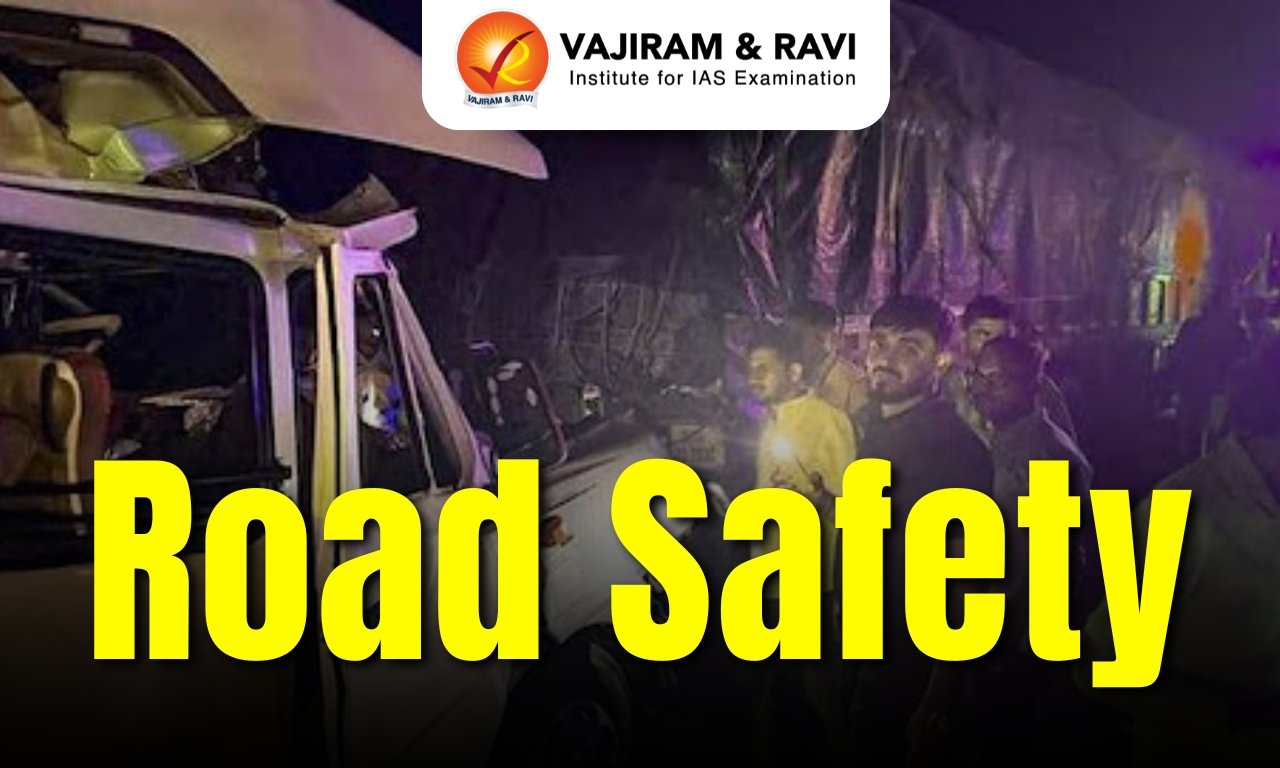
- One incident involved a bus hitting a stationary trailer on the Bharatmala Expressway in Rajasthan, killing 15 people. Another accident in Telangana resulted in 19 deaths when a lorry collided with a bus while avoiding a pothole.
- These incidents prompted the Supreme Court to take suo motu cognisance of road safety issues.
- Observations of the Supreme Court
- The Court criticised the National Highways Authority of India (NHAI) and state public works departments for lapses in safety management.
- The Court observed that highways must not become “corridors of peril” due to administrative negligence or infrastructural gaps.
- The Court also highlighted the dangers of illegal parking of heavy vehicles, particularly near roadside establishments, which significantly increases accident risks.
- Key Directions Issued by the Court
- The Supreme Court issued a comprehensive set of directives.
- Parking of heavy and commercial vehicles on highways has been prohibited except in designated areas such as lay-bys and wayside amenities.
- The Court directed the use of Advanced Traffic Management Systems (ATMS) to monitor highways and detect violations through GPS-enabled systems.
- It mandated the deployment of ambulances and recovery vehicles at intervals of 75 km to ensure quick response in emergencies.
- Further, authorities have been instructed to identify accident-prone black spots within 45 days and install safety measures such as lighting, cameras, and warning signs.
- Regulation of Roadside Activities
- The Court has prohibited the construction of new dhabas and commercial establishments within the Right of Way (ROW) of highways.
- It also directed the demolition of unauthorised structures and imposed restrictions on land use within a specified distance from highways.
- These measures aim to reduce roadside congestion and unsafe practices.
- Strengthening Enforcement Mechanisms
-
- The Court called for the creation of dedicated highway surveillance teams involving police and transport departments for round-the-clock monitoring.
- Integration of surveillance systems with e-challan mechanisms has been emphasised to ensure effective enforcement.

 Last updated on August, 2026
→ UPSC Mains 2026 commenced on 21st August 2026 and will continue through 30th August 2026, as per the official examination schedule.
→ UPSC Mains Question Paper 2026 is out now for Essay & GS Paper 1, 2, 3 & 4.
→ UPSC Mains GS Paper 1 2026 is out now.
→ UPSC Mains GS Paper 2 2026 is out now.
→ UPSC Mains GS Paper 3 2026 is out now.
→ UPSC Mains GS Paper 4 2026 is out now.
→ UPSC Mains Indian Language Paper & English Compulsory Paper are out now.
→ Check out the latest UPSC Syllabus 2026 here.
→ UPSC Mains Admit Card 2026 is now out.
→ Enroll in Vajiram & Ravi’s UPSC Mains Test Series 2027 for structured answer writing practice, expert evaluation, and exam-oriented feedback.
→ Join Vajiram & Ravi’s UPSC Mentorship Program 2027 for personalized guidance, strategy planning, and one-to-one support from experienced mentors.
→ Go through the UPSC Mains Previous Year Papers to enhance your preparation.
→ Download UPSC Mains Essay Paper 2025, UPSC Mains GS Paper-I 2025, UPSC Mains GS Paper-II 2025, UPSC Mains GS Paper-III 2025, UPSC Mains GS Paper-IV 2025, UPSC Mains English (Compulsory) Paper 2025, UPSC Mains Hindi (Qualifying) Paper 2025 here.
→ UPSC has released UPSC Toppers List 2025 with the Civil Services final result on its official website.
→ UPSC Calendar 2027 has been released.
→ Also check Best UPSC Coaching in India
Road Safety FAQs
Q1. What is Article 142 of the Constitution?+
Q2. Why did the Supreme Court take suo motu action on road safety?+
Q3. What is the significance of Article 21 in this case?+
Q4. What major restriction did the Court impose on highways?+
Q5. What proportion of road deaths occur on National Highways?+
Tags: mains articles road safety upsc current affairs upsc mains current affairs