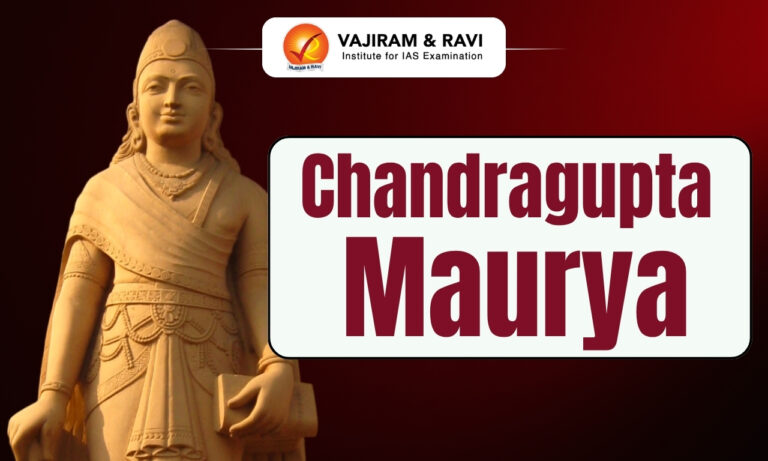
Chandragupta Maurya was the founder of the Mauryan Empire and one of the most influential rulers of ancient India. He played a major role in overthrowing the Nanda dynasty and bringing large parts of the Indian subcontinent under a strong centralised administration. With the guidance of Chanakya, he built a powerful empire and developed an organised system of governance. His reign also saw important military and diplomatic developments, including relations with Seleucus I Nicator. This article covers Chandragupta Maurya’s early life, rise to power, administration, expansion, major achievements and historical significance.
Chandragupta Maurya Early Life and Background
The early life and background of Chandragupta Maurya provide an insight into his origins, upbringing and training, which played an important role in his rise to power.
- Chandragupta Maurya was the founder of the Mauryan dynasty and one of the most important rulers of ancient India.
- He is generally believed to have ruled from around 321 BCE to 297 BCE and played a major role in bringing several regions of the Indian subcontinent under a single political authority.
- The exact origin and early life of Chandragupta Maurya remain uncertain because different Greek, Buddhist, Jain and Brahmanical sources provide different accounts of his ancestry.
- Some traditions describe him as belonging to the Moriya or Maurya Kshatriya clan, while other accounts connect his origins with a humble background.
- According to traditional accounts, Chandragupta lost his father at an early age and faced difficult circumstances during his childhood.
- He was reportedly brought up by a pastoral family before coming under the guidance of Chanakya, also known as Kautilya.
- Chanakya played an important role in Chandragupta Maurya’s rise. He recognised the young Chandragupta’s leadership abilities and trained him in areas such as administration, military strategy and statecraft.
- Chandragupta is traditionally associated with Taxila, where he is said to have received education and military training.
- His association with Chanakya helped prepare him for the political and military challenges that lay ahead.
- Chanakya’s political ideas are closely associated with the Arthashastra, an important Sanskrit work dealing with governance, administration, economics, diplomacy and statecraft. Chandragupta’s rule is often studied in connection with these ideas.
Rise of Chandragupta Maurya and Foundation of the Mauryan Empire
The rise of Chandragupta Maurya marked the beginning of the Mauryan Empire, as he overthrew the Nanda dynasty with the guidance of Chanakya and established a powerful new kingdom.
- Chandragupta’s rise took place during a period when Magadha was ruled by the Nanda dynasty. With the guidance of Chanakya, he organised military forces and built support to challenge Nanda authority.
- Chandragupta eventually defeated Dhana Nanda, the last Nanda ruler according to several traditions and captured Pataliputra, the capital of Magadha. This victory laid the foundation of the Mauryan Empire around 321 BCE.
- After establishing his authority in Magadha, Chandragupta consolidated his position and brought several territories under Mauryan control. His rise marked the beginning of one of the earliest large-scale empires in the Indian subcontinent.
- Following the death of Alexander the Great in 323 BCE, political conditions changed in north-western India.
- Chandragupta took advantage of this situation and expanded his authority into areas that had earlier been controlled by Macedonian or Greek officials.
- Chandragupta’s success was closely linked with the strategic guidance of Chanakya. While Chanakya provided political and strategic direction, Chandragupta led the military campaigns and administration that helped establish the new empire.
- The Mauryan state gradually developed into a powerful and organised empire. Chandragupta laid the political foundation that was later strengthened by his successors, particularly Bindusara and Ashoka.


Chandragupta Maurya and His Administration
Chandragupta Maurya developed a strong and centralised administrative system to govern his vast empire, with organised taxation, a powerful army and efficient officials.
- Chandragupta Maurya established a strong centralised administration to govern his expanding empire. The system included officials, taxation arrangements, military organisation and mechanisms for maintaining law and order.
- Pataliputra served as the centre of Mauryan administration. From the capital, the ruler and his officials managed the affairs of a large territory and supervised different aspects of governance.
- The Mauryan state maintained a large standing army consisting of infantry, cavalry and war elephants. Greek accounts provide different estimates of its size, but they clearly indicate that Chandragupta possessed a powerful military force.
- A secret intelligence network was also an important feature of the administration described in traditions associated with Chandragupta and the Arthashastra. Information gathering helped the state monitor officials, political developments and possible threats.
- Agriculture and trade were important parts of the Mauryan economy. The state regulated economic activities and promoted infrastructure that supported communication, transportation and commercial exchange.
- Roads and other infrastructure played an important role in connecting different parts of the empire. Major routes linked Pataliputra with Taxila and other regions, helping movement of people, goods and military forces.
- The Mauryan administration also paid attention to weights and measures, taxation and economic regulation. These measures helped strengthen the economic base of the empire and supported its large administrative and military structure.
- The organised nature of Chandragupta’s administration helped maintain control over a vast territory and provided a foundation for the continued expansion of the Mauryan Empire under his successors.
Chandragupta Maurya and the Expansion of the Mauryan Empire
The expansion of the Mauryan Empire under Chandragupta Maurya brought large parts of northern and central India under his control through military campaigns and strategic alliances.
- After consolidating Magadha and northern India, Chandragupta expanded the Mauryan Empire towards the north-western regions of the Indian subcontinent. This brought several territories formerly associated with Alexander’s eastern empire under Mauryan control.
- A major event in Chandragupta’s expansion was his conflict with Seleucus I Nicator, one of Alexander’s successors. The confrontation took place around 305 BCE in the north-western region.
- Chandragupta emerged successful from the conflict and a treaty was concluded between the Mauryas and Seleucids. Under the agreement, Seleucus ceded territories east of the Indus, while Chandragupta is said to have provided 500 war elephants.
- The treaty also helped establish friendly relations between the Mauryan and Seleucid kingdoms. Diplomatic contacts increased and Greek envoys were sent to the Mauryan court.
- Megasthenes, a Greek ambassador, visited the court of Chandragupta Maurya. His observations were recorded in a work known as Indica, which provides valuable information about Mauryan India, although the original text has not survived in full.
- By the end of Chandragupta’s reign, the Mauryan Empire covered a vast part of northern and central India, extending towards the north-west and the Vindhya region. His son Bindusara continued the expansion of the empire towards the south.
Chandragupta Maurya Achievements, Legacy and Historical Significance
The achievements, legacy and historical significance of Chandragupta Maurya reflect his contribution to building a powerful empire and establishing an organised system of governance in ancient India.
- Foundation of the Mauryan Empire: Chandragupta Maurya is remembered as the founder of the Mauryan Empire and for bringing many previously separate territories under a single political authority. His achievements laid the foundation for one of ancient India’s most powerful empires.
- Political Unification: He played an important role in the political consolidation of large parts of the Indian subcontinent. His empire extended from the north-western regions towards northern and central India, creating a strong territorial base for later Mauryan rulers.
- Strong Administration: Chandragupta developed a centralised and organised system of governance, supported by officials, taxation, military power and intelligence networks. This administrative structure helped the empire remain stable and effective.
- Military Strength: His successful campaigns against the Nanda dynasty and Seleucus I Nicator demonstrated the strength and organisation of the Mauryan military. The large army also helped protect and consolidate the expanding empire.
- Diplomatic Relations: The treaty with Seleucus established a period of peaceful relations and diplomatic exchange between the Mauryan and Seleucid realms. The presence of Megasthenes at the Mauryan court is an important example of these contacts.
- Economic and Infrastructure Development: The Mauryan administration supported agriculture, trade, roads, irrigation and other infrastructure, helping strengthen communication and economic activity across the empire.
- Association with Jainism: According to Jain tradition, Chandragupta later accepted Jainism under the influence of the sage Bhadrabahu. During a period associated with a severe famine, he is said to have travelled to Shravanabelagola in present-day Karnataka.
- Renunciation and Death: Jain traditions state that Chandragupta abdicated the throne in favour of his son Bindusara and spent his final years at Shravanabelagola. He is traditionally believed to have died around 297 BCE through Sallekhana, a Jain practice of gradually giving up food under specific religious circumstances.
- Historical Significance: Chandragupta Maurya’s reign marked the beginning of the Mauryan imperial tradition. His political achievements, administrative system, military organisation and diplomatic relations created the foundation on which Bindusara and Ashoka later expanded the empire.
- Enduring Legacy: Chandragupta remains one of the most significant rulers of ancient Indian history. His rise from uncertain and humble beginnings to the founder of a major empire, together with Chanakya’s strategic guidance, continues to make his life an important subject of historical study.

 Last updated on Oct, 2026
→ UPSC 2027 Notification will be released on 13 January 2027 at upsconline.nic.in.
→ Asian Games 2026 are being held in Aichi-Nagoya, Japan, from 19 September to 4 October.
→ Check Nobel Prize 2026 Winners List here.
→ Download PIB PRiSM Monthly Magazine 2026 here.
→ Check UPSC Monthly Current Affairs Magazine The Recitals here.
→ Check out the latest UPSC Syllabus here.
→ Download UPSC Model Answers for Mains 2026
→ UPSC Mains Question Paper 2026 is out now for Essay & GS Paper 1, 2, 3 & 4.
→ UPSC Calendar 2027 has been released.
→ Enroll in Vajiram & Ravi’s UPSC Mains Test Series 2027 for structured answer writing practice, expert evaluation, and exam-oriented feedback.
→ Join Vajiram & Ravi’s UPSC Mentorship Program 2027 for personalized guidance, strategy planning, and one-to-one support from experienced mentors.
→ Go through the UPSC Mains Previous Year Papers to enhance your preparation.
→ UPSC has released UPSC Toppers List 2025 with the Civil Services final result on its official website.
→ Also check Best UPSC Coaching in India
Chandragupta Maurya FAQs
Q1. Who was Chandragupta Maurya?+
Q2. When did Chandragupta Maurya rule?+
Q3. Who helped Chandragupta Maurya establish the Mauryan Empire?+
Q4. How did Chandragupta Maurya establish the Mauryan Empire?+
Q5. What was the role of Chandragupta Maurya in the expansion of the Mauryan Empire?+
Q6. Who was Seleucus Nicator in relation to Chandragupta Maurya?+
Q7. Who was Megasthenes and why is he important?+
Q8. What were the major features of Chandragupta Maurya’s administration?+
Q9. Did Chandragupta Maurya follow Jainism?+
Q10. What is the historical significance of Chandragupta Maurya?+
Tags: chandragupta chandragupta maurya history history notes