India is undergoing rapid urbanisation, with cities emerging as the primary engines of economic growth, innovation, and employment generation. As India moves towards the vision of Viksit Bharat 2047 and a $30 trillion economy, the role of cities becomes central to national transformation.
However, the potential of urban centres remains constrained by structural challenges in urban governance, including fragmented institutions, weak fiscal autonomy, and limited administrative capacity.
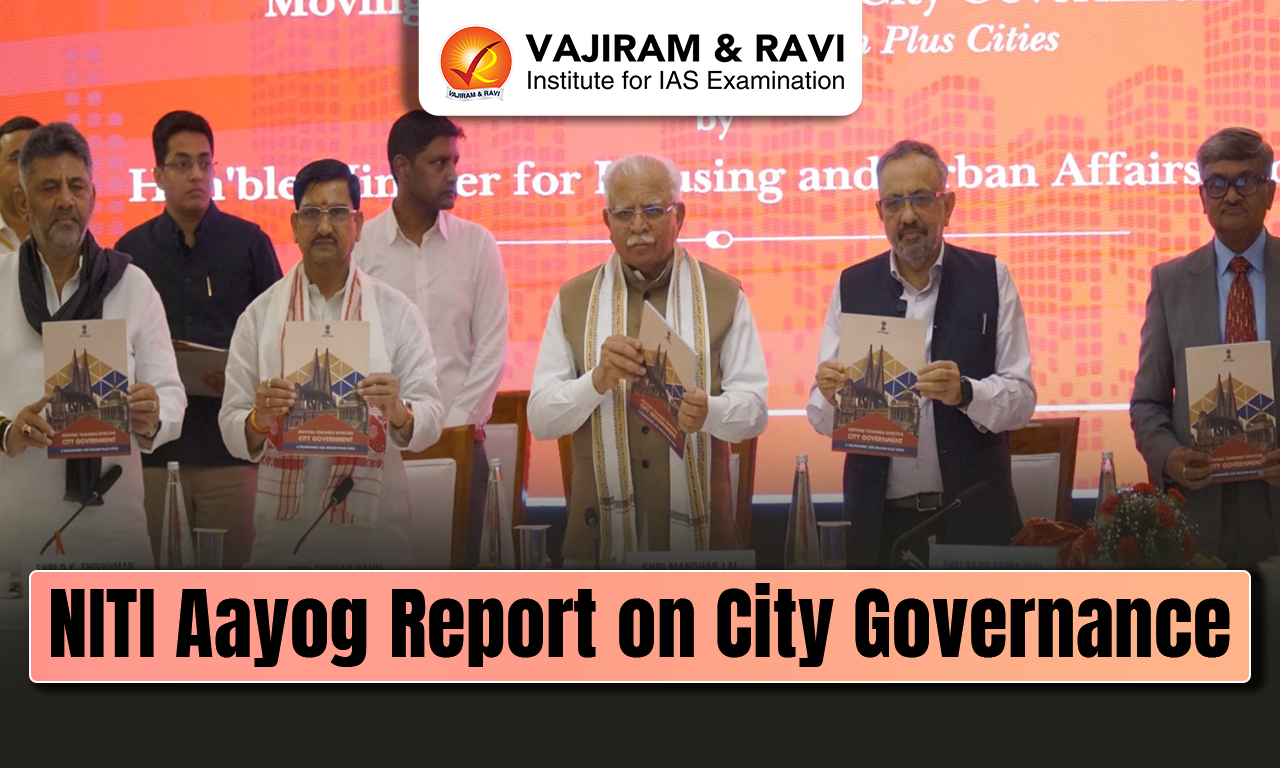
In this context, the NITI Aayog report titled “Moving Towards Effective City Government – A Framework for Million-plus Cities” provides a comprehensive roadmap for strengthening urban local governance in India.
Million-Plus Cities: Focus of the Report
The NITI Ayog report on City Governance focuses on million-plus cities, which are urban agglomerations with a population of one million or more.
- These cities are critical because, although they represent a limited number of urban centres, they account for a disproportionately large share of Gross Domestic Product (GDP), industrial activity, and service sector growth.
- They also function as major hubs of internal migration, attracting labour from rural and semi-urban areas.
- Due to their scale, density, and complexity, these cities require advanced systems of urban governance, stronger institutions, and greater financial and administrative autonomy.
Strengthening governance in these cities is therefore seen as a high-impact entry point for improving overall urban development in India.
Core Objective of the Niti Ayog Report on City Governance
The NITI Ayog Report on City Governance titled “Moving Towards Effective City Government – A Framework for Million-plus Cities” focuses on transforming urban local bodies into effective city governments capable of functioning as integrated governance units. Its central idea is to strengthen:
- Institutional capacity
- Fiscal autonomy
- Functional clarity
The emphasis is on treating cities not merely as service providers but as economic governance units driving urban transformation. However, the realisation of this vision is constrained by several deep-rooted structural and institutional challenges in urban governance.


Key Challenges in Urban Governance
The key constraints highlighted by the NITI Ayog on City Governance report include:
Limited Devolution of Functions:
- Although the 74th Constitutional Amendment Act, 1992 provides for the devolution of eighteen functions under the 12th schedule , the actual transfer of responsibilities varies significantly across states and remains largely incomplete.
- A performance audit by the Comptroller and Auditor General of India shows that urban local bodies exercise full control over only a limited number of functions, while in several others their role is minimal or absent.
Fragmented Institutional Framework:
- Urban governance is characterised by multiple overlapping agencies such as municipal corporations, development authorities, and parastatal bodies. This fragmentation leads to duplication of functions, lack of coordination, and diffusion of accountability.
Weak City Leadership: Most urban local bodies lack empowered and stable executive leadership.
- Mayors are generally not directly elected and lack executive and financial authority. Their tenure varies across states, and real decision-making power rests with municipal commissioners or committees, leading to weak accountability and fragmented urban governance.
Fiscal Constraints: Urban local bodies face persistent fiscal stress due to weak own-source revenues, inadequate transfers, and dependence on tied grants.
- Key issues include poor property tax collection, reluctance to impose user charges, and unpredictable state transfers, compounded by weak implementation of State Finance Commissions.
- This weak fiscal base limits access to capital markets such as municipal bonds and constrains long-term infrastructure investment.
Inadequate Human Resources and Capacity Constraints: Urban local bodies face significant shortages of skilled personnel in areas such as urban planning, engineering, finance, and project management. Key constraints include:
- High dependence on deputation from state services
- Frequent transfer of municipal commissioners, affecting continuity
- Lack of professional municipal cadres
- Limited training and skill development opportunities
These constraints weaken institutional capacity for effective project planning, procurement, revenue collection, and contract management.
Key Recommendations of the Report
Strengthening Urban Political Leadership: The report recommends the introduction of a directly elected mayor with a fixed tenure. This mayor should be supported by a mayor-in-council system to ensure collective decision-making and administrative continuity.
Integration of Urban Service Delivery: Core urban services such as water supply, sanitation, solid waste management, and urban transport should be consolidated under city governments. This integration is intended to reduce institutional fragmentation and improve accountability in service delivery.
Strengthening Municipal Finances: The report emphasises strengthening the fiscal base of urban local bodies through:
- Expansion of own source revenue
- Improvement in property tax assessment and collection
- Strengthening the role of State Finance Commissions
- Development of municipal bond markets to enable access to capital funding
Institutional Rationalisation: The report recommends bringing various parastatal agencies involved in urban development under the oversight or coordination of city governments. This is intended to ensure institutional coherence and improve governance efficiency.
Implementation Strategy
The NITI Ayog report on City Governance report proposes a phased and incremental approach to reform implementation. It suggests that:
- States undertake necessary amendments to their municipal legislation
- The Ministry of Housing and Urban Affairs revise the Model Municipal Law
- Pilot reforms be implemented in selected million-plus cities
- Successful models be scaled across urban centres based on evaluation and learning
This approach reflects the principle of cooperative federalism, where both the central and state governments collaborate in institutional reform.

 Last updated on Sep, 2026
→ UPSC Mains Question Paper 2026 is out now for Essay & GS Paper 1, 2, 3 & 4.
→ UPSC Mains GS Paper 1 2026 is out now.
→ UPSC Mains GS Paper 2 2026 is out now.
→ UPSC Mains GS Paper 3 2026 is out now.
→ UPSC Mains GS Paper 4 2026 is out now.
→ UPSC Mains Indian Language Paper & English Compulsory Paper are out now.
→ Check out the latest UPSC Syllabus 2026 here.
→ UPSC Mains Admit Card 2026 is now out.
→ Enroll in Vajiram & Ravi’s UPSC Mains Test Series 2027 for structured answer writing practice, expert evaluation, and exam-oriented feedback.
→ Join Vajiram & Ravi’s UPSC Mentorship Program 2027 for personalized guidance, strategy planning, and one-to-one support from experienced mentors.
→ Go through the UPSC Mains Previous Year Papers to enhance your preparation.
→ Download UPSC Mains Essay Paper 2025, UPSC Mains GS Paper-I 2025, UPSC Mains GS Paper-II 2025, UPSC Mains GS Paper-III 2025, UPSC Mains GS Paper-IV 2025, UPSC Mains English (Compulsory) Paper 2025, UPSC Mains Hindi (Qualifying) Paper 2025 here.
→ UPSC has released UPSC Toppers List 2025 with the Civil Services final result on its official website.
→ UPSC Calendar 2027 has been released.
→ Also check Best UPSC Coaching in India
NITI Aayog Report on City Governance FAQs
Q1. What is the core objective of NITI Ayog report on City Governance titled “Moving Towards Effective City Government – A Framework for Million-plus Cities?+
Q2. What are million-plus cities in the NITI Aayog report?+
Q3. What are the major governance challenges identified in urban local bodies?+
Q4. What are the key recommendations of the NITI Aayog report on city governance?+
Q5. What is the significance of the NITI Aayog report on city governance?+
Tags: niti aayog report on city governance