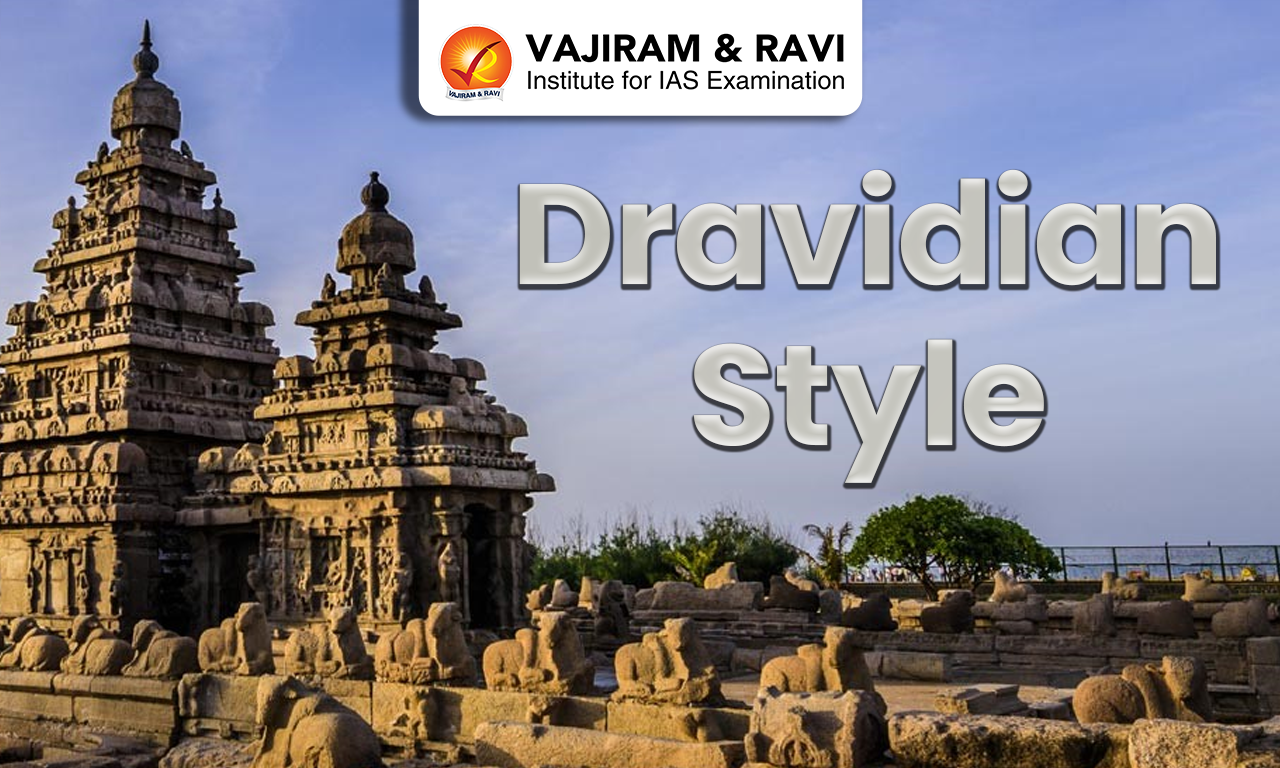
Dravidian Style of Temple Architecture is a South Indian tradition known for its grand temples with pyramid-shaped towers called vimanas and tall gateway towers known as gopurams. It developed under dynasties like the Pallavas and Cholas and is described in texts like the Vastu Shastra. These temples are built within large enclosures and include halls, water tanks, and detailed stone carvings. Famous examples such as the Brihadisvara Temple highlight its scale, symmetry, and artistic excellence.
Dravidian Style of Temple Architecture Features
Dravidian temples are known for their grandeur, symmetry, and intricate craftsmanship. The following are the defining characteristics:
- High Boundary Walls: Temples are enclosed within massive rectangular walls, separating sacred space from the outside world.
- Gopuram (Gateway Tower): Tall, pyramidal entrance towers dominate the temple complex, often more prominent than the central shrine in later periods.
- Panchayatan Layout: The temple complex typically includes a main shrine surrounded by four subsidiary shrines.
- Vimana (Main Tower): A stepped pyramidal structure rising above the sanctum (garbhagriha), unlike the curved shikhara of North India.
- Single Vimana Principle: Only the main shrine has a vimana, while subsidiary shrines usually lack it.
- Shikhara: In Dravidian style, this refers to the crowning element above the vimana, often shaped like a dome or stupika.
- Antarala (Vestibule): A passage connecting the mandapa (hall) to the garbhagriha (sanctum).
- Sculptural Decoration: Entrances are adorned with figures like Dwarapalas, Yakshas, and Mithuna sculptures.
- Temple Tank: Presence of a water reservoir within the complex for rituals and purification.
- Multiple Enclosures: Large temples evolved with concentric walls and multiple gopurams.
- Urban Centers: Temples functioned as religious, economic, and administrative hubs between the 8th and 12th centuries.
Famous Dravidian Style Temples in India
South India is home to some of the most iconic Dravidian-style temples:
- Brihadisvara Temple – Built by Rajaraja Chola I in 1011 AD; one of the tallest temples in India.
- Gangaikonda Cholapuram Temple – Built by Rajendra Chola I to celebrate his northern conquests.
- Meenakshi Amman Temple – Famous for its colorful gopurams and intricate carvings.
- Airavatesvara Temple – A UNESCO-listed Chola masterpiece.
- Annamalaiyar Temple – Dedicated to Lord Shiva, associated with fire (Agni).
- Kailashnath temple at Ellora


Contribution of Pallavas to Dravidian Architecture
The Pallavas (4th-9th century CE) were pioneers of Dravidian architecture, initiating a crucial shift from rock-cut cave temples to fully developed structural stone temples. They established core elements like vimana (tower), mandapa (pillared hall), and sculpted gateways, laying the foundation for the grand temple traditions of South India.
Key Contributions:
- Evolution of Architectural Styles
- Mahendra Style (c. 600-625 CE): Began with rock-cut cave temples featuring simple pillared mandapas instead of wood or brick structures.
- Mamalla Style (c. 625-674 CE): Introduced monolithic rathas (chariots carved from single rocks), best seen at Pancha Rathas.
- Rajasimha & Nandi Styles (c. 674-900 CE): Marked the emergence of structural, free-standing temples built with stone, including the Shore Temple and Kailasanatha Temple.
- Development of Key Architectural Elements
- Vimana: Multi-tiered pyramidal towers became a defining feature of Dravidian temples.
- Mandapa: Large pillared halls were designed for rituals and gatherings.
- Gopuram: Early gateway towers were introduced, later expanded significantly by the Cholas.
- Excellence in Sculptural Art
- Pallava temples are known for detailed narrative carvings and bas-reliefs.
- A prime example is the Descent of the Ganga (Arjuna’s Penance), showcasing dynamic and realistic artistry.
- Regional and Cultural Influence
- Pallava architectural styles spread beyond India through maritime trade.
- Influenced early temple architecture in Southeast Asia, including regions like Java and Cambodia.
- Significant Monuments
- Shore Temple – One of the earliest structural temples and a UNESCO World Heritage site.
- Kailasanatha Temple – The most elaborate Pallava structural temple.
- Pancha Rathas – Monolithic temples demonstrating diverse Dravidian forms.
- Vaikunta Perumal Temple – Known for its architectural innovation and sculptural richness.
Contribution of Cholas to Dravidian Architecture
The Cholas (c. 850-1200 CE) transformed Dravidian architecture by perfecting large-scale structural stone temples and elevating them to monumental proportions. Moving beyond earlier Pallava traditions, they introduced massive granite constructions, towering vimanas, and highly refined sculptural art, setting new standards in temple architecture.
Dominance of Stone & Engineering Excellence
- The Cholas replaced brick and rock-cut forms with massive granite structures.
- Their temples showcased advanced engineering, allowing construction at unprecedented scales and heights.
Towering Vimana (Sanctum Tower)
- The vimana became the most prominent feature, rising as a stepped pyramid.
- These towers were significantly taller than earlier examples, symbolizing power and devotion.
- The crowning element (shikhara) was often octagonal and dome-like.
Monumental Temple Tradition
- Royal patronage led to the construction of grand temples such as the Brihadisvara Temple built by Rajaraja I.
- The Gangaikonda Cholapuram Temple built by Rajendra I further refined this style.
- These temples are now recognized as UNESCO World Heritage monuments.
Evolution of Gopurams and Temple Layout
- Gopurams (gateway towers) became more elaborate and decorative, though still secondary to the vimana in this period.
- Temples featured high enclosure walls and expansive courtyards, reflecting organized spatial planning.
Intricate Sculpture and Iconography
- Chola temples are renowned for detailed carvings depicting deities, mythological scenes, and celestial beings.
- Sculptures were both decorative and symbolic, enhancing the spiritual atmosphere.
- The iconic Nataraja form of Lord Shiva represents the peak of Chola artistic achievement.
Refinement of Structural Components
- Development of key architectural elements such as:
- Ardha-mandapa (entrance porch)
- Maha-mandapa (main assembly hall)
- Nandi-mandapa (pavilion for Nandi, Shiva’s mount)
- These additions improved both functionality and aesthetic balance.

 Last updated on Sep, 2026
→ UPSC 2027 Notification will be released on 13 January 2027 at upsconline.nic.in.
→ Check out the latest UPSC Syllabus here.
→ Download UPSC Model Answers for Mains 2026
→ UPSC Mains Question Paper 2026 is out now for Essay & GS Paper 1, 2, 3 & 4.
→ UPSC Calendar 2027 has been released.
→ Enroll in Vajiram & Ravi’s UPSC Mains Test Series 2027 for structured answer writing practice, expert evaluation, and exam-oriented feedback.
→ Join Vajiram & Ravi’s UPSC Mentorship Program 2027 for personalized guidance, strategy planning, and one-to-one support from experienced mentors.
→ Go through the UPSC Mains Previous Year Papers to enhance your preparation.
→ UPSC has released UPSC Toppers List 2025 with the Civil Services final result on its official website.
→ Also check Best UPSC Coaching in India
Dravidian Style of Temple Architecture FAQs
Q1. What is the Dravidian style of temple architecture?+
Q2. Where did Dravidian architecture originate?+
Q3. Which ancient text mentions Dravidian temple architecture?+
Q4. What is a vimana in Dravidian temples?+
Q5. What is the role of a gopuram?+
Tags: history medieval history