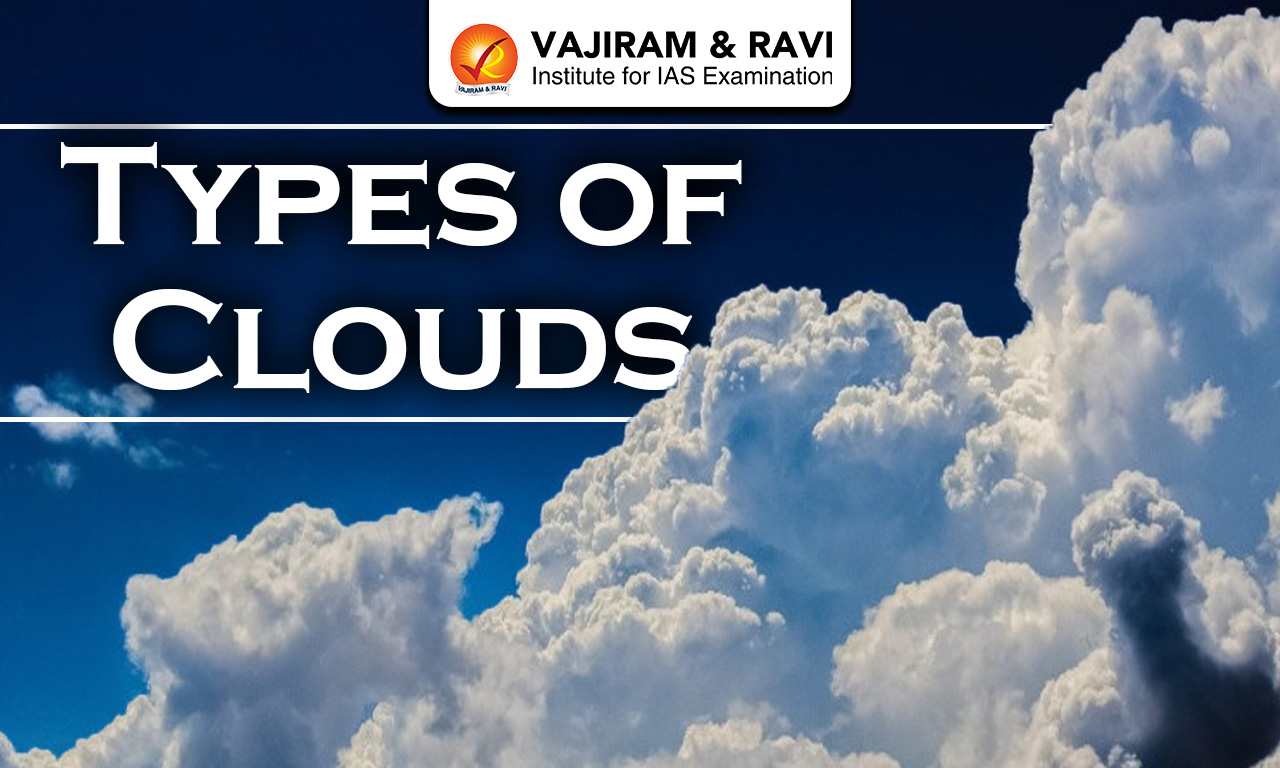
Clouds are visible masses of tiny water droplets or ice crystals suspended in the Earth’s atmosphere, formed when water vapour cools and condenses around particles like dust or salt. Common examples include cirrus, cumulus, stratus and nimbus. Clouds play a crucial role in regulating Earth’s temperature by reflecting sunlight during the day and trapping heat at night. They are essential to the water cycle, enabling rainfall and snowfall, which sustain ecosystems and human life.
Clouds
The study of Clouds is part of Nephology that helps understand weather forecasting and climate dynamics. The modern classification system was developed in 1803 by Luke Howard and later standardized in the International Cloud Atlas.
Understanding Types of Clouds also helps in predicting weather events such as storms, rainfall and temperature changes. For example, cirrus clouds may indicate stable weather, while cumulonimbus clouds warn of severe thunderstorms. Similarly, nimbostratus clouds suggest prolonged precipitation and stratus clouds indicate overcast conditions.
Also Check: Cloud Formation
Types of Clouds
Clouds are classified mainly on the basis of height and physical shape, which together explain their structure, formation process and associated weather conditions.
- Classification based on Height: Clouds are grouped as high, middle, low and vertical types based on altitude, ranging from near the surface up to above 12,000 metres depending on region and atmospheric conditions.
- Classification based on Shape: Clouds are divided into cirrus, cumulus, stratus and nimbus forms depending on their appearance such as feathery, puffy, layered, or rain bearing structures. Latin terms like cirro, cumulo, strato and nimbo describe cloud features such as height, shape, layering and precipitation.


Types of Clouds Based on Shape
Cloud classification by shape depends on structure, density and appearance, reflecting atmospheric processes like convection, turbulence and condensation patterns.
- Cirrus Clouds: Cirrus clouds form at high altitudes between 8,000 and 12,000 metres and appear thin, white and feathery due to ice crystals. They often indicate fair weather but may signal an approaching warm front or change in weather conditions.
- Cumulus Clouds: Cumulus clouds develop at heights of about 4,000 to 7,000 metres and look like cotton balls with flat bases and rounded tops. They form due to convection and can grow into storm clouds under unstable atmospheric conditions.
- Stratus Clouds: Stratus clouds are low, horizontal and layered clouds that cover large portions of the sky, giving overcast conditions. They form due to cooling or mixing of air masses and often bring dull, cloudy weather with possible drizzle.
- Nimbus Clouds: Nimbus clouds are dense, dark clouds found mostly at lower altitudes and are associated with heavy rainfall and thunderstorms. They block sunlight and include types like nimbostratus and cumulonimbus, which produce intense precipitation and lightning.
Types of Clouds Based on Height
Clouds are grouped into categories based on altitude, which varies with latitude, temperature and atmospheric conditions, influencing their composition and weather effects.
- High Level Clouds: These clouds form above 5,000 metres in temperate regions and up to 18,300 metres in tropical areas, mainly composed of ice crystals due to low temperatures, appearing thin and white.
- Cirrus: Thin, wispy clouds made entirely of ice crystals, often the first sign of a changing weather system such as an approaching warm front.
- Cirrostratus: Thin, sheet like clouds covering the sky, often producing halo effects around the sun or moon due to light refraction through ice crystals.
- Cirrocumulus: Small, patchy, ripple like clouds arranged in rows or waves, indicating atmospheric instability at high altitudes but generally not producing precipitation.
- Middle Level Clouds: These clouds form between 2,000 and 7,600 metres depending on region and contain water droplets, ice crystals, or both, often indicating developing weather systems.
- Altostratus: Grey or bluish uniform clouds covering large sky areas, allowing diffused sunlight and often preceding widespread rain or snow events.
- Altocumulus: Puffy, patchy clouds with shading, often arranged in rows, indicating moisture and instability that may lead to thunderstorms later in the day.
- Low Level Clouds: These clouds occur from the surface up to about 2,000 metres and are mainly composed of water droplets, often producing precipitation or overcast conditions.
- Stratus: Uniform grey clouds forming a continuous layer, often bringing drizzle or light rain and creating dull weather conditions over extended periods.
- Stratocumulus: Low clouds with rounded masses or rolls, sometimes with gaps, commonly seen before or after weather fronts and usually producing little precipitation.
- Nimbostratus: Thick, dark clouds with diffuse bases, producing continuous rainfall or snowfall over long durations, often associated with widespread weather systems.
- Clouds with Vertical Development: These clouds extend through multiple altitude levels due to strong convection, often associated with severe weather and intense atmospheric activity.
- Cumulus: Vertically growing clouds with flat bases and rounded tops, indicating rising warm air and fair weather, but capable of developing into storm clouds.
- Cumulonimbus: Massive towering clouds reaching up to 16 kilometres, producing thunderstorms, heavy rain, lightning, hailstorm and sometimes tornadoes, representing the most intense weather systems.

 Last updated on Sep, 2026
→ UPSC Mains Question Paper 2026 is out now for Essay & GS Paper 1, 2, 3 & 4.
→ UPSC Mains GS Paper 1 2026 is out now.
→ UPSC Mains GS Paper 2 2026 is out now.
→ UPSC Mains GS Paper 3 2026 is out now.
→ UPSC Mains GS Paper 4 2026 is out now.
→ UPSC Mains Indian Language Paper & English Compulsory Paper are out now.
→ Check out the latest UPSC Syllabus 2026 here.
→ UPSC Mains Admit Card 2026 is now out.
→ Enroll in Vajiram & Ravi’s UPSC Mains Test Series 2027 for structured answer writing practice, expert evaluation, and exam-oriented feedback.
→ Join Vajiram & Ravi’s UPSC Mentorship Program 2027 for personalized guidance, strategy planning, and one-to-one support from experienced mentors.
→ Go through the UPSC Mains Previous Year Papers to enhance your preparation.
→ Download UPSC Mains Essay Paper 2025, UPSC Mains GS Paper-I 2025, UPSC Mains GS Paper-II 2025, UPSC Mains GS Paper-III 2025, UPSC Mains GS Paper-IV 2025, UPSC Mains English (Compulsory) Paper 2025, UPSC Mains Hindi (Qualifying) Paper 2025 here.
→ UPSC has released UPSC Toppers List 2025 with the Civil Services final result on its official website.
→ UPSC Calendar 2027 has been released.
→ Also check Best UPSC Coaching in India
Types of Clouds FAQs
Q1. What are the main Types of Clouds?+
Q2. Which Types of Clouds bring rainfall?+
Q3. What are high level Types of Clouds?+
Q4. What are low level Types of Clouds?+
Q5. Which Types of Clouds cause thunderstorms?+
Tags: geography geography notes types of clouds