Charkha Latest News
- Rabindranath Tagore and Mahatma Gandhi shared a close friendship for nearly three decades, but they also differed sharply on several political and social questions. One of their most significant debates centred on the charkha, or spinning wheel.
- While Gandhi viewed spinning as a symbol of self-reliance, discipline, and national regeneration, Tagore was uncomfortable with the idea that every Indian must adopt it as a moral duty.
- Their disagreement reflected deeper philosophical differences on nationalism, individual freedom, and the direction of India’s freedom movement.
The Gandhi–Tagore Intellectual Conflict
- Jawaharlal Nehru once remarked that few people differed as profoundly as Mahatma Gandhi and Rabindranath Tagore.
- Despite mutual respect and friendship, their contrasting worldviews made ideological conflict almost inevitable.
- The first major differences emerged in 1915 when Gandhi visited Shantiniketan after returning from South Africa. They differed on issues such as nationalism, education, and political strategy.
Debates Over Nationalism and Protest
- Their disagreements widened after the Jallianwala Bagh Massacre.
- Gandhi launched the Non-Cooperation Movement, while Tagore feared that mass political mobilisation could encourage blind nationalism.
- Instead of joining the movement, Tagore renounced his British knighthood in protest against colonial repression.
Differences on Religion and Social Reform
- The two leaders also clashed over Gandhi’s interpretation of the 1934 Bihar earthquake as divine punishment for untouchability.
- Tagore rejected linking natural disasters with moral or religious explanations, arguing against associating cosmic events with ethical judgments.
Contrasting Philosophies
- Historians have described Gandhi and Tagore as representing contrasting ideals:
- Gandhi as the ascetic, nationalist, and mass mobiliser
- Tagore as the artist, internationalist, and individualist thinker
- Their debates reflected deeper disagreements on politics, spirituality, nationalism, and the future direction of Indian society.


The Gandhi–Tagore Debate on the Charkha
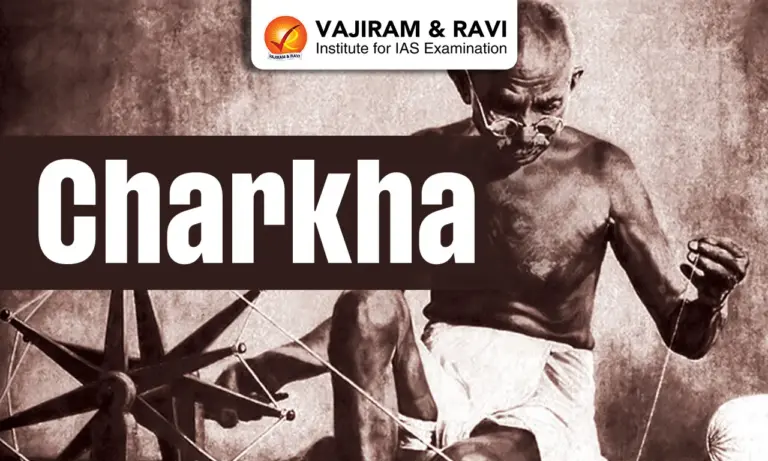
- Rabindranath Tagore strongly opposed what he viewed as the “cult of the charkha” and the growing moral pressure surrounding the khadi movement promoted by Mahatma Gandhi.
- In 1924, Gandhi and Congress leaders resolved that party members should wear khadi at political functions and contribute hand-spun yarn every month. Gandhi believed spinning would promote self-reliance and morally discipline Congress workers.
- Tagore criticised the movement in his essay The Cult of the Charkha, arguing that it encouraged blind obedience and suppressed individual freedom and diversity.
- He feared Indians were being pushed into uniformity under moral pressure from revered leaders.
Concerns About Mechanical Labour
- Tagore believed repetitive spinning involved “muscles and not the mind,” reducing creative and intellectual engagement.
- He argued that turning spinning into a ritual diluted its original purpose of helping the poor secure clothing.
- Tagore rejected the idea of withdrawing from science and modern technology.
- Using the examples of Sparta and Athens, he argued that societies flourish through openness, creativity, and intellectual development rather than rigid uniformity.
Gandhi’s Defence of the Charkha
- In response, Gandhi defended the spinning wheel in The Poet and the Charkha, arguing that Tagore misunderstood its social and ethical value.
- Gandhi believed spinning connected people with the struggles of the poor and restored dignity to manual labour.
- For Gandhi, the charkha represented more than cloth production.
- It symbolised self-reliance, cooperation, rural upliftment, and resistance to exploitative industrial systems, while still allowing limited use of machinery where necessary.
Tagore’s Uneasy Dissent on the Charkha
- Rabindranath Tagore was not opposed to the charkha as a practical means of helping people meet basic clothing needs.
- However, he was uncomfortable with the central moral and political importance it acquired in Mahatma Gandhi’s programme.
- Despite his disagreements, Tagore expressed them with reluctance and respect, admitting that opposing Gandhi on principles or methods was personally painful for him, even though he believed intellectual disagreement was legitimate.
Source: IE

 Last updated on Sep, 2026
→ UPSC 2027 Notification will be released on 13 January 2027 at upsconline.nic.in.
→ Check out the latest UPSC Syllabus here.
→ Download UPSC Model Answers for Mains 2026
→ UPSC Mains Question Paper 2026 is out now for Essay & GS Paper 1, 2, 3 & 4.
→ UPSC Calendar 2027 has been released.
→ Enroll in Vajiram & Ravi’s UPSC Mains Test Series 2027 for structured answer writing practice, expert evaluation, and exam-oriented feedback.
→ Join Vajiram & Ravi’s UPSC Mentorship Program 2027 for personalized guidance, strategy planning, and one-to-one support from experienced mentors.
→ Go through the UPSC Mains Previous Year Papers to enhance your preparation.
→ UPSC has released UPSC Toppers List 2025 with the Civil Services final result on its official website.
→ Also check Best UPSC Coaching in India
Charkha FAQs
Q1. What was the Tagore Gandhi charkha debate about?+
Q2. Why did Tagore oppose the charkha movement?+
Q3. How did Gandhi defend the charkha in the debate?+
Q4. What broader issues emerged in the Tagore Gandhi charkha debate?+
Q5. Did Tagore completely reject the charkha in the debate?+
Tags: Charkha mains articles upsc current affairs upsc mains current affairs