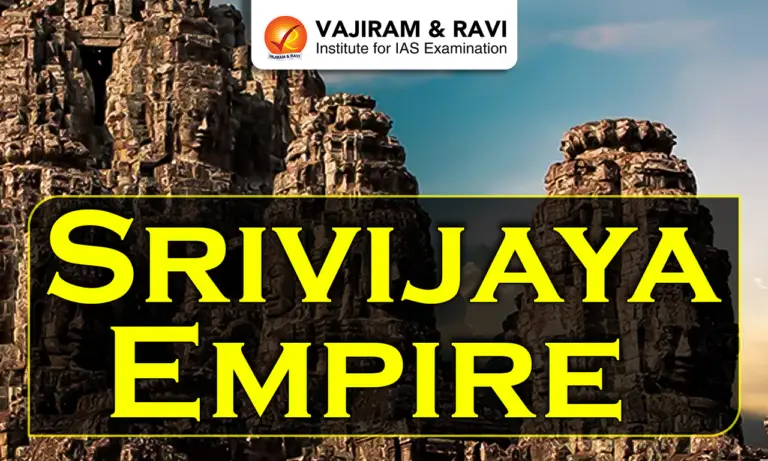
The Srivijaya Empire was a powerful maritime and commercial kingdom that flourished between the 7th and 13th centuries in Southeast Asia, mainly in present day Indonesia. Srivijaya became famous for maritime trade, naval strength, Buddhism and cultural exchange with India and China. It also emerged as a major centre of Mahayana and Vajrayana Buddhism in the Malay Archipelago.
Srivijaya Empire
Srivijaya Empire became a dominant naval empire through trade control, Buddhist influence, political alliances and strategic command over Southeast Asian waterways.
- Origin: Srivijaya was founded around the 7th century near Palembang in Sumatra.
- Founder: The Kedukan Bukit inscription dated 682 CE mentions Dapunta Hyang Sri Jayanasa as the founder who led a sacred expedition with nearly 20,000 troops.
- Time Period: The empire flourished from approximately 601 CE to 1300 CE and became the first major polity to dominate western Maritime Southeast Asia, including Sumatra, Java, Malay Peninsula and nearby islands.
- Capital and Location: Palembang, situated on the Musi River in modern Indonesia, is widely accepted as the capital. Archaeological remains, Chinese ceramics, Buddhist statues, canals and inscriptions support its importance as Srivijaya’s political and commercial centre.
- Kings and Rulers: Important rulers included Dapunta Hyang Sri Jayanasa, Dharmasetu, Samaratungga, Balaputradewa, Sri Cudamani Warmadewa and Sangrama Vijayatunggavarman. Many rulers combined political authority with Buddhist religious legitimacy to strengthen royal power.
- Religion: Srivijaya followed Mahayana and Vajrayana Sects of Buddhism and became an important Buddhist learning centre. Chinese monk Yijing visited Palembang in 671 CE and recorded that more than 1,000 Buddhist monks lived there.
- Language: Old Malay written in Pallava script became the official language of administration and trade. Sanskrit, Arabic and Persian influences in inscriptions show Srivijaya’s wide commercial and cultural interactions.
- Economy: Srivijaya traded ivory, camphor, sandalwood, cloves, nutmeg, tin, gold, spices, silk, porcelain and medicinal products. The empire also issued gold and silver coins embossed with sandalwood flower symbols and Sanskrit words.
- Decline of the Empire: Srivijaya weakened after repeated naval raids by Rajendra Chola I in 1025 CE. Chola forces captured Palembang, attacked major ports and disrupted maritime trade networks across Southeast Asia.
Srivijaya Empire Relations with India
Srivijaya Empire maintained strong political, cultural, religious and commercial relations with India through Buddhism, maritime trade, diplomacy and educational exchanges.
- Maritime Trade with India: Srivijaya controlled sea routes linking South India and China, making it an essential intermediary in Indian Ocean commerce. Indian merchants exchanged textiles, spices, metals and luxury goods through Srivijayan ports.
- Buddhist Religious Connections: The empire followed Mahayana and Vajrayana Buddhism which originated in India. Buddhist monks travelling from China to Nalanda University in India regularly stayed at Palembang for religious studies and Sanskrit learning.
- Monasteries in India: Srivijayan rulers established Buddhist Monasteries at Nagapattinam in southeastern India. King Maravijayattungavarman built the Chudamani Vihara there during the reign of Raja Raja Chola I.
- Relations with Pala Empire: Srivijaya maintained close cultural and religious relations with the Buddhist Pala Empire of Bengal. The Nalanda inscription of 860 CE records Balaputradewa funding a monastery at Nalanda University.
- Sanskrit Influence on Language: Old Malay inscriptions included numerous Sanskrit words due to strong Indian cultural influence. Sanskrit became important in administration, royal titles, religion and Buddhist inscriptions throughout the empire.
- Chola Dynasty Invasion: Relations with South India later became hostile when Rajendra Chola I attacked Srivijaya in 1025 CE. Chola naval raids targeted Palembang and other ports to control profitable maritime trade routes.


 Last updated on Sep, 2026
→ UPSC 2027 Notification will be released on 13 January 2027 at upsconline.nic.in.
→ Check out the latest UPSC Syllabus here.
→ Download UPSC Model Answers for Mains 2026
→ UPSC Mains Question Paper 2026 is out now for Essay & GS Paper 1, 2, 3 & 4.
→ UPSC Calendar 2027 has been released.
→ Enroll in Vajiram & Ravi’s UPSC Mains Test Series 2027 for structured answer writing practice, expert evaluation, and exam-oriented feedback.
→ Join Vajiram & Ravi’s UPSC Mentorship Program 2027 for personalized guidance, strategy planning, and one-to-one support from experienced mentors.
→ Go through the UPSC Mains Previous Year Papers to enhance your preparation.
→ UPSC has released UPSC Toppers List 2025 with the Civil Services final result on its official website.
→ Also check Best UPSC Coaching in India
Srivijaya Empire FAQs
Q1. What was the Srivijaya Empire famous for?+
Q2. Where was the capital of the Srivijaya Empire located?+
Q3. Which religion was followed in the Srivijaya Empire?+
Q4. Who attacked the Srivijaya Empire in 1025 CE?+
Q5. Why was the Srivijaya Empire important in Asian trade?+
Tags: geography geography notes srivijaya empire