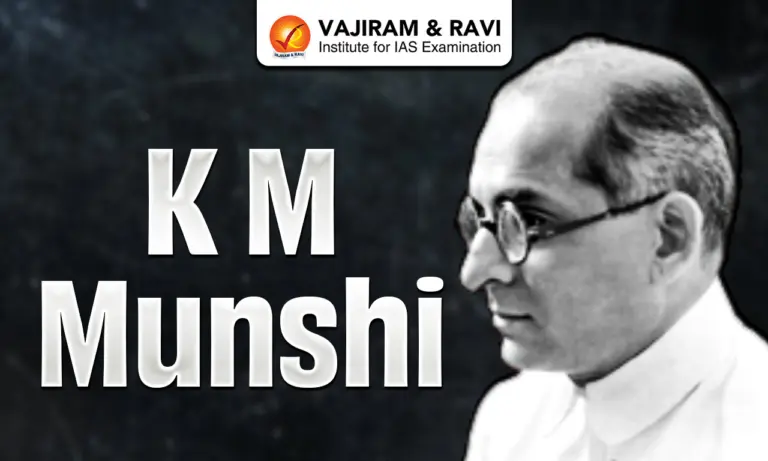
Kanhaiyalal Maneklal Munshi, popularly known as K. M. Munshi, was a freedom fighter, lawyer, constitution maker, educationist, environmentalist and celebrated Gujarati writer. He actively participated in India’s national movement. He was a member of the Constituent Assembly, Union Minister and Governor of Uttar Pradesh. He founded Bharatiya Vidya Bhavan in 1938 and wrote extensively in Gujarati, English and Hindi under the pen name “Ghanshyam Vyas”. Munshi’s contributions combined nationalism, cultural revival, constitutionalism, literature and educational reform, making him one of modern India’s most influential public intellectuals.
K M Munshi Biography
K. M. Munshi’s life reflected intellectual brilliance, nationalist commitment, literary creativity and institution building that shaped modern India significantly.
- Early Life and Birth: Kanhaiyalal Maneklal Munshi was born on 30 December 1887 in Bharuch of present day Gujarat during British rule and belonged to a traditional Gujarati family deeply connected with education and cultural values.
- Education: Munshi joined Baroda College in 1902 and graduated with distinction, receiving the “Ambalal Sakarlal Paritoshik” and later the “Elite Prize” in 1907 for securing highest marks in English.
- Legal Career: After obtaining his law degree in Mumbai in 1910, Munshi enrolled as an advocate in the Bombay High Court and soon gained recognition as a capable lawyer and public intellectual.
- Influences: Sri Aurobindo, Maharaja Sayajirao Gaekwad III, Mahatma Gandhi, Sardar Vallabhbhai Patel and Bhulabhai Desai deeply influenced Munshi’s nationalist ideas, constitutional outlook and cultural philosophy throughout his public life.
- Personality: Munshi worked simultaneously as a politician, novelist, journalist, environmentalist, constitutional expert and educationist, creating a rare combination of literary scholarship and practical political leadership in twentieth century India.
- Death: After decades of service in literature, politics and education, K. M. Munshi passed away in Bombay on 8 February 1971 at the age of 83.
K M Munshi Role in the Constitution
K M Munshi played an active constitutional role by shaping debates on rights, citizenship, cultural protections and democratic governance.
- Constituent Assembly Membership: Munshi was elected to the Constituent Assembly from Bombay on a Congress ticket and became one of the most active members participating in nearly 16 committees and sub committees.
- Role in Drafting Committee: He served on the Drafting Committee headed by Dr. B. R. Ambedkar and contributed significantly to constitutional discussions concerning democratic structure, civil liberties and institutional safeguards.
- Fundamental Rights Contribution: Munshi strongly advocated inclusion of progressive Fundamental Rights and supported guarantees related to freedom of speech, equality before law, religious freedom and cultural protections within constitutional provisions.
- Minority and Citizenship Debates: During debates on citizenship and minority rights, Munshi argued for national unity while ensuring constitutional safeguards that balanced cultural diversity with the larger interests of independent India.
- Cultural and Heritage Vision: Munshi emphasized constitutional protection for India’s civilizational heritage, historical monuments and cultural traditions, reflecting his belief that democracy should remain rooted in Indian cultural identity.
- National Flag Committee: In August 1947, Munshi served on the Ad Hoc Flag Committee that finalized the design of India’s national flag during the crucial phase of independence and constitution making.


K M Munshi Role in Pre Independence Era
K M Munshi actively participated in India’s freedom movement through revolutionary activism, Congress politics, satyagraha campaigns and legislative leadership.
- Revolutionary Activities: Influenced by Sri Aurobindo during his college years, Munshi initially leaned towards revolutionary nationalism and even became associated with activities related to bomb making against colonial rule.
- Home Rule Movement Participation: After shifting to Bombay, Munshi joined the Indian Home Rule Movement and became its secretary in 1915, supporting constitutional reforms and greater Indian political autonomy.
- Bombay Presidency Association: In 1917, he became secretary of the Bombay Presidency Association, expanding his influence within nationalist politics and strengthening Congress led political mobilization in western India.
- Congress Session and Bardoli Satyagraha: Munshi attended the 1920 Ahmedabad Congress session where Surendranath Banerjee influenced him deeply and later resigned from the Bombay Legislative Assembly after Bardoli Satyagraha on Gandhi’s advice.
- Civil Disobedience and Imprisonment: Munshi participated in the Civil Disobedience Movement in 1930 and was imprisoned for six months, while his participation in the second phase led to another two year imprisonment in 1932.
- Congress Parliamentary Leadership: He became secretary of the Congress Parliamentary Board in 1934 and emerged as a prominent Congress organizer involved in legislative strategy and nationalist political coordination across provinces.
- Home Minister of Bombay Presidency: After re-election in 1937, Munshi became Home Minister of Bombay Presidency and effectively controlled communal riots in Bombay through administrative measures and strict law enforcement.
- Individual Satyagraha and Akhand Hindustan: Arrested again during Individual Satyagraha in 1940, Munshi later opposed the Pakistan demand and strongly advocated the idea of “Akhand Hindustan” based on Hindu-Muslim unity.
K M Munshi Literary Works
K M Munshi enriched Gujarati literature through historical novels, essays, journalism and cultural writings based on Indian civilization and heritage.
- Literary Identity: Munshi wrote under the pen name “Ghanshyam Vyas” and became one of the most respected literary figures in Gujarati literature during the twentieth century.
- Historical Novel Tradition: His famous Patan Trilogy consisting of “Patan-ni-Prabhuta”, “Gujarat-no-Nath” and “Rajadhiraj” revived interest in medieval Gujarat through themes of heroism, patriotism and cultural pride.
- Famous Literary Works: Munshi authored major works including “Prithivivallabh”, “Jay Somnath”, “Tapasvini”, “Bhagavan Parashurama” and the eight volume “Krishnavatara”, combining mythology, history and philosophical themes effectively.
- Multilingual Writing: He wrote extensively in Gujarati, Hindi and English and produced influential books such as “Imperial Gujaras”, “Bhagavad Gita and Modern Life” and “Creative Art of Life”.
- Journalism and Editorial Work: Munshi founded the Gujarati journal “Bhargava”, co-edited “Young India” and established “Bhavan’s Journal” in 1954, which continues publication through Bharatiya Vidya Bhavan even today.
- Literary Organizations Leadership: He served as president of both Gujarati Sahitya Parishad and Hindi Sahitya Sammelan, promoting regional languages, literary development and cultural integration across India.
K M Munshi Contributions and Social Reforms
Beyond politics and literature, K. M. Munshi contributed immensely to education, environmental protection, cultural revival and institutional development in India.
- Bharatiya Vidya Bhavan Foundation: Munshi founded Bharatiya Vidya Bhavan in Bombay on 7 November 1938 along with Lilavati Munshi and Harshidbhai Divatia to combine modern education with Indian cultural traditions.
- Educational Institution Building: He helped establish Bhavan’s College, Rajhans Vidyalaya, Rajhans Balvatika, Panchgani Hindu School and Mumbadevi Sanskrit Mahavidyalaya for promoting value based and traditional education.
- Promotion of Sanskrit and Regional Languages: As Fellow of Bombay University, Munshi worked to ensure proper representation of Indian languages and promoted Sanskrit education alongside scientific and technical learning.
- Hyderabad and Junagadh Integration: After independence, Munshi served as Agent General in Hyderabad until its accession in 1948 and also assisted Sardar Patel and N. V. Gadgil in stabilizing Junagadh.
- Somnath Temple Reconstruction: Munshi became the principal advocate of rebuilding the Somnath Temple after independence and continued the reconstruction effort even when Prime Minister Jawaharlal Nehru expressed reservations about the project.
- Van Mahotsav Initiative: As Union Minister of Food and Agriculture during 1950-52, Munshi launched “Van Mahotsav”, a nationwide tree plantation festival conducted every July to increase India’s forest cover.
- Governor and Administrative Roles: Munshi served as Governor of Uttar Pradesh from 1952 to 1957 and also chaired institutions such as the Indian Law Institute and Institute of Agriculture, Anand.
- Swatantra Party and Political Ideology: In 1959, Munshi joined Chakravarti Rajagopalachari in founding the Swatantra Party, which supported free markets, private property rights, limited state control and strong democratic opposition.
- Vishva Hindu Parishad Formation: Munshi chaired the Sandipini Ashram meeting in August 1964 that led to the establishment of the Vishva Hindu Parishad, reflecting his commitment to cultural nationalism and Hindu civilizational unity.

 Last updated on Oct, 2026
→ UPSC 2027 Notification will be released on 13 January 2027 at upsconline.nic.in.
→ Asian Games 2026 are being held in Aichi-Nagoya, Japan, from 19 September to 4 October.
→ Check Nobel Prize 2026 Winners List here.
→ Download PIB PRiSM Monthly Magazine 2026 here.
→ Check UPSC Monthly Current Affairs Magazine The Recitals here.
→ Check out the latest UPSC Syllabus here.
→ Download UPSC Model Answers for Mains 2026
→ UPSC Mains Question Paper 2026 is out now for Essay & GS Paper 1, 2, 3 & 4.
→ UPSC Calendar 2027 has been released.
→ Enroll in Vajiram & Ravi’s UPSC Mains Test Series 2027 for structured answer writing practice, expert evaluation, and exam-oriented feedback.
→ Join Vajiram & Ravi’s UPSC Mentorship Program 2027 for personalized guidance, strategy planning, and one-to-one support from experienced mentors.
→ Go through the UPSC Mains Previous Year Papers to enhance your preparation.
→ UPSC has released UPSC Toppers List 2025 with the Civil Services final result on its official website.
→ Also check Best UPSC Coaching in India
K M Munshi FAQs
Q1. Who was K. M. Munshi?+
Q2. What is K. M. Munshi famous for?+
Q3. What role did K. M. Munshi play in the freedom struggle?+
Q4. What was K. M. Munshi’s contribution to environmental protection?+
Q5. Which political party was founded by K. M. Munshi after independence?+
Tags: geography geography notes k m munshi