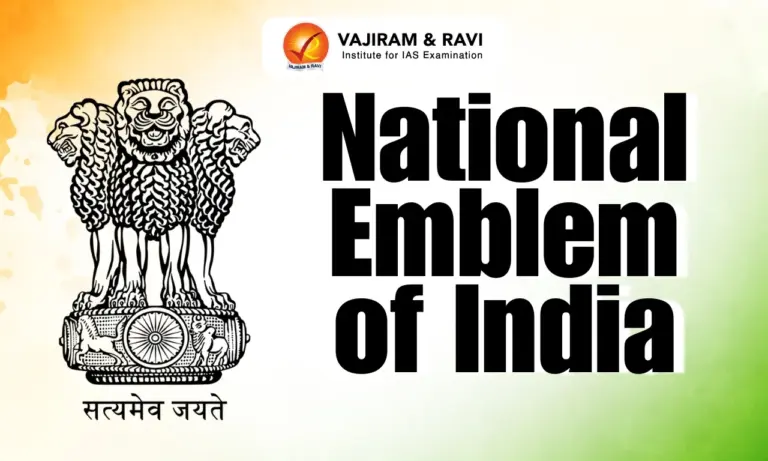
An emblem is a symbolic mark that identifies a nation, institution, or authority. The National Emblem of India represents India’s sovereignty, authority, heritage and constitutional values. It is adapted from the Lion Capital of Ashoka at Sarnath and was adopted on 26 January 1950. Its design combines lions, the Dharma Chakra, animals and the motto Satyameva Jayate.
What is National Emblem of India?
The National Emblem of India is the official State Emblem of the Republic of India and serves as an important symbol of governmental authority. It is based on the 3rd century BCE Lion Capital of Ashoka at Sarnath. The adopted design shows three visible lions, a Dharma Chakra, a bull and a galloping horse, with Satyameva Jayate written below.
National Emblem of India History
The history and origin of the National Emblem of India has been discussed below:
- Mauryan Origin: Emperor Ashoka erected pillars across the Mauryan Empire during the 3rd century BCE, carrying inscriptions and animal capitals associated with Buddhist teachings.
- Sarnath Lion Capital: The original capital has four Asiatic lions standing back to back on a circular abacus, which rests on a bell shaped lotus.
- Design: The abacus carries high relief figures of an elephant, galloping horse, bull and lion, separated by Dharma Chakras representing the four directions.
- Stone Craftsmanship: Mauryan pillars were rock cut structures. The capitals were carved from stone, including material associated with Chunar and Mathura, demonstrating advanced craftsmanship.


National Emblem of India Adoption
The National Emblem of India was formally adopted by the Government of India on 26 January 1950, when India became a republic. The adaptation retained the essential Sarnath symbolism while simplifying its visual representation.
- First Usage: After independence on 15 August 1947, the Dominion of India adopted a temporary official state emblem on 30 December 1947 based on the Sarnath Lion Capital.
- Official Adoption: The emblem was officially adopted on 26 January 1950 with some modifications, coinciding with the commencement of the Constitution and India becoming a Republic.
- Constitution Artwork: Nandalal Bose led the artistic work for the original Constitution manuscript. Dinanath Bhargava studied lions at Kolkata Zoo to depict them realistically.
- Design Modification: The bell shaped lotus of the original Sarnath capital was omitted from the official two dimensional representation adopted by India.
- National Motto: Satyameva Jayate was placed below the Lion Capital in Devanagari script as an integral part of the State Emblem.
- Constitutional Representation: The Lion Capital was incorporated into the original Constitution artwork, with the fourth lion omitted from the two dimensional depiction.
National Emblem of India Features
The National Emblem of India combines Mauryan heritage with symbols associated with Dharma, authority, courage and truth. Its official design differs from the complete original Sarnath sculpture.

- Four Lions: The original capital contains four back to back lions representing power, courage, confidence and pride. Three lions are visible in the official emblem.
- Dharma Chakra: The wheel at the centre of the abacus represents the Dharma Chakra or Wheel of Law and forms a major element of the design.
- Horse and Bull: The adopted emblem shows a galloping horse on the left and a bull on the right, with outlines of Dharma Chakras at both extremes.
- Animal Symbolism: The elephant, horse, bull and lion in the original sculpture are associated respectively with Buddha’s conception, departure from princely life, Taurus and enlightenment.
- National Motto: “सत्यमेव जयते” (Satyameva Jayate) means “Truth Alone Triumphs”. It comes from the Mundaka Upanishad and is written below the emblem in Devanagari script.
- Official Usage: The emblem appears on government letterheads, official documents, Indian currency, passports and national awards including Bharat Ratna and Padma Awards. Permitted display in Government Buildings includes Rashtrapati Bhawan, Parliament House, Supreme Court, High Courts, Central Secretariat, State Legislatures, Raj Bhawan or Raj Niwas and diplomatic missions.
National Emblem of India Legal Provisions
The use of the National Emblem of India is legally controlled to protect its dignity and prevent unauthorized representation by individuals or organisations.
- 2005 Act: The State Emblem of India (Prohibition of Improper Use) Act 2005 regulates and restricts improper or unauthorized use of the State Emblem.
- 2007 Rules: The State Emblem of India (Regulation of Use) Rules 2007 prescribe permitted uses and authorities that may officially display the emblem.
- Punishment: Violation of provisions concerning improper use can attract imprisonment of up to two years or a fine of up to Rs 5000.
- Restricted Private Use: Individuals and private organisations cannot use the emblem for official correspondence without proper authority, ensuring that it is not misrepresented as government authority.
- Official Authority: The emblem is used by the Union Government, State Governments, Union Territory administrations and authorised government agencies for specified official purposes.

 Last updated on Oct, 2026
→ UPSC 2027 Notification will be released on 13 January 2027 at upsconline.nic.in.
→ Check Nobel Prize 2026 Winners List here.
→ Download PIB PRiSM Monthly Magazine 2026 here.
→ Check UPSC Monthly Current Affairs Magazine The Recitals here.
→ Check out the latest UPSC Syllabus here.
→ Download UPSC Model Answers for Mains 2026
→ UPSC Mains Question Paper 2026 is out now for Essay & GS Paper 1, 2, 3 & 4.
→ UPSC Calendar 2027 has been released.
→ Enroll in Vajiram & Ravi’s UPSC Mains Test Series 2027 for structured answer writing practice, expert evaluation, and exam-oriented feedback.
→ Join Vajiram & Ravi’s UPSC Mentorship Program 2027 for personalized guidance, strategy planning, and one-to-one support from experienced mentors.
→ Go through the UPSC Mains Previous Year Papers to enhance your preparation.
→ UPSC has released UPSC Toppers List 2025 with the Civil Services final result on its official website.
→ Also check Best UPSC Coaching in India
National Emblem of India FAQs
Q1. What is the National Emblem of India?+
Q2. When was the National Emblem of India adopted?+
Q3. What is the motto of the National Emblem of India?+
Q4. How many lions are visible in the National Emblem of India?+
Q5. Which law regulates the use of the National Emblem of India?+
Tags: national emblem national emblem of india