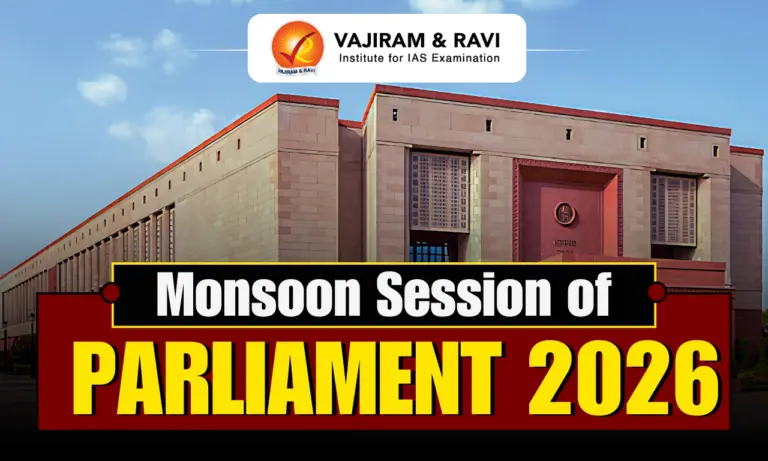
The Monsoon Session of Parliament 2026 is the second regular session of the Indian Parliament held every year after the Budget Session. During this session, the Lok Sabha and Rajya Sabha discuss important national issues, introduce and pass bills, scrutinize government policies, and hold the executive accountable. The 2026 Monsoon Session has gained significant attention due to the introduction of key legislations and debates on major political, economic, and social issues.
Why is the Monsoon Session 2026 in News?
The Monsoon Session of Parliament 2026 commenced on 20 July 2026 and is scheduled to continue until 13 August 2026. The session is expected to witness discussions on several important bills, government policies, and current national issues. The government is also planning to hold a discussion to resolve the issue of Paper Leaks in India, as there is an ongoing protest due to NEET paper leak students at Jantar Mantar, Delhi.
Bills to be Introduced in the Monsoon Session 2026
The government has listed several important bills for introduction, discussion, and passage during the session. Some of the key bills include:
- Micro, Small and Medium Enterprises Development (Amendment) Bill, 2026
- Income Tax (Amendment) Bill 2026 aimed at simplifying and modernizing direct tax laws.
- Registration of Births and Deaths (Amendment) Bill 2026
- Supreme Court (Number of Judges) Amendment Bill 2026
- Prevention of Insults to National Honour (Amendment) Bill, 2026
Also Read:- Section 163 of Bharatiya Nagarik Suraksha Sanhita


Constitutional Provisions Related to Parliamentary Sessions
The Constitution of India provides the legal framework for convening, conducting, and regulating the sessions of Parliament, ensuring the smooth functioning of the country’s legislative process.
- Article 79: Establishes the Parliament of India, consisting of the President, Lok Sabha (House of the People), and Rajya Sabha (Council of States).
- Article 85: Empowers the President to summon each House of Parliament, prorogue either House or both Houses, and dissolve the Lok Sabha on the advice of the Council of Ministers.
- Maximum Gap Between Sessions: The Constitution mandates that not more than six months shall elapse between the last sitting of one session and the first sitting of the next session.
- Article 86: Grants the President the right to address either House or both Houses of Parliament and send messages regarding pending legislative matters.
- Article 87: Requires the President to address both Houses assembled together at the beginning of the first session after every General Election and the first session of each calendar year, outlining the government’s policies and legislative agenda.
- Article 88: Allows the Attorney General of India to participate in the proceedings of both Houses and Parliamentary Committees without having the right to vote.
- Article 100: Specifies that questions in either House are decided by a majority of members present and voting, with the Presiding Officer exercising a casting vote in the event of a tie.
- Article 107: Lays down the procedure for the introduction, consideration, and passage of ordinary bills in Parliament.
- Article 108: Provides for a Joint Sitting of both Houses to resolve a legislative deadlock on an ordinary bill under specified circumstances.
- Article 111: States that a bill passed by both Houses becomes law only after receiving the President’s assent.
- Article 118: Empowers each House of Parliament to make rules governing its own procedure and conduct of business, subject to constitutional provisions.
- Constitutional Practice: Although the Constitution does not mention the Budget, Monsoon, and Winter Sessions by name, Parliament generally meets in three sessions every year to ensure uninterrupted legislative and oversight functions.
Also Read:- Right to Protest in India
Powers of the President in Summoning Parliament
The President of India plays a key constitutional role in convening and regulating the sessions of Parliament. These powers are exercised on the aid and advice of the Council of Ministers headed by the Prime Minister, as provided under the Constitution.
- Summons Parliament: Under Article 85, the President summons each session of the Lok Sabha and Rajya Sabha.
- Ensures Regular Sessions: Ensures that not more than six months elapse between the last sitting of one session and the first sitting of the next.
- Prorogues Parliament: Has the power to prorogue either House or both Houses after the completion of a session under Article 85.
- Dissolves the Lok Sabha: Can dissolve the Lok Sabha before the expiry of its term on the advice of the Council of Ministers.
- Addresses Parliament: Under Article 87, addresses both Houses assembled together at the beginning of the first session after every General Election and the first session of each year.
- Sends Messages to Parliament: Under Article 86, may send messages to either House or both Houses regarding pending bills or any matter requiring consideration.
- Gives Assent to Bills: Under Article 111, grants assent to bills passed by Parliament, returns certain ordinary bills for reconsideration, or withholds assent where constitutionally permissible.
- Promulgates Ordinances: Under Article 123, may issue an Ordinance when Parliament is not in session if immediate legislative action is necessary. The Ordinance must be approved by Parliament within the prescribed constitutional period.
- Convenes Joint Sitting: Under Article 108, may summon a Joint Sitting of both Houses to resolve a deadlock over an ordinary bill, on the advice of the government.
Monsoon Session 2026 Significance
The Monsoon Session 2026 is an important phase of India’s parliamentary calendar, providing an opportunity to enact legislation, review government policies, and discuss issues of national importance through democratic debate.
- Facilitates Law-Making: Enables Parliament to introduce, debate, amend, and pass important bills.
- Strengthens Executive Accountability: Allows Members of Parliament to question the government through Question Hour, Zero Hour, and parliamentary debates.
- Addresses National Issues: Provides a platform to discuss matters related to the economy, agriculture, internal security, foreign policy, social welfare, and public interest.
- Reviews Government Policies: Examines the implementation and effectiveness of government schemes, programmes, and administrative decisions.
- Represents Public Concerns: Gives elected representatives an opportunity to raise issues affecting their constituencies and seek government action.
- Enhances Parliamentary Oversight: Enables Parliamentary Committees and both Houses to scrutinize legislative proposals and executive functioning.
- Supports Democratic Governance: Encourages debate, consensus-building, and informed decision-making in the legislative process.
- Ensures Legislative Continuity: Maintains the momentum of parliamentary business between the Budget Session and the Winter Session.

 Last updated on Oct, 2026
→ UPSC 2027 Notification will be released on 13 January 2027 at upsconline.nic.in.
→ Asian Games 2026 are being held in Aichi-Nagoya, Japan, from 19 September to 4 October.
→ Check Nobel Prize 2026 Winners List here.
→ Download PIB PRiSM Monthly Magazine 2026 here.
→ Check UPSC Monthly Current Affairs Magazine The Recitals here.
→ Check out the latest UPSC Syllabus here.
→ Download UPSC Model Answers for Mains 2026
→ UPSC Mains Question Paper 2026 is out now for Essay & GS Paper 1, 2, 3 & 4.
→ UPSC Calendar 2027 has been released.
→ Enroll in Vajiram & Ravi’s UPSC Mains Test Series 2027 for structured answer writing practice, expert evaluation, and exam-oriented feedback.
→ Join Vajiram & Ravi’s UPSC Mentorship Program 2027 for personalized guidance, strategy planning, and one-to-one support from experienced mentors.
→ Go through the UPSC Mains Previous Year Papers to enhance your preparation.
→ UPSC has released UPSC Toppers List 2025 with the Civil Services final result on its official website.
→ Also check Best UPSC Coaching in India
Monsoon Session of Parliament 2026 FAQs
Q1. What is the Monsoon Session of Parliament?+
Q2. When will the Monsoon Session of Parliament 2026 be held?+
Q3. Why is the Monsoon Session 2026 important?+
Q4. Which Article of the Constitution deals with summoning Parliament?+
Tags: monsoon session of parliament 2026 parliament sessions of parliament