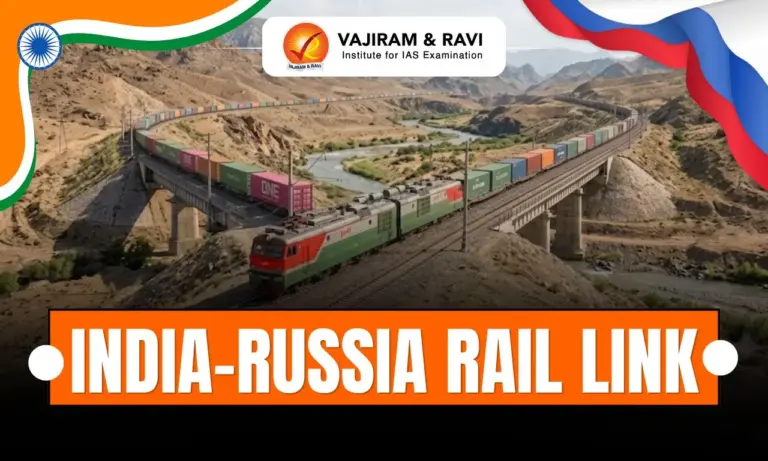
The India-Russia Rail Link is a proposed overland connectivity initiative being explored by Russia to reach the Indian Ocean and India. The proposal aims to create alternative trade connectivity and reduce exposure to maritime chokepoints. It remains a proposal, with no confirmed direct passenger train, launch date or ticketing system.
India-Russia Rail Link Latest News
Russia is examining a possible India-Russia Rail Link towards the Indian Ocean amid concerns over risks affecting the Bosphorus and Strait of Hormuz. Russian Deputy Prime Minister Marat Khusnullin suggested examining routes through Turkmenistan, Iran, Afghanistan and Pakistan. On August 7, India and Russia also reviewed railway cooperation, including infrastructure, Vande Bharat and signalling equipment, during their 12th Session of the India-Russia Working Group on Modernization and Industrial Cooperation in New Delhi.
India-Russia Rail Link Features
The proposed India-Russia Rail Link is primarily linked with freight, strategic connectivity and alternative trade routes rather than confirmed passenger services.
- Proposed Route: Russia is considering routes through Turkmenistan, Iran, Afghanistan and Pakistan to establish access towards India and the Indian Ocean.
- Russian proposal: Russian Deputy Prime Minister Marat Khusnullin stated that any route providing access to India could be considered, indicating flexibility regarding the final alignment.
- Strategic objective: The proposed railway could reduce dependence on maritime routes exposed to risks around the Bosphorus and Strait of Hormuz.
- Freight focus: The proposal is centred on movement of goods and logistics. No official announcement has confirmed passenger trains, direct tickets or tourism services.
- Existing Russian network: Russia’s Federal Passenger Company operates 40 international long distance routes connecting Russia with 19 countries across Europe and Asia.
- Railway cooperation: India and Russia discussed railway infrastructure, the Vande Bharat train project and signalling equipment during their August 7 modernization and industrial cooperation meeting.
- Multimodal possibility: Existing India-Russia connectivity can involve combinations of rail, road and sea transport. A fully continuous railway between both countries is not currently operational.
- Regional connectivity: The proposed route could involve Central Asian and West Asian states, making connectivity with Russia, India and the Indian Ocean region more geographically integrated.


India-Russia Rail Link Significance
The proposal of India-Russia Rail Link has strategic importance because it seeks to expand land based connectivity between Russia and India while reducing dependence on vulnerable maritime chokepoints.
- Trade diversification: A land route could provide Russia and India with another pathway for cargo movement and reduce excessive dependence on traditional maritime trade routes.
- Chokepoint risks: The Strait of Hormuz handles roughly 25% of global oil trade and around 20% of global LNG shipments, making route diversification strategically important.
- India-Russia connectivity: A direct overland framework could strengthen commercial connectivity between India and Russia while also linking important Central and South Asian regions.
- Regional integration: Connectivity through Turkmenistan, Iran, Afghanistan and Pakistan could create wider economic linkages across Central Asia, West Asia and South Asia.
- Railway cooperation: India-Russia discussions on railway infrastructure, Vande Bharat and signalling show that railways remain an active area of bilateral modernization cooperation.
- Supply chain resilience: Additional land connectivity could provide another logistics option during disruptions affecting major maritime routes and strategically important shipping corridors.
India-Russia Rail Link Challenges
The proposed India-Russia Rail Link route faces major geographical, infrastructural, security and coordination challenges because it would cross several countries and require extensive international cooperation.
- Geographical complexity: A route through Turkmenistan, Iran, Afghanistan and Pakistan would cross several national territories and require coordinated infrastructure and border arrangements.
- Security concerns: Afghanistan and parts of the wider region present security challenges that could affect the reliability and continuity of international freight movement.
- Infrastructure gaps: A seamless railway requires compatible rail infrastructure, border facilities, signalling systems and efficient freight handling arrangements across participating countries.
- Multiple borders: International rail freight would require coordinated customs, documentation, tariffs and transit procedures across several jurisdictions.
- Political coordination: The proposed alignment would depend on sustained cooperation among Russia, India and transit countries, making geopolitical stability essential.
- Passenger limitations: Passenger connectivity would require visas, integrated schedules, passenger facilities and security arrangements that have not yet been established for this proposal.
How is India-Russia Rail Link Different from INSTC?
The major difference between India-Russia Rail Link and International North-South Transport Corridor (INSTC) has been highlighted below:
- Mode: India-Russia Rail Link is a proposed railway oriented connection towards India, while INSTC is an established multimodal framework using rail, road and sea routes.
- Route concept: The proposed rail link may cross Turkmenistan, Iran, Afghanistan and Pakistan, whereas INSTC has multiple corridors through Iran, Azerbaijan and Central Asia.

 Last updated on Oct, 2026
→ UPSC 2027 Notification will be released on 13 January 2027 at upsconline.nic.in.
→ Asian Games 2026 are being held in Aichi-Nagoya, Japan, from 19 September to 4 October.
→ Check Nobel Prize 2026 Winners List here.
→ Download PIB PRiSM Monthly Magazine 2026 here.
→ Check UPSC Monthly Current Affairs Magazine The Recitals here.
→ Check out the latest UPSC Syllabus here.
→ Download UPSC Model Answers for Mains 2026
→ UPSC Mains Question Paper 2026 is out now for Essay & GS Paper 1, 2, 3 & 4.
→ UPSC Calendar 2027 has been released.
→ Enroll in Vajiram & Ravi’s UPSC Mains Test Series 2027 for structured answer writing practice, expert evaluation, and exam-oriented feedback.
→ Join Vajiram & Ravi’s UPSC Mentorship Program 2027 for personalized guidance, strategy planning, and one-to-one support from experienced mentors.
→ Go through the UPSC Mains Previous Year Papers to enhance your preparation.
→ UPSC has released UPSC Toppers List 2025 with the Civil Services final result on its official website.
→ Also check Best UPSC Coaching in India
India-Russia Rail Link FAQs
Q1. What is the India-Russia Rail Link?+
Q2. Why is Russia considering a rail link to India?+
Q3. Which countries could the proposed rail link pass through?+
Q4. Is there a direct train from Russia to India?+
Q5. How is the India-Russia Rail Link different from INSTC?+
Q6. Is the India-Russia Rail Link operational?+
Q7. What could the India-Russia Rail Link transport?+
Tags: india-russia india-russia rail link india-russia summit