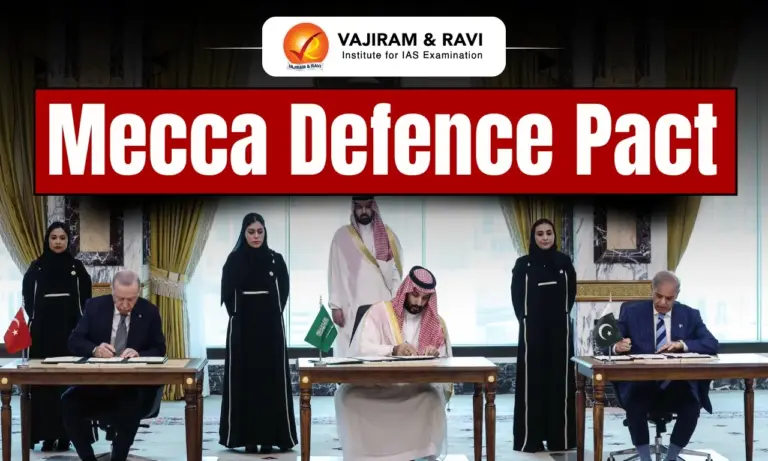
The Mecca Defence Pact, formally the Mecca Joint Defence Agreement, was signed by Saudi Arabia, Türkiye and Pakistan on 7 August 2026 in Mecca. The agreement seeks to strengthen collective deterrence and defence cooperation among the three countries. The agreement has attracted attention because it provides that an armed attack against any one of the three countries would be regarded as an attack against all three.
About the Mecca Defence Pact
The Mecca Defence Pact seeks to institutionalise the existing defence relationships among the three countries within a broader trilateral security framework.
- Saudi Arabia brings financial resources, strategic influence and a key position in the Gulf.
- Pakistan contributes military manpower, operational experience, nuclear capability and longstanding defence ties with Saudi Arabia.
- Türkiye contributes NATO experience and a rapidly expanding indigenous defence industry.
- The pact aims to strengthen collective deterrence and defence cooperation among the three countries.
- The detailed text of the agreement has not been made public, leaving the exact nature of mutual obligations unclear.
- It builds upon the Saudi-Pakistan Strategic Mutual Defence Agreement (SMDA) of September 2025.
Mecca Defence Pact Key Features
While the detailed text of the Mecca Defence Pact has not been made public, its broad objectives and publicly stated provisions indicate the following key features:
- Collective defence: Attack on one member is to be treated as an attack on all.
- Enhanced defence cooperation: Greater cooperation in military affairs and defence capabilities.
- Complementary strengths: Saudi finance, Pakistani military capability and Turkish defence technology create a mutually beneficial strategic triangle.
- Regional security focus: The pact is primarily linked to the changing security environment in West Asia and does not explicitly identify India as an adversary.
- Defence-industrial cooperation: It could facilitate greater cooperation in defence production, technology and military-industrial capacity.


Why was the Mecca Defence Pact Signed?
The Mecca Defence Pact is driven by a combination of regional security concerns, strategic autonomy and the need to strengthen defence capabilities.
- Rising regional tensions: Conflicts involving Iran, Israel, the US and regional armed groups have increased security risks in the Gulf.
- Saudi Arabia’s strategic autonomy: Saudi Arabia wants to reduce overdependence on the US by building partnerships with other major military powers.
- Pakistan’s strategic value: Pakistan provides military manpower, operational experience and defence expertise, while strengthening its ties with Saudi Arabia.
- Türkiye’s regional influence: Türkiye seeks a greater role in West Asian geopolitics, supported by its rapidly expanding indigenous defence industry.
- Strengthening defence industry: Saudi Arabia wants to develop indigenous defence production by accessing Türkiye’s technology and Pakistan’s military expertise.
- Collective deterrence: By promising mutual support, the pact seeks to deter external aggression and increase the strategic costs for any potential adversary.
Is it a ‘NATO of the Muslim World’?
Although the collective-defence clause resembles NATO’s Article 5, the Mecca pact currently lacks the institutional depth of NATO.
- NATO has an integrated military command, permanent institutions, joint planning mechanisms and decades of operational experience.
- The Mecca pact does not presently have a unified military command or permanently deployed joint force.
- The three countries also have different strategic priorities: Saudi Arabia focuses on Gulf security, Türkiye has wider European and West Asian interests, while Pakistan’s principal security concern remains India.
Thus, its actual deterrence value will depend on how the members respond to a real security crisis, rather than merely on the wording of the agreement.
Implications for India
While the Mecca Defence Pact does not immediately alter India’s military balance, its institutionalisation could influence India’s strategic interests in South Asia and West Asia.
- Pakistan gains strategic space: Institutionalised defence ties with Saudi Arabia and Türkiye could increase Pakistan’s diplomatic leverage and access to financial resources and defence technology.
- India–Saudi ties may face pressure: Saudi Arabia has built strong energy, trade, investment and strategic ties with India. Greater security dependence on Pakistan could complicate this growing partnership.
- India’s regional influence: A closer Pakistan–Saudi–Türkiye grouping could influence the emerging West Asian security architecture, where India seeks a greater strategic role.
- Gulf and Red Sea security: India depends on these regions for energy supplies, trade and maritime connectivity. Any instability arising from stronger regional rivalries could directly affect Indian interests.
- Limited impact on India-Pakistan conflict: The pact does not name India as an adversary, and its detailed obligations are not public. Hence, it does not automatically mean Saudi or Turkish military intervention against India in a future conflict.
Way Forward
India should respond through strategic balancing rather than treating the pact as an immediate threat, while protecting its interests in the Gulf and wider Indian Ocean region.
India should deepen its strategic partnership with Saudi Arabia in energy, trade, investment and defence, strengthen engagement with other Gulf partners, and safeguard energy security, maritime connectivity and the interests of the Indian diaspora. At the same time, New Delhi should closely monitor Pakistan–Türkiye defence cooperation and maintain strategic autonomy and calibrated diplomacy, especially since the pact does not explicitly target India.

 Last updated on Oct, 2026
→ UPSC 2027 Notification will be released on 13 January 2027 at upsconline.nic.in.
→ Check Nobel Prize 2026 Winners List here.
→ Download PIB PRiSM Monthly Magazine 2026 here.
→ Check UPSC Monthly Current Affairs Magazine The Recitals here.
→ Check out the latest UPSC Syllabus here.
→ Download UPSC Model Answers for Mains 2026
→ UPSC Mains Question Paper 2026 is out now for Essay & GS Paper 1, 2, 3 & 4.
→ UPSC Calendar 2027 has been released.
→ Enroll in Vajiram & Ravi’s UPSC Mains Test Series 2027 for structured answer writing practice, expert evaluation, and exam-oriented feedback.
→ Join Vajiram & Ravi’s UPSC Mentorship Program 2027 for personalized guidance, strategy planning, and one-to-one support from experienced mentors.
→ Go through the UPSC Mains Previous Year Papers to enhance your preparation.
→ UPSC has released UPSC Toppers List 2025 with the Civil Services final result on its official website.
→ Also check Best UPSC Coaching in India
Mecca Defence Pact FAQs
Q1. What is the Mecca Joint Defence Agreement?+
Q2. What is the key provision of the Mecca Defence Pact?+
Q3. Is the Mecca Defence Pact a NATO-like alliance?+
Q4. Is the Mecca Defence Pact directed against India?+
Q5. How does the Mecca Defence Pact affect Pakistan?+
Q6. What are the implications of the Mecca Defence Pact on India?+
Q7. What should India do in response to the Mecca Defence Pact?+
Tags: mecca defence pact