Bharat Ratna is India’s highest civilian honour, instituted in 1954 to recognize exceptional service or performance of the highest order. The term “Bharat Ratna” means “Jewel of India.” It is awarded to individuals who have made extraordinary contributions in any field of human endeavour. The award is not given every year and since its establishment, several years have passed without any Bharat Ratna announcement. It remains the most prestigious civilian recognition conferred by the Republic of India.
What is Bharat Ratna?
Bharat Ratna is the highest civilian award presented by the President of India to individuals for outstanding contributions to the nation and humanity. It originally recognized achievements in arts, literature, science and public services. In 2011, the eligibility was broadened to include any field of human endeavour. The award carries immense national prestige but does not include any monetary grant. Recipients receive a Medallion and a Sanad signed by the President of India.
Bharat Ratna History
The Bharat Ratna has several unique characteristics that distinguish it from all other civilian honours in India which has evolved throughout years.
- Origin: The award was instituted by President Dr. Rajendra Prasad on 2 January 1954, creating a formal mechanism to recognize exceptional national service and achievement.
- How Many Get the Bharat Ratna Awards: Normally, a maximum of three Bharat Ratna awards can be conferred in a year. However, exceptions occurred in 1999 when four individuals were honoured and in 2024 when five recipients were announced.
- First Bharat Ratna Awardees: The inaugural recipients in 1954 were Dr. Sarvepalli Radhakrishnan, Sir C.V. Raman and Chakravarti Rajagopalachari, representing excellence in scholarship, science and public life.
- Award Suspension Periods: Bharat Ratna was temporarily suspended between 1977 and 1980 and again between 1992 and 1995 due to political changes and legal challenges.
- No Mandatory Annual Conferment: The government is not required to announce Bharat Ratna every year. The last two awards were announced in 2019 and 2024.
- Restriction on Titles: Under Article 18(1) of the Constitution, recipients cannot use “Bharat Ratna” as a prefix or suffix to their names. However, they may mention the honour in official biographies and documents.
- Notable Controversy: In 1992, Bharat Ratna was announced for Subhash Chandra Bose posthumously. However, due to the absence of conclusive evidence regarding his death, the award was later withdrawn after objections from his family and legal challenges.
- Contributions Across Fields: Bharat Ratna awardees have included freedom fighters, social reformers, musicians, economists, scientists, engineers, filmmakers, educators, political leaders and sports personalities.


Famous Bharat Ratna Awardees & Nominees
The list of the Famous Bharat Ratna Awardees include:
- Youngest Recipient: Sachin Tendulkar became the youngest Bharat Ratna awardee and the first sportsperson to receive the honour in 2014. He is also the only cricketer among the recipients.
- Oldest Recipient: The Oldest Recipient of Bharat Ratna Award is Dhondo Keshav Karve, who was honoured in 1958 at the age of 100. A renowned social reformer and educator, Karve played a crucial role in women’s education and widow remarriage in India during the early 20th century. His lifetime of service to society earned him this prestigious recognition at a remarkably advanced age.
- Distinguished Awardees: Recipients include leaders such as Jawaharlal Nehru, Indira Gandhi, Rajiv Gandhi, Vallabhbhai Patel, Atal Bihari Vajpayee, Pranab Mukherjee and scientists like A.P.J. Abdul Kalam and C.N.R. Rao.
List of Bharat Ratna Award Winners Year Wise 1954 to 2026
The Bharat Ratna, India’s highest civilian honour, has a rich history associated with its recipients and nominations. For instance, in 1992, the Government of India decided to present the award posthumously to Netaji Subhas Chandra Bose. However, his family and supporters opposed it, questioning the circumstances surrounding his death. Similarly, the legendary hockey player Major Dhyan Chand’s name has frequently surfaced for this honour, yet he has not been awarded to date.
No Bharat Ratna awards were presented in 2021 or 2022. Below is a List of Bharat Ratna Award Winners Year Wise from 1954 to 2026.
| List of Bharat Ratna Award Winners Year Wise 1954 to 2026 | ||
| Recipients (State/UT) | Year | Key Notes |
|
C. Rajagopalachari/ Rajaji (Tamil Nadu) |
1954 |
He was the last Governor General of India and also founder of the Swatantra Party. He was the conscience keeper of MK Gandhi. |
|
(Tamil Nadu) |
1954 |
He was the first Vice President of India and the country’s second President. |
|
(Tamil Nadu) |
1954 |
He became the first Asian scientist to receive a Nobel Prize in any branch of science, also famous for his discoveries in physics like Raman Scattering. |
|
Bhagwan Das (Uttar Pradesh) |
1955 |
He co-founded the Mahatma Gandhi Kashi Vidyapith, also contributed to the foundation of Banaras Hindu University. |
|
(Karnataka) |
1955 |
He was a civil engineer who contributed much to the country’s dam development. |
|
(Uttar Pradesh) |
1955 |
Jawaharlal Nehru became the first and longest tenure Prime Minister (PM) of India, He was PM at the time of receiving this award. |
|
Govind Ballabh Pant (Uttarakhand) |
1957 |
He was elected to be the first chief minister of the state of Uttar Pradesh who was a huge supporter of making Hindi a national language. |
|
Dhondo Keshav Karve (Maharashtra) |
1958 |
Dhondo Keshav Karve was a great social reformer and was famous for women’s education, and widow remarriage also founded the Widow Marriage Association. |
|
Bidhan Chandra Roy (West Bengal) |
1961 |
Bidhan Chandra Roy is recognized as the Maker of Modern West Bengal. |
|
Purushottam Das Tandon (Uttar Pradesh) |
1961 |
Purushottam Das Tandon was titled Rajarshi. He became the speaker in Uttar Pradesh Legislative Assembly. He supported the Hindi language making it the official language. |
|
(Bihar) |
1962 |
Rajendra Prasad swore as the first President of India. He was actively involved in the non-cooperation movement with Mahatma Gandhi Ji. |
|
Zakir Husain (Andhra Pradesh) |
1963 |
Zakir Husain was elected to be the second Vice President and third President of India. He became the Vice Chancellor of Aligarh Muslim University. |
|
Pandurang Vaman Kane (Maharashtra) |
1963 |
He was a great Indologist and Sanskrit scholar who was well known for his works like ‘History of Dharmasastra: Ancient and Mediaeval Religious and Civil Laws in India’. |
|
(Uttar Pradesh) * |
1966 |
Lal Bahadur Shastri became the first posthumous recipient of the Bharat Ratna Award, He was elected to be the second PM of India. He is popular in the country for his slogan ‘Jai Jawan Jai Kisan’. |
|
(Uttar Pradesh) |
1971 |
Indira Gandhi was the first female recipient of the Bharat Ratna Award, She was PM during the Indo-Pak War of 1971. |
|
V. V. Giri (Odisha) |
1975 |
V. V. Giri, 4th President of India, was a trade union leader and freedom fighter championing workers’ rights and democracy. |
|
K. Kamaraj (Tamil Nadu) * |
1976 |
K. Kamaraj, “Kingmaker,” played a pivotal role in Indian politics by supporting Lal Bahadur Shastri and Indira Gandhi as Prime Ministers. |
|
(West Bengal, born in North Macedonia) |
1980 |
Mother Teresa, a Bharat Ratna recipient and Nobel Laureate, founded the Missionaries of Charity, dedicating her life to humanitarian service. |
|
(Maharashtra) * |
1983 |
Vinoba Bhave, a Gandhian, is renowned for the Bhoodan Movement and received the Ramon Magsaysay Award for his humanitarian efforts. |
|
(Pakistan) |
1987 |
Khan Abdul Ghaffar Khan, “Frontier Gandhi,” founded the Red Shirt Movement and was the first non-citizen Bharat Ratna recipient. |
|
M. G. Ramachandran (Tamil Nadu) * |
1988 |
M. G. Ramachandran, the first actor to receive Bharat Ratna, founded AIADMK and became the first actor-turned-Chief Minister. |
|
(Maharashtra) |
1990 |
B.R. Ambedkar, chief architect of the Indian Constitution and first Law Minister, strongly opposed the caste system in Hinduism. |
|
(South Africa) |
1990 |
Nelson Mandela, known as the “Gandhi of South Africa,” was the second non-citizen Bharat Ratna recipient and Nobel laureate. |
|
Rajiv Gandhi (Uttar Pradesh) |
1991 |
Rajiv Gandhi, India’s youngest PM at 40, passed landmark laws like the Anti-defection Law during his tenure from 1984. |
|
(Gujarat) |
1991 |
Vallabhbhai Patel, the “Iron Man of India,” served as Deputy Prime Minister and led the Bardoli Satyagraha and All India Services. |
|
Morarji Desai (Gujarat) |
1991 |
Morarji Desai, India’s first non-Congress PM and oldest PM, is the only Indian awarded Pakistan’s Nishan-e-Pakistan honour. |
|
(West Bengal) |
1992 |
Maulana Abul Kalam Azad, India’s first Education Minister, is honoured on his birth anniversary (11th November) as National Education Day. He declined the Bharat Ratna Award throughout his life. |
|
J. R. D. Tata (Maharashtra) |
1992 |
J. R. D. Tata, an industrialist and aviation pioneer, founded Air India and established institutes like TIFR, TCS, and Tata Motors. |
|
Satyajit Ray (West Bengal) |
1992 |
Satyajit Ray, renowned for bringing Indian cinema global recognition, directed Pather Panchali and received the Dadasaheb Phalke Award. |
|
Gulzarilal Nanda (Punjab) |
1997 |
Gulzarilal Nanda served twice as interim PM and deputy chairman of the Planning Commission, advocating labor issues nationally. |
|
(West Bengal) |
1997 |
Aruna Asaf Ali, the first post-independence Mayor of Delhi, played a key role in the Quit India Movement of 1942. |
|
(Tamil Nadu) |
1997 |
A.P.J. Abdul Kalam, the “Missile Man of India,” advanced missile technology, served as 11th President, and authored notable works. |
|
(Tamil Nadu) |
1998 |
M. S. Subbulakshmi, the Queen of Songs, was India’s first musician awarded the Ramon Magsaysay for her charity work. |
|
Chidambaram Subramaniam (Tamil Nadu) |
1998 |
Chidambaram Subramaniam contributed to the Green Revolution in India and the International Rice Research Institute of Manila, Philippines. |
|
(Bihar) |
1999 |
Jayaprakash Narayan, known as Loknayak, led the Total Revolution Movement against the Congress government, advocating for political and social reforms. |
|
(West Bengal) |
1999 |
Amartya Sen, Nobel Laureate in Economics, contributed to welfare economics, social justice, and social choice theory, influencing global policies. |
|
Gopinath Bordoloi (Assam) |
1999 |
Gopinath Bordoloi, Assam’s first chief minister, is honored as Lokapriya for his dedication to Assam’s development and progress. |
|
(Uttar Pradesh) |
1999 |
Ravi Shankar, the world’s leading Hindustani classical musician, is renowned for his mastery and received a Grammy Award for his work. |
|
(Maharashtra) |
2001 |
Lata Mangeshkar, the Nightingale of India, honoured with the Dadasaheb Phalke Award, is celebrated as the Queen of Melody. |
|
Bismillah Khan (Uttar Pradesh) |
2001 |
Bismillah Khan, a renowned shehnai virtuoso, popularised the instrument in Indian music and became the third classical musician honoured with Bharat Ratna. |
|
Bhimsen Joshi (Karnataka) |
2009 |
Bhimsen Joshi, a renowned Hindustani classical singer from Kirana Gharana, was celebrated for his mastery in the Khyal genre. |
|
(Karnataka) |
2014 |
C. N. R. Rao, an eminent chemist, contributed to solid-state chemistry and received numerous prestigious awards, including the Marlow Medal. |
|
Sachin Tendulkar (Maharashtra) |
2014 |
Sachin Tendulkar is known as the Master Blaster in cricket history. He is the only batsman to score more than 30,000 runs in entire forms of international cricket matches. |
|
(Uttar Pradesh) |
2015 |
Madan Mohan Malaviya was the founder of the Banaras Hindu University and Akhil Bharatiya Hindu Mahasabha. |
|
(Madhya Pradesh) |
2015 |
Atal Bihari Vajpayee, a three-time PM and 1994 Best Parliamentarian, was also a renowned poet and statesman. |
|
Pranab Mukherjee (West Bengal) |
2019 |
Pranab Mukherjee, the 13th President of India and former Lok Sabha leader, passed away in 2020 due to COVID-19. |
|
Nanaji Deshmukh (Maharashtra) |
2019 |
Nanaji Deshmukh, also known as Chandikadas Deshmukh, contributed to education, rural development, health, and led Bharatiya Jana Sangh. |
|
Bhupen Hazarika (Assam) |
2019 |
Bhupen Hazarika, known as Sudhakantha, was an influential filmmaker, poet, lyricist, playback singer, and musician in India. |
|
(Bihar)* |
2024 |
Karpoori Thakur, Bihar’s former CM and Jan Nayak, passed away on 17th February 1988; award recognized 35 years later. |
|
Lal Krishna Advani |
2024 |
He served as Home Minister and later Deputy Prime Minister in Atal Bihari Vajpayee’s cabinet from 1999 to 2004. |
|
(Thiruvananthapuram) |
2024 |
Conferred with the Bharat Ratna – the country’s highest civilian honour. |
|
Chaudhary Charan Singh (Uttar Pradesh)* |
2024 |
He dedicated his life to farmers’ welfare, opposed the Emergency, and inspired through his unwavering commitment to farmers. |
|
PV Narasimha Rao (Andhra Pradesh) |
2024 |
Narasimha Rao led major economic reforms in the 1990s, transforming India’s economy while heading a Congress government at Centre. |
Note: Posthumous recipients have been marked by an asterisk (*)
First Bharat Ratna Award Winners
The Bharat Ratna, India’s highest civilian honour, was first awarded in 1954. Among the inaugural recipients were C. Rajagopalachari, C.V. Raman, and Dr. Sarvepalli Radhakrishnan, all from Tamil Nadu.
- Rajagopalachari, a multifaceted leader, was a prominent activist, statesman, and lawyer.
- Dr. Radhakrishnan, renowned for his contributions to education, served as India’s first Vice-President and later became its second President.
- C.V. Raman, a distinguished physicist and mathematician, is celebrated for his groundbreaking work in the field of physics, particularly for the discovery of Raman Scattering. His remarkable achievements led him to become the first Asian scientist to win a Nobel Prize in a scientific field.
Who was the First Bharat Ratna Award Winner Woman?
Former Prime Minister of India Indira Gandhi was the first Indian Woman to get Bharat Ratna Award in the year 1971. She was awardedin the honor for the contribution in leadership roles of India especially the 1971 Indo-Pakistani War and the liberation of Bangladesh. She was presented the award while serving the office as the Prime Minister of India by President V. V. Giri, which makes her count among the few Prime Ministers Who Got Awarded Bharat Ratna while being in Office.
Which Indian President Got Bharat Ratna?
Between 1954 and 2026, several Indian Presidents have been honoured with the Bharat Ratna Award. Out of the 48 individuals who have received this esteemed recognition, six of them have served as Presidents of India. Below is a table listing the names of these Presidents and the years they were awarded the Bharat Ratna.
| List of President of India Who Got Bharat Ratna | |
|
Presidents of India |
Year of Award |
|
Sarvapalli Radhakrishnan |
1954 |
|
Rajendra Prasad |
1962 |
|
Zakir Hussain |
1963 |
|
A. P. J. Abdul Kalam |
1997 |
|
Dr. V V Giri |
1975 |
|
Pranab Mukherjee |
2019 |
Who can Get Bharat Ratna Award?
The Bharat Ratna recognizes extraordinary contributions across diverse fields without restricting eligibility to nationality or profession. The Bharat Ratna Eligibility has been discussed below:
- Initially limited to arts, literature, science and public service, the award criteria were expanded in 2011 to cover exceptional achievements in any field of human endeavour, allowing recognition across wider disciplines.
- The award can be granted irrespective of race, occupation, position, gender, or social background. There is no formal requirement that only Indian citizens can receive the Bharat Ratna.
- Non Indians have also been honoured. Abdul Ghaffar Khan received the award in 1987, while Nelson Mandela was awarded Bharat Ratna in 1990 for his remarkable contributions to humanity.
- The original 1954 statute did not allow posthumous awards. This provision was introduced in 1966, beginning with Lal Bahadur Shastri, making posthumous recognition possible in exceptional circumstances.
- Formal public nominations are not required. Recommendations are made directly by the Prime Minister of India to the President for consideration and approval.
- How to Get Bharat Ratna? No one can self nominate or apply for the Bharat Ratna award. It is solely directed by the Government of India for exceptional National Services.
Bharat Ratna Medal Design
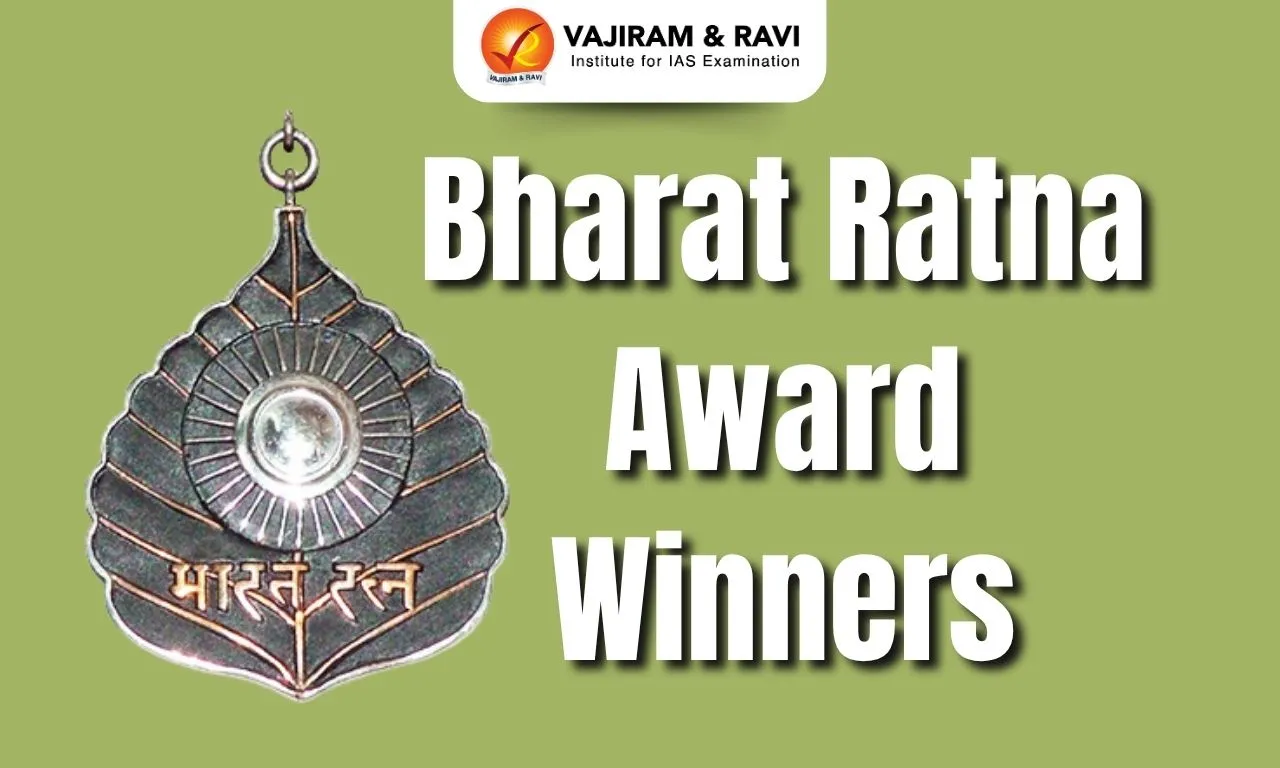
The Bharat Ratna Medallion carries unique national symbols that reflect India’s heritage and constitutional values.

- Peepal Leaf Shape: The medal is designed in the form of a peepal leaf, a symbol deeply associated with Indian culture and civilization. This distinctive shape makes the award instantly recognizable.
- Front Design: The obverse side features a prominent sunburst at the centre. Below the sun, the words “Bharat Ratna” are inscribed in Devanagari script, highlighting the award’s national identity.
- Reverse Side Elements: The reverse displays the State Emblem of India. Beneath it appears the national motto “Satyameva Jayate” written in Devanagari script.
- Material Composition: The medallion is primarily cast in bronze. The emblem, sunburst and rim are crafted using platinum elements, while inscriptions are finished in burnished bronze.
- Certificate and Medal: Every awardee receives a Sanad signed by the President of India along with the Bharat Ratna medallion, making the honour both symbolic and official.
- Manufacturing Location: The medals are produced at the Alipore Mint in Kolkata, a historic institution responsible for manufacturing several important national decorations.
- No Cash Component: Unlike many international honours, Bharat Ratna does not carry any monetary reward. Its significance lies entirely in national recognition and prestige.
Bharat Ratna Award Process
The Bharat Ratna selection process is highly exclusive and involves the highest constitutional offices of India.
- Prime Minister’s Recommendation: The process begins with recommendations made by the Prime Minister of India. No formal public nomination mechanism exists for the award.
- Presidential Approval: The recommendations are submitted to the President of India, who formally confers the Bharat Ratna upon approved recipients.
- Official Announcement: After presidential approval, the names of awardees are officially announced by the Government of India and the President’s office.
- Presentation Ceremony: Recipients are honoured in a formal investiture ceremony where they receive the Bharat Ratna medallion and the Sanad signed by the President.
- Exceptional Selection Standards: The award is reserved only for individuals whose contributions are considered of the highest order and have created a lasting impact on society, the nation, or humanity.
Who Refused To Take Bharat Ratna?
Some individuals and families declined the Bharat Ratna due to personal principles, objections to state honours, or concerns surrounding recognition and history.
- Maulana Abul Kalam Azad: India’s first Education Minister declined the Bharat Ratna nomination in 1954, believing selection committee members should not receive national honours; he was awarded posthumously in 1992.
- H. N. Kunzru: The freedom fighter and Constituent Assembly member refused the Bharat Ratna nomination in 1968, opposing the practice of granting title-like state honours within a republic.
- Hanuman Prasad Poddar: The freedom fighter and spiritual writer declined the Bharat Ratna when nominated, explaining that he preferred avoiding public distinctions and circumstances that could create political discomfort.
- Subhas Chandra Bose’s Family: His extended family and supporters declined the posthumous Bharat Ratna announced in 1992, citing delayed recognition and unresolved questions about his death; legal challenges led to cancellation.
What Are The Benefits For Bharat Ratna Award?
The key benefits of the Bharat Ratna Awards has been highlighted below:
- Bharat Ratna awardees are placed at Position 7A in the Table of Precedence, alongside top dignitaries like Governors, Former Presidents, and the Deputy Prime Minister, ensuring high-level recognition during official events.
- Awardees receive a diplomatic passport, granting them access to separate immigration counters, VIP lounges at airports, and other privileges reserved for top government officials.
- Recipients enjoy lifetime free air travel in executive class across domestic routes, sponsored by the Government of India.
- They receive the same treatment as senior government dignitaries during official travels, including protocol services and access to government guest houses.
- The Bharat Ratna Award includes a bronze medallion shaped like a peepal leaf, a miniature replica, and a certificate signed by the President of India.
- Bharat Ratna Prize Money is not usually designated by the official awarding authority.
- Bharat Ratna recipients are revered across the country. Their names are often associated with public institutions, and they hold a permanent place of respect in Indian history and society.
- Bharat Ratna Award Family Benefits are not officially provided to the families of the awardees including Posthumous awards.

 Last updated on Oct, 2026
→ UPSC 2027 Notification will be released on 13 January 2027 at upsconline.nic.in.
→ Check Nobel Prize 2026 Winners List here.
→ Download PIB PRiSM Monthly Magazine 2026 here.
→ Check UPSC Monthly Current Affairs Magazine The Recitals here.
→ Check out the latest UPSC Syllabus here.
→ Download UPSC Model Answers for Mains 2026
→ UPSC Mains Question Paper 2026 is out now for Essay & GS Paper 1, 2, 3 & 4.
→ UPSC Calendar 2027 has been released.
→ Enroll in Vajiram & Ravi’s UPSC Mains Test Series 2027 for structured answer writing practice, expert evaluation, and exam-oriented feedback.
→ Join Vajiram & Ravi’s UPSC Mentorship Program 2027 for personalized guidance, strategy planning, and one-to-one support from experienced mentors.
→ Go through the UPSC Mains Previous Year Papers to enhance your preparation.
→ UPSC has released UPSC Toppers List 2025 with the Civil Services final result on its official website.
→ Also check Best UPSC Coaching in India
Bharat Ratna FAQs
Q1. Who became the first Bharat Ratna Award winner?+
Q2. Who became the youngest Bharat Ratna Awardee?+
Q3. Who were the first three recipients of Bharat Ratna?+
Q4. Who are the recipients of the Bharat Ratna Award 2026?+
Q5. How many people have received the Bharat Ratna Award till now?+
Tags: awards and honors bharat ratna bharat ratna award winners list