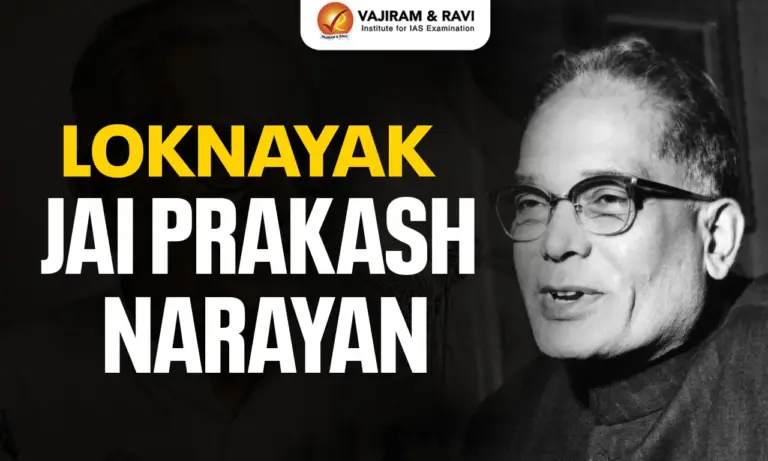
Loknayak Jai Prakash Narayan, popularly known as JP, was one of India’s most respected freedom fighters, social reformers, political thinkers, and champions of democracy. He played a crucial role in India’s struggle for independence and later became the leading voice against corruption, authoritarianism, and misuse of power. His call for “Sampoorna Kranti” (Total Revolution) inspired millions of people and significantly influenced Indian politics.
Loknayak Jai Prakash Narayan Early Life & Education
Loknayak Jai Prakash Narayan’s early life and education played a significant role in shaping him into a freedom fighter, social reformer, and champion of democracy.
Early Life
- Born on 11 October 1902 in Sitabdiara village, located on the border of present-day Bihar and Uttar Pradesh.
- Father: Harsu Dayal, a government employee in the irrigation department.
- Mother: Phul Rani Devi, known for her religious and moral values.
- Grew up in a middle-class Kayastha family with strong cultural and ethical traditions.
- Displayed qualities of honesty, discipline, and leadership from a young age.
- Was deeply influenced by the growing nationalist movement against British rule.
- Earned the affection of family and friends for his simple lifestyle and commitment to social causes.
Education
- Received his primary education in Sitabdiara before moving to Patna for higher studies.
- Studied at Patna Collegiate School, where he excelled academically.
- Joined Patna College, but left his studies after being inspired by the Non-Cooperation Movement led by Mahatma Gandhi.
- Enrolled at Bihar Vidyapeeth, a nationalist educational institution established to support the freedom movement.
- Traveled to the United States in 1922 for higher education and self-development.
- Studied at several American universities, including the University of California, Berkeley, the University of Wisconsin, and other institutions.
- Worked in farms, factories, restaurants, and other jobs to finance his education.
- Studied subjects such as Political Science, Sociology, Economics, and Philosophy.
- Became influenced by socialist and democratic ideas, which later shaped his political ideology.
- Returned to India in 1929 with a strong commitment to social justice, national service, and democratic reforms.
Role in the Indian Freedom Struggle
Loknayak Jai Prakash Narayan played a significant role in India’s freedom struggle and emerged as one of the most influential revolutionary leaders of the independence movement.
- Returned to India in 1929 and joined the Indian National Congress to actively participate in the national movement against British rule.
- Worked closely with prominent freedom fighters such as Mahatma Gandhi, Jawaharlal Nehru, and Subhas Chandra Bose.
- Became a strong advocate of socialist ideas and sought to combine the struggle for political freedom with social and economic justice.
- Co-founded the Congress Socialist Party (CSP) in 1934, which worked within the Indian National Congress to promote the rights of workers, peasants, and marginalized communities.
- Participated actively in the Civil Disobedience Movement and other anti-British campaigns organized by the Congress.
- Was arrested several times by British authorities for his involvement in nationalist activities and protests.
- Played a crucial role in the Quit India Movement of 1942, which demanded an immediate end to British rule in India.
- Escaped from Hazaribagh Central Jail in 1942 and continued organizing underground resistance against the British government.
- Led secret revolutionary networks, coordinated communication among freedom fighters, and mobilized public support for the independence movement.
- Endured imprisonment, surveillance, and harsh treatment by colonial authorities but remained committed to the cause of freedom.
- Advocated mass participation, urging students, workers, and farmers to join the struggle for independence.
- Helped strengthen the socialist and democratic dimensions of India’s national movement.


Sampoorna Kranti (Total Revolution)
Sampoorna Kranti (Total Revolution) was a movement launched by Loknayak Jai Prakash Narayan in 1974 to bring comprehensive change in Indian society. It aimed to reform the political, social, economic, educational, and moral systems of the country. JP believed that merely changing governments was not enough; the entire system needed improvement. The movement encouraged citizens, especially youth, to actively participate in creating a just, transparent, and democratic society.
Major Contributions of Jai Prakash Narayan
- Participation in the Freedom Struggle: Actively fought against British rule and played a key role in the Quit India Movement of 1942.
- Co-founder of the Congress Socialist Party (1934): Helped establish the Congress Socialist Party to promote socialist ideals and protect the interests of workers and farmers.
- Promotion of Democratic Socialism: Advocated social and economic equality while supporting democratic methods of governance.
- Leadership in the Quit India Movement: Organized underground resistance activities and mobilized people against colonial rule after escaping from Hazaribagh Jail.
- Champion of Social Justice: Worked for the welfare of peasants, laborers, and marginalized sections of society.
- Advocate of Sarvodaya Movement: Supported Gandhian principles and worked for the upliftment of all sections of society through peaceful means.
- Concept of Sampoorna Kranti (Total Revolution): Called for comprehensive reforms in politics, society, economy, education, and administration to create a better India.
- Leader of the JP Movement (1974): Led a nationwide movement against corruption, inflation, unemployment, and misuse of political power.
- Defender of Democracy During the Emergency: Strongly opposed the Emergency (1975–77) and fought to protect civil liberties and democratic rights.
- Unification of Opposition Parties: Played a crucial role in bringing various opposition groups together, leading to the formation of the Janata Party.
- Promotion of Decentralized Governance: Advocated greater power for villages and local self-government institutions.
- Inspiration for Youth and Social Activists: Encouraged young people to participate in nation-building and uphold ethical values in public life.
- Strengthening Democratic Values: Emphasized transparency, accountability, and citizen participation in governance.
- Legacy of Ethical Politics: Remains a symbol of honesty, integrity, and public service in Indian political history.
Loknayak Jai Prakash Narayan Legacy
Loknayak Jai Prakash Narayan’s legacy is rooted in his unwavering commitment to democracy, social justice, and ethical politics. His leadership during the JP Movement and his opposition to the Emergency strengthened democratic values in India. The idea of Sampoorna Kranti (Total Revolution) continues to inspire efforts toward political and social reform. He is remembered as a symbol of integrity, public service, and people’s empowerment, earning a permanent place in India’s history.

 Last updated on Oct, 2026
→ UPSC 2027 Notification will be released on 13 January 2027 at upsconline.nic.in.
→ Check Nobel Prize 2026 Winners List here.
→ Download PIB PRiSM Monthly Magazine 2026 here.
→ Check UPSC Monthly Current Affairs Magazine The Recitals here.
→ Check out the latest UPSC Syllabus here.
→ Download UPSC Model Answers for Mains 2026
→ UPSC Mains Question Paper 2026 is out now for Essay & GS Paper 1, 2, 3 & 4.
→ UPSC Calendar 2027 has been released.
→ Enroll in Vajiram & Ravi’s UPSC Mains Test Series 2027 for structured answer writing practice, expert evaluation, and exam-oriented feedback.
→ Join Vajiram & Ravi’s UPSC Mentorship Program 2027 for personalized guidance, strategy planning, and one-to-one support from experienced mentors.
→ Go through the UPSC Mains Previous Year Papers to enhance your preparation.
→ UPSC has released UPSC Toppers List 2025 with the Civil Services final result on its official website.
→ Also check Best UPSC Coaching in India
Loknayak Jai Prakash Narayan FAQs
Q1. Who was Loknayak Jai Prakash Narayan?+
Q2. Why is Jai Prakash Narayan called "Loknayak"?+
Q3. What was the Sampoorna Kranti movement?+
Q4. What role did Jai Prakash Narayan play in the Freedom Struggle?+
Q5. What was the JP Movement of 1974?+
Tags: famous personalities important personalities