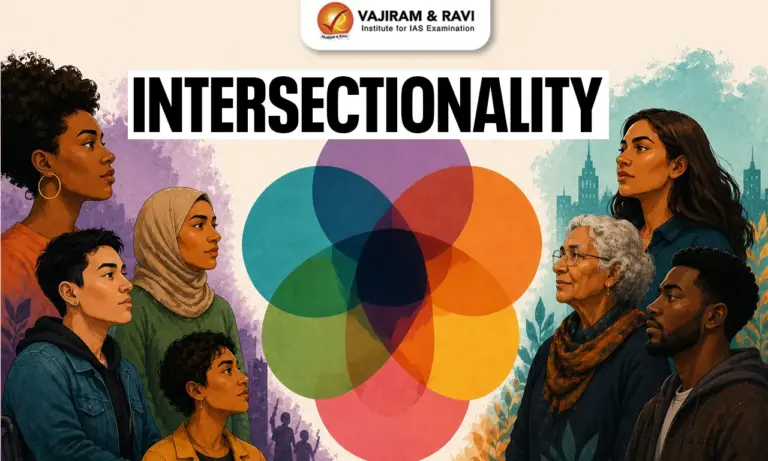
Intersectionality is the idea that different aspects of a person’s identity like gender, caste, class, race, or disability interact with each other to shape their life experiences. It highlights that people may face multiple forms of discrimination or disadvantage at the same time, not just one. This concept helps in understanding inequality better and promotes more inclusive and fair policies.
About Intersectionality
- Intersectionality is the idea that people’s lives are shaped by multiple identities such as caste, gender, class, religion, region, and disability, which interact with each other rather than acting separately.
- In the Indian context, it shows that a person may face overlapping forms of discrimination. For example, a Dalit woman may experience inequality both because of her caste and her gender. This shows that inequality in India is not one-dimensional, but complex and interconnected.
- These experiences are interconnected, meaning the disadvantage is often deeper than facing just one type of discrimination alone.
- It helps us understand that inequality in India is complex, as factors like caste hierarchy, patriarchy, economic status, and social norms all combine to shape people’s lives.
- Intersectionality also explains why some groups, such as women from marginalized castes, tribal communities, or minority religions, face greater barriers in areas like education, employment, and justice.
- It acts as a framework to study how different identities influence a person’s opportunities, privileges, or disadvantages in society.
Intersectionality Origin
- The idea of Intersectionality was first clearly explained by Kimberlé Crenshaw in 1989. She used this term to show that people can face multiple forms of discrimination at the same time, and these cannot be understood separately.
- She introduced this concept in her famous article “Demarginalizing the Intersection of Race and Sex”, where she explained that the problems faced by Black women were not just about race or gender alone, but a combination of both.
- Later, in 1991, she expanded this idea further and showed how identity, power, and inequality are deeply connected in real-life experiences.
- The concept developed as a response to the limitations of earlier movements. During the 1980s, many feminist movements focused mainly on gender, while anti-racism movements focused only on race. Crenshaw pointed out that this approach ignored people who were affected by both at once.
- Even before Crenshaw, thinkers like W. E. B. Du Bois had discussed how race, class, and social status are connected and reinforce inequality, although gender was not fully included in his analysis.
- In the 1970s, groups like the Combahee River Collective also talked about “interlocking oppressions”, meaning that systems like racism, sexism, and social norms work together to create inequality. This helped shape the foundation of intersectional thinking.
- Over time, the idea of Intersectionality has expanded beyond race and gender. Today, it includes many factors such as caste, class, religion, sexuality, age, and disability, especially in countries like India where social structures are complex.
- The main idea is that these identities do not act separately, they overlap and interact, creating unique experiences of privilege or disadvantage for every individual.
- Today, Intersectionality is widely used as a tool for understanding inequality, helping policymakers and society design more inclusive and fair solutions that address multiple forms of discrimination together.
- In India, the idea of Intersectionality has existed for a long time, even before the term was formally used.
- Indian society has always had multiple layers of inequality like caste, gender, class, religion, and region, which often overlap.


Key Theoretical Frameworks
- Intersectionality in India can be better understood through different theoretical approaches:
- Critical Race Theory (adapted to caste context) explains how caste-based hierarchies create structural inequalities and intersect with other identities.
- Feminist Theory highlights how patriarchy interacts with caste, class, and religion, creating unequal outcomes for women across different social groups.
- Postcolonial Theory examines how colonial policies reinforced social divisions and economic inequalities, which continue to influence present-day India.
- These frameworks together provide a comprehensive understanding of power structures, helping in analysing inequality in a more realistic and inclusive way.
Different Aspects of Intersectionality
Intersectionality includes various dimensions of identity and inequality such as caste, class, gender, religion, region, disability, and sexuality, which together shape people’s lived experiences. The following aspects are discussed below to understand how Intersectionality operates in different spheres of life.
Gender and Caste as a Double Layer of Inequality
- The intersection of caste and gender creates one of the most severe and visible forms of inequality in India.
- Dalit and lower-caste women often face discrimination from both upper-caste groups and patriarchal norms within their own communities.
- Their experiences are not simply the addition of two forms of discrimination but a unique and more intense form of marginalization.
- They are more vulnerable to violence, exploitation, manual scavenging, and social exclusion, especially in rural areas.
- This highlights the need for intersection-specific policies, rather than treating caste and gender issues separately.
Religion and Gender as Multiple Layers of Identity
- The intersection of religion and gender adds another dimension to inequality in India.
- Muslim women, for instance, have historically faced issues like triple talaq (now banned), along with socio-economic marginalization.
- Women in Hindu and Christian communities, especially from weaker sections, also face social restrictions, limited agency, and unequal access to opportunities.
- These overlapping identities create complex lived experiences, where discrimination cannot be addressed through a single lens.
- Policies must therefore be inclusive, secular, and sensitive to diversity.
Class and Gender as Linked Economic Inequalities
- Economic status combined with gender creates significant barriers to development and empowerment.
- A large number of women in India work in the informal economy, where jobs are low-paying, insecure, and lack legal protection.
- Limited access to banking, credit, property ownership, and financial literacy further restricts women’s independence.
- Women from poorer backgrounds face greater challenges in accessing healthcare, education, and employment opportunities.
- Addressing this requires financial inclusion, skill development, and social security policies targeted at vulnerable groups.
Marital Status and Gender as Linked Social Inequality
- A woman’s marital status plays a significant role in shaping her social and economic position in India.
- Widows often face social stigma, isolation, and economic insecurity, particularly in traditional settings.
- Single mothers and divorced women may face discrimination in employment, housing, and social acceptance.
- These women often bear the dual burden of earning a livelihood and managing household responsibilities alone.
- While NGOs and community networks provide some support, there is a strong need for societal change and stronger institutional support systems.
Ethnicity and Gender as Intersecting Marginalisation
- Tribal (Adivasi) women face discrimination due to both their gender and ethnic identity.
- They often lack access to basic services like healthcare, education, sanitation, and infrastructure, especially in remote areas.
- In rural and forest regions, issues like displacement, land alienation, and lack of awareness worsen their condition.
- Even in urban areas, they face social exclusion and limited opportunities, despite better infrastructure.
- Although government schemes exist, their impact is limited due to poor implementation and lack of awareness among beneficiaries.
Impact of Intersectionality
- Intersectionality leads to multiple and overlapping forms of discrimination, making the experiences of marginalised individuals more intense and complex than single-axis discrimination.
- It results in deeper social exclusion, where certain groups such as Dalit women, minority women, and tribal women face greater marginalisation compared to others within the same category.
- It creates serious barriers in access to education and employment opportunities. Girls from marginalised communities often face early school dropouts due to poverty, domestic responsibilities, early marriage, and social discrimination.
- Even when they receive education, they encounter limited employment opportunities, wage gaps, and unsafe working conditions, which restrict their economic independence.
- Women from lower castes are largely concentrated in informal sectors such as domestic work, agriculture, and daily wage labour, leading to low income, job insecurity, and lack of social protection.
- This further results in economic disadvantages and limited social mobility, creating a cycle of poverty and inequality across generations.
- Intersectionality also weakens the effectiveness of legal and policy frameworks, as existing systems often fail to recognise overlapping identities and provide adequate protection.
- There is significant underrepresentation in decision-making and governance, which means the voices of intersectionally disadvantaged groups remain unheard.
- It reinforces social stigma, stereotypes, and discrimination, especially against those belonging to multiple marginalised identities.
- Continuous exposure to such discrimination negatively impacts mental and emotional well-being, leading to stress, insecurity, and reduced self-worth.
- Overall, Intersectionality highlights that inequality is layered and interconnected, and without addressing these complexities, the goals of social justice, equality, and inclusive development remain incomplete.
Legal Protections and Implementation Gaps
- India has a wide range of laws and constitutional provisions to protect individuals from discrimination based on caste, gender, religion, and other factors. Principles like equality before law and non-discrimination form the core of these protections.
- However, most of these laws address discrimination in a separate and isolated manner, focusing on one ground at a time rather than recognising that individuals may face multiple forms of discrimination simultaneously.
- In reality, discrimination is often overlapping. For example, a Dalit woman may face both caste-based and gender-based discrimination, but the legal system generally treats these as two distinct issues, not as a combined and compounded experience.
- Due to this limitation, victims of intersectional discrimination often find it difficult to seek justice, as their experiences do not fit neatly into existing legal categories and frameworks.
- The problem is further aggravated by poor implementation of laws, lack of awareness, social stigma, institutional biases, and delays in the justice delivery system, which reduce the effectiveness of legal protections.
- Although India promotes equality and non-discrimination through its constitutional and legal framework, these protections often remain inadequate in addressing intersectional realities.
- As a result, intersectional discrimination remains under-recognised and insufficiently addressed within the current legal system.
- There is a clear need for intersection-sensitive legal interpretation, along with stronger enforcement mechanisms and more inclusive policy design, to better capture the complexity of real-life discrimination.
- In this context, the role of the judiciary, civil society, and grassroots activism becomes crucial in bridging these gaps and ensuring that justice is more accessible and meaningful.
- Overall, while India has a strong legal foundation for equality, it is not fully equipped to deal with the complex and layered nature of intersectional inequality, highlighting the need for reforms and a more holistic approach.
Legal and Policy Measures for Addressing Intersectionality
- The Constitution of India provides the foundational framework for addressing discrimination through key provisions such as Article 14 (equality before law), Article 15 (prohibition of discrimination), Article 16 (equal opportunity in public employment), and Article 21 (right to life and dignity). These provisions ensure equal treatment for all individuals, although they do not explicitly mention Intersectionality.
- Article 15(3) and 15(4) empower the State to make special provisions for women, children, and socially and educationally backward classes. This indirectly supports an intersectional approach by recognising that certain groups face multiple and layered vulnerabilities.
- The Scheduled Castes and Scheduled Tribes (Prevention of Atrocities) Act, 1989 addresses caste-based violence and discrimination. It is particularly significant for protecting individuals such as Dalit women, who often experience both caste-based and gender-based oppression, though overlapping vulnerabilities still need stronger recognition.
- The Protection of Women from Domestic Violence Act, 2005 provides legal protection against domestic abuse. However, it does not fully account for how factors like caste, class, or religion may intensify such violence.
- The Sexual Harassment of Women at Workplace (Prevention, Prohibition and Redressal) Act, 2013 ensures a safer working environment for women. Yet, its implementation often varies depending on social and economic backgrounds, revealing important intersectional gaps.
- The Rights of Persons with Disabilities Act, 2016 recognises and protects the rights of persons with disabilities. When combined with factors such as gender or poverty, it highlights the need for a more intersectional understanding in law and policy.
- The Transgender Persons (Protection of Rights) Act, 2019 marks progress in recognising gender diversity, but transgender individuals often face layered discrimination based on caste, class, and social stigma, requiring stronger implementation and sensitivity.
- Judicial interpretation has also played a key role. The Supreme Court, in cases such as Navtej Singh Johar v. Union of India, has expanded the understanding of rights, identity, and dignity, indirectly supporting an intersectional perspective.
- Despite these measures, a major limitation remains that most laws function in isolated categories (such as caste or gender) and do not fully address overlapping forms of discrimination.
- Welfare measures like reservations in education and employment for SCs, STs, and OBCs have helped reduce structural inequalities. However, there is still a need for more targeted schemes for individuals facing multiple disadvantages, such as women within these groups.
- Government programmes such as Beti Bachao Beti Padhao and the Deendayal Antyodaya Yojana – National Rural Livelihoods Mission aim at empowerment, but their effectiveness can improve by adopting an intersectional approach that considers caste, region, and economic status together.
- Institutions like the National Commission for Women, National Commission for Scheduled Castes, and National Commission for Scheduled Tribes play an important role in safeguarding rights. However, better coordination among these bodies is necessary to address overlapping discrimination effectively.
- Courts in India, especially the Supreme Court of India, have increasingly adopted an inclusive and expansive interpretation of rights, creating space for recognising intersectional harms, though a clear and structured framework is still evolving.
Significance of Civil Society and Activism
- Activists, NGOs, and civil society groups play a very important role in bringing attention to intersectional issues.
- They highlight how marginalized groups such as Dalit women, tribal women, religious minorities, and LGBTQ+ individuals face multiple and overlapping disadvantages.
- These groups work on the ground by providing legal aid, spreading awareness, and supporting victims of discrimination and violence.
- They also push the government to reform existing laws and introduce more inclusive policies that reflect real-life challenges.
- Social movements and campaigns have helped in bringing issues like gender justice, caste violence, and minority rights into public debate.
- Advocacy efforts also encourage greater accountability from institutions, including the police, judiciary, and administration.
Way Forward for Intersectionality
- An intersection-sensitive approach should be integrated into policymaking, where multiple identities are considered together rather than treating individuals as belonging to a single category.
- The legal framework must be strengthened to explicitly recognise intersectional discrimination, enabling more effective access to justice.
- There is a need for better implementation of existing laws, as gaps often arise due to weak enforcement, lack of awareness, and social biases.
- The government should design targeted welfare schemes for highly vulnerable groups such as Dalit women, tribal communities, persons with disabilities, and transgender individuals.
- Improved data collection and research, including a disaggregated data system based on caste, gender, disability, and region, is essential for designing more targeted and effective policies.
- Training and sensitisation of police, administrators, and the judiciary should be enhanced to ensure empathetic and fair responses to intersectional issues.
- Improved institutional coordination among commissions and welfare bodies is required to address overlapping forms of discrimination effectively.
- Education and awareness programmes should promote inclusivity, social sensitivity, and reduction of stereotypes in society.
- Civil society organisations and grassroots movements should be supported, as they play a key role in raising awareness and ensuring accountability.
- Ultimately, adopting an intersectional approach is crucial to achieving social justice, equality, and inclusive development, ensuring that no one is left behind.

 Last updated on Oct, 2026
→ UPSC 2027 Notification will be released on 13 January 2027 at upsconline.nic.in.
→ Check Nobel Prize 2026 Winners List here.
→ Download PIB PRiSM Monthly Magazine 2026 here.
→ Check UPSC Monthly Current Affairs Magazine The Recitals here.
→ Check out the latest UPSC Syllabus here.
→ Download UPSC Model Answers for Mains 2026
→ UPSC Mains Question Paper 2026 is out now for Essay & GS Paper 1, 2, 3 & 4.
→ UPSC Calendar 2027 has been released.
→ Enroll in Vajiram & Ravi’s UPSC Mains Test Series 2027 for structured answer writing practice, expert evaluation, and exam-oriented feedback.
→ Join Vajiram & Ravi’s UPSC Mentorship Program 2027 for personalized guidance, strategy planning, and one-to-one support from experienced mentors.
→ Go through the UPSC Mains Previous Year Papers to enhance your preparation.
→ UPSC has released UPSC Toppers List 2025 with the Civil Services final result on its official website.
→ Also check Best UPSC Coaching in India
Intersectionality FAQs
Q1. What is Intersectionality in simple terms?+
Q2. Why is Intersectionality important in India?+
Q3. How does Intersectionality affect education and employment?+
Q4. What are examples of intersectional discrimination in India?+
Q5. What role do policies play in addressing Intersectionality?+
Tags: intersectionality sociology sociology notes