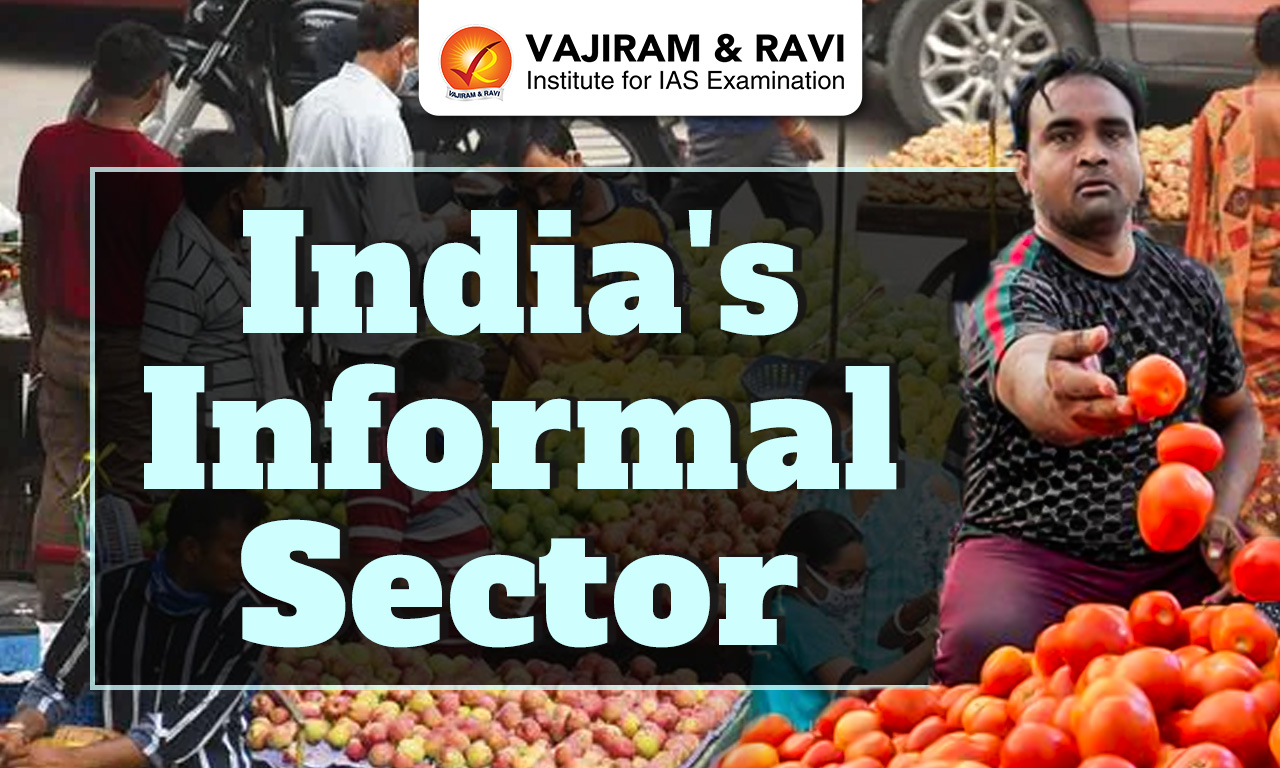
According to the International Labour Organization (ILO) and recent government data, India has one of the largest informal economies in the world, employing over 400 million workers. Globally, more than 2 billion people depend on informal jobs, making up over 60% of the world’s workforce. In India, this sector is even more dominant, contributing significantly to employment, livelihoods, and economic growth.
What is the Informal Sector?
The informal sector refers to jobs and businesses that operate without formal registration, legal protection, or job security. Workers in this sector usually do not have written contracts, fixed salaries, or access to benefits like insurance and pensions. It includes activities such as street vending, domestic work, construction labour, and small-scale farming. This sector provides livelihood to millions of people, especially in developing countries like India.
Significance of India’s Informal Sector
India’s informal sector forms the backbone of the economy, providing livelihoods to a vast majority of the population despite operating outside formal regulations.
- Major employment provider: Around 90-93% of India’s workforce is employed in the informal sector, as per NSSO/MoSPI data
- Large enterprise base: About 6.5 crore unincorporated enterprises employ nearly 11 crore workers (2022-23, government data)
- Economic contribution: Generates significant output, with informal enterprises contributing about ₹15.4 lakh crore GVA
- Shock absorber: Provides employment during crises; informal jobs increased by 75 lakh in 2025 (NSO data)
- Support to rural economy: Majority of agricultural and allied workers are informal, ensuring livelihood security
- Urban economy backbone: Construction, trade, and transport sectors rely heavily on informal labour (major employment providers as per NSSO)
- Poverty reduction: Provides income opportunities to vulnerable groups with low entry barriers


Challenges Faced by India’s Informal Sector
India’s informal sector faces multiple structural and socio-economic challenges that limit workers’ income, security, and overall well-being. These issues arise due to lack of regulation, weak implementation of laws, and limited access to resources and opportunities.
- Lack of Social Security: Most workers do not have access to pensions, health insurance, or paid leave, leading to financial insecurity during emergencies.
- Low Wages and Exploitation: Workers are often paid below minimum wages and work long hours under poor conditions without any legal protection.
- Precarious Employment: Jobs are unstable, seasonal, and lack written contracts, making income uncertain and irregular.
- Occupational Hazards: Workers in sectors like construction, mining, and waste management face serious health and safety risks without proper protective equipment.
- Vulnerability to Economic Shocks: Events like pandemics, inflation, or natural disasters can instantly disrupt livelihoods due to lack of savings or safety nets.
- Social Inequality: Marginalized groups such as SC, ST, OBC, and women are overrepresented and face discrimination and wage gaps.
- Lack of Legal Protection: Many informal workers are not covered under labour laws, making it difficult to seek justice against exploitation.
- Limited Access to Credit: Difficulty in accessing formal banking and loans forces workers to depend on informal lenders with high interest rates.
Government Initiatives for India’s Informal Sector
Government initiatives for the informal sector aim to provide social security, employment opportunities, and financial support to workers who are outside the formal system. These measures focus on improving livelihoods, reducing vulnerability, and gradually integrating informal workers into the formal economy.
- Viksit Bharat Guarantee for Rozgar and Ajeevika Mission (Gramin) (VB G RAM G) Act, 2025. ensures 125 days of guaranteed wage employment to rural households, providing income security and reducing distress migration.
- Pradhan Mantri Shram Yogi Maandhan (PM-SYM) offers a voluntary pension scheme for unorganized workers with monthly contributions, ensuring financial stability in old age.
- Pradhan Mantri Jeevan Jyoti Bima Yojana (PMJJBY) provides affordable life insurance coverage of ₹2 lakh, helping workers’ families during unforeseen events.
- Pradhan Mantri Suraksha Bima Yojana (PMSBY) offers accidental insurance coverage at a very low premium, supporting workers in case of disability or death.
- Atal Pension Yojana (APY) guarantees a fixed pension after retirement, especially benefiting low-income informal workers.
- e-Shram Portal creates a national database of unorganized workers and provides a Universal Account Number (UAN) to enable targeted delivery of welfare schemes.
- Pradhan Mantri Rojgar Protsahan Yojana (PMRPY) encourages employers to register workers under formal systems like EPFO, helping shift informal workers to formal employment.
- Pradhan Mantri Kaushal Vikas Yojana (PMKVY) focuses on skill development and certification to improve employability and income levels of informal workers.
- Deen Dayal Upadhyay Gramin Kaushal Yojana (DDU-GKY) targets rural youth by providing skill training and placement opportunities.
- Deen Dayal Antyodaya Yojana (DAY-NULM & DAY-NRLM) promotes self-employment and livelihood generation through self-help groups and micro-enterprises.
- PM SVANidhi Scheme provides collateral-free loans to street vendors to help them restart and expand their businesses.
- Pradhan Mantri Garib Kalyan Yojana (PM-GKAY) ensures free food grains to vulnerable populations, especially during crises like the COVID-19 pandemic.
- Labour Codes (2019-2020) aim to simplify and universalize labour laws, covering wages, social security, industrial relations, and occupational safety for broader worker inclusion.
Way Forward
A comprehensive approach involving policy reforms, skill development, and effective implementation of welfare schemes is essential for inclusive development.
- Expand social security coverage by ensuring universal access to health insurance, pensions, maternity benefits, and accident protection for all informal workers.
- Strengthen implementation of the Social Security Code, 2020 to bring informal workers under a unified legal framework with real ground-level benefits.
- Promote formalization of jobs by encouraging businesses to register workers, adopt digital payments, and provide written contracts to improve transparency.
- Invest in large-scale skill development and upskilling programs to help workers transition from low-paying informal jobs to better-paying formal employment.
- Strengthen the e-Shram portal by integrating it with other government databases to ensure targeted delivery of benefits and reduce exclusion errors.
- Ensure portability of benefits like ration cards, healthcare, and pensions for migrant workers to support labour mobility across states.
- Improve working conditions by enforcing minimum wages, occupational safety standards, and grievance redressal mechanisms across sectors.
- Promote micro-entrepreneurship by expanding access to credit, subsidies, and market linkages through schemes like MUDRA and self-help groups.
- Focus on women workers by providing equal wages, childcare facilities, and safe working environments to increase their participation.
- Use technology and data-driven governance such as GIS mapping and digital platforms to identify vulnerable workers and deliver timely support.
- Learn from global best practices like conditional cash transfers and public employment programs to design more effective welfare policies.
- Encourage collective representation and unionization of informal workers to strengthen their bargaining power and protect their rights.
- Align policies with Sustainable Development Goals (SDG 8) to ensure decent work, economic growth, and social inclusion.

 Last updated on Oct, 2026
→ UPSC 2027 Notification will be released on 13 January 2027 at upsconline.nic.in.
→ Check Nobel Prize 2026 Winners List here.
→ Download PIB PRiSM Monthly Magazine 2026 here.
→ Check UPSC Monthly Current Affairs Magazine The Recitals here.
→ Check out the latest UPSC Syllabus here.
→ Download UPSC Model Answers for Mains 2026
→ UPSC Mains Question Paper 2026 is out now for Essay & GS Paper 1, 2, 3 & 4.
→ UPSC Calendar 2027 has been released.
→ Enroll in Vajiram & Ravi’s UPSC Mains Test Series 2027 for structured answer writing practice, expert evaluation, and exam-oriented feedback.
→ Join Vajiram & Ravi’s UPSC Mentorship Program 2027 for personalized guidance, strategy planning, and one-to-one support from experienced mentors.
→ Go through the UPSC Mains Previous Year Papers to enhance your preparation.
→ UPSC has released UPSC Toppers List 2025 with the Civil Services final result on its official website.
→ Also check Best UPSC Coaching in India
India's Informal Sector FAQs
Q1. What is the informal sector?+
Q2. How big is India’s informal sector?+
Q3. Why is the informal sector important for India?+
Q4. What are the main problems faced by informal workers?+
Q5. What is the government doing for informal workers?+
Tags: indias informal sector