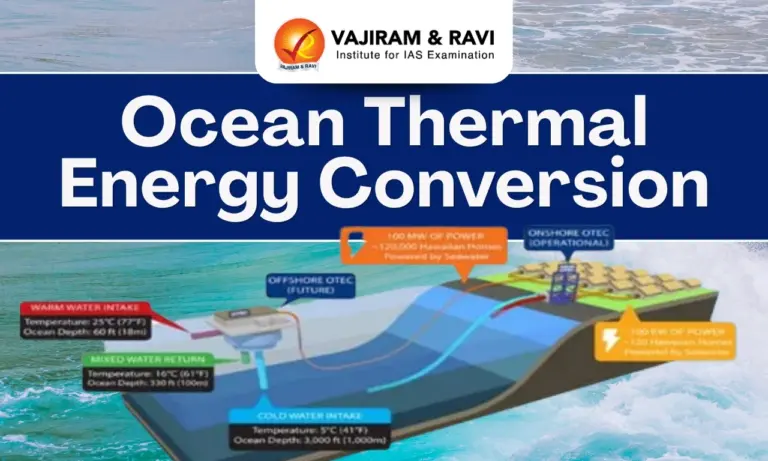
The oceans are the world’s largest solar energy collectors. Nearly 70% of the Earth’s surface is covered by water, and oceans absorb enormous quantities of solar radiation every day. This absorbed heat creates a natural temperature difference between the warm surface waters and the cold waters found at greater depths.
Ocean Thermal Energy Conversion (OTEC) is a technology that harnesses this thermal gradient to generate electricity.
What is Ocean Thermal Energy Conversion?
Ocean Thermal Energy Conversion (OTEC) is a technology for generating renewable energy.
- It uses the temperature differential between the deep cold and relatively warmer surface waters of the ocean to generate baseload electricity.
- The technology is viable primarily in equatorial areas of the earth where the year round temperature differential between the deep cold and warm surface ocean waters is greater than 20 ⁰C (36 ⁰F).
- An OTEC facility continuously requires large volumes of both warm and cold water to generate electricity. A 100 megawatt (MW) OTEC facility would likely require 10-20 billion gallons of water per day.
How Does Ocean Thermal Energy Conversion (OTEC) Work?
OTEC works by using the temperature difference between warm surface seawater and cold deep seawater to generate electricity.
- Warm surface seawater acts as the heat source, while cold deep seawater acts as the heat sink.
- The warm water is used to convert a working fluid (or seawater itself) into vapour.
- The vapour drives a turbine connected to a generator, producing electricity.
- Cold deep-sea water is then used to cool and condense the vapour back into liquid form.
- The process is repeated continuously, enabling uninterrupted power generation.
As OTEC relies on naturally occurring ocean temperatures rather than fossil fuels, it produces electricity with minimal greenhouse gas emissions.


Types of Ocean Thermal Energy Conversion (OTEC) Systems
- Closed-Cycle OTEC: Closed-cycle OTEC uses a low-boiling-point working fluid such as ammonia, which is heated by warm surface seawater to produce vapour that drives a turbine, and then condensed using cold deep seawater in a continuous closed loop, making it the most widely used and efficient system.
- Open-Cycle OTEC: Open-cycle OTEC uses seawater itself as the working fluid, where warm surface water is flash-evaporated into steam under low pressure to run a turbine and is then condensed using cold deep water, producing desalinated freshwater as a useful by-product.
- Hybrid OTEC: Hybrid OTEC combines closed and open-cycle systems to generate electricity while also producing freshwater, thereby improving overall efficiency and making it especially suitable for island and coastal regions facing both energy and water scarcity.
Ocean Thermal Energy Conversion (OTEC) Potential
The energy stored in tropical oceans is immense.
- Scientists estimate that the technical potential of OTEC exceeds 7 terawatts (TW), which is significantly higher than current global electricity demand.
- Unlike solar and wind energy, OTEC is not intermittent. Ocean temperature differences remain relatively constant throughout the day and across seasons. As a result, OTEC can provide baseload power, supplying electricity 24 hours a day and 365 days a year. This characteristic makes OTEC an attractive complement to other renewable energy sources in future low-carbon energy systems.
Several countries are actively pursuing OTEC research and pilot projects:
- The United States pioneered OTEC development through the Mini-OTEC project in Hawaii and continues to conduct advanced research.
- Japan has established operational pilot facilities in Okinawa and remains one of the global leaders in the field.
- South Korea and France are investing in commercial-scale projects, while many Pacific and Indian Ocean island nations view OTEC as a promising solution for energy and water security.
Although no large-scale commercial OTEC plant currently exists, technological progress and declining costs are expected to improve its viability in the coming decades.
India’s OTEC Potential
- India is among the countries with the highest OTEC potential due to its geographical location in the tropical Indian Ocean.
- The country possesses an Exclusive Economic Zone (EEZ) of approximately 2.37 million square kilometres, much of which experiences favourable thermal gradients for OTEC operations.
- The waters surrounding the Lakshadweep Islands and the Andaman and Nicobar Islands are particularly suitable because deep cold water is available relatively close to the coast.
- The Ministry of Earth Sciences has entrusted the National Institute of Ocean Technology (NIOT), Chennai, with the responsibility of developing OTEC technologies in India.
- Over the years, NIOT has conducted pilot studies and developed floating OTEC concepts for island applications.
- The National Perspective Plan for Blue Economy also identifies OTEC as a strategic marine energy resource capable of supporting India’s long-term energy transition.
Significance of Ocean Thermal Energy Conversion (OTEC)
Ocean Thermal Energy Conversion (OTEC) has the potential to become an important source of clean energy for tropical countries like India. Its significance lies in the following:
- Reliable Renewable Energy: Unlike solar and wind energy, OTEC can generate electricity continuously throughout the day and year, providing a stable source of baseload power.
- Supports Climate Goals: Since OTEC generates electricity without burning fossil fuels, it produces very low greenhouse gas emissions and contributes to India’s clean energy and net-zero ambitions.
- Helps Address Water Scarcity: Open-cycle and hybrid OTEC plants can also produce desalinated freshwater, which can benefit water-scarce island and coastal regions.
- Promotes the Blue Economy: OTEC can support activities such as aquaculture, mariculture, seawater air conditioning, desalination, and green hydrogen production, creating new economic opportunities from ocean resources.
- Improves Energy Security: For island territories like Lakshadweep and Andaman & Nicobar Islands, OTEC can reduce dependence on imported diesel and provide a reliable local source of energy.
Furthermore, successful development of OTEC could enable India to emerge as a technology provider for island nations in the Indian Ocean and Pacific regions, strengthening both economic opportunities and maritime diplomacy.
Ocean Thermal Energy Conversion (OTEC) Challenges and Limitations
Despite its potential, OTEC faces several challenges that limit its large-scale adoption.
- Low Efficiency: The temperature difference between warm surface water and cold deep water is relatively small, so OTEC plants convert only a small fraction of energy into electricity, requiring huge volumes of seawater for power generation.
- High Costs: Setting up OTEC plants requires expensive infrastructure such as offshore platforms, turbines, heat exchangers, and long deep-sea pipes, making them costlier than many other renewable energy sources.
- Technical Difficulties: The harsh marine environment causes corrosion, biofouling, and wear and tear of equipment. Maintaining deep-water pipelines and offshore structures is also technically challenging.
- Environmental Concerns: Large-scale pumping of deep seawater may affect marine ecosystems and nutrient balances. In closed-cycle systems, accidental leakage of working fluids like ammonia can also pose environmental risks.
- Limited Commercial Deployment: OTEC technology is still at the pilot and demonstration stage in most countries, with very few large-scale commercial projects operating globally.
Way Forward
- Increase investment in research and testing to make OTEC technology more efficient and affordable.
- Undertake pilot and demonstration projects in Lakshadweep and Andaman & Nicobar Islands to assess its feasibility for large-scale power generation and desalination.
- Provide government support and private investment to overcome the high cost of building OTEC plants.
- Invest in advanced marine engineering solutions to overcome challenges related to corrosion, biofouling, and deep-sea infrastructure maintenance.
- Integrate OTEC with Blue Economy initiatives such as desalination, aquaculture, seawater air conditioning, and green hydrogen production to maximise its overall benefits.
- Promote international collaboration and technology transfer with countries that have experience in OTEC development to accelerate innovation and deployment.
- Ensure proper environmental monitoring so that marine ecosystems are protected while harnessing ocean energy.

 Last updated on Oct, 2026
→ UPSC 2027 Notification will be released on 13 January 2027 at upsconline.nic.in.
→ Check Nobel Prize 2026 Winners List here.
→ Download PIB PRiSM Monthly Magazine 2026 here.
→ Check UPSC Monthly Current Affairs Magazine The Recitals here.
→ Check out the latest UPSC Syllabus here.
→ Download UPSC Model Answers for Mains 2026
→ UPSC Mains Question Paper 2026 is out now for Essay & GS Paper 1, 2, 3 & 4.
→ UPSC Calendar 2027 has been released.
→ Enroll in Vajiram & Ravi’s UPSC Mains Test Series 2027 for structured answer writing practice, expert evaluation, and exam-oriented feedback.
→ Join Vajiram & Ravi’s UPSC Mentorship Program 2027 for personalized guidance, strategy planning, and one-to-one support from experienced mentors.
→ Go through the UPSC Mains Previous Year Papers to enhance your preparation.
→ UPSC has released UPSC Toppers List 2025 with the Civil Services final result on its official website.
→ Also check Best UPSC Coaching in India
Ocean Thermal Energy Conversion FAQs
Q1. What is Ocean Thermal Energy Conversion (OTEC)?+
Q2. Why is Ocean Thermal Energy Conversion (OTEC) suitable for tropical regions like India?+
Q3. What are the main types of Ocean Thermal Energy Conversion (OTEC) systems?+
Q4. What is the key advantage of Ocean Thermal Energy Conversion (OTEC) over solar and wind energy?+
Q5. What are the major challenges in Ocean Thermal Energy Conversion (OTEC) development?+
Tags: ocean thermal energy conversion