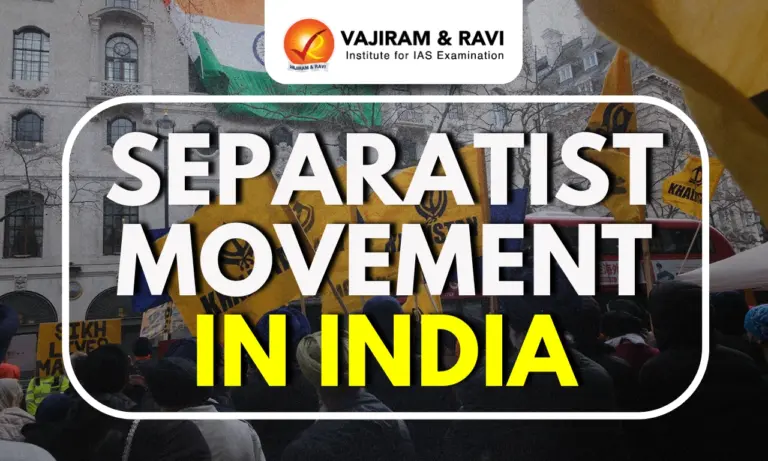
Separatism refers to the demand by a group based on ethnicity, religion, language, tribe, or regional identity for greater autonomy or even separation from an existing nation-state.
In India, separatist movements have ranged from demands for statehood and autonomy to armed insurgencies seeking secession.
India’s Constitution under Article 1 describes India as an “indestructible Union of destructible States”, thereby rejecting any constitutional right to secession. However, India’s immense diversity and uneven development have periodically generated separatist tendencies in different regions.
Historical Roots and Causes of Separatism in India
Separatist movements in India have emerged due to a combination of historical experiences, identity-based concerns, political grievances, economic inequality, and external interference.
Colonial Legacy
- British colonial policies created administrative boundaries without adequately considering ethnic, tribal, or linguistic identities. Several communities remained divided across regions without political recognition.
Impact of Partition
- The Partition of India in 1947 on religious lines deeply influenced identity politics in India.
- It created the perception among some groups that sustained political mobilisation and violence could alter territorial arrangements.
- The trauma of Partition also intensified communal tensions and identity consciousness across regions.
Linguistic Reorganisation and Regional Identity
- The States Reorganisation Act of 1956 reorganised Indian states mainly on linguistic lines following the recommendations of the Fazl Ali Commission. Although this reduced many linguistic tensions, especially in South India, it also strengthened regional and sub-national identities.
- In regions where communities felt politically marginalised or economically neglected even after reorganisation, demands for autonomy and separate statehood continued.
- Example: Bodo movement.
Integration Challenges after Independence
- The accession of Jammu and Kashmir through the Instrument of Accession in October 1947 remained politically contested and became a major source of separatist politics.
- Many tribal groups in the Northeast felt politically alienated after integration into India because they feared cultural assimilation and loss of traditional autonomy.
| Major Causes of Separatism in India | |
| Factor | Explanation |
|
Historical Factors |
Colonial boundary-making, unresolved accession disputes, and the legacy of Partition contributed significantly to separatist tendencies. |
|
Ethnic and Linguistic Factors |
Many groups feared cultural assimilation and demanded recognition of their distinct identity and traditions. For example,
|
|
Economic Factors |
Underdevelopment, unemployment, uneven regional growth, and perceptions of resource exploitation intensified regional dissatisfaction. |
|
Political Factors |
Governance failures, weak political representation, excessive centralisation, and Centre-State tensions strengthened alienation. |
|
External Factors |
Pakistan’s support for terrorism, foreign funding networks, and alleged external support to insurgent groups complicated internal conflicts. For example,
|
|
Ideological Factors |
Religious extremism, Maoist ideology, and online radicalisation contributed to violent separatist movements. |
Major Separatist Movements in India
Separatist movements in India have emerged in different regions due to identity-based grievances, political alienation, economic disparities, and demands for autonomy or secession.
Jammu and Kashmir Separatist Movement
- The separatist movement in Jammu and Kashmir emerged from the disputed circumstances surrounding the accession of the princely state to India in 1947.
- Pakistan’s tribal invasion compelled Maharaja Hari Singh to sign the Instrument of Accession in favour of India.
- Under the Instrument of Accession, Jammu and Kashmir became part of India, while Article 370 of the Indian Constitution granted the region special constitutional status and significant autonomy.
- Over time, political instability, cross-border terrorism, radicalisation, and alleged governance failures intensified separatist sentiments. From the late 1980s, militancy escalated significantly with support from Pakistan-based terror groups.
- Separatist organisations such as the Jammu and Kashmir Liberation Front (JKLF) demanded independence, while groups like Hizbul Mujahideen and Lashkar-e-Taiba supported accession to Pakistan.
- The Government of India responded through large-scale counter-insurgency operations, border fencing, intelligence coordination, and deployment of security forces.
- In 2019, Article 370 was abrogated and the state was reorganised into two Union Territories of Jammu and Kashmir and Ladakh.
- Although militant violence has declined compared to the 1990s, terrorism, radicalisation, and infiltration continue to remain major security concerns.
Khalistan Movement in Punjab
- The Khalistan movement emerged during the 1970s and 1980s among sections of Sikh extremists demanding a separate Sikh homeland called Khalistan.
- The movement was influenced by religious radicalisation, political grievances, Centre-State tensions, and external support from Pakistan’s ISI.
- Militancy peaked during the 1980s under leaders such as Jarnail Singh Bhindranwale. Militant organisations including Babbar Khalsa International and Khalistan Commando Force carried out assassinations, bombings, and terror attacks.
- In response, the Government launched Operation Blue Star in 1984 to remove militants from the Golden Temple complex. The assassination of Prime Minister Indira Gandhi later that year and the anti-Sikh riots further deepened tensions.
- During the 1990s, strong policing, intelligence operations, and counter-terrorism measures successfully dismantled large-scale militancy in Punjab. However, Khalistani propaganda, overseas funding networks, and online radicalisation continue to pose security challenges.
Naga Insurgency
The Naga insurgency is one of the oldest separatist movements in India and began even before Indian independence.
- Under the leadership of A.Z. Phizo, the Naga National Council (NNC) demanded an independent Naga homeland.
- Later, insurgent groups such as the National Socialist Council of Nagalim (NSCN) continued the movement with demands for a sovereign “Greater Nagalim” integrating Naga-inhabited areas of Nagaland, Manipur, Assam, and Arunachal Pradesh.
- The movement was driven by ethnic identity, fears of cultural assimilation, and demands for political autonomy.
- The Government responded by granting statehood to Nagaland in 1963 and introducing Article 371A to protect Naga customary laws and land rights.
- Several ceasefire agreements and peace negotiations followed, including the Framework Agreement signed in 2015.
- Although violence has reduced significantly, the peace process remains unresolved due to disagreements regarding a separate Naga flag and constitution.
Mizo Movement
- The Mizo separatist movement originated in the 1960s following dissatisfaction with the Assam government’s handling of the Mautam famine of 1959.
- The Mizo National Front (MNF), under Laldenga, launched an armed insurgency demanding independence for Mizoram.
- The movement reflected grievances related to political neglect, ethnic identity, and lack of development.
- The Government initially responded through military action but later adopted a political approach through negotiations.
- The Mizoram Peace Accord signed in 1986 became a landmark agreement that ended two decades of insurgency. Mizoram was granted full statehood in 1987, militants were rehabilitated, and democratic governance was restored.
- The success of the Mizo Peace accord transformed Mizoram into one of the most peaceful states in Northeast India and is often regarded as India’s most successful model of conflict resolution.
ULFA Movement in Assam
The United Liberation Front of Asom (ULFA) emerged in Assam in 1979 amid growing concerns regarding illegal migration, economic exploitation of Assam’s natural resources, and fears of cultural marginalisation.
- ULFA demanded a sovereign Assam and adopted violent methods including extortion, kidnappings, and attacks on security forces.
- The movement gained support among sections of youth frustrated with unemployment and underdevelopment.
- In response, the Government launched counter-insurgency operations such as Operation Bajrang and Operation Rhino.
- Cooperation with Bangladesh after 2009 helped dismantle insurgent camps operating across the border.
- Peace talks with moderate factions and development initiatives weakened the insurgency considerably, although some militant factions remain active.
Bodo Movement
- The Bodo movement emerged in Assam as a tribal assertion for protection of Bodo identity, language, land rights, and political representation.
- Bodo organisations such as the All Bodo Students Union (ABSU) and later militant groups like the National Democratic Front of Bodoland (NDFB) demanded a separate Bodoland state.
- Ethnic tensions and competition over land intensified violence in several areas of Assam.
- The Government adopted a strategy of negotiations and political accommodation.
- The Government introduced autonomous arrangements through the Bodoland Territorial Council (BTC) under the 6th Schedule of the constitution in 2003. Later, the Bodo Peace Accord of 2020 led to the creation of the Bodoland Territorial Region (BTR), greater political and administrative autonomy, rehabilitation of more than 1,500 militants, and a significant decline in violence in Bodo-dominated areas of Assam.
Dravidian Movement
- The Dravidian movement emerged in South India, particularly Tamil Nadu, during the early twentieth century against perceived North Indian domination and Hindi imposition.
- Initially, organisations such as the Dravidar Kazhagam (DK) and later the Dravida Munnetra Kazhagam (DMK) demanded a separate “Dravida Nadu” for South Indians.
- The movement reflected linguistic identity, regional pride, and opposition to cultural homogenisation.
- The Government responded through linguistic reorganisation of states and assurances regarding continued use of English along with Hindi under the Official Languages Act 1963.
- Over time, the movement shifted from separatism to demands for greater state autonomy within the Indian federal framework.
Government Strategy to Address Separatist Movements in India
The Government of India has adopted a multi-pronged strategy combining security measures, political accommodation, constitutional safeguards, development initiatives, and rehabilitation policies to address separatist movements and strengthen national integration.
Security Measures
- Counter-insurgency operations such as Operation Bajrang and Operation Rhino were launched against ULFA militants in Assam.
- Security operations by the Army, CRPF, and Jammu and Kashmir Police were intensified to tackle militancy and cross-border terrorism in Jammu and Kashmir.
- Laws such as the Unlawful Activities (Prevention) Act (UAPA) and AFSPA have been used in disturbed areas like Nagaland, Manipur, and Jammu and Kashmir.
- The National Investigation Agency (NIA) has conducted investigations against Khalistani terror financing and extremist networks linked to Pakistan-based handlers.
Political and Constitutional Measures
- Nagaland was granted statehood in 1963 and Article 371A was introduced to protect Naga customary laws and land rights.
- The Sixth Schedule provided autonomy through Autonomous District Councils in tribal areas of Northeast India.
- The Mizoram Peace Accord of 1986 successfully ended the Mizo insurgency through political settlement and statehood.
- The Bodo Peace Accord of 2020 created the Bodoland Territorial Region under the Sixth Schedule.
Development Measures
- The North East Special Infrastructure Development Scheme (NESIDS) was launched to improve roads, connectivity, and social infrastructure in the Northeast.
- The Aspirational Districts Programme targeted underdeveloped and Left Wing Extremism-affected districts.
- Special economic and development packages were introduced for Jammu and Kashmir after the abrogation of Article 370.
Rehabilitation and Counter-Radicalisation
- Surrender and rehabilitation policies were implemented for former militants in Assam, Nagaland, and Maoist-affected states.
- Deradicalisation and youth engagement programmes were introduced in Jammu and Kashmir to reduce extremist influence.
- Intelligence agencies increased monitoring of online propaganda and social media radicalisation linked to Khalistani and jihadist networks.
Diplomatic and External Measures
- India strengthened cooperation with Bangladesh and Myanmar to dismantle insurgent camps operating near the border regions.
- Diplomatic pressure has been used against Pakistan regarding support for cross-border terrorism in Punjab and Jammu and Kashmir.


Success of Government Efforts Against Separatism
The Government of India has achieved significant success in reducing separatist violence and insurgency through a combination of security operations, peace accords, constitutional accommodation, infrastructure development, and rehabilitation policies.
- The Mizoram Peace Accord of 1986 successfully ended two decades of insurgency, and Mizoram is today regarded as one of the most peaceful states in Northeast India.
- The Bodo Peace Accord of 2020 led to the creation of the Bodoland Territorial Region (BTR), rehabilitation of more than 1,500 former militants, and a major decline in violence in Bodo-dominated areas of Assam.
- Counter-insurgency operations and strong policing during the 1990s effectively dismantled large-scale Khalistani militancy in Punjab and restored political stability in the state.
- Security cooperation with Bangladesh after 2009 helped dismantle camps of ULFA and other Northeast insurgent groups, significantly weakening their operational capacity.
- According to the Ministry of Home Affairs, insurgency incidents in the Northeast declined by more than 70% between 2014 and 2024, while civilian deaths and security force casualties also reduced sharply.
- The surrender and rehabilitation policies implemented in states such as Assam, Chhattisgarh, and Nagaland enabled thousands of former militants to join mainstream society through financial assistance, skill development, and employment support.
- In Jammu and Kashmir, improved intelligence coordination, border fencing, and counter-infiltration measures reduced large-scale militant violence compared to the peak years of the 1990s and early 2000s.
- Assembly elections conducted in Jammu and Kashmir in 2024 marked the return of an elected government after the reorganisation of the former state in 2019.
Major Challenges That Continue
Despite significant progress in controlling separatist movements and insurgencies, several political, security, and socio-economic challenges continue to threaten peace and national integration in different parts of India.
- Unresolved Naga Peace Process: The Naga peace talks remain unresolved despite the Framework Agreement signed in 2015, mainly due to disagreements over the demand for a separate Naga flag, constitution, and Greater Nagalim.
- Ethnic Violence in Manipur: The Meitei–Kuki conflict that began in May 2023 continues to create instability, displacement, and communal mistrust, with increasing use of drones, explosives, and sophisticated weapons indicating deeper militarisation.
- Revival of Khalistani Extremism: Khalistani propaganda and radicalisation through social media, overseas networks, and alleged ISI support continue to pose security concerns, particularly after recent incidents such as blasts and attacks in Punjab.
- Cross-Border Terrorism in Jammu and Kashmir: Pakistan-sponsored infiltration, terrorism, and radicalisation continue despite the decline in large-scale militancy after the abrogation of Article 370 in 2019.
- Legacy Issues in Left Wing Extremism Areas: Although Maoist violence has declined sharply, several former LWE-affected districts still suffer from poverty, weak governance, tribal displacement, and lack of economic opportunities.
- Illegal Migration and Identity Politics: Concerns regarding illegal immigration and demographic change continue to fuel regional tensions and identity-based politics in states such as Assam and Tripura.
- External Support Networks: Some separatist and extremist organisations continue to receive ideological, financial, or logistical support from foreign actors and cross-border networks.
- Governance Deficit and Underdevelopment: Poor infrastructure, unemployment, corruption, and weak state presence in remote regions continue to create conditions that can encourage alienation and unrest.
- Human Rights Concerns: Allegations of human rights violations and misuse of laws such as AFSPA continue to generate resentment among sections of the population in conflict-prone areas.
- Digital Radicalisation: Social media platforms and encrypted communication channels are increasingly being used for extremist propaganda, recruitment, and mobilisation of youth.
Way Forward
- Political dialogue and peace-building should remain the primary approach for resolving unresolved conflicts such as the Naga peace process and the Manipur ethnic crisis.
- Inclusive development and last-mile connectivity through roads, telecom infrastructure, education, healthcare, and employment generation are essential to reduce alienation and regional disparities.
- Cooperative federalism and decentralisation must be strengthened to accommodate regional aspirations within the constitutional framework.
- Protection of tribal identity and cultural autonomy through Article 371, the Sixth Schedule, and safeguards for customary laws and land rights should be ensured.
- Balanced counter-insurgency strategy combining security operations with accountability and human rights protection is necessary to maintain public trust.
- Integrated border management and intelligence coordination should be enhanced to curb cross-border terrorism, illegal migration, and arms trafficking.
- Counter-radicalisation and digital surveillance mechanisms should be strengthened to tackle extremist propaganda, online recruitment, and terror financing networks.
- Rehabilitation and mainstreaming policies for surrendered militants should focus on skill development, livelihood generation, and social reintegration.
- Good governance and responsive administration are necessary to address corruption, governance deficits, and delivery failures in conflict-prone regions.

 Last updated on Oct, 2026
→ UPSC 2027 Notification will be released on 13 January 2027 at upsconline.nic.in.
→ Check Nobel Prize 2026 Winners List here.
→ Download PIB PRiSM Monthly Magazine 2026 here.
→ Check UPSC Monthly Current Affairs Magazine The Recitals here.
→ Check out the latest UPSC Syllabus here.
→ Download UPSC Model Answers for Mains 2026
→ UPSC Mains Question Paper 2026 is out now for Essay & GS Paper 1, 2, 3 & 4.
→ UPSC Calendar 2027 has been released.
→ Enroll in Vajiram & Ravi’s UPSC Mains Test Series 2027 for structured answer writing practice, expert evaluation, and exam-oriented feedback.
→ Join Vajiram & Ravi’s UPSC Mentorship Program 2027 for personalized guidance, strategy planning, and one-to-one support from experienced mentors.
→ Go through the UPSC Mains Previous Year Papers to enhance your preparation.
→ UPSC has released UPSC Toppers List 2025 with the Civil Services final result on its official website.
→ Also check Best UPSC Coaching in India
Separatist Movements in India FAQs
Q1. What is Separatism?+
Q2. What are the major causes of Separatist movements in India?+
Q3. Which regions in India witnessed major Separatist movements in India?+
Q4. Which Constitutional provision rejects the right to secession in India?+
Q5. What are the major government strategies to tackle Separatist movements in India?+
Q6. What are the major challenges in dealing with Separatist movements in India?+
Tags: separatist movements in india